
 English
  Italian
  French
  German
  Spanish
  Arabic
 Bag design is moving into a useful middle ground. Buyers still care about shape, color, and visual identity, but they are paying closer attention to what happens after the bag leaves the display shelf. Can it hold daily essentials? Does it feel comfortable when full? Will the material still look good after months of use?
The signals appearing through 2026 point toward larger shoulder bags, East-West proportions, soft leather, updated top-handle bags, modern clutches, bowling shapes, woven surfaces, and more visible hardware. These directions are already appearing across runway and fashion-market reporting, which gives brands a useful starting point when planning 2027 collections.
From my years working with bag development, I would not treat Bag Trends 2027 as a list of shapes that every brand should copy. The stronger opportunity is to understand why certain designs are returning, then decide which elements fit your own customer, product positioning, materials, and production capability.
1. What Will Define Bag Trends in 2027?
From Fashion-First Designs to Practical Everyday Bags
Fashion bags are becoming easier to live with. Larger shoulder bags and oversized totes give customers more room, while soft pouches and relaxed clutches make fashionable shapes less restrictive. Even compact designs are being developed with wider openings, useful pockets, and adjustable straps.
This shift does not mean appearance matters less. The design still needs a clear personality. The difference is that buyers are asking more questions about carrying comfort, capacity, closure security, interior layout, and material weight before approving a style.
I see this often during sampling. Two bags can look almost identical in a drawing, yet one feels much better once a phone, wallet, bottle, charger, and small personal items are placed inside. Handle drop, opening width, lining weight, reinforcement, and pocket position can completely change the result.
Why Function, Material, and Versatility Matter More in 2027
One useful way to read Bag Trends 2027 is through versatility. Customers are expecting more situations from one bag. Work bags are becoming less formal. Travel bags are becoming easier to carry every day. Fashion handbags are borrowing organization ideas from practical bags.
Material also affects this direction. Soft leather creates a relaxed shoulder bag but may need hidden reinforcement around the handle connection. Lightweight nylon suits a larger tote because it controls total weight. Heavy canvas can create a strong body, though the same fabric may feel too stiff in a gathered pouch.
The design decision starts with use, not the trend name.
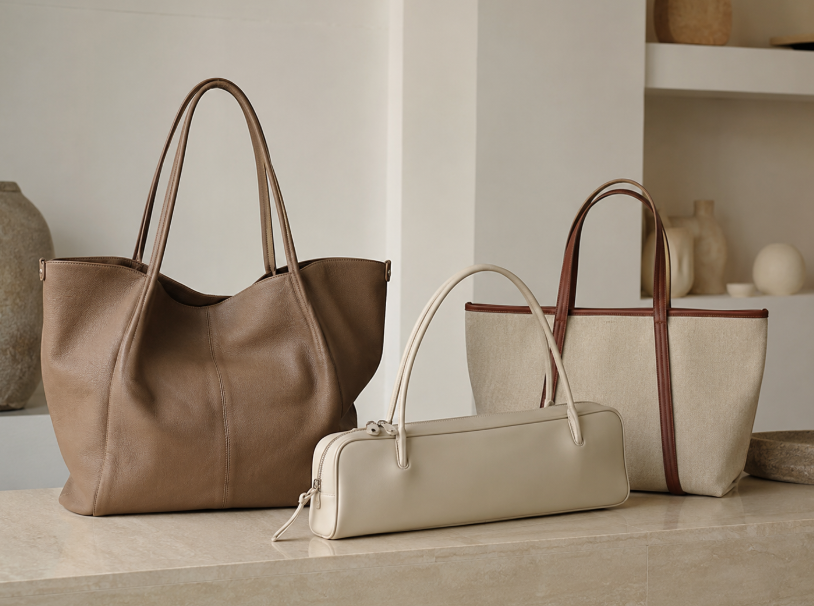
2. 10 Bag Styles to Watch in 2027
The following styles show good carryover potential based on the directions visible in 2026 collections and market reporting. East-West bags, pouches, soft shoulder bags, bowling shapes, top handles, and oversized designs have already gained strong attention.
For a closer look at silhouettes and construction details, see our handbag styles trending in 2027 guide.
| Bag Style | Why It Matters for 2027 | Development Focus |
|---|---|---|
| Oversized Tote | Practical capacity and strong visual scale | Weight, handles, base support |
| East-West Bag | Clean horizontal proportion | Opening width, structure |
| Slouchy Shoulder Bag | Relaxed everyday look | Drape, reinforcement |
| Modern Top-Handle | Refined but usable | Handle attachment, closure |
| Soft Clutch / Pouch | Day-to-evening flexibility | Softness, opening, lining |
| Drawstring / Bucket | Adjustable shape and casual feel | Cord system, base shape |
| Barrel / Bowling | Strong recognizable silhouette | Curved panels, zipper |
| Compact Crossbody | Hands-free everyday use | Strap, organization |
| Woven Bag | Texture and craft character | Material consistency |
| Convertible Bag | Multiple carrying options | Hardware and load balance |
1. Oversized Tote Bags
Oversized totes are useful because they solve a real capacity problem while still giving designers a large surface for shape, texture, and branding. Large bags have continued to appear in 2026 fashion coverage, supporting their potential beyond a short seasonal moment.
The manufacturing challenge is weight. Increasing the bag dimensions without reconsidering material thickness, lining, handles, and bottom reinforcement can produce a bag that already feels heavy before anything is packed inside.
Brands developing this category should test the bag fully loaded. Handle width and reinforcement become much more important at larger sizes. You can also review the construction possibilities on our custom tote bag manufacturing page when comparing material and structural options.
2. East-West Bags
East-West bags use a longer horizontal body with a relatively shallow height. The shape has been visible across recent handbag collections and works particularly well when a brand wants a modern silhouette without relying on heavy decoration.
Proportion needs careful control. Make the body too long and the center may collapse. Make the opening too narrow and customers struggle to reach the corners.
Pattern engineering matters here more than many buyers expect. The base width, zipper length, side-panel angle, and reinforcement should be developed together rather than corrected separately after the first sample.
3. Slouchy Shoulder and Hobo Bags
Soft shoulder bags continue moving away from rigid, box-like construction. Pre-Fall and Fall 2026 reporting has already highlighted slouchy and softer bag structures, giving this direction strong relevance when planning 2027 assortments.
The key is controlled softness. Removing every reinforcement layer usually creates a bag that looks weak rather than relaxed. We normally keep support around the opening, strap connection, zipper area, or base while allowing the main panels to fall naturally.
Material hand feel becomes especially important. Soft leather, washed fabrics, suede, and flexible synthetic materials work better than fabrics that fight against the intended drape.
4. Modern Top-Handle Bags
Top-handle bags are becoming less ceremonial and easier to use during normal daily routines. Recent runway reporting shows renewed attention to compact and medium top-handle silhouettes with cleaner hardware and updated proportions.
Handle engineering deserves close attention. The handle may look small, but its attachment points receive concentrated load. Poor reinforcement can cause the body material to stretch, wrinkle, or pull away from the hardware.
Many brands are also adding detachable shoulder straps. That small change makes a traditional handbag much easier to use across work, travel, shopping, and social occasions.
5. Soft Clutch and Pouch Bags
The clutch is moving beyond evening use. Soft, pillow-like and gathered versions appearing in current fashion coverage show how the category can work with more casual clothing.
Capacity still needs discipline. Increasing the width without changing the gusset or opening often creates a clutch that looks spacious but is awkward once filled.
Magnetic closures, framed openings, concealed zippers, and internal wrist straps can improve usability without changing the visual simplicity of the design.
6. Drawstring and Bucket Bags
Drawstring bags give designers a useful mix of structure and movement. The opening changes shape as the cord is tightened, which creates a casual look that feels different from a standard zipper handbag.
Cord thickness, eyelet size, friction, reinforcement, and stopper design all affect how the bag feels. A beautiful cord that becomes difficult to pull after repeated use will quickly frustrate customers.
Brands exploring this construction can review our custom drawstring bag development options to understand how fabric, cord systems, printing, and bag structure can be combined.
7. Barrel and Bowling Bags
Bowling bags have returned through rounded bodies, horizontal zipper openings, and short top handles. Fashion coverage during 2026 has repeatedly pointed to bowling and barrel-inspired silhouettes, making them one of the clearer shapes to watch entering 2027.
Curved sewing is where many samples go wrong. Small pattern differences can create twisting around the zipper or uneven ends.
Factories need good pattern accuracy and controlled seam allowance. Piping can strengthen the silhouette, though softer versions may deliberately remove it for a less structured finish.
8. Compact Crossbody Bags
Crossbody bags are not new, but their role keeps changing. The better 2027 direction is not simply making them smaller. It is making limited space work harder.
Phone access, card pockets, key storage, zipper placement, and strap adjustment matter more when the body is compact. Every centimeter starts doing a job.
Strap width should also match the likely load. Very thin straps may suit a delicate design, yet they become uncomfortable when the bag carries heavier daily items. Our guide to crossbody handbag features and benefits covers the category in more detail.
9. Woven and Craft-Inspired Bags
Woven bags continue to move beyond traditional beach styling. Leather weaving, raffia, textile braiding, crochet-like structures, and basket-inspired surfaces have remained visible in 2026 bag coverage.
Production consistency becomes the main concern. Woven structures can change dimension during assembly, especially when the material is soft or handmade.
Brands should define acceptable variation before production starts. Edge treatment, lining attachment, strand tension, handle reinforcement, and abrasion around high-contact areas should all be checked during sampling.
10. Convertible and Modular Bags
Convertible bags fit the larger move toward versatility. One body may work as a shoulder bag, crossbody, tote, or handheld bag through detachable straps and adjustable hardware.
The idea works only when each carrying mode feels intentional. Adding extra D-rings everywhere does not automatically make the product useful.
Hardware position should be tested with weight inside the bag. Strap attachment points that look balanced on an empty sample may cause the body to tilt once loaded.
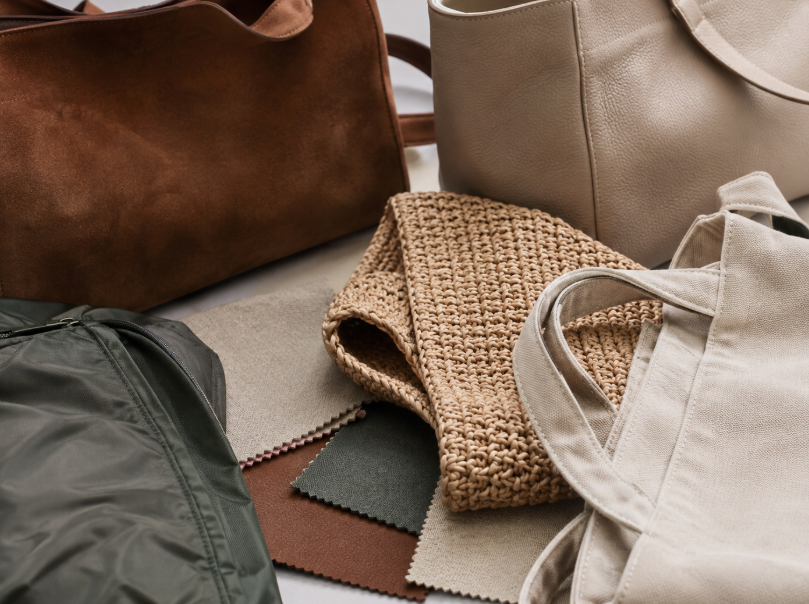
3. Bag Materials Trending in 2027
Material trends are closely tied to shape. The same silhouette can look polished, sporty, casual, or handcrafted depending on its surface, thickness, coating, and structure.
| Material Direction | Best Match | Main Development Concern |
|---|---|---|
| Soft Leather / Suede | Shoulder, hobo, tote | Stretch and surface care |
| Recycled Nylon / Polyester | Tote, travel, crossbody | Traceability and coating |
| Canvas / Technical Fabrics | Tote, utility, travel | Weight and abrasion |
| Raffia / Woven Materials | Summer and fashion bags | Dimensional variation |
| Alternative Leather | Fashion handbags | Aging and surface performance |
Soft Leather and Suede
Soft leather supports the relaxed silhouettes becoming more visible in handbag design. Suede adds even more texture, though buyers should think about color transfer, abrasion, moisture, and surface consistency before selecting it.
Thickness should match the structure. A thin leather may need backing around the opening and handle areas, while heavy leather can make a large bag uncomfortable.
Recycled Nylon and Polyester
Recycled fabrics remain useful in travel, tote, backpack, and lightweight lifestyle collections. Buyers making recycled-content claims should ask for more than a fabric label or supplier statement.
The Global Recycled Standard from Textile Exchange provides third-party criteria covering recycled material verification and chain of custody, with added processing requirements under GRS.
Certification requirements should be discussed before material ordering because documentation and traceability need to match the intended claim.
Canvas and Durable Technical Fabrics
Canvas remains useful when a brand wants a natural surface, printing area, or firmer body. Nylon and polyester are better choices when lower weight, water resistance, or easier cleaning matters more.
There is no universal winner. Our canvas vs nylon bag material guide explains how these materials behave differently in custom production.
Raffia, Woven, and Natural-Look Materials
Raffia and woven surfaces bring visible texture without relying on complex prints. Recent 2026 coverage shows woven materials continuing across handbags and accessories.
The sourcing question is consistency. Natural-looking materials may vary in shade, width, surface, or stiffness between batches. Buyers should approve a range rather than one tiny cutting when natural variation is expected.
Vegan and Alternative Leather Materials
Alternative leather remains an important option for brands that want a leather-like surface without animal hide. PU, microfiber, coated textile bases, and newer bio-based blends can produce very different results.
Ask about backing fabric, coating thickness, hydrolysis resistance, flex performance, abrasion, and colorfastness. The marketing name tells you much less than the actual material construction.
4. Colors, Textures, and Hardware Details to Watch
Earthy Neutrals, Burgundy, and Statement Colors
Burgundy has been especially visible through recent 2026 handbag coverage, while warm brown, tan, cream, olive, muted red, and other earthy shades remain easy to build into commercial ranges.
Color selection should also consider material behavior. Burgundy on suede will not read the same way as burgundy on coated PU or smooth leather. Brands should approve color on the final material rather than relying only on a Pantone reference.
Woven, Quilted, Distressed, and Tactile Surfaces
Texture is becoming part of the product identity. Woven panels, quilting, washed surfaces, embossing, brushed fabrics, suede, and wrinkled leather can make simple silhouettes feel more developed without adding multiple trims.
Each treatment changes production. Quilting changes panel dimensions. Washing can cause shrinkage. Embossing may soften around curved seams. Texture should be tested on the actual component rather than a flat material swatch alone.
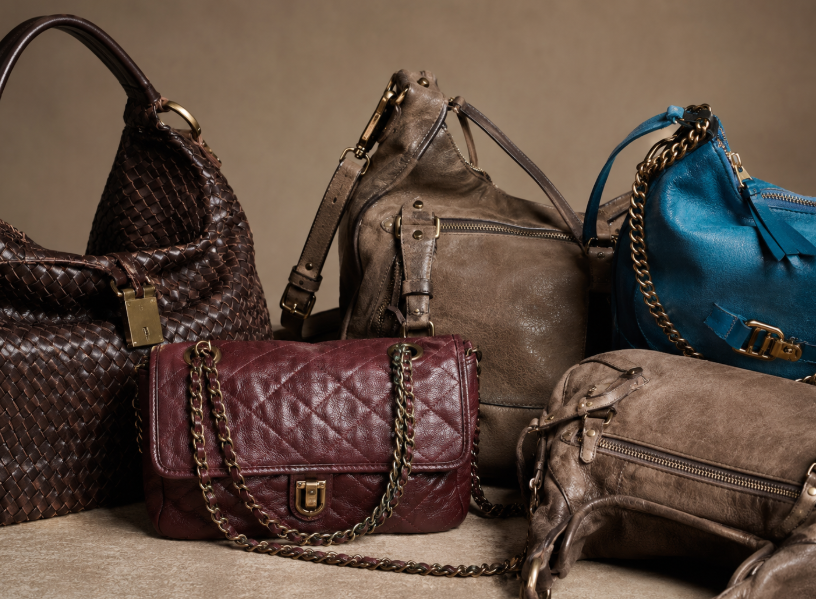
Belts, Chains, Exposed Zippers, Buckles, and Metal Hardware
Visible hardware is returning as a design feature. Exposed zippers, chains, buckles, rings, locks, and decorative belts have already appeared prominently across 2026 bag reporting.
Hardware adds weight quickly. Buyers should check plating consistency, edge smoothness, opening force, attachment strength, and repeated movement.
Large metal parts can look impressive on the table but make a soft handbag sag in an unwanted way. The material and hardware need to be developed as one system.
If your collection focuses on women’s handbags, our guide to 2027 women’s handbag trends compares shapes, materials, and colors in more detail.
5. Functional Features Shaping 2027 Bag Design
Lightweight Construction and Comfortable Carrying
Large dimensions make weight control more important. Fabric GSM, leather thickness, lining, reinforcement boards, metal parts, straps, and even zipper size all contribute to the finished weight.
I normally prefer removing unnecessary weight before reducing strength. A lighter lining or localized reinforcement often works better than simply making every component thinner.
Better Internal Organization and Secure Closures
Customers want organization without turning every handbag into a technical backpack. One zipper pocket, one open pocket, a useful key point, and a well-planned main compartment can be enough.
Pocket placement should follow the way the bag hangs. Heavy items placed high on a soft wall may pull the lining out of shape.
Adjustable and Convertible Strap Systems
Adjustable straps allow one design to serve more body heights and carrying preferences. Detachable systems add flexibility but create more stress points.
Swivel hooks, rings, sliders, and reinforced tabs should be tested together. A strong hook attached to a weak PU tab does not create a strong strap system.
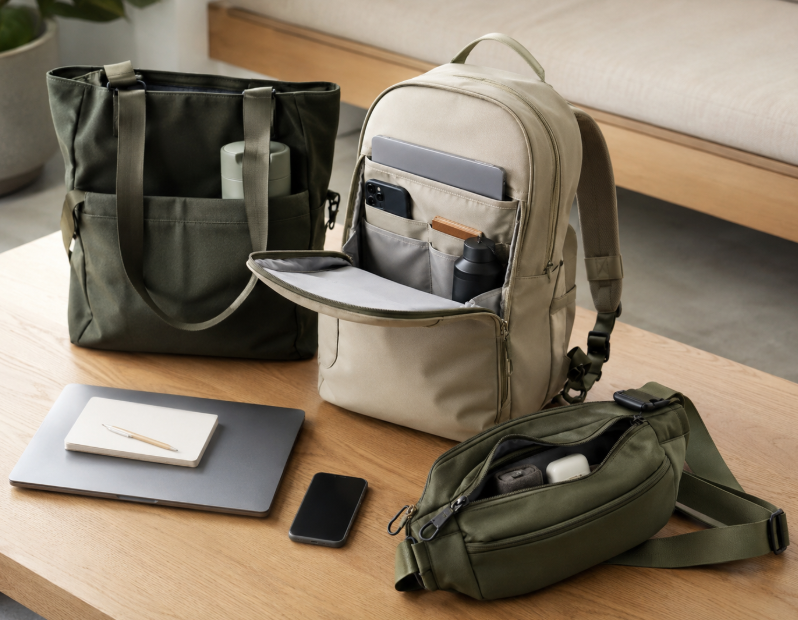
Laptop, Travel, and Everyday Storage Features
Laptop storage is moving into totes and lifestyle bags, while luggage sleeves, bottle pockets, cable pockets, and quick-access compartments are appearing beyond traditional travel products.
These features should remain appropriate to the silhouette. A slim East-West handbag does not need every travel feature simply because they are useful elsewhere.
These requirements are especially relevant to backpacks; see our breakdown of backpack trends for 2027 for category-specific design ideas.
Water-Resistant and Easy-Care Construction
Water resistance often depends on more than the face fabric. Coating, zipper construction, seams, needle holes, lining, and edge finishing can all affect performance.
Brands should state the intended performance level clearly. “Water-resistant” and “waterproof” should never be treated as interchangeable product claims without proper construction and testing.
When performance matters, independent laboratories such as Intertek’s luggage and bag testing services can evaluate areas including strength and bag performance.
For a category where insulation and easy-clean construction matter, see the lunch bag styles trending in 2027.
6. How Brands Should Develop a 2027 Bag Collection
Match Bag Styles With the Target Customer
Start with the customer rather than the trend board. Think about what they carry, how they travel, where they use the product, and how much maintenance they accept.
An oversized suede tote may look strong in a fashion range but make little sense for customers who need something lightweight and easy to clean. The same trend can be translated into nylon, canvas, PU, or leather depending on the audience.
Balance Trend Appeal With Long-Term Usability
Strong collections usually mix recognizable shapes with a smaller number of directional products. This gives buyers visual freshness without making the whole assortment dependent on one short trend cycle.
Changing proportion, texture, hardware, or strap design can refresh a proven body without rebuilding every pattern from zero.
Select Materials Based on Structure and End Use
Material selection should happen before the design is locked. Soft materials collapse. Heavy materials increase carrying weight. Thick coatings affect sewing. Woven structures may stretch.
Chemical and material requirements also need attention when products enter different markets. Buyers concerned about harmful-substance testing can review the scope of OEKO-TEX STANDARD 100, which covers textiles and components tested against specified harmful substances.
That reference does not mean every bag or supplier automatically holds the certification. Certificates, validity, product scope, and material coverage should always be checked individually.
Test Samples Before Moving Into Bulk Production
This is the stage I would never rush. Check appearance first, then use the sample like a customer.
Load the bag. Open and close every zipper. Adjust the straps several times. Carry it by each handle. Look at the corners, seam tension, lining movement, hardware position, and body balance.
The first sample answers whether the concept can be made. Later samples should answer whether it can be made consistently.
Bulk production becomes much safer when dimensions, materials, reinforcements, stitching, logo position, hardware, acceptable tolerances, and packaging have already been confirmed in the approved sample and specification sheet.
For the factory-side decisions behind sampling and production, read our 2027 OEM bag trends guide.
Conclusion
Bag Trends 2027 are not only about new shapes or seasonal colors. The strongest styles combine a clear visual identity with the comfort, capacity, and durability customers expect from an everyday bag. Oversized totes, East-West bags, soft shoulder bags, woven textures, and convertible designs are all worth exploring, but each one should be adapted to your audience and market.
Before confirming a new collection, test how every bag performs when it is actually used. Check the finished weight, opening, pockets, straps, hardware, reinforcement, and material performance. A good-looking sample is important, but a successful bag must also remain comfortable, practical, and consistent during bulk production.
If you are planning a custom or wholesale bag collection, HeteBag can support you with material selection, sampling, logo customization, structure development, production, and quality control. Share your ideas, reference images, or specifications with our team, and we can help you turn them into practical, production-ready bags.
FAQs About 2027 Bag Trends
What Bags Will Be Popular in 2027?
Oversized totes, East-West bags, relaxed shoulder bags, modern top-handle bags, soft clutches, bowling shapes, compact crossbody bags, and woven designs currently have strong carryover potential based on 2026 market signals.
Brands should still choose styles according to customer use, material position, selling channel, capacity, and target product image. Trend strength alone is not enough to justify a new SKU.
What Bag Materials Will Trend in 2027?
Soft leather, suede, recycled nylon, recycled polyester, canvas, technical fabrics, woven materials, raffia, and alternative leather are all worth watching.
The right choice depends on the bag structure. Soft leather suits relaxed shoulder bags, lightweight synthetics work well in larger functional bags, and woven materials are useful when texture is part of the design identity.
Are Oversized Bags Still in Style in 2027?
Current 2026 fashion signals support continued interest in larger totes and shoulder bags, so oversized designs have good potential to remain relevant into 2027.
Brands should control finished weight carefully. Handle reinforcement, base support, strap width, opening size, and internal organization become more demanding as the body grows.
Which 2027 Bag Trends Are Best for Custom Brands?
Convertible bags, oversized totes, East-West bags, woven handbags, slouchy shoulder bags, and compact crossbody styles give custom brands plenty of room to create their own identity.
Material, proportion, hardware, stitching, logo method, lining, pocket layout, strap configuration, and surface treatment can all create differentiation without copying another brand’s recognizable design.
How Early Should Brands Start Developing a 2027 Bag Collection?
Development should begin early enough to allow material sourcing, pattern work, sampling, corrections, performance checks, packaging approval, and production planning.
Complex leather bags, custom hardware, woven construction, new molds, special colors, recycled-material documentation, or detailed surface treatments usually need more development work than simple existing constructions. Starting earlier gives your team more room to improve the product rather than approving an unfinished sample because a launch date is already too close.
8. Conclusion
Bag Trends 2027 point toward a market where style and usefulness are becoming harder to separate. Oversized totes, East-West silhouettes, slouchy shoulder bags, bowling shapes, woven textures, softer materials, visible hardware, lighter construction, and flexible strap systems all have room to develop.
The useful question is not which trend you should copy. You need to decide which direction fits your customer, then build the material, structure, hardware, capacity, and details around that use.
We have worked in bag manufacturing for more than 15 years in Huadu, Guangzhou, China, supporting custom bag development and working with manufacturing partners across different bag categories. Our experience covers material selection, sampling, structure development, production coordination, and quality control for OEM and ODM projects.
If you are looking for a bag manufacturer for your next collection, you can leave your contact information through our website. Tell us what type of bag you want to develop, your preferred material, size, quantity, target market, and any reference drawings you already have. We would be glad to review the project with you and explore how we can work together.


