



Do you know? Over the past decade and a half in the luggage manufacturing industry, we have come into contact with customers from various countries and regions around the world. When many buyers first look for handbag factories, they are often attracted by samples, prices, or the promises of the salespeople, but they overlook the factory’s true core capabilities. In fact, whether a factory has a complete production system, strict quality management processes, and stable supply chain resources often determines whether the subsequent cooperation can proceed smoothly.
In this article, I will combine my years of industry experience to guide you through the process of determining whether a handbag factory is truly professional. We will delve into the key characteristics that a high-quality handbag factory should possess, covering aspects such as product development capabilities, raw material procurement, production processes, and quality control systems. Additionally, you will learn about the issues to focus on when selecting suppliers, as well as how to avoid common purchasing pitfalls and find manufacturing partners that are suitable for the long-term development of your brand.
Why Is Choosing the Right Handbag Factory So Important?
When many buyers are looking for handbag factories, the first thing they consider is the price. After all, controlling the procurement cost is a concern that every brand will take into account. However, based on our experience, a price that is too low does not necessarily mean it is truly cost-effective. Some factories are able to quote prices far below the market level because they have compressed costs in areas such as materials, craftsmanship, quality inspection, or services. In the short term, this might save the budget, but from the perspective of long-term cooperation, quality issues and delivery risks often lead to greater losses.
What a factory actually controls:
Your factory isn’t just a production facility. It influences your unit economics, your lead times, your ability to respond to market trends, and ultimately your customer experience. A factory with strong material sourcing can help you access better fabrics at consistent pricing. A factory with solid project management means your samples arrive when promised, your bulk order doesn’t slip by three weeks, and someone picks up the phone when there’s a problem.
Conversely, an unreliable tote bag supplier creates a specific kind of operational drag that’s very hard to recover from. You end up spending disproportionate time managing exceptions — chasing updates, re-inspecting shipments, managing customer complaints — instead of growing the business.
The hidden risks of the wrong partner:
Beyond the obvious quality issues, working with the wrong factory carries compounding risks. Inconsistent dyeing across batches makes it impossible to maintain a coherent product line. Weak quality control processes mean defect rates that look manageable at small volumes become catastrophic at scale. And factories that don’t maintain compliance documentation — BSCI audits, material safety certifications, labor standards — create liability exposure in regulated markets like the EU and North America.
The decision isn’t just about finding a supplier. It’s about finding a long-term manufacturing partner with enough depth to grow alongside you.
What Product Development Capabilities Should a Handbag Factory Have?
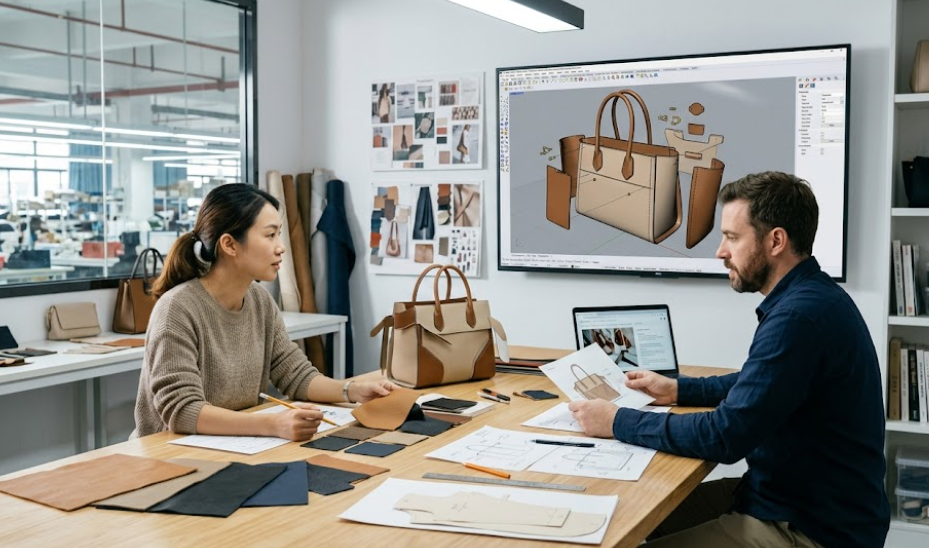
A factory that can only execute your designs is useful. A factory that can actively participate in product development is genuinely valuable.
Design support that goes beyond aesthetics:
Strong handbag factories have in-house design teams — not just pattern makers, but people who understand construction, material behavior, hardware sourcing, and trend direction. When you bring a reference image or a concept sketch, they should be able to identify structural concerns early, suggest material alternatives based on your target price point, and anticipate where a design might fail in production.
This kind of upstream input saves enormous time. A design that looks perfect on paper can have serious issues once it moves to sampling: zipper placement that causes bunching, handles that don’t distribute weight evenly, lining materials that crack in cold climates. Factories with real design experience catch these problems before they become expensive.
The sampling process as a quality signal:
How a factory handles sampling tells you almost everything about how they’ll handle production. Expect a structured process: a proto sample to verify the concept, a pre-production sample to confirm materials and construction, and a production sample to lock in the final specification. Each stage should come with a clear timeline and detailed feedback loop.
Factories that rush the sampling process or treat samples as a formality are the same factories that will surprise you during bulk production. The sample process is where you establish standards. If a factory doesn’t take it seriously at this stage, that attitude carries forward.
OEM vs. ODM — understanding the difference:
OEM (Original Equipment Manufacturing) means the factory produces according to your design specifications. ODM (Original Design Manufacturing) means the factory offers existing designs that you can customize or brand. Both have legitimate applications depending on your business model.
For brands building a distinct identity — especially in the custom tote bag space — OEM capability is essential. For buyers sourcing promotional merchandise or building private label lines quickly, ODM can dramatically compress development timelines. The best factories offer both, giving you flexibility as your needs evolve.
| Capability | What to Look For | Red Flags |
|---|---|---|
| Design Support | In-house team, CAD capability, material knowledge | “We can copy anything” without structural input |
| Sampling Process | Staged samples, clear timelines, written specs | Single sample, no spec sheet, vague timelines |
| OEM/ODM Services | Both options available, clear MOQ per path | Only one option, inflexible on customization |
For buyers who are still evaluating manufacturers, our article How to Find a Trustworthy Handbag Manufacturer in China provides a practical framework for comparing suppliers and avoiding common sourcing mistakes.
How Can You Evaluate the Quality of Materials Used by a Handbag Factory?
Material quality is where factory claims diverge most sharply from reality. Every supplier will tell you their materials are excellent. The question is how to verify it.
Understanding the material landscape:
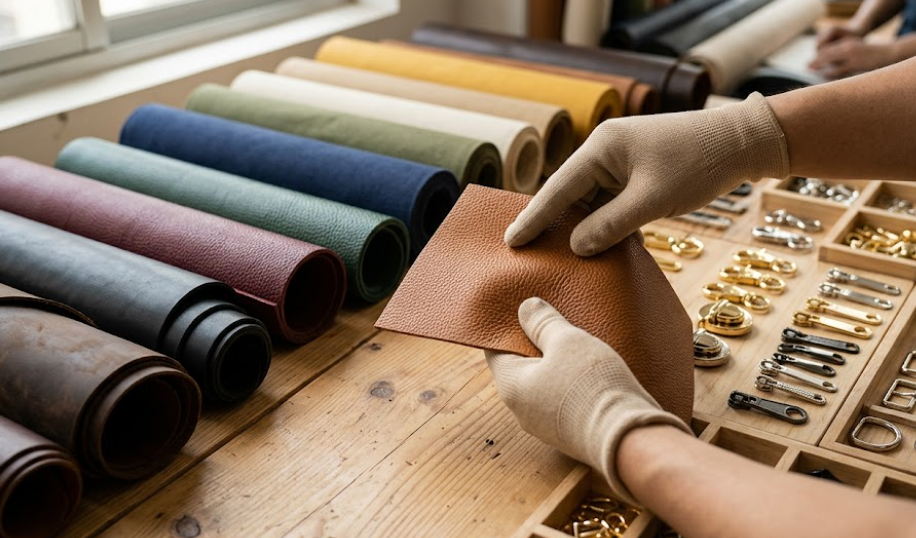
Genuine leather remains the benchmark for premium handbags — full-grain and top-grain leathers are durable, age well, and have real texture variation that makes each piece distinct. But the leather market is complex. Sourcing matters enormously: leather from tanneries that process hides without proper chrome management can be brittle, prone to peeling, and — in some markets — legally non-compliant.
PU leather has come a long way. Modern PU materials, especially those using water-based polyurethane coatings, offer impressive durability and a much cleaner production process. The distinction between different grades of PU is significant, though — entry-level PU degrades quickly under UV exposure and repeated use, while high-grade PU with proper backing can outlast some genuine leather products.
Canvas and nylon remain workhorses for the tote bag factory segment. Woven canvas with a tight weave count holds its shape better, resists abrasion, and prints more cleanly. For nylon, denier count matters: a 400D nylon bag behaves very differently from an 800D version under the same conditions.
Eco-friendly materials are increasingly important. Recycled PET, organic cotton canvas, cork, and Piñatex (pineapple fiber leather) are all entering the mainstream for buyers with sustainability mandates. A factory that sources these materials credibly — with documentation to back it up, not just marketing language — is a genuine asset for brands in markets where material transparency matters.
Material sourcing and consistency:
One of the most underappreciated risks in bag manufacturing is batch-to-batch consistency. A factory might use excellent leather on your initial sample and substitute a lower-grade equivalent during bulk production. Color consistency is particularly vulnerable — even with the same material supplier, dye lots vary, and without proper color matching protocols, you can end up with product that looks visibly different across shipments.
Ask factories specifically how they manage material consistency across orders. Do they maintain approved material libraries? Do they require color standard sign-off before bulk cutting? Do they work with named material suppliers with documented specifications?
Compliance and testing:
For export to EU and US markets, material compliance isn’t optional. Azo dye restrictions (REACH regulation in the EU), California Prop 65 limits on heavy metals in hardware, CPSIA requirements for products that might be purchased for children — these regulations carry real enforcement risk. A credible tote bag supplier will have testing documentation from accredited labs (SGS, Intertek, Bureau Veritas) and will update certifications on a regular cycle.
If you’re comparing the performance of these two materials in detail, you can also read our guide on Canvas vs Nylon Bags: Which Material Is Better for Custom Bags?.
What Manufacturing Processes Indicate a High-Quality Handbag Factory?
Equipment and process discipline separate factories that deliver consistent quality from those that deliver quality when conditions are perfect.
Production equipment:
Modern cutting equipment — CNC die-cutting, laser cutting for precise pattern pieces — reduces material waste and ensures dimensional consistency across large runs. The difference between hand-cut and machine-cut pieces becomes visible in final assembly: edges align better, seam allowances are consistent, and the overall silhouette is cleaner.
Sewing equipment matters too. Industrial machines calibrated for specific seam types — flat seams, French seams, bar-tack reinforcements — produce structurally different results than general-purpose machines running whatever thread is on hand. High-output factories often have specialized stations for hardware attachment, zipper insertion, and handle assembly, each set up for the specific tolerances required.
Skilled craftsmanship:
Equipment is only part of the equation. Handbag manufacturing is still highly skill-dependent. Edge painting, skiving leather for joins, setting eyelets without distorting surrounding material, hand-finishing corners — these operations require trained workers with accumulated experience. Factories with high turnover or heavy reliance on untrained temporary labor will show it in their output.
When evaluating a factory, it’s worth asking specifically about their workforce — average tenure of production workers, whether they have apprenticeship or training programs, and how they handle quality at the individual operator level. Factories that invest in workforce development produce more consistent quality and have lower defect rates than those treating skilled workers as interchangeable.
Production capacity and efficiency:
Capacity matters in two directions. A factory without enough capacity will push your order to the back of the queue when a larger client needs priority. But a factory with far more capacity than your order requires may assign your production to less experienced lines.
For custom tote bag production especially, understanding how a factory structures its lines — dedicated lines for specific product categories vs. flexible generalist lines — tells you a great deal about how much attention your particular product will receive.
How Does a Reliable Handbag Factory Ensure Product Quality?
Quality control isn’t an inspection step at the end of production. In well-run factories, it’s a continuous process integrated throughout manufacturing.
Quality control procedures:
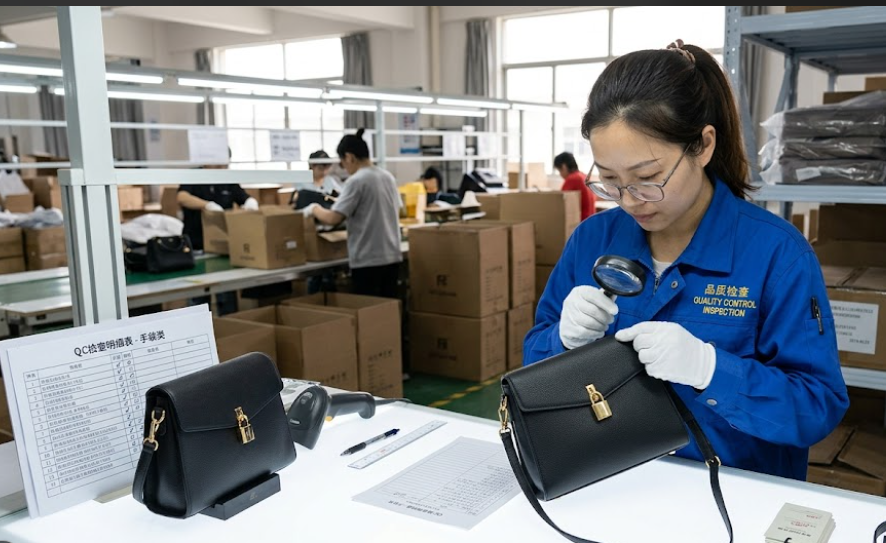
The most robust QC systems work in layers. Incoming material inspection verifies that fabrics, hardware, and accessories meet approved specifications before they enter production — catching problems at the source rather than after labor has been applied. In-line QC monitors work in progress, catching errors while they can still be corrected at low cost. Final inspection before shipping provides the last gate before product leaves the factory.
Factories that rely solely on final inspection are exposing themselves — and their clients — to significant risk. By the time a defect is caught at final QC, correcting it requires either rework (which adds cost and delays) or replacement production (which adds cost, delays, and material waste). Prevention is structurally cheaper than correction.
Inspection checkpoints:
Different product categories have different high-risk checkpoints. For leather handbags, the critical points tend to be material grading (before cutting), seam integrity (during sewing), hardware function (after attachment), and surface finishing (before packaging). For canvas tote bags, print registration, color fastness, and handle reinforcement are common failure points.
A factory that can walk you through their specific inspection protocol — not a generic “we check everything” answer, but a detailed description of what gets checked, when, and against what standard — is a factory that has actually thought about quality systematically.
Defect prevention strategies:
The most effective defect prevention happens at the design and sample stage. Factories that flag potential production issues during the sampling process — pointing out that a particular material won’t behave well in a specific construction method, or that a hardware choice has historically caused problems at scale — are saving you from defects that would otherwise appear at volume.
| QC Stage | What’s Being Verified | Why It Matters |
|---|---|---|
| Incoming Material | Specs, color standards, certifications | Prevents defects from starting |
| In-Line | Seam integrity, alignment, hardware function | Catches errors before rework becomes expensive |
| Final Inspection | Appearance, dimensions, packaging | Last gate before shipment |
| Packing Check | Quantities, labeling, carton integrity | Prevents logistics and customs issues |
What Signs Show That a Handbag Factory Is Reliable and Professional?
Quality control and manufacturing capability matter, but they’re not visible until you’re deep into production. The signals of reliability are often apparent much earlier — in how a factory communicates before you’ve placed a single order.
Communication efficiency:
Response time is a surface indicator. What it signals is organizational capacity. A factory where your inquiry sits unanswered for four days, where follow-up questions go to different contacts each time, or where answers are vague and non-committal — that factory is showing you its operational style. You’re seeing the best version of the relationship, before any complications arise.
Strong factories have dedicated account management structures. Your point of contact understands both the commercial side (pricing, timelines, MOQs) and the technical side (material specs, production capabilities, sampling logistics). When you ask a specific question about construction, you get a specific answer — not a redirect.
Delivery performance:
On-time delivery is easy to promise and hard to execute consistently. Ask about historical on-time delivery rates, and ask specifically how a factory handles delays when they do occur. Do they proactively communicate? Do they offer solutions, or do they wait to be asked?
Factories that have invested in production planning systems — capacity scheduling, raw material lead time tracking, shipping buffer management — have fundamentally different delivery profiles than factories managing this informally.
Customer service and project management:
For buyers managing multiple SKUs, seasonal development cycles, and multi-market compliance requirements, the project management capability of a factory matters as much as the production capability. Can they manage concurrent sample development across multiple styles? Do they maintain proper documentation — tech packs, approved sample records, material certifications — in an accessible format?
The ability to retrieve and share accurate records quickly is a sign of operational maturity. It also protects you during audits, customs inquiries, and retailer compliance reviews.
How Can Buyers Verify a Handbag Factory Before Placing an Order?
Due diligence isn’t a bureaucratic step. It’s the mechanism by which you separate what factories claim from what they actually deliver.
Factory audits:
A physical audit — or a verified third-party audit — gives you direct visibility into production environment, workforce conditions, equipment quality, and QC systems. SMETA (Sedex Members Ethical Trade Audit), BSCI, and ISO 9001 audits are the most common frameworks in the international bag sourcing space. Factories that maintain current certifications from these auditors have already been evaluated against a rigorous standard.
If you can visit in person — especially to a manufacturing hub like Huadu District in Guangzhou, where the concentration of bag factories is high enough to visit multiple suppliers in one trip — the value of direct observation is significant. You see the actual production floor, not a showroom. You meet the operators, not just the sales team.
Sample evaluation:
Before committing to bulk production, a thorough sample evaluation should cover: dimensional accuracy against your spec, material quality and consistency, hardware function and finish, seam integrity under load, color accuracy against your standard, and — for practical products like tote bags — real-world use testing (loading weight, wearing on shoulder, zipper cycling).
Document everything. An approved sample with written sign-off and physical retention creates an unambiguous standard for production. It also gives you a clear basis for dispute if bulk production deviates.
Certifications and customer references:
Certifications tell you a factory has met a threshold at a point in time. Customer references tell you how they actually behave in an ongoing relationship. Ask for references from buyers in similar markets to yours — same product category, similar order volumes, comparable compliance requirements.
Specifically useful questions to ask references:
- How does the factory handle quality issues when they arise?
- Has there ever been a significant delivery delay, and how was it managed?
- Has anything changed in quality or service as your relationship has scaled?
Questions to ask before cooperation:
The questions you ask before placing an order reveal both your sophistication as a buyer and give you critical information. Useful questions include:
- What is your current production capacity, and how much is committed to existing clients?
- What is your sampling timeline for a new design, and what information do you need to start?
- How do you handle material sourcing for custom specifications?
- What certifications do you currently hold, and when were they last renewed?
- What is your standard defect rate, and how do you measure it?
- What is your process when bulk production doesn’t match the approved sample?
The quality of the answers — their specificity, the confidence behind them, the willingness to share data rather than reassurances — tells you more than any brochure.If you’re comparing sourcing options, you may also want to explore our list of Top 15 Bag Manufacturers in China to benchmark different factories and production capabilities.
Conclusion
Sourcing a handbag factory is a process that rewards preparation. The factories that look attractive on first contact aren’t always the ones that deliver reliably at scale. The signals of quality — systematic QC, real design capability, transparent communication, documented compliance — are visible if you know where to look.
The buyers who build strong long-term manufacturing partnerships treat factory selection as seriously as they treat product development. The two are inseparable.
If you’re actively looking for a handbag manufacturer you can trust, Hetebag is worth your attention. Based in Huadu District, Guangzhou — the heart of China’s bag manufacturing industry — Hetebag has built over 15 years of manufacturing experience and works with multiple factories to offer broad production flexibility. With OEM and ODM capabilities across women’s handbags, tote bags, crossbody bags, and a full range of accessories, Hetebag has served clients across more than 70 countries in North America, Europe, the Middle East, and Asia.
Their quality management system is ISO 9001-certified, backed by SGS, SMETA, and BSCI audits — the kind of documentation that matters when you’re sourcing for regulated markets.
If you’re currently evaluating tote bag suppliers or looking to source custom tote bags with consistent quality and reliable delivery, leave your contact information on the Hetebag website. Their team will be glad to hear from you, and they’re genuinely looking forward to building something together.
Frequently Asked Questions
What is the most important factor when choosing a handbag factory?
While pricing is important, the most critical factors are product quality, manufacturing capability, quality control systems, and delivery reliability. A factory with stable production processes can help reduce risks and support long-term business growth.
What certifications should a professional handbag factory have?
Most international buyers look for certifications such as ISO 9001, BSCI, SMETA, and SGS testing reports. These certifications help verify a factory’s quality management system, social compliance, and product safety standards.
How can I verify a handbag factory before placing a bulk order?
You can request samples, review audit reports, check customer references, verify certifications, and conduct a factory audit either in person or through a third-party inspection company before committing to large-volume production.
What is the difference between OEM and ODM handbag manufacturing?
OEM manufacturing follows your own designs and specifications, while ODM manufacturing uses existing factory designs that can be customized with your logo, colors, or branding. OEM offers greater uniqueness, while ODM can reduce development time.