
 English
  Italian
  French
  German
  Spanish
  Arabic
 Finding a reliable handbag manufacturer in China is not as simple as typing a few keywords into Google and picking the first factory that shows up. There are thousands of suppliers online — some are genuine, experienced factories with solid export records; others are trading companies presenting themselves as manufacturers. A few are outright scams. For fashion brands, wholesalers, and private label businesses, choosing the wrong partner doesn’t just cost money. It costs time, it costs brand reputation, and it can derail an entire product launch.
This guide walks through everything you need to evaluate before committing to a handbag supplier in China — from understanding the manufacturing advantages, to asking the right questions, to spotting the red flags that experienced buyers learn .
Why Choose a Handbag Manufacturer in China?
Manufacturing Experience and Supply Chain Advantages
China’s dominance in handbag manufacturing didn’t happen by accident. Regions like Huadu District in Guangzhou have developed over decades into complete leather goods ecosystems, where factories, material suppliers, hardware producers, and finishing services are all clustered within a short distance of each other. This supply chain density is something you simply cannot replicate in most other manufacturing regions.
Huadu, in particular, is widely known as the “Leather Capital of China.” The concentration of expertise there means skilled craftspeople, specialized machinery, and a deep institutional knowledge of bag construction that has been passed down through generations of factory workers. When a factory has been producing handbags and cosmetic bags in this environment for 10, 15, or 20 years, that experience shows in the quality of the finished product.
Competitive Pricing and Production Capacity
Labor costs in China remain competitive compared to Europe or North America, though they have risen significantly over the past decade. More importantly, Chinese manufacturers offer a combination of price and scale that is difficult to match elsewhere. Whether you need 500 units for a boutique brand launch or 50,000 units for a major seasonal order, established factories can accommodate both.
The cost advantage is not just about labor. It is also about proximity to raw materials, hardware, and packaging — all of which reduce production costs without cutting corners on the final product.
OEM & ODM Customization Services
Most serious handbag manufacturers in China offer both OEM (Original Equipment Manufacturing) and ODM (Original Design Manufacturing) services. Understanding the difference matters:
OEM means you provide the design, technical specifications, and branding, and the factory produces according to your requirements. This is the standard approach for brands that have already developed their own designs and need a production partner.
ODM means the factory has its own existing designs that you can customize, adapt, or purchase as-is. This works well for buyers who want to move quickly or who are still developing their own product identity.
A manufacturer that genuinely supports both OEM and ODM services typically has its own design team, pattern-making capabilities, and material sourcing networks. That combination of services signals a factory with depth — not just a production line.
If you want to explore some experienced OEM & ODM suppliers in China, you can also read our guide on Top 20 Chinese Custom Leather Bag Factories for OEM & ODM.
Access to Different Handbag Materials and Hardware
One of the clearest advantages of working with a Chinese handbag manufacturer is material access. Here is a quick overview of the most commonly used materials and their typical applications:
| Material | Characteristics | Common Applications |
|---|---|---|
| Genuine Leather | Durable, premium feel, natural texture | Luxury handbags, structured totes, leather purses |
| PU Leather | Vegan-friendly, cost-effective, easy to clean | Fashion handbags, cosmetic bags, everyday bags |
| Canvas / Cotton | Lightweight, customizable print surface | Tote bags, casual handbags, promotional bags |
| Nylon / Polyester | Water-resistant, lightweight, strong | Travel bags, backpacks, functional crossbody bags |
| RPET (Recycled Polyester) | Eco-certified, sustainable | Eco-friendly lines, corporate gifting bags |
Hardware — zippers, clasps, D-rings, buckles, rivets — is equally important. Chinese factories typically source hardware from specialized suppliers within the same industrial cluster, giving them flexibility to match hardware quality to your price point and product tier. To review how a factory controls materials, workmanship, and inspections, see our guide to evaluating handbag factory quality.
Choosing the right material is equally important for product positioning and durability. You may also want to check our guide on Best 8 Materials for Custom Ladies Handbags in 2026.
How Can You Verify Whether a Handbag Manufacturer Is Legitimate?
This is where many buyers make their first serious mistake: they skip verification because the supplier seems professional online, has a polished website, and responds quickly to inquiries. None of those signals confirm that a manufacturer is legitimate. They only confirm that the supplier is good at marketing.
Request a Business License
Every legitimate Chinese manufacturer should be able to provide a copy of their business license without hesitation. This document confirms the company is legally registered to operate in China. You can independently verify it by searching the company name or registration number in China’s National Enterprise Credit Information Publicity System (NECIPS). If a supplier refuses or delays providing this document, treat that as a serious warning sign.
Ask for an Export License
Factories that have a genuine history of exporting to international markets will have the documentation to prove it. Ask to see their export license or customs records. A manufacturer with real export experience in the US, EU, or Australian markets will be accustomed to this request.
Check Third-Party Certifications
Legitimate factories that serve international brands often hold certifications such as ISO 9001 (quality management), BSCI (business social compliance), or Sedex (ethical trade). These are not cosmetic credentials — they require regular audits by external bodies. A supplier with verifiable certification history has undergone real scrutiny.
Request a Factory Audit
If you are placing a substantial order, a factory audit is worth the investment. This can be arranged through a third-party inspection company. An audit will confirm the factory’s production capacity, working conditions, equipment, and quality control systems. Some manufacturers will allow a virtual tour if a physical visit is not feasible.
Verify Online Presence Carefully
You can Check the factory’s website closely. Does it have clear product photos with consistent quality? Does it show real factory images — equipment, production lines, workers — rather than stock photography? Is there a physical address that matches their stated location? Cross-reference the address on mapping tools.
What Questions Should You Ask Before Choosing a Handbag Manufacturer?
Before you commit to sampling — let alone a production order — there are specific questions that will quickly reveal whether a supplier is worth your time. These are not generic questions. They are the ones that separate professional factories from casual trading companies.
MOQ Requirements
Minimum order quantities vary significantly across factories. Some manufacturers set MOQ at 300–500 units per style; others require 1,000 units or more. Knowing this upfront prevents wasted time. More importantly, how a factory responds to your order size tells you something. A professional factory will be transparent about why their MOQ exists — it is about production efficiency, not arbitrary pricing. Be cautious of factories that immediately lower their MOQ dramatically the moment you push back. It may indicate flexible manufacturing standards.
Sampling Process and Lead Time
A clear, structured sampling process is one of the strongest indicators of a professional manufacturer. Ask specifically:
- How long does a first sample take after specifications are submitted?
- What information do you need to start a sample?
- How many rounds of revision are included before a sample is finalized?
- Is the sample fee refundable against a production order?
Typical sample lead times from Chinese factories range from 7 to 20 business days depending on the complexity of the design. Factories that cannot give a specific timeline — or that promise an unrealistically fast turnaround — are worth treating with caution.
Material Sourcing Capabilities
Ask the manufacturer where they source their primary materials — leather, hardware, lining fabric. Factories that have established relationships with material suppliers can offer more consistent quality and better pricing than those who purchase materials ad hoc. For premium or certified materials (like REACH-compliant hardware or certified vegan leather), ask for documentation.
Quality Control Procedures
A factory without a documented quality control process is a risk. Ask how quality is checked at each stage: material inspection on arrival, in-process checks during production, and final inspection before shipping. Do they have an in-house QC team or do they rely on external inspection? For larger orders, many experienced buyers also arrange third-party pre-shipment inspections through companies like SGS or Bureau Veritas — and a legitimate factory will accommodate this.
Export Experience with Overseas Brands
Ask directly: which countries do they currently export to? What kinds of brands or buyers have they worked with? A factory with genuine experience exporting to the US, UK, EU, or Australia will understand labeling requirements, shipping terms, and compliance expectations. This is different from a factory that claims to export internationally but has only done so once or twice.

How Do You Evaluate the Quality of a Handbag Manufacturer?
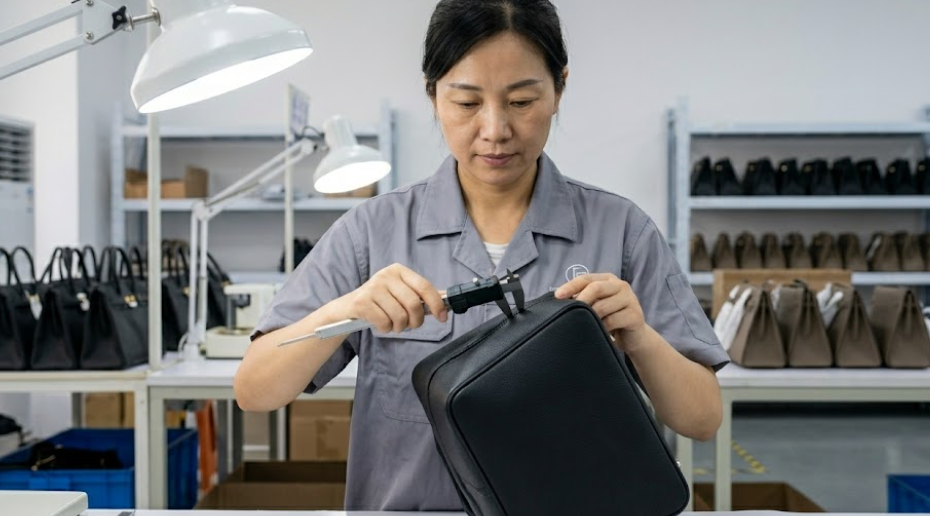
Quality evaluation should happen before you place any bulk order. The most reliable method is straightforward: order a sample and inspect it carefully. Here is what to look for. For a leather handbag project, our custom leather handbag buying guide connects these sample checks with material specifications, development, and production approval.
Stitching and Construction
Stitching should be even, tight, and consistent throughout the bag. Uneven tension, loose threads, or irregular spacing are signs of poor workmanship. Check seam reinforcement at stress points — handles, zipper ends, and attachment points. These areas carry the most wear and will show poor construction first.
Hardware Quality
Zippers should open and close smoothly without catching. Metal hardware should have a consistent finish — no flaking, rough edges, or uneven plating. Test clasps and magnetic closures for their pull strength. Hardware that feels cheap or looks inconsistent with the rest of the bag indicates the factory is using low-grade components to cut costs.
Material Authenticity
If you specified genuine leather, confirm it. Leather has a distinct texture and smell that differs from PU or bonded leather. For PU leather, check the backing material (usually fabric) and the surface texture. Lower-grade PU will crack or peel within months of normal use. If you need eco-certified materials, ask for material certification documents before approving the sample.
Interior and Lining
The interior of a bag is often where corners get cut. Check that the lining is properly attached, that pockets are reinforced at the top, and that the lining material matches what was specified. Fraying edges or glue residue inside the bag are signs of hasty production.
Consistency Across Multiple Samples
If you are ordering in bulk, request two or three samples rather than one. Compare them side by side. Color consistency, stitching alignment, and hardware placement should be nearly identical across all units. Variation between samples predicts variation — and complaints — in your bulk production run.
Can the Handbag Manufacturer Support Custom and Private Label Projects?
For brands building their own identity, this is one of the most important questions to answer before anything else. Not every factory that advertises customization can genuinely deliver it.
A manufacturer that truly supports custom handbag production should be able to handle:
Original Design Development
This means working from your sketches, tech packs, or concept images to produce a pattern and prototype. It requires a design team and pattern-making capability — not just a production line. Ask to see examples of custom projects they have developed from scratch rather than adapted from existing styles.
Material and Hardware Selection
A capable custom handbag manufacturer will give you access to their material library and hardware options, or source specific materials based on your requirements. This might include branded hardware, custom-dyed leather, or specialty fabrics. The range of options they offer tells you a great deal about their supplier network and production flexibility.
Branding and Labeling
Private label support includes embossed or debossed logos, printed labels, woven tags, dust bags, and branded packaging. Ask for samples of how they execute branding — particularly logo embossing on leather, which requires precision and the right die tooling. Sloppy embossing or uneven label placement affects the perceived quality of your product regardless of how good the bag construction is.
Packaging Customization
Many buyers overlook this until late in the process. Confirm early whether the factory can source or produce custom boxes, tissue paper, ribbon, and hang tags — or whether they work with packaging partners. Receiving beautifully produced bags in generic packaging is a problem you want to avoid before production, not after.
The following table summarizes what to look for when comparing custom capabilities across manufacturers:
| Capability | What to Ask | Why It Matters |
|---|---|---|
| Pattern & prototype development | Can you work from my sketches or tech pack? | Confirms genuine design capability |
| Material sourcing | Do you have access to certified or specialty materials? | Affects quality, compliance, and differentiation |
| Logo execution | Can I see examples of embossing/printing on bags you’ve produced? | Branding quality affects brand perception |
| Packaging | Do you offer custom packaging, or is it additional sourcing? | Affects unboxing experience and total cost |
| Revision process | How many sampling revisions are included? | Affects timeline and cost to finalize designs |
Red Flags to Watch for When Working with a Chinese Handbag Manufacturer
Even after thorough research, some suppliers present warning signs that are easy to rationalize away — especially when pricing looks attractive. These signals consistently appear in problematic supplier relationships.
Vague or Inconsistent Communication
A manufacturer that takes days to respond to basic questions, gives inconsistent answers about lead times, or can’t explain their production process clearly is showing you their actual working style. Communication problems before the order becomes significantly worse once production begins and money is on the table. Expect clear, timely, and specific responses — especially on specifications, pricing, and timelines.
Unwillingness to Provide Documentation
Any legitimate factory should provide a business license, export records, and certifications without making it feel like an interrogation. Resistance to sharing basic documentation is a direct indicator of either illegitimacy or inexperience with international buyers. Neither is acceptable for a long-term partnership.
Pressure for Full Upfront Payment
Standard payment terms in Chinese manufacturing typically involve a 30–50% deposit before production and the balance before shipment. A supplier demanding full payment upfront before production begins — particularly from a new buyer — is a major warning sign. Use escrow services or letters of credit for large initial orders if you cannot verify the supplier through other means.
Samples That Don’t Match Production Output
This is a well-known tactic: impress buyers with a high-quality sample, then reduce material quality or workmanship in the bulk production run. Pre-shipment inspection by a third-party inspector is the most reliable way to catch this. Budget for it from the start.
Building Trust Through Small Trial Orders
One of the most practical ways to establish a genuine partnership with a Chinese handbag manufacturer is to start with a smaller trial order before scaling. This gives you a real view of their production quality, lead time accuracy, packaging standards, and communication during the production process — all under conditions where the financial risk is manageable. Factories that do excellent work on small orders and are transparent throughout that process are the ones worth growing with.
Regular Quality Feedback and Cooperation
A manufacturer worth keeping will want your feedback. Quality communication is a two-way process: you provide clear specifications and timely approvals; they provide production updates, flag potential issues early, and communicate proactively when problems arise. Factories that disappear during production and reappear only when shipment is ready are not partners — they are vendors, and the difference matters.
Stable Order Planning
Sudden, large order changes create production chaos and quality problems. If you are working toward a long-term relationship with a handbag supplier, give them as much advance notice as possible about upcoming orders, seasonal spikes, and design changes. Factories that know your order patterns can schedule resources accordingly, which directly affects the consistency of what you receive.
If you are still researching suppliers, you may also find these resources helpful:
Top 15 Bag Manufacturers in China
Conclusion
Finding the right handbag manufacturer in China takes research, patience, and a willingness to ask hard questions. The best manufacturers are not necessarily the cheapest, the most prominent on Alibaba, or the ones with the most impressive-looking website. They are the ones with a consistent track record, transparent processes, real customization capability, and a communication style that treats your business seriously.
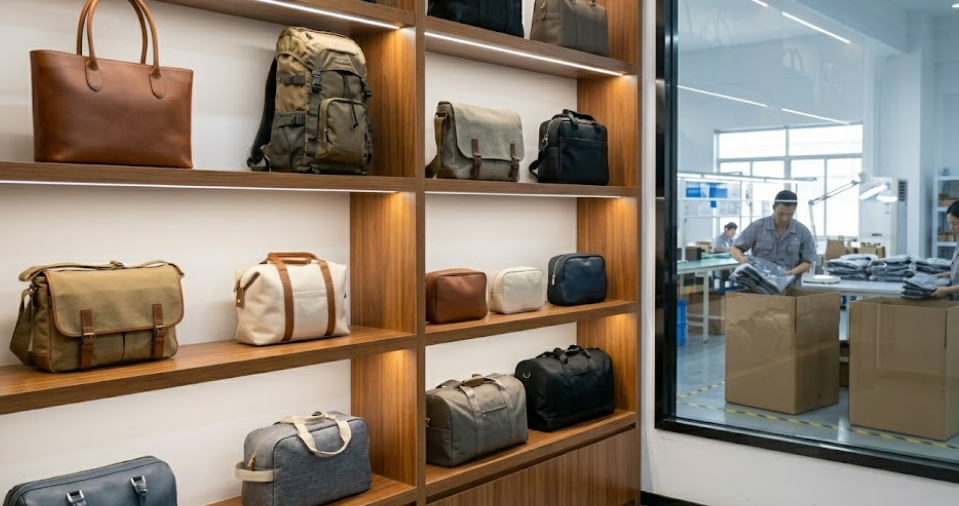
If you are currently looking for a reliable handbag manufacturer and custom handbag supplier in China, Hetebag is worth considering. Based in Huadu District, Guangzhou — one of China’s most established manufacturing hubs for leather goods and handbags — Hetebag operates its own factory with over 15 years of production experience. The team works with multiple production facilities and offers full OEM and ODM services, covering everything from design development and material sourcing to quality control and export logistics.
Our product range spans handbags, tote bags, backpacks, crossbody bags, cosmetic bags, and travel bags — supporting both fashion-forward brands and functional product lines. With a customer base across North America, Europe, Australia, and beyond, they have the export experience and compliance knowledge that international buyers need.
If you are building a bag line, scaling an existing brand, or sourcing for wholesale distribution, you are welcome to leave your contact details directly on their website. The team is ready to discuss your project, answer your questions, and explore what a production partnership could look like. They look forward to hearing from you.
Frequently Asked Questions
How do I know if a handbag manufacturer in China is a real factory?
A legitimate handbag manufacturer should be able to provide a valid business license, export documentation, factory photos or videos, and third-party certifications such as ISO or BSCI. You can also request a factory audit or arrange a third-party inspection to verify their production capabilities and quality systems.
What is the typical MOQ for custom handbags?
Most Chinese handbag manufacturers set MOQs between 300 and 1,000 pieces per style, depending on the materials, complexity, and customization requirements. Some factories may offer lower MOQs for startups or trial orders, but pricing is usually higher for smaller quantities.
Can Chinese handbag manufacturers support OEM and private label projects?
Yes. Most experienced factories offer OEM and private label services, including custom logos, packaging, labels, hardware, and material sourcing. Some manufacturers also provide ODM services for buyers who want to customize existing bag styles.
What should I check before approving a handbag sample?
You should carefully inspect stitching quality, hardware durability, material consistency, logo placement, lining construction, and overall craftsmanship. It is also recommended to compare multiple samples to ensure production consistency before placing a bulk order.


