English
 Italian
 French
 German
 Spanish
 Arabic
Before you choose a tote bag manufacturer, many brands actually encounter the same problem: there are many suppliers, but it’s not easy to find those who are reliable, stable in the long term, and can meet custom requirements. Especially now, with the increasing demand for eco-friendly shopping bags, canvas bags, and reusable handbags in the market, enterprises not only need to consider the price when purchasing, but also pay attention to quality, delivery time, and whether they support customized production.
A professional tote bag manufacturer is not merely a factory that “makes bags”, but rather a partner that can offer OEM/ODM solutions, material suggestions, printing process support, and stable production capabilities. If these issues are not clarified in the early stage, it is very likely that problems such as poor communication, inconsistent samples, or delayed deliveries will occur during the subsequent cooperation.
Additionally, the requirements for tote bags vary across different countries and markets. Some focus on environmental certifications, while others place greater emphasis on appearance design and brand customization effects. Therefore, before placing a formal order, it is advisable to understand the key points in the industry. This will help you quickly select the appropriate manufacturer and also reduce a lot of unnecessary trial-and-error costs.
Next, we have compiled 10 key points that you must understand before collaborating with the tote bag manufacturer, to help you make a more informed decision.
Understand Your Tote Bag Product Requirements
Before you reach out to a single manufacturer, you need to know exactly what you are building. Vague briefs produce vague samples. Specific briefs produce bags you can actually sell.
Size and structure come first. A standard grocery tote, a flat promotional bag, and a structured fashion tote are manufactured differently — different machinery, different material thicknesses, different labor time. Know your target dimensions and whether the bag needs a flat bottom, gusset, or reinforced base.
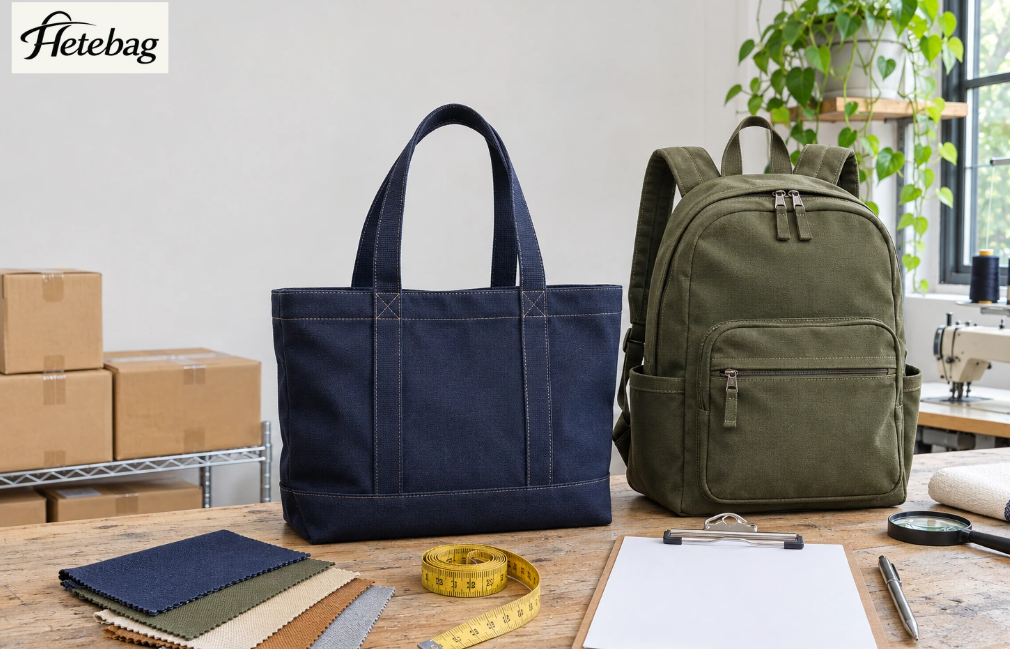
Material selection shapes everything downstream: price, weight, feel, and how well the bag holds print. Canvas and cotton are the go-to for promotional and eco-positioned products. Polyester and nylon perform better in functional or travel-oriented designs. RPET is increasingly preferred by sustainability-driven brands. Jute has a distinct natural appeal but behaves differently in printing. Your material choice also affects MOQ thresholds and lead times because factories stock fabrics differently.
Printing method is not just an aesthetic decision — it’s a production cost driver. Screen printing is economical at high volumes. Digital printing offers flexibility for complex artwork or short runs. Embroidery signals quality and is preferred for premium positioning. Heat transfer is quick but can reduce breathability depending on the fabric.
Handle construction is often an afterthought and it shouldn’t be. Handle length, width, stitching reinforcement at the attachment point, and whether the handle is flat or rolled — these details determine how the finished bag feels in the hand and how long it lasts in daily use.
Accessories like zippers, inner pockets, snap closures, and lining all need to be specified before sampling. Adding them after approval delays the entire process and often changes the unit cost significantly.
| Component | Options | Impact |
|---|---|---|
| Material | Canvas, cotton, RPET, nylon, polyester, jute | Cost, sustainability, printability |
| Print method | Screen print, digital, embroidery, heat transfer | Setup cost, color range, durability |
| Handle | Flat, rope, rolled; stitched or riveted | Durability, aesthetics, comfort |
| Accessories | Zipper, pocket, lining, snap | Unit cost, MOQ, lead time |
Promotional bags and premium bags require completely different specification frameworks. A promotional canvas tote for a trade show can tolerate lighter fabric and basic screen printing. A retail tote expected to carry 15 kg daily cannot. Define your target market before you define your product.
If you are still deciding what type of tote bag best fits your project, it’s helpful to understand the different styles and use cases first. You can learn more about tote bag types, materials, and practical applications in this guide.
Verify Whether the Manufacturer Is a Real Factory
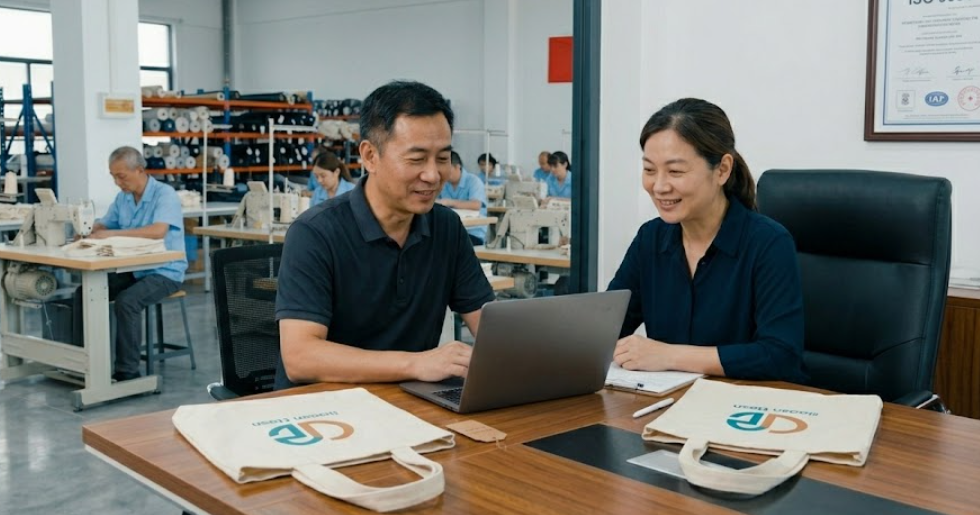
This distinction matters more than most buyers realize. China’s bag manufacturing supply chain has two layers: actual factories that own production equipment, and trading companies that broker orders to multiple factories. Both can produce bags. Only one of them gives you consistent quality and transparent pricing.
Trading companies are not inherently bad partners. For first-time buyers with low volumes, they can simplify things. But they add a margin on top of factory prices, they don’t control production, and when quality issues arise, resolution is slower because you’re not talking to the people holding the scissors.
Real factories offer direct communication with production staff, better pricing at volume, faster problem resolution, and actual visibility into their process — which matters when you need a mid-production adjustment.
To verify a factory’s legitimacy, ask for:
- Business license documentation
- Photos and video of production floor (not stock images)
- Reference clients willing to confirm orders
- Third-party audit reports (BSCI, SMETA, SGS)
Ask specifically: How many sewing machines do you operate? What is your monthly output capacity for tote bags? Do you cut fabric in-house or outsource cutting?
These are questions a real factory answers without hesitation. A trading company often deflects or gives vague answers.
Factory audits add another layer of confidence. Factories that have passed BSCI or SMETA audits have already been evaluated on labor practices, facility conditions, and production management. This isn’t just an ethical check — audited factories tend to have tighter operational controls, which translates into more consistent output.
Direct factories also reduce your per-unit cost. When a trading company is involved, their margin — typically 10–20% — comes out of your profit. At 10,000 units, that gap is significant.
Before working with any supplier, it’s also important to fully understand how bag manufacturers operate, including production structure, OEM/ODM services, and sourcing risks. This complete guide explains everything buyers should know:What Is a Bag Manufacturer? Complete Guide for Buyers
Check the Manufacturer’s OEM & Private Label Capabilities
Not every factory is equipped to build a brand. Some are excellent at volume production but have no infrastructure for custom packaging, branded labels, or hang tags. If building a private label tote bag line is part of your strategy, you need a manufacturer with genuine OEM and ODM capabilities — not just the willingness to stitch a logo on a stock bag.
OEM (Original Equipment Manufacturing) means the factory produces your design according to your specifications. You own the design; they execute it.
ODM (Original Design Manufacturing) means the factory develops or co-develops the design with you. This is valuable when you don’t have an in-house designer but want differentiated product, not generic stock.
For private label development, check whether the factory offers:
- Custom woven labels and printed tags
- Branded hang tags with barcode support
- Custom polybag or retail box packaging
- Color-matched tissue paper or branded inserts
Branding consistency across a product line is easy to underestimate. If your custom tote bags ship in unbranded packaging while your other products arrive in branded boxes, the disconnect weakens the perceived quality of the entire line. A manufacturer who understands retail packaging treats it as part of the product.
Ask to see examples of packaging work they have done for other clients. The quality and attention to detail in those samples will tell you more than any brochure.
Understand MOQ (Minimum Order Quantity)
MOQ is one of the first numbers buyers ask about, and one of the most misunderstood. The number itself isn’t the issue — it’s whether you understand what’s driving it and how it interacts with your pricing.
For tote bags, standard MOQs in Chinese factories typically range from 300 to 1,000 units per style. The lower end is usually associated with simpler products — a basic canvas tote with one-color screen printing. Complex bags with multiple components, embroidery, or specialty materials push MOQ higher because the setup costs are spread across fewer units if quantities are low.
How MOQ affects pricing:
| Order Quantity | Price Trend | Notes |
|---|---|---|
| 300–500 units | Higher per unit | Setup costs dominate |
| 500–1,000 units | Moderate | Common starting point |
| 1,000–3,000 units | Better pricing | Material buying power improves |
| 3,000+ units | Best rates | Factory prioritizes your order |
For startups or new product lines, low-MOQ suppliers reduce risk but rarely offer the best pricing. The smarter move is to confirm a supplier at a manageable quantity, validate the product in the market, then negotiate volume pricing on the second or third order.
MOQ is not always fixed. Factories can sometimes flex on minimums if you are ordering multiple styles in the same material — because they can cut fabric more efficiently across the run. Always ask directly: Can we consolidate two styles to meet a shared MOQ? It’s a common practice and worth the conversation.
Sample orders before bulk production are non-negotiable. Paying a sample fee and approving a physical sample before committing to bulk is the single most effective way to avoid expensive surprises. Never skip it, regardless of how confident you feel about the brief.

Evaluate Material Quality and Sustainability
Material quality is where product reputation gets built — or lost. The feel of a tote bag, how it performs after 200 uses, whether the color fades after the third wash — all of this starts with the fabric spec you approve before production.
Fabric is sold by weight (grams per square meter, or GSM). A 10 oz canvas behaves very differently from a 6 oz canvas. Heavier fabrics are more durable but cost more and affect the MOQ because they use more material per bag. When evaluating samples, feel the handle, check the weave density, and pull the seams to test stitching strength.
Sustainability has moved from a differentiator to a baseline expectation in most retail markets. The certifications that carry weight include:
- GOTS (Global Organic Textile Standard) — for organic cotton
- GRS (Global Recycled Standard) — for RPET and recycled materials
- OEKO-TEX Standard 100 — tests for harmful substances in finished products
- BSCI — social compliance in the supply chain
RPET (recycled polyester made from plastic bottles) is increasingly popular because it addresses both environmental positioning and durability. A well-spec’d RPET tote is lighter than canvas, holds shape well, and is resistant to moisture — practical attributes, not just environmental optics.
Organic cotton carries a premium — expect 15–30% higher material cost compared to conventional cotton. But for brands targeting health-conscious or eco-focused consumers, that premium is well-supported by buyer research.
Ask factories directly: Do you carry GRS-certified RPET stock? Can you source GOTS-certified organic cotton? A factory with genuine sustainability infrastructure can answer this without needing three days to check.
Learn About Sampling and Product Development
Sampling is where most product development friction lives. It is also where the relationship with your manufacturer reveals itself.
A well-run sampling process follows a clear structure: design brief → technical spec sheet → counter sample or prototype → buyer review → revision rounds → pre-production sample approval. Each stage has a lead time, and those lead times stack.
Typical sampling timelines:
- Basic tote bag sample (existing materials): 7–10 business days
- Custom material or new construction: 15–20 business days
- Revised sample after feedback: 5–7 business days
Sampling costs vary. Some factories offer free samples and charge only for shipping. Others charge a sample fee that is credited against the bulk order. Neither model is a red flag — what matters is clarity on the terms before you request.
Common mistakes in sampling that delay projects:
Approving materials before approving the construction. If you sign off on fabric but not the stitching pattern or handle attachment method, you can get the right material in the wrong bag.
Skipping pre-production samples. Pre-production samples confirm that production-line workers can replicate the approved prototype consistently. Skipping this step is where visual surprises happen at delivery.
Providing artwork late. Factories can build the bag structure while waiting for final artwork, but any printing spec needs to be confirmed before production starts. Late artwork pushes your delivery date, not theirs.
The factories that handle sampling well are usually the ones that ask the most questions upfront. Clarifying questions are a sign of experience, not uncertainty.
Understand Printing and Customization Options
The printing method you choose affects visual quality, durability, cost, and minimum print run. Understanding the trade-offs upfront means fewer surprises when the first samples arrive.
Screen printing is the most common method for tote bags. It produces vibrant, durable color and is cost-effective at quantities of 500+. Each color in the design requires a separate screen, so a 4-color logo costs more in setup than a 1-color logo. Spot colors can be matched to Pantone references, which is important for brand consistency.
Digital printing (DTG or sublimation) allows photographic-quality artwork and gradients without screen setup costs. It’s ideal for short runs or designs with many colors. The trade-off is slightly lower washfastness compared to screen printing, and some fabrics don’t accept digital printing as well as others.
Embroidery adds texture and perceived quality. It’s preferred for structured bags, corporate gifting, and premium retail. It’s not suitable for fine details or photography-style artwork — embroidery has a limited color count and minimum thread size.
Heat transfer is fast and flexible for complex designs. It’s commonly used on polyester fabrics. On natural fabrics, adhesion can degrade with heavy washing.
| Method | Best For | Min Quantity | Durability |
|---|---|---|---|
| Screen print | Logos, spot colors | 200+ | Excellent |
| Digital print | Complex artwork, photos | 50+ | Good |
| Embroidery | Premium bags, structured designs | 200+ | Excellent |
| Heat transfer | Polyester, complex designs | 50+ | Moderate |
Pantone color matching is worth the extra step for brand-sensitive clients. When you specify a Pantone code, the factory mixes ink to match it — as opposed to approximating it from a standard color. For logos on promotional bags that will be used at events alongside branded materials, color accuracy matters.
Artwork files should be provided as vector files (AI or EPS) for screen printing and embroidery. Low-resolution JPEGs will produce blurry output. If a factory doesn’t ask for vector files for printed designs, that’s a quality red flag.
Review Production Lead Time and Delivery Process
Lead time mismanagement is the single most common source of client frustration in bag manufacturing. Products arrive after the event. Retail shipments miss the seasonal window. The calculation wasn’t wrong — it just started from incorrect assumptions.
Production lead time is typically 30–45 days for a standard tote bag after sample approval and purchase order confirmation. Complex bags with specialty materials, multi-color embroidery, or custom hardware can push this to 60 days.
Add before you calculate:
- Sampling and approval: 2–4 weeks
- Pre-shipment inspection: 2–3 days
- Shipping lead time: 25–35 days by sea, 5–7 days by air
- Customs clearance and last-mile delivery: 3–7 days
Work backwards from your need-by date with that total in mind. If your product launch is in September, your purchase order needs to be confirmed by early June for sea freight from China.
Shipping terms define who bears risk and cost at each stage of transit. The most common terms:
FOB (Free on Board) — the factory delivers to the port; you arrange and pay for ocean freight and insurance. Most common for experienced buyers.
EXW (Ex Works) — you collect from the factory gate. You manage all logistics. Lowest factory price, highest buyer responsibility.
DDP (Delivered Duty Paid) — the factory delivers to your door, duties included. Easiest for buyers but highest total cost. Useful for first-time importers.
Peak seasons (Q3/Q4 factory runs, Chinese New Year, Golden Week) extend lead times by 1–3 weeks. Factories prioritize large-volume orders during busy periods. If you have a time-sensitive order, communicate the deadline clearly in the contract, not just in emails.
Check Quality Control Procedures
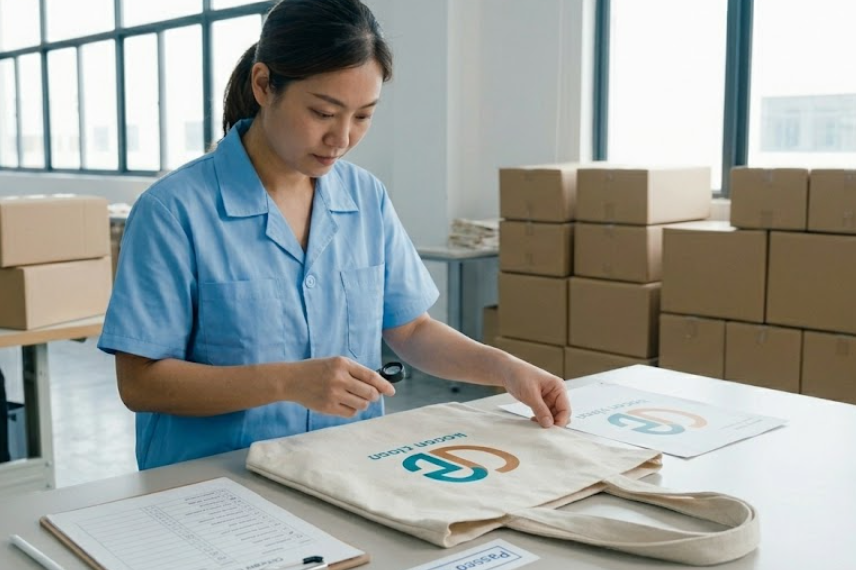
Quality control is not a single event at the end of production — it’s a system that runs throughout. Factories with robust QC catch problems at the cutting stage, not the shipping stage.
Inline QC happens during production. Supervisors check a percentage of units at each production stage: cutting accuracy, stitching consistency, printing registration, handle attachment. Issues caught here cost a fraction of what they cost post-production.
Pre-shipment inspection is the final check before goods leave the factory. This can be conducted by the factory’s own QC team or by an independent third party. For first orders or high-value shipments, third-party inspections (through companies like SGS, Bureau Veritas, or QIMA) provide an objective assessment.
AQL (Acceptable Quality Level) standards define what percentage of defects are acceptable in a batch. The AQL 2.5 standard is commonly used in apparel and bags — it means that in a random sample, defects above 2.5% trigger a fail. Knowing these numbers helps you set clear pass/fail criteria before production starts.
Common tote bag quality issues to specify against:
- Uneven stitching or skipped stitches at stress points
- Misaligned print registration
- Handle attachment not reinforced (failure point under load)
- Color variation between production batches
- Zipper alignment off-center
Send your QC checklist to the factory before production starts. A factory that reviews and accepts a specific checklist is committing to defined standards — which makes dispute resolution much cleaner if something goes wrong.
Third-party inspections are not a sign of distrust. Experienced manufacturers expect them. A factory that discourages independent inspection is giving you important information about their confidence in their own output.
Build a Long-Term Relationship with Your Tote Bag Manufacturer
The best pricing, fastest sampling, and highest production priority all go to repeat clients. This is not just goodwill — it’s how factory economics work. Customers who place consistent, predictable orders are more valuable than single-order buyers, and factories allocate their attention accordingly.
Stable communication is the foundation. Assign one point of contact on your side and build a relationship with one account manager or product manager on the factory side. When your contact knows your brand’s standards without being reminded every order, sampling gets faster and quality becomes more consistent.
Repeat orders build real leverage. By your second or third order, you know the factory’s rhythm. You know when to place orders to hit your delivery windows. You know which production details need extra attention for your specific products. That institutional knowledge is worth real money — it reduces sampling rounds, reduces errors, and reduces the time you spend on project management.
Better pricing over time is a genuine benefit of long-term relationships. After you’ve placed three or four orders, you have standing to negotiate on unit cost, especially if your volumes are growing. Factories want to keep growing clients.
Scaling a tote bag business efficiently requires a manufacturer who can grow with you. A factory with adequate production capacity, documented processes, and strong materials sourcing can accommodate a 3x increase in order volume without dropping quality. Vetting for this capacity before you need it — by asking about peak production rates and how they handle large simultaneous orders — prepares you for growth instead of scrambling to find a new supplier when you need one most.
Strategic manufacturing partnerships also open doors to product development collaboration. Factories that understand your brand will proactively suggest materials, construction improvements, or new styles that fit your direction. That input, from people who understand production realities, is often more useful than a design brief built in isolation.
Long-term relationships also simplify compliance. A factory that has worked with you across multiple orders understands your certification requirements, labeling standards, and packaging specifications — without you starting from scratch every time.
Conclusion
Working with a tote bag manufacturer successfully isn’t about finding the lowest price. It’s about finding a partner who has the production infrastructure, quality systems, and communication culture to deliver what you need — consistently and at scale.
The ten areas covered here — from product specification to long-term relationship building — form the framework that experienced buyers use to evaluate and manage manufacturer relationships. Each point connects to the others. Strong sampling reduces QC surprises. Verified factory status makes pricing conversations more transparent. Clear product requirements make every downstream decision cleaner.
If you are currently searching for a tote bag manufacturer you can trust, Hetebag is a factory-based custom bag manufacturer located in Huadu, Guangzhou, China, with over 15 years of manufacturing experience. We work with multiple production facilities and offer full OEM and ODM services — covering material selection, sampling, branding, and bulk production — for brands, wholesalers, and distributors across more than 70 countries. Our operations are backed by ISO 9001 certification and third-party audits including BSCI, SMETA, and SGS.
If you are ready to start a conversation, you can leave your contact information directly on our website. We look forward to hearing about your project and exploring what we can build together.
Frequently Asked Questions
What is the typical MOQ for custom tote bags?
Most tote bag manufacturers require a minimum order quantity (MOQ) between 300 and 1,000 pieces per style. Simpler canvas tote bags usually have lower MOQs, while custom materials, embroidery, or complex structures may require higher quantities.
How long does tote bag production usually take?
Standard production time is typically 30–45 days after sample approval. Custom materials, complex printing, or peak production seasons may extend lead times to 60 days or longer.
What materials are commonly used for tote bags?
Common tote bag materials include canvas, cotton, polyester, nylon, jute, and RPET recycled fabric. Each material offers different advantages in durability, sustainability, printing performance, and pricing.
Can I customize the logo and packaging?
Yes. Most professional OEM tote bag manufacturers support custom logo printing, woven labels, hang tags, packaging boxes, polybags, and other private label services.
What printing methods are available for custom tote bags?
Popular printing methods include:
Screen printing
Digital printing
Embroidery
Heat transfer printing
The best option depends on your artwork, order quantity, fabric type, and budget.
Are recycled tote bags durable enough for daily use?
High-quality RPET tote bags are durable, lightweight, water-resistant, and suitable for repeated daily use. Many brands now use RPET materials to support sustainability goals.