



Over the years, (Hetebag is a bag manufacturer with fifteen years of experience) we have dealt with many customers from different countries. When they start looking for a backpack supplier, the most common question they usually ask is not which factory offers the lowest price, but which factory is truly reliable.
In fact, a good manufacturer is not only responsible for producing products, but also provides assistance in areas such as material selection, product development, quality control, and delivery management. Therefore, when choosing a supplier, understanding the overall strength of the factory is often more important than simply comparing prices.
In this article, we have compiled information on 15 well-known custom backpack manufacturers in China and have also shared some key points to consider when choosing a supplier.
Why Source Custom Backpacks from China?
Production cost advantage
Labor costs in China’s bag manufacturing hubs remain significantly lower than in Europe, the US, and even competing regions like Vietnam or Bangladesh for complex, multi-component products. A well-constructed custom laptop backpack with YKK zippers, padded laptop sleeve, multiple organizer pockets, and a woven brand label might cost $18–$28 to produce in China at mid-volume. The same specification from a European factory could run $60–$90.
That gap doesn’t mean cutting corners. China’s experienced bag factories have spent decades perfecting the production of complex sewn goods. The labor cost advantage comes from workforce specialization and scale — not lower standards.
Supply chain density
Guangzhou’s Huadu District, Baiyun District, and the broader Pearl River Delta region are home to an extraordinary concentration of upstream suppliers. Fabric mills, zipper manufacturers (including licensed YKK distributors), buckle and hardware suppliers, foam manufacturers, lining fabric producers — they all operate within a few hours of each other. That proximity compresses lead times and gives factories real leverage when negotiating material pricing.
When you source from a well-connected Chinese factory, you’re not just buying their sewing capability. You’re accessing an entire regional ecosystem.
OEM and ODM depth
Chinese backpack factories have refined their OEM and ODM capabilities over decades of working with demanding international brands. Many factories in this list have developed in-house design teams that can take a brief — a rough sketch, a reference product, a mood board — and turn it into a production-ready sample within two to three weeks. That kind of speed-to-sample is difficult to match elsewhere.
Certification and compliance infrastructure
Serious factories have invested heavily in certifications: ISO 9001, BSCI, SEDEX, OEKO-TEX, GRS (Global Recycled Standard), and others. These aren’t just paperwork. They represent audited quality systems, ethical labor practices, and material traceability. For brands selling into European or North American markets, this infrastructure matters enormously.
What Makes a Great Custom Backpack Manufacturer?
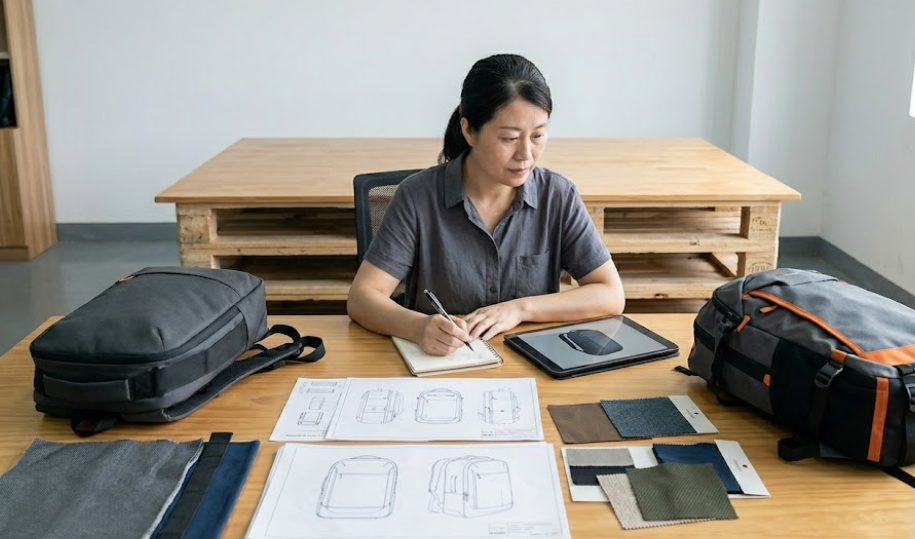
Not every factory that calls itself a “custom backpack manufacturer” can actually deliver a custom backpack at production quality. Here’s what separates the genuinely capable factories from the ones that will waste your time and money.
Production Experience
Years in operation matter, but what matters more is relevant experience. A factory with 15 years of experience producing tactical military packs has developed very different capabilities than one specializing in fashion-forward urban backpacks. Ask not just “how long have you been operating?” but “how many of my product type have you produced, and for which markets?”
Factories with deep experience in your category will have:
- Established relationships with the right material suppliers
- Skilled sewers who specialize in your product type
- Pattern-making and grading capability for your size range
- Quality control checkpoints calibrated to your product’s failure points
OEM vs. ODM Capability
OEM (Original Equipment Manufacturing): You provide complete designs, tech packs, and specifications. The factory manufactures to your exact requirements. This is the right model when you have a strong in-house design team and want full control over the product.
ODM (Original Design Manufacturing): The factory develops the design based on your brief, category, and target market. You select from or modify their existing designs. This is faster, lower development cost, and ideal for brands that want a quality product without a full design investment.
The best manufacturers handle both with equal competence. A factory that only does OEM may struggle when you ask for creative input. One that only pushes ODM may not have the technical rigor to execute precise custom specifications.
Quality Control Systems
| QC Stage | What to Look For |
|---|---|
| Incoming Material Inspection | Material certificates, color matching against approved standards, weight/thickness verification |
| In-Process QC | Stitch density checks, seam stress testing, zipper pull force testing during production |
| Pre-Shipment Inspection | Full product against spec, random sampling per AQL standards, photos/video documentation |
| Third-Party Audits | SGS, Bureau Veritas, or similar independent inspections available on request |
A factory that can’t describe its QC process specifically is a factory that doesn’t have one.
International Certifications
Certifications tell you something real about a factory’s operational discipline. For backpack manufacturers specifically, look for:
- ISO 9001 — Quality management systems
- BSCI / SEDEX / SA8000 — Social compliance and labor practices
- OEKO-TEX Standard 100 — Material safety (no harmful substances)
- GRS (Global Recycled Standard) — For RPET and recycled material claims
- REACH compliance — Required for EU market access
Top 15 Custom Backpack Manufacturers in China
The following manufacturers represent a range of specializations, scales, and capabilities. This list combines factories with strong export track records, verified OEM/ODM capacity, and demonstrated quality systems.
1. Hetebag — Guangzhou, Huadu District (Est. 2011)
Main Products: Custom backpacks, tote bags, laptop bags, RPET bags, promotional bags
Hetebag operates out of Guangzhou’s Huadu District, one of China’s most concentrated bag manufacturing zones. With over 15 years of factory experience, Hetebag has built its reputation on two things: precision OEM execution and a genuine commitment to sustainable production, particularly RPET bags made from recycled PET bottles.
What distinguishes Hetebag from many competitors is the combination of factory ownership and trade flexibility. They work across a wide range of product types — from structured business laptop backpacks to lightweight RPET tote bags — and their team has the technical depth to guide clients through material selection, logo application methods, and cost optimization without compromising quality.
Hetebag serves clients across North America, Europe, and Southeast Asia. Their minimum order quantities are accessible for growing brands, and their sample development turnaround is consistently faster than the industry average.
Strengths: RPET and sustainable materials expertise, strong OEM customization, Huadu District location with dense supply chain access, 15+ years of manufacturing experience
2. Kingsons — Guangzhou (Est. 1997)
Main Products: Backpacks, laptop backpacks, travel backpacks, sling bags, laptop briefcases
Kingsons is one of the more established names in Chinese bag manufacturing, founded in 1997 and headquartered in Guangzhou. Their longevity reflects a consistent ability to adapt — from producing basic laptop bags in the early 2000s to developing tech-integrated, anti-theft travel backpacks for global retail.
They operate an integrated model: design, manufacturing, and export under one roof. For buyers who want a manufacturer that can handle everything from product development through to logistics, Kingsons has the infrastructure to deliver.
3. Endian — China (Est. 2000)
Main Products: School backpacks, business backpacks, travel backpacks
Endian has spent over two decades focused on three core categories: school, business, and travel backpacks. That focus has built genuine depth. Their factories understand the structural requirements that differentiate a durable school bag — reinforced base panels, ergonomic shoulder strap construction, safe zipper pulls — from a polished business backpack designed for executive daily use.
4. OMASKA — China (Est. 2000)
Main Products: Luggage, backpacks, laptop bags, gym bags
OMASKA operates across multiple bag categories, with luggage as its anchor product and a strong capability in backpacks and gym bags. For buyers sourcing a mixed product line — say, a travel backpack alongside matching luggage — OMASKA’s cross-category capability simplifies supplier management.
5. DDHBA — Guangzhou (Est. 2006)
Main Products: Business travel bags, gym bags, marathon bags, diaper bags, pet carriers
DDHBA is an R&D-oriented manufacturer, which shows in their product range. Marathon bags with hydration compatibility, smart-organized diaper bags with insulated pockets, anti-theft business travel backpacks — these are products that require more than sewing skill. They require understanding how a product is actually used.
Certified to ISO 9001 and SGS standards, DDHBA’s quality systems are auditable and consistent. Their range of specialized functional bags makes them a strong partner for brands entering performance or lifestyle categories.
6. Guangzhou Yakeda Outdoor Travel Products — Guangzhou (Est. 2006)
Main Products: Tactical backpacks, outdoor backpacks, military gear
Yakeda occupies a specialized corner of the market: tactical and military-grade gear. If your product requires MOLLE webbing systems, high-denier Cordura or Oxford fabric, compression straps, and the kind of construction that needs to hold up under genuine outdoor stress, Yakeda has the factory infrastructure and material sourcing to deliver it.
They’re not the right partner for fashion-forward urban backpacks. They are exactly the right partner for brands in the outdoor, survival, or law enforcement equipment space.
7. Guangzhou Liangsi Co., Ltd. — Guangzhou (Est. 2009)
Main Products: Bags, gift sets, backpacks
Liangsi has a particular strength in the promotional and gifting segment. Their ability to combine backpacks with coordinated gift sets — branded sets that might include a backpack, a pouch, and a tote — makes them useful for corporate gifting programs and event-driven procurement.
8. YC Bag Making — China (Est. 2005)
Main Products: Laptop backpacks, leather backpacks, foldable backpacks, PVC backpacks
YC Bag Making’s range spans materials in a way that most factories don’t. Leather backpacks require entirely different construction techniques than PVC bags or foldable packable backpacks. The fact that YC handles all three suggests strong pattern-making capability and a diverse stitching floor. Buyers with varied material requirements, or those looking to test multiple material options for a new line, will find this flexibility valuable.
9. Guanghui Bags — China (Est. 2021)
Main Products: Backpacks, beach bags, cooler bags, cosmetic bags, diaper bags
Guanghui is among the newer entries on this list. Their product breadth — spanning beach bags, cooler bags, cosmetics bags, and backpacks — suggests a versatile production setup. While their track record is shorter than longer-established factories, newer manufacturers often bring more current equipment and a hunger for long-term client relationships that established factories with full order books may not prioritize.
10. Anhui Honeyoung International Trade Development Co., Ltd. — Anhui (Est. 1998)
Main Products: Backpacks, school bags, promotional backpacks, travel accessories
Honeyoung is one of the more prominent volume players on this list. With over 25 years of operation and a reported annual production exceeding hundreds of millions of bags, their scale is significant. They handle OEM/ODM with a professional team and have worked extensively with international buyers seeking competitive pricing at high quantities.
Their MOQ of 500 pieces makes them accessible for mid-scale orders, though their pricing advantage becomes most apparent at larger volumes.
11. Yabo International Enterprise Limited — China (Est. 2003)
Main Products: Laptop backpacks, sports bags, travel bags
Yabo has two decades of experience focused on the core commercial categories: laptop, sports, and travel bags. These are high-volume, competitive product types that require consistent quality execution rather than novelty. Buyers looking for reliable repeat orders on proven product types will find Yabo’s consistency valuable.
12. Xiamen Lemay Trading Co., Ltd. — Xiamen (Est. 2000)
Main Products: Waterproof backpacks, outdoor gear
Lemay’s specialization in waterproof backpacks puts them in a technically demanding niche. Genuine waterproofing — not water-resistant but waterproof — requires specific fabrics (TPU laminates, welded seams instead of stitched), and factories without this expertise produce bags that fail in the field. Lemay’s focus on outdoor gear suggests they’ve developed the right material sourcing and construction methods for this category.
13. Oneier — China (Est. 2007)
Main Products: Luggage, backpacks
Oneier covers the luggage and backpack space with a standard commercial offering. Their longevity since 2007 speaks to consistent quality delivery. For buyers sourcing within those categories without highly specialized requirements, Oneier represents a stable, experienced option.
14. LeelineBags — China (Est. 2015)
Main Products: Leather bags, promotional bags, sports bags, laptop bags
LeelineBags occupies an interesting middle ground — premium materials like leather alongside promotional and sports bags. This range suggests versatile sourcing capability, which can be useful for buyers building multi-SKU product lines that span different price points and materials.
15. Quanzhou Center Bag & Case Co., Ltd. — Quanzhou, Fujian (Est. 1996)
Main Products: Customized bags, school backpacks, laptop backpacks, travel backpacks
Quanzhou Center is the oldest factory on this list, founded in 1996. Nearly 30 years of bag manufacturing builds specific kinds of institutional knowledge: how to handle complex specifications, how to manage quality consistency across long production runs, how to communicate with international buyers across time zones and languages. Their location in Quanzhou puts them in Fujian Province, another key bag manufacturing cluster alongside Guangdong.
Manufacturer Comparison at a Glance
| Manufacturer | Est. | Core Strength | Best For |
|---|---|---|---|
| Hetebag | 2011 | RPET sustainability + OEM precision | Sustainable brands, full custom |
| Kingsons | 1997 | Integrated design + manufacturing | Laptop & travel, one-stop |
| DDHBA | 2006 | Functional R&D | Performance, lifestyle categories |
| Yakeda | 2006 | Tactical/military construction | Outdoor, tactical gear |
| Honeyoung | 1998 | High-volume scale | Large orders, competitive pricing |
| Quanzhou Center | 1996 | Longevity + breadth | Complex specs, mixed categories |
What Types of Custom Backpacks Can Chinese Factories Produce?
China’s bag manufacturing ecosystem covers every commercial backpack category. Understanding which factories specialize where saves you months of sample disappointment.If you’re new to the backpack industry, you may also want to read our guide on what a backpack is, its common types, and applications.
Laptop Backpacks
The most commercially competitive category. A proper laptop backpack requires a dedicated padded laptop sleeve with shock absorption, organized front panel, ergonomic shoulder harness, and often additional features like USB pass-through ports, hidden pockets, or TSA-friendly opening configurations. Factories experienced in this category understand the structural engineering involved — it’s not just a bag with a padded pocket.
Material choices typically include ballistic nylon, polyester jacquard, and increasingly, RPET fabrics for brands with sustainability commitments.If you’re comparing different backpack materials, our guide on backpack materials: nylon vs polyester vs canvas explains the advantages and disadvantages of each option in detail.
Travel Backpacks
Travel backpacks are among the most specification-intensive products in the category. Weight distribution systems, sternum straps, hip belt construction, top-loading vs. front-panel-access configurations, compression straps, rain covers — each of these requires specific technical capability. Factories that produce genuine travel packs have typically invested in ergonomic testing and weight distribution analysis that smaller, generalist factories haven’t.
School Backpacks
Volume category, broad market from primary school to university. Key requirements: durable base panels, reinforced shoulder attachment points, reflective safety elements for younger users, ergonomic back panels for spine health, and — increasingly — compliance with children’s safety regulations in target markets (particularly relevant for EU and US sales).
Hiking Backpacks
Technical outdoor packs require hydration compatibility (reservoir sleeve and hose routing), frame sheet pockets, load lifter straps, and construction from abrasion-resistant materials like Cordura. Factories without outdoor experience frequently underestimate these requirements. A hiking pack that fails on the trail is a quality and liability problem.
Promotional Backpacks
The economics of promotional backpacks are different. Here, the priority is brand visibility, reasonable quality, and cost efficiency at volume. These bags need to carry a logo well, hold up through normal use, and land at a price point that makes sense for gifting budgets. Factories with strong heat transfer printing, embroidery, and screen printing capabilities matter more than structural engineering depth.
Business Backpacks
Business backpacks occupy a premium tier that demands premium construction. Professional buyers notice things like zipper quality, lining fabric, handle stitching, and hardware finish. A business backpack is a daily-use professional accessory, and the factories that produce them well have quality standards calibrated accordingly.
How Much Does Custom Backpack Manufacturing Cost?
Pricing is where most buyers make their first mistake: treating it as a fixed number rather than a function of variables. Here’s how those variables actually work.Material selection has a significant impact on manufacturing costs. You can learn more in our comparison of canvas vs nylon bags.
Material Costs
Material is typically 40–60% of production cost for a backpack. The main cost drivers:
Main fabric: Polyester (economy) → Nylon (mid-premium) → Cordura/ballistic nylon (premium) → RPET recycled polyester (sustainability premium, often similar to mid-range virgin polyester at volume)
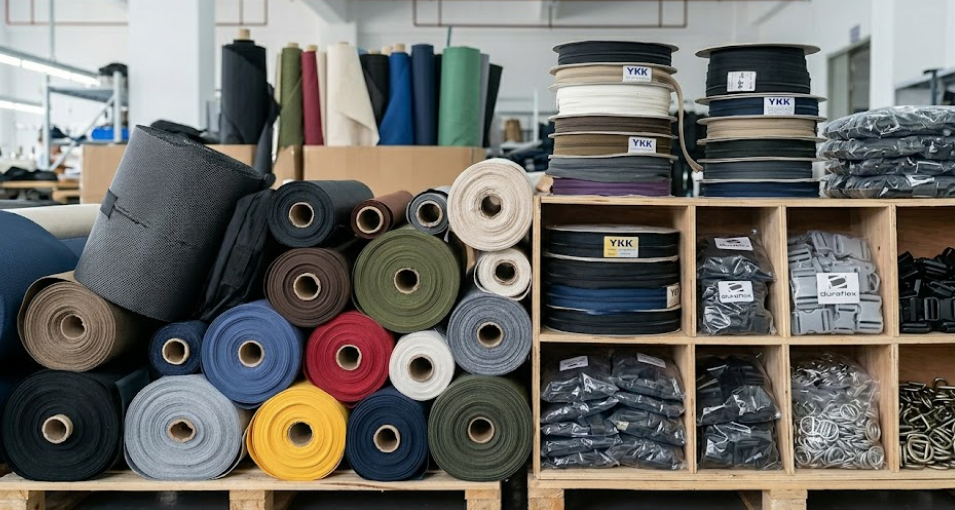
Zippers: Generic Chinese zippers at the low end; YKK at a significant premium but with auditable quality. For business or travel packs, YKK is worth the cost.
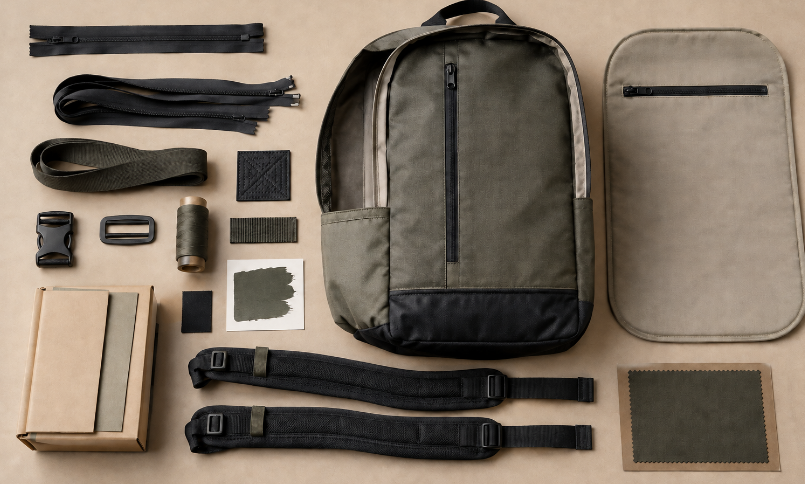
Hardware: Buckles, D-rings, and sliders vary enormously in quality. Injection-molded generic hardware fails under stress; branded hardware (Duraflex, ITW Nexus) costs more but lasts.
Lining: Often overlooked, lining quality affects perceived premium feel and durability.
Logo Application Costs
| Method | Best For | Cost Premium |
|---|---|---|
| Embroidery | Premium feel, small logos, text | Medium |
| Screen printing | Large areas, flat graphics | Low |
| Heat transfer | Full-color, photo-quality graphics | Low-Medium |
| Woven label | Brand labels, care tags | Low |
| PVC patch | Outdoor/tactical look, durability | Medium |
| Debossed/embossed | Leather or faux leather panels | Medium-High |
MOQ Impact on Unit Price
This is where buyers often misunderstand Chinese factory economics. A factory’s overhead and setup costs are fixed per order. When you order 200 units, those fixed costs spread across fewer pieces, driving unit price up. At 2,000 units, the math shifts substantially.
A realistic illustration: a custom laptop backpack might be quoted at $32/unit at 300 pieces, $24/unit at 1,000 pieces, and $19/unit at 3,000 pieces. The product is identical. The pricing reflects cost amortization.
Knowing your target volume before negotiating gives you much stronger positioning.
Sampling Fees and Production Pricing
Most serious factories charge for sample development — typically $50–$200 per sample depending on complexity. This is normal and healthy. Factories that offer “free samples” on everything are either recovering that cost in other ways or not investing properly in sample development.
Sampling costs are often credited against your first production order. Confirm this before you commit.
Development samples (first round) should never be used to evaluate final quality. They establish specification alignment. Production samples — made from production-run materials on production tooling — are what you evaluate before approving the full run.
How to Choose the Right Custom Backpack Manufacturer?
Selecting a manufacturer is a process, not a Google search. Here’s a systematic approach that actually works.Many buyers also struggle with supplier verification. Our article on how to find a trustworthy bag manufacturer in China provides additional sourcing tips that apply to backpack projects as well.
Evaluate Factory Capability Against Your Product
Request a factory profile that includes: years in operation, production capacity (units/month), product categories, certifications, and key client references. Then ask specific questions about your product type. A factory producing 50,000 hiking packs a month is not necessarily equipped to produce the structured business backpack you need.
Visit the factory if the order scale justifies it. If you can’t visit in person, a video call factory tour conducted during business hours — with no advance preparation of specific areas — tells you a lot.
Sample Testing Protocol
Don’t approve a product based on aesthetics alone. Create a structured testing checklist:
- Zipper pull force (does the zipper operate smoothly under load?)
- Seam strength (stress test at high-load points: shoulder attachment, base corners)
- Strap durability (shoulder straps under weighted load over time)
- Material colorfastness (rub test, UV exposure)
- Logo adhesion (peel test for heat transfer, wash cycle test for embroidery)
- Hardware function (buckle release force, snap closure strength)
A manufacturer worth working with will welcome this rigor. One that resists it is showing you something important.
Communication Capability
Misunderstandings in bag manufacturing are expensive. A factory whose English-speaking staff understands technical terminology — “bartack stitch,” “D-ring attachment point,” “contrast lining,” “drop-in molded base” — will execute your spec significantly more accurately than one communicating through a basic translator.
Test communication early: send a detailed inquiry and evaluate the quality and specificity of the response. Speed matters, but accuracy matters more.
Lead Time Management
Standard production lead times for custom backpacks run 45–75 days from approved production sample, depending on order complexity and factory load. Understand this timeline before you commit to a launch date or a retail window.
Build in buffer for: sample revision rounds (each round adds 1–2 weeks), material procurement delays, pre-shipment inspection, and shipping transit time. An order that needs to land in North America for a holiday season launch should be in production by August at the latest.
Common Mistakes Buyers Make When Sourcing Backpacks from China
After years of working with international buyers, the same patterns of mistakes appear repeatedly. These are the most costly ones.
Buying on Price Alone
Price is not a proxy for value. A factory offering a 30% lower price than comparable alternatives is either cutting on material quality, compromising construction standards, or planning to recover margin elsewhere. The real cost of a quality problem — product returns, brand damage, replacement production — vastly exceeds the initial savings.
Compare quotes at identical specifications. If you don’t have a complete tech pack, quotes are not actually comparable — factories are pricing different products.
Skipping Quality Inspection
Pre-shipment inspection is not optional. Approving a shipment based on factory photos is not an inspection. Third-party inspection (SGS, Bureau Veritas, or equivalent) at the factory before goods are loaded costs a few hundred dollars and protects an order worth tens or hundreds of thousands. The math is obvious.
Misreading Production Capacity
A factory that quotes 30-day lead time with no caveat about their current order load may be telling you what they think you want to hear rather than what’s realistic. Always ask for current production calendar availability. A factory running at 95% capacity cannot commit to your timeline, regardless of what they say in the negotiation.
Not Documenting Product Specifications
A verbal agreement or email description is not a product specification. Before production starts, you need a written, signed specification document that covers: main fabric (with material reference), lining fabric, zipper brand and color, hardware specifications, logo placement and application method, dimensions, and packaging requirements.
Every deviation from specification needs written approval before the factory makes changes. Without documentation, you have no recourse when the product arrives looking different than what you discussed.
Conclusion
Different products, volumes, and market positions call for different manufacturing partners. A startup building a sustainable RPET backpack line has different needs than a corporate procurement team sourcing 10,000 branded conference bags. Understanding your own requirements clearly is the first step to identifying the right factory.
Match manufacturer to requirement:
- Sustainability-focused products: Factories with GRS certification and demonstrated RPET capability (Hetebag’s strength in this area is notable)
- High-volume promotional: Scale-focused factories like Honeyoung, with established volume pricing
- Technical outdoor/tactical: Specialized factories like Yakeda, with material sourcing and construction expertise for performance products
- Premium business/laptop: Manufacturers with quality control systems calibrated for professional end users
Starting an OEM/ODM project: what to prepare
Before reaching out to any factory, have these ready:
- Product category and target use case
- Target retail price (so the factory can calibrate material recommendations)
- Anticipated order volume (annual, not just first order)
- Key feature requirements
- Any certification requirements for your target market
- Timeline from sample to production approval to delivery
Requesting a quote: minimum information needed
- Reference product or tech pack (even rough sketches help)
- Main fabric preference or performance requirements
- Logo application method preference
- Target quantity range
- Delivery destination (for landed cost calculation)
If you’re actively looking for a backpack manufacturing partner in China, Hetebag operates a factory in Guangzhou’s Huadu District with over 15 years of manufacturing experience. We work across custom backpacks, tote bags, laptop bags, and RPET sustainable bag programs, and we collaborate with multiple production facilities to handle varied order types and scales. Whether you’re developing a new product from a brief or scaling an existing design, we’re ready to discuss your requirements. You can leave your contact details directly on our website — we look forward to hearing from you and building something worth putting your brand on.
Frequently Asked Questions
What is the typical MOQ for custom backpack manufacturing in China?
Most Chinese backpack manufacturers require a minimum order quantity (MOQ) between 300 and 500 pieces, depending on the backpack design, materials, and customization requirements. More complex products or custom materials may require higher MOQs.
How long does it take to develop and produce a custom backpack?
Sample development usually takes 7–15 days, while mass production typically requires 30–60 days after sample approval. Lead times may vary depending on order quantity, material availability, and factory production schedules.
Can Chinese backpack manufacturers help with product design?
Yes. Many manufacturers offer both OEM and ODM services. If you already have a design or tech pack, they can produce according to your specifications. If you only have an idea, ODM manufacturers can assist with design, material selection, and sample development.
What certifications should I look for when choosing a backpack manufacturer?
Common certifications include ISO 9001 for quality management, BSCI or SEDEX for social compliance, OEKO-TEX for material safety, and GRS certification for recycled materials. The required certifications depend on your target market and product requirements.
How can I verify the reliability of a backpack manufacturer before placing an order?
Request factory certifications, product samples, production photos, and recent audit reports. It’s also recommended to conduct a factory audit or arrange a third-party inspection before mass production to ensure the supplier meets your quality and compliance standards.