
 English
  Italian
  French
  German
  Spanish
  Arabic
 Two synthetic leather swatches may share the same grain and color while one puckers at a stitched corner or separates at a folded edge. Buyers comparing microfiber leather and PU leather need to inspect the backing, coating, thickness, and assembled sample rather than approve a catalog label.
Microfiber leather usually refers to a synthetic leather made with a three-dimensional microfiber nonwoven base and a polyurethane surface system. Conventional PU leather usually uses a textile base, such as polyester or cotton fabric, with one or more polyurethane coating layers.
This difference affects the material’s structure, flexibility, surface feel, edge behavior, and potential durability. A high-grade PU material may perform well in a daily-use bag, while a poorly specified microfiber material may still create production or quality problems.
For a custom bag project, the right comparison should consider the actual backing, coating, thickness, finish, intended use, and test requirements.
For the complete purchasing process, use the custom leather handbag sourcing guide to connect material approval with bag construction, supplier selection, sampling, and bulk inspection.
What is the main difference between microfiber leather and PU leather?
How microfiber leather is made
Microfiber leather is generally built around an engineered nonwoven base made from very fine synthetic fibers. These fibers are arranged and bonded to create a dense, leather-like structure. The material is then processed with polyurethane and surface finishing to achieve the desired grain, color, softness, and appearance.
The microfiber base gives the material a more complex internal structure than a simple fabric-backed coating. It can provide a balanced combination of flexibility, support, and resistance to repeated handling when the material is properly engineered.
Some microfiber leather products are designed to imitate smooth leather, while others are finished with pebbled grain, matte texture, glossy coating, or suede-like surfaces. Official microfiber material suppliers such as Clarino also position microfiber as an engineered synthetic material with applications in footwear, fashion, accessories, and automotive products.
How conventional PU leather is made
Conventional PU leather commonly starts with a woven or knitted textile backing. Polyurethane layers are applied to the surface, and an embossing or finishing process creates the grain pattern and final appearance.
The textile backing affects how the material behaves during cutting and sewing. The polyurethane coating affects the surface feel, color, gloss, grain definition, and resistance to abrasion or moisture.
The term “PU leather” therefore covers many different specifications. Two PU materials may look similar in a supplier’s catalog but perform differently because of differences in thickness, backing density, polyurethane formulation, surface finishing, and production control.
Quick comparison of their main features
| Feature | Microfiber leather | Conventional PU leather |
|---|---|---|
| Main structure | Engineered microfiber nonwoven base with PU surface system | Textile backing with polyurethane coating |
| Surface appearance | Can imitate smooth, pebbled, or premium leather grain | Wide range of colors, grains, gloss levels, and textures |
| Hand feel | Often dense, soft, and leather-like | Can range from soft and flexible to firm and structured |
| Flexibility | Usually balanced between support and flexibility | Depends strongly on backing and coating |
| Typical use | Premium handbags, structured accessories, footwear, and higher-use products | Fashion bags, private-label products, cosmetic bags, and daily-use items |
| Main quality risk | Inconsistent structure, poor finishing, or unsuitable grade | Peeling, cracking, hydrolysis, or weak surface adhesion |
| Best comparison method | Review material construction and performance data | Review coating, backing, thickness, and test results |
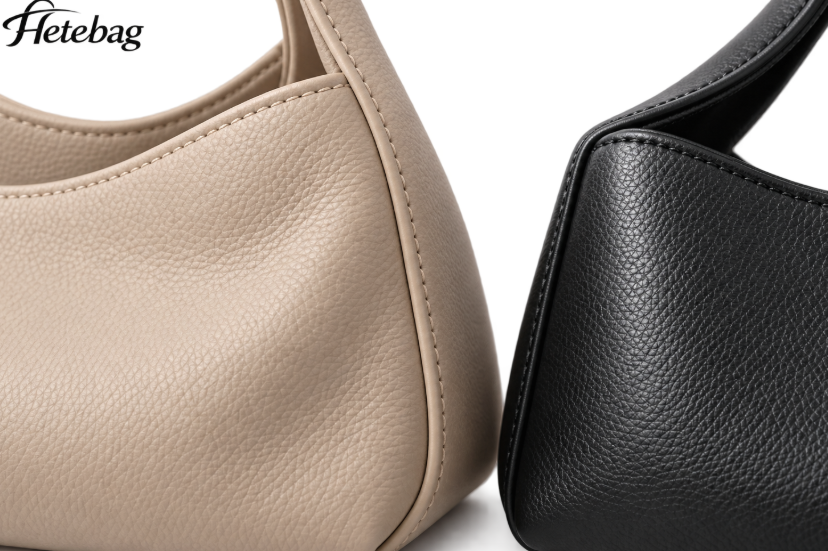
Which material looks and feels more like genuine leather?
Microfiber leather often gives a dense and refined hand feel that can be close to genuine leather. It may have a more natural-looking grain, smoother recovery after bending, and a more substantial feel at the edge.
That does not mean every microfiber material will look better than every PU material. A well-finished PU leather with a carefully selected grain can look more attractive than a low-grade microfiber material. Surface embossing, coating thickness, color, gloss, and finishing technique have a major effect on the final appearance.
For buyers, the most useful checks include:
- Does the grain look regular but not artificial?
- Does the surface recover after light bending?
- Does the material feel hollow, plastic-like, or excessively stiff?
- Does the edge show a clean backing structure?
- Does the texture remain consistent across the full roll?
- Does the material match the approved color and gloss under different lighting?
A bag’s construction also changes the result. A structured handbag may need a firmer material with good shape retention. A soft crossbody bag may require more flexibility. A makeup pouch may prioritize easy cleaning and a smooth surface over a highly natural leather feel.
Microfiber leather vs PU leather: Which is more durable for bags?
Microfiber leather is often selected for products that require a stronger and more leather-like structure. Its engineered base can support good resistance to repeated flexing, abrasion, and handling when the material has been correctly specified.
PU leather can also be durable enough for many bag applications. Its performance depends on the quality of the polyurethane surface, the textile backing, the thickness, and the way the bag is constructed.
Abrasion, tear, and flex resistance
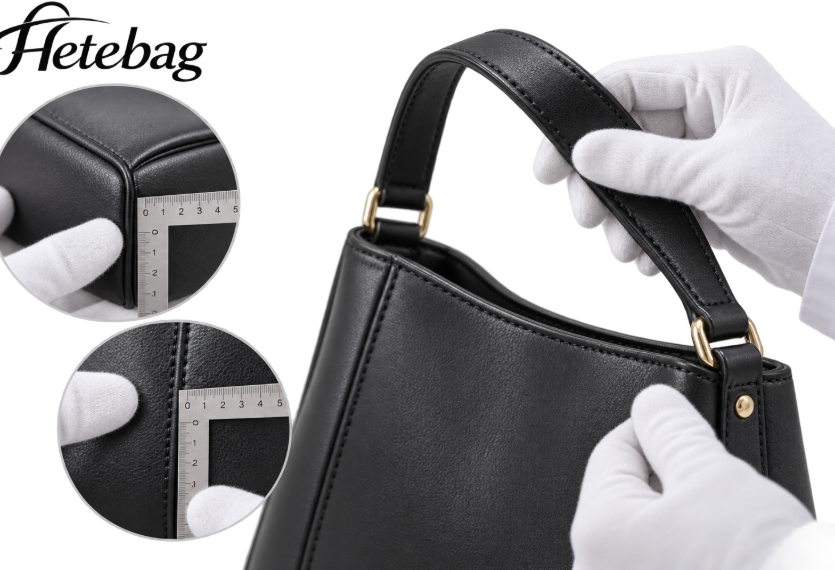
Bag corners, handle bases, shoulder straps, and fold lines receive more stress than large flat panels. These areas should be checked during sampling because a material may look excellent on a flat swatch but behave differently after sewing and shaping.
A buyer should ask the supplier to consider:
- Surface abrasion on corners and frequently touched areas.
- Repeated flexing on shoulder straps and fold points.
- Tear resistance around stitch holes.
- Seam strength at handle and strap attachment points.
- Surface adhesion after bending.
- Color transfer when the bag rubs against clothing.
Peeling, cracking, and hydrolysis
Peeling and cracking are often associated with the surface coating rather than the word “PU” alone. In warm, humid, or poorly ventilated storage conditions, certain polyurethane systems may be more vulnerable to hydrolysis. The risk depends on the specific formulation, construction, storage conditions, and length of exposure.
Buyers should not accept a general statement such as “this material will last for many years.” Instead, request the material specification and ask which tests are suitable for the planned end use.
A useful development process is to inspect the material after:
- Repeated folding and bending.
- Surface rubbing.
- Humidity or heat exposure where relevant.
- Stitching and edge finishing.
- Compression and packing.
- Hardware installation.
Why material grade and testing matter
Durability is a system result. It depends on material, thread, stitch density, reinforcement, lining, hardware, pattern design, and production control.
For a premium handbag, a supplier may need to evaluate the surface and structure together. For a makeup pouch, surface cleaning and coating adhesion may matter more. For a daily-use tote, corner abrasion and handle reinforcement may be more important.
Do not promise a fixed service life unless the product has been tested under a defined method and use condition.
How do microfiber leather and PU leather compare in water resistance and care?
Both materials can have a water-resistant surface, but surface water resistance does not make the entire bag waterproof.
Water may still enter through:
- Stitching holes.
- Zipper seams.
- Handle attachment points.
- Unsealed edges.
- The opening of the bag.
- The lining and internal construction.
A PU surface is usually easy to wipe clean, which is one reason it is often used for cosmetic bags and daily-use fashion accessories. Microfiber leather can also be easy to maintain, although the care method depends on the finish and surface treatment.
For routine care, brands should provide practical instructions:
- Wipe spills promptly with a soft, slightly damp cloth.
- Avoid strong solvents, bleach, and abrasive cleaning tools.
- Do not store the bag while it is wet.
- Keep the product away from prolonged heat and direct sunlight.
- Allow the bag to dry naturally in a ventilated area.
- Avoid folding or compressing the bag for long periods when the material is structured.
If the product will be marketed as water-resistant, the claim should relate to the actual finished bag and, where needed, a defined test method. A water-resistant outer material does not automatically justify a waterproof claim.
Which material works better for custom bag manufacturing?
The better material depends on the design and production requirements.
Cutting, stitching, and edge finishing
Microfiber leather can provide a dense, stable edge for structured bags, but the thickness and stiffness must match the pattern. If the material is too rigid, tight curves and folded edges may become difficult to control.
PU leather can be easier to work with across a wide range of bag styles. However, the supplier still needs to confirm how the coating behaves when the material is skived, folded, stitched, or turned over an edge.
Important production checks include:
- Clean cutting without surface damage.
- Even seam allowance.
- Consistent edge folding.
- No coating cracks along folded edges.
- Proper reinforcement around handles and straps.
- No visible needle damage or enlarged stitch holes.
Embossing, debossing, and logo printing
Both materials may support embossing, debossing, heat transfer, screen printing, labels, or metal logo hardware. The best option depends on the surface texture, thickness, coating, logo size, and required visual effect.
A fine-grain surface may produce a cleaner debossed logo than a deep, irregular grain. A glossy coating may affect ink adhesion or create unwanted reflections. A supplier should test the logo on the final material instead of approving the decoration only from a digital mockup.
HeteBag provides material and finishing options such as custom bag materials, embossing, debossing, grain textures, matte finishes, glossy finishes, and other surface treatments.
Matching materials to different bag styles
- Handbags: Microfiber leather may suit structured or premium-positioned designs that need a substantial hand feel. PU leather can work well for fashion collections with multiple colors and textures.
- Tote bags: The choice depends on whether the tote should be soft, structured, lightweight, or highly resistant to daily abrasion. Review HeteBag’s custom handbag and tote bag manufacturing options.
- Crossbody bags: Flex resistance, surface recovery, strap attachment, and edge durability deserve extra attention because the bag is handled and bent frequently.
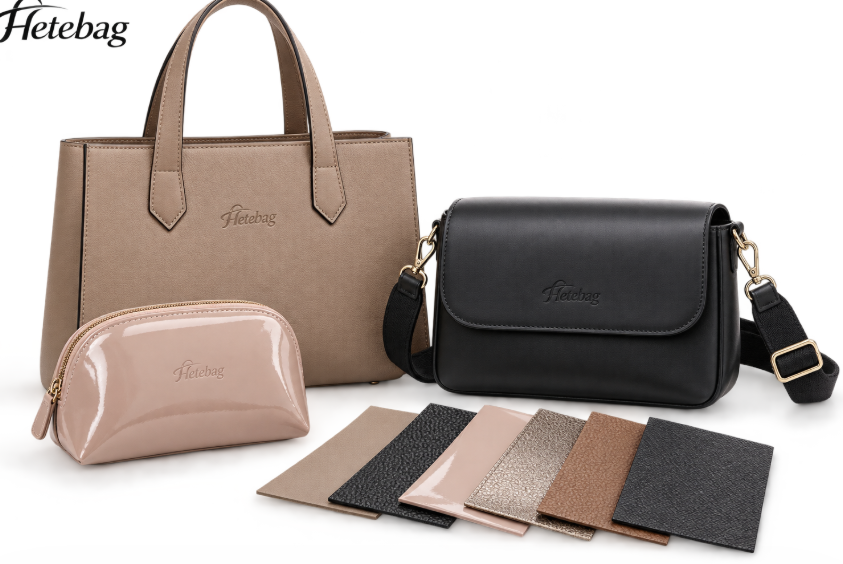
- Makeup bags: PU leather is often practical when the buyer wants a smooth, wipe-clean surface. Microfiber leather may be selected when the brand wants a more premium hand feel and a stronger outer structure. HeteBag’s custom makeup bag page covers PU, canvas, nylon, PVC, TPU, and other material options.
Is microfiber leather worth the extra cost compared with PU leather?
There is no universal answer because not every microfiber material costs more than every PU material. The final budget depends on material grade, thickness, finish, color, order quantity, construction, decoration, hardware, and testing requirements.
Microfiber leather may be worth considering when:
- The bag has a premium positioning.
- The product will receive frequent handling.
- The design requires a dense, leather-like hand feel.
- The surface and edge need to look refined.
- The buyer wants additional material structure for a more demanding product.
PU leather may be the better choice when:
- The collection needs many colors or surface finishes.
- The product is designed for daily fashion use.
- Easy surface cleaning is important.
- The bag requires a flexible or lightweight construction.
- The product positioning does not require a premium microfiber specification.
The correct comparison should be made using approved samples rather than material names alone. Ask the supplier to quote comparable thicknesses and finishes, then evaluate appearance, construction, logo effect, and test results together.
How do you choose the right material for your bag collection?
Start with the product’s real use rather than the material label.
Ask these questions before requesting a quotation:
- What will the customer carry in the bag?
- How often will the bag be opened, folded, or handled?
- Will it be exposed to rain, humidity, cosmetics, oils, or abrasion?
- Should the bag hold a firm shape or feel soft?
- Which areas require reinforcement?
- Which logo or surface-finishing process will be used?
- Does the target market require material or chemical documentation?
- What tests should be completed before bulk production?
- Will the same material need to be reordered in the future?
- Can the supplier provide a pre-production sample for approval?
What Should the Material Approval Sheet Record?
Record the supplier material code, backing composition, coating description, thickness tolerance, usable width, grain, color, gloss, and any agreed test requirements. Microfiber is commonly a base structure within a polyurethane material system, so it should not automatically be treated as a PU-free material. If animal hide is also an option, compare PU leather and genuine leather separately.
Ask for a sample made with the intended production material. Review folds, stitch holes, edge treatment, adhesion, logo appearance, and shape recovery. If the supplier provides abrasion, flexing, or hydrolysis data, check the material reference, conditions, date, and result; do not transfer a report for another grade to the selected material.
Conclusion
Microfiber leather and PU leather are not interchangeable labels for exactly the same material. Microfiber leather usually uses a more engineered microfiber base, while conventional PU leather commonly combines a textile backing with a polyurethane coating.
Microfiber leather may provide a denser hand feel and stronger leather-like structure, while PU leather offers broad flexibility in colors, textures, finishes, and applications. Neither material should be judged by name alone. The right choice depends on the bag style, expected use, surface finish, construction method, testing needs, and brand positioning.
HeteBag supports brands with material selection, custom bag development, sampling, logo finishing, and production coordination. If you are comparing microfiber leather and PU leather for a handbag, tote, crossbody bag, or makeup bag, you can contact HeteBag with your design, target use, preferred finish, and expected order requirements.
Frequently asked questions
Is microfiber leather the same as PU leather?
No. Microfiber leather usually refers to an engineered microfiber base combined with a polyurethane surface system. Conventional PU leather commonly uses a textile backing with polyurethane coating.
Is microfiber leather always more durable than PU leather?
No. A high-grade microfiber material may perform very well, but durability depends on the complete material specification, coating, backing, construction, and testing. A well-made PU material can be suitable for many daily-use bags.
Which material is better for handbags?
Microfiber leather may suit premium or structured handbags that need a dense hand feel and refined appearance. PU leather can be suitable for fashion handbags requiring flexible colors, textures, and finishes.
Which material is better for makeup bags?
PU leather is often practical for makeup bags because its smooth surface can be wiped clean. Microfiber leather may be chosen when the brand wants a more premium feel or a more structured design.
What should I request from a supplier before mass production?
Request material swatches, thickness and composition information, a sample made with the actual material, logo testing, construction checks, and any relevant abrasion, flex, adhesion, hydrolysis, or colorfastness documentation.
Can HeteBag help choose between microfiber leather and PU leather?
Yes. HeteBag can review the bag design, intended use, target market, surface finish, logo method, and construction requirements before recommending suitable material options.


