



During the past decade or so of our bag manufacturing process, we have observed that many buyers, when looking for suppliers of insulated bags, tend to focus mainly on the price. However, for enterprises that have been operating brands, retail channels, or promotional programs for a long time, choosing a reliable Cooler Bag Manufacturer is far more important than obtaining a low price.
An excellent manufacturer not only can guarantee stable product quality, but also can create long-term value for customers in aspects such as material selection, customized development, delivery cycle and after-sales service. So, when faced with numerous suppliers in the market, how can we determine whether a thermal insulation bag factory is worth cooperating with? In this article, we will conduct an analysis from multiple dimensions to help you find a manufacturing partner that suits your business needs.
What Should You Look for in a Cooler Bag Manufacturer?
The foundation of any good sourcing decision is understanding who you’re actually dealing with. A trading company masquerading as a factory is one of the most common — and costly — mistakes in China bag sourcing.
Factory Scale and Physical Infrastructure
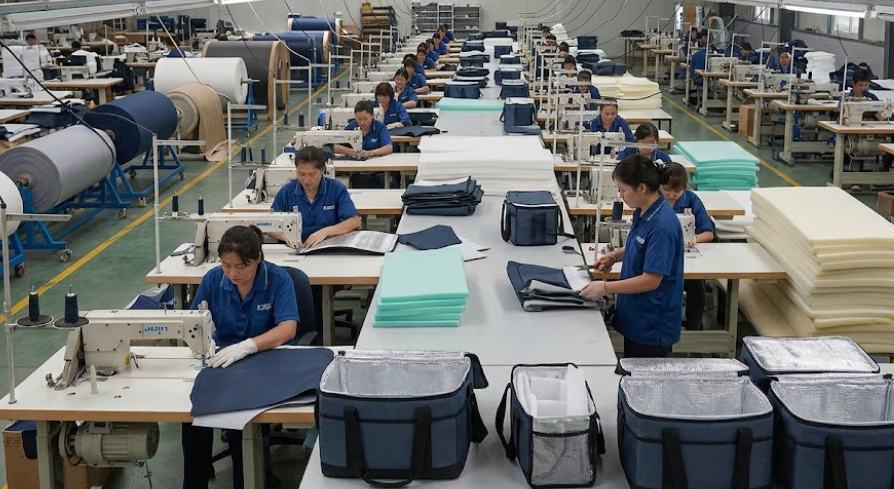
A legitimate cooler bag manufacturer operates its own production facility. That means owned or long-leased floor space, in-house cutting and sewing lines, and an on-site quality control department. When you visit or audit a factory, you’re looking for evidence of production depth: are the sewing machines industrial-grade? Is there a pattern room? Do they have dedicated areas for insulation lamination and lining insertion?
Factory scale matters because it directly affects your order flexibility. A small operation with three or four sewing lines will struggle to meet a 5,000-unit order at a consistent quality level. A mid-to-large factory with 20+ sewing lines can absorb your order without rushing, which protects quality.
Industry Experience and Market Focus
Not all bag factories are equal in category depth. A factory that primarily makes fashion handbags is not automatically equipped to produce cooler bags with proper insulation performance. Cooler bag production involves material handling specific to thermal liners, heat-sealing PEVA layers, and assembling foam padding without compression defects. You want a factory that has done this repeatedly, not one that’s learning on your order.
Ask how long they’ve been producing cooler bags specifically. Three years is a minimum baseline for process maturity. Fifteen or more years indicates a factory that has navigated material price fluctuations, dealt with international compliance requests, and refined their insulation assembly process through real-world feedback.
Export Markets and International Experience
A manufacturer that exports to the US, EU, and Australia has already been tested. Their buyers have submitted compliance requirements, conducted audits, and pushed back on quality issues. That pressure builds real capability. A factory that only sells domestically or to one regional market is working to a much lower specification bar.
Ask for a list of export markets. Ask which retailers or brands they currently supply. If they can share non-confidential references, follow up on them. The information you get from a reference call is worth more than any factory brochure.
Production Capacity as a Fit Indicator
Monthly production capacity tells you whether a factory is the right size for your order volume. A factory producing 200,000 units per month will deprioritize a 500-unit order unless you’re paying a premium or have a long-term relationship. Conversely, a factory built for small orders may not scale reliably when your volumes grow.
Identify your current and projected order size and choose a supplier whose capacity range makes you a meaningful customer — not their biggest, not their smallest.
How Can You Verify the Manufacturer’s Production Capabilities?
Manufacturers often overstate their capabilities in sales conversations. Verification requires going beyond what’s written in a capability sheet.
Production Lines and Configuration
The number of active sewing lines is a proxy for throughput. Ask for a factory floor layout and a rough count of active production lines. A 15-line operation producing standard cooler tote bags can typically output 8,000 to 12,000 units per week depending on bag complexity. If the numbers don’t align with what they’re quoting as monthly capacity, that’s a flag.
Equipment Configuration
Cooler bag manufacturing requires specific equipment beyond standard sewing machines. Look for:
- Industrial cutting machines (automatic cutter or at minimum semi-automatic die-cutting presses)
- Heat-sealing equipment for PEVA and aluminum foil lining bonding
- Ultrasonic welding capability (for sealed seam coolers)
- Roller lamination or manual lamination stations for foam layers
If a factory claims to produce sealed-seam soft coolers but doesn’t have ultrasonic welding equipment, the product won’t meet proper leak-resistance standards.
Sampling Capability and Turnaround
The sampling process reveals more about a manufacturer’s competence than almost anything else. A well-run factory has an in-house sample room with dedicated sample makers, a pattern library for existing designs, and the ability to produce a first sample within 7–14 days from approved spec sheet.
Watch out for factories that outsource sampling to third parties. It creates a communication gap and means the production team isn’t engaged in understanding your product requirements until after sampling is already done. That’s a quality risk.
Monthly Output and Lead Time Transparency
Ask the factory directly: “What is your current production schedule, and what lead time can you commit to for a first order of X units?” A factory that gives you a vague answer or quotes unrealistically short lead times without asking about design complexity is not being honest with you. Realistic lead times for a custom cooler bag order, including pre-production sampling, range from 30 to 60 days depending on complexity and material sourcing lead time.
What Materials and Insulation Options Does the Manufacturer Offer?
Material selection is where cooler bag quality actually starts. A well-designed bag with poor insulation materials is just a bag that looks like a cooler.
Outer Shell Fabrics
The most common outer materials in cooler bag manufacturing are:
| Materiale | Il migliore per | Considerations |
|---|---|---|
| 600D Polyester Oxford | Everyday cooler totes, promotional bags | Durable, cost-effective, wide color range |
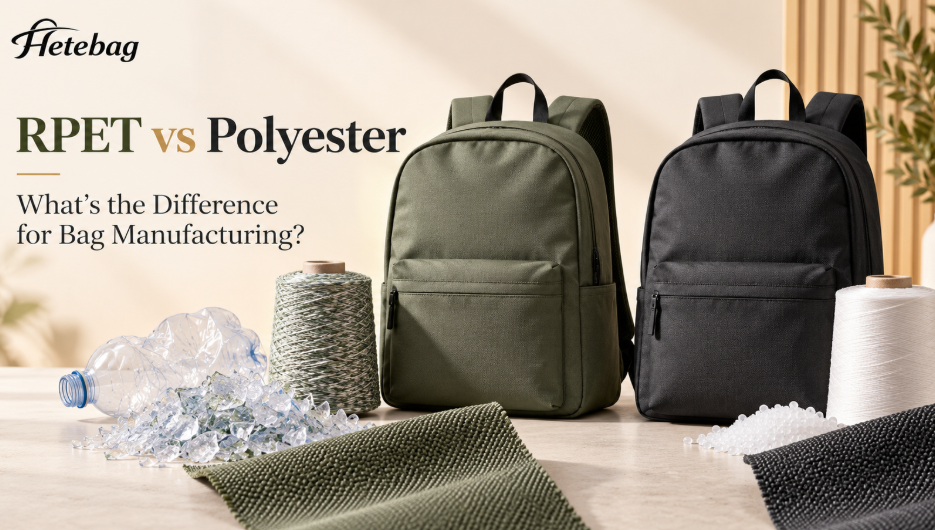
| Tessuto RPET | Eco-conscious brands, sustainability campaigns | Made from recycled bottles, supports GRS certification |
| Canvas (Cotton/Poly Blend) | Lifestyle brands, farmers market aesthetics | Heavier, premium feel, higher cost |
| Nonwoven Polypropylene | Low-cost promotional coolers | Limited durability, not suitable for premium segments |
| Neoprene | Can sleeves, small cooler pouches | Excellent grip, poor structural rigidity at large sizes |
If your brand is positioning around sustainability, ask specifically whether the factory sources RPET fabric certified under the Global Recycled Standard (GRS), which is audited by bodies like Intertek and SGS. GRS certification provides third-party verification that the recycled content claims are legitimate — not just marketing language.
Insulation Materials and Performance
This is the most technically critical choice. The thermal performance of your cooler bag is almost entirely determined by what’s inside.
- PEVA (Polyethylene Vinyl Acetate): The most widely used cooler lining. Food-safe, waterproof, easy to clean. Standard weight is 3–5mm foam bonded to PEVA film. Heavier foam bonding extends ice retention.
- EPE Foam (Expanded Polyethylene): More rigid than bonded PEVA. Used in structured cooler bags where shape retention matters alongside insulation. Commonly 5–10mm thick.
- Aluminum Foil Laminate: Used as a reflective inner layer. Reduces radiant heat transfer. Most effective when combined with foam backing. Look for full-seam coverage, not just a partial liner.
- Composite Insulation (Foam + Foil + PEVA): The highest-performing option for soft cooler bags. A three-layer composite liner — foam core, aluminum foil facing, and PEVA inner — provides both radiant and conductive thermal resistance.
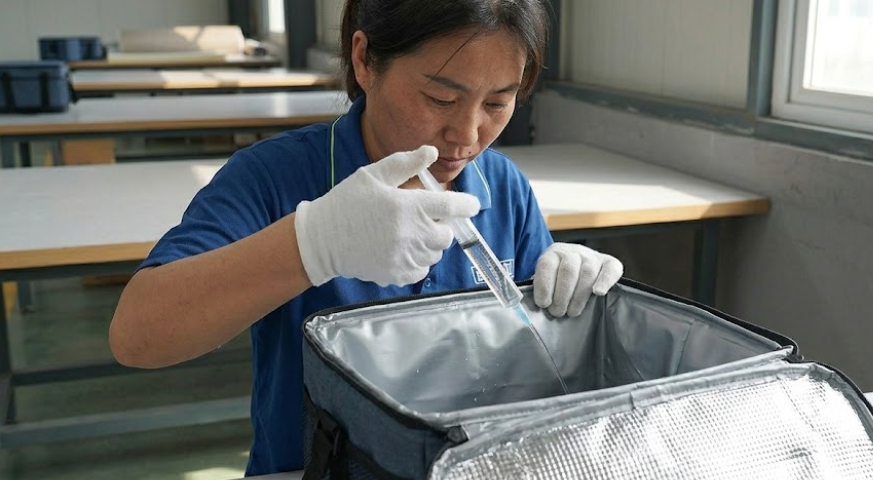
Ask the factory what ice retention time their standard insulation construction achieves and how they test it. A factory that has never run an ice retention test on their own product is producing coolers as fashion items, not functional tools.
Eco-Material Options
Environmental pressure from major retailers is real. Many US and EU buyers now require documentation on material sourcing. Beyond RPET, look at whether the factory can source OEKO-TEX STANDARD 100 certified fabrics, which confirm that materials have been tested for harmful substances. This matters especially for food-contact cooler bags where the interior liner may come into direct contact with food packaging.
If you’re also sourcing other custom bag types like borse per il pranzo personalizzate o borse da viaggio personalizzate, confirm that the factory uses consistent material standards across bag categories, not just their showcase cooler line.
How Do You Evaluate Product Quality and Quality Control Systems?
A manufacturer can have good equipment and good materials and still ship inconsistent product if their quality control process is weak. Quality is a system, not an inspection at the end.
IQC — Incoming Quality Control
Before production begins, a proper factory inspects all incoming materials: fabric rolls, zippers, hardware, liners, and foam inserts. IQC means checking that the material received matches the approved specification. This catches problems before they become production problems. Ask the factory how they handle material deviations — do they return them to the supplier, or do they absorb and work around?
IPQC — In-Process Quality Control
Mid-production inspection is where defects are caught before they multiply. In a well-run cooler bag factory, IPQC checkpoints are built into the line at key stages: after cutting, after lining insertion, after handle attachment, and before final assembly. Inline inspectors check for consistent stitch density, proper foam alignment, and correct color matching against the approved sample.
FQC — Final Quality Control
Before packaging, every finished cooler bag should pass a final inspection. For a basic FQC on cooler bags, this includes:
- Visual check for stitching defects, loose threads, and fabric irregularities
- Zipper operation test (all zippers opened and closed at minimum twice)
- Structural integrity check on handles and attachment points
- Dimensional measurement against the approved size spec
- Liner leak check for cooler bags with sealed interiors
Third-Party Inspection
For your first order with any new bag factory — and periodically on established relationships — budget for a third-party pre-shipment inspection. SGS and Intertek are the most widely recognized inspection bodies. A standard pre-shipment inspection costs $200–$400 USD and provides independent verification before you release the balance payment.
| Fase QC | What It Catches | Who Does It |
|---|---|---|
| IQC (Incoming) | Off-spec materials, wrong colors, substandard hardware | Factory QC team |
| IPQC (In-Process) | Assembly defects, lining misalignment, stitch skips | Inline QC inspectors |
| FQC (Final) | Finished product defects, size deviations, missing components | Factory QC + optional third-party |
| PSI (Pre-Shipment) | Carton packing, quantity verification, final product compliance | Third-party body (SGS, Intertek) |
Prove di prestazione dell'isolamento
For cooler bags sold under a brand promise — “keeps ice for 24 hours” or similar — the insulation claim needs to be backed by a documented test result, not manufacturer assertion. Ask for a test report conducted under controlled conditions: room temperature, starting ice weight, documented elapsed time. If the factory can’t provide this, the performance claim is unverifiable.
Durability testing matters too. Handle pull strength, zipper cycle count, and fabric abrasion resistance are the three most common durability failure modes in soft cooler bags.
What Customization Services Should a Reliable Manufacturer Provide?
The word “customization” covers a wide range. Understanding what a factory can actually do — versus what they say they can do — is critical before committing to an OEM or ODM order.
OEM vs. ODM: Understanding the Difference
OEM (Original Equipment Manufacturing) means you provide the design, spec, and branding, and the factory builds to your specification. ODM (Original Design Manufacturing) means the factory contributes to the design itself, either adapting an existing design or co-developing a new one with you.
A strong cooler bag manufacturer should be capable of both. If they only do OEM, their design capability is limited. If they only push ODM designs with minimal modification, they may lack the technical depth to build to complex external specs.
Logo Application Methods
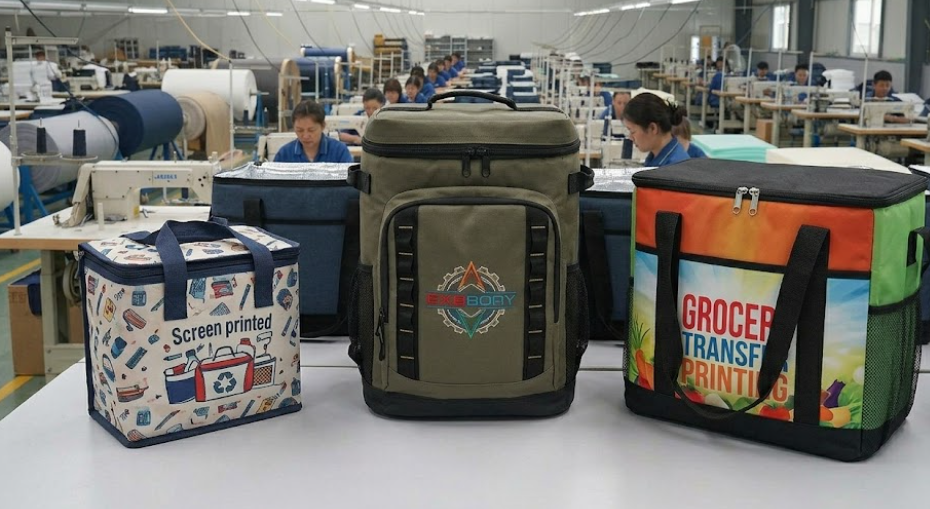
Not all logo techniques suit all cooler bag materials. Common methods include:
- Screen printing: Cost-effective for simple designs on flat panels. Limited color gradients.
- Heat transfer: Good for photographic or full-color logos. Suitable for polyester and RPET surfaces.
- Embroidery: Premium appearance, durable. Works well on structured canvas bags.
- Woven or sublimation patch: Detachable or sewn-in branding. Popular for outdoor and lifestyle brands.
Ask to see production samples with each technique before specifying your logo application. A factory’s sample room should have reference pieces showing technique quality.
Size and Structural Customization
Beyond logos, you should be able to specify the exact dimensions, pocket configuration, handle length, zipper placement, and closure type. A factory with real pattern-making capability can work from a flat sketch or a reference photo and produce an accurate first sample. If the factory requires you to supply a ready-made tech pack before they can begin, their design capability is limited.
Personalizzazione dell'imballaggio
Retail buyers often forget to ask about packaging until the order is already in production. Can the factory supply custom-printed poly bags? Branded hang tags? Inner carton dividers? Retail shelf-ready packaging? These seem like small details, but they affect landed cost and retail presentation significantly.
For brands also sourcing borse personalizzate o zaini personalizzati alongside cooler bags, ask whether the factory can handle all SKUs under one roof. Consolidating production simplifies logistics, reduces sampling lead times, and strengthens your negotiating position.
New Product Development Support
A mature bag factory has engineers and product developers who can look at a concept and give you a realistic assessment of production feasibility and cost implications. That kind of honest technical feedback — “this pocket design will require a second subassembly step, which adds $0.35 per unit” — is a sign of a factory that understands its own costs and is investing in the partnership.
What Certifications and Compliance Standards Matter for International Buyers?
Compliance is not optional for markets like the US, EU, UK, and Australia. The cost of a product recall or customs hold far exceeds any savings from skipping verification.
Factory Social Compliance
BSCI (Business Social Compliance Initiative) e SEDEX are the two most widely recognized social compliance frameworks in the bag manufacturing industry. BSCI audits cover labor conditions, working hours, wage practices, health and safety, and environmental practices. A valid BSCI audit report (typically issued within the last 12 months) provides confidence that the factory meets the baseline social standards required by major European and US retailers.
ISO 9001 certification documents the factory’s quality management system. It doesn’t guarantee product quality directly, but it does indicate that the factory has structured processes for managing quality at an organizational level.
Product Material Compliance
For cooler bags entering the US market, particularly those with food-contact liners, compliance becomes more specific:
- REACH (EU): Restricts the use of certain hazardous substances in materials sold in the EU. Relevant for dyes, hardware coatings, and adhesives.
- CPSIA (US): Consumer Product Safety Improvement Act. If your cooler bags are marketed to or accessible by children under 12, lead and phthalate testing is required.
- FDA (Food Contact): PEVA and other interior liner materials that may contact food packaging should meet FDA 21 CFR standards for food-contact materials. This is particularly relevant for lunch coolers and food delivery applications.
A responsible cooler bag manufacturer should be able to provide material test reports from accredited labs. These don’t need to be paid for separately by every buyer — most established factories maintain current reports as part of their standard documentation.
| Certificazione | Scope | Applies To |
|---|---|---|
| BSCI / SEDEX | Factory social compliance | All export markets |
| ISO 9001 | Sistema di gestione della qualità | All markets |
| REACH | Hazardous substance restriction | EU market |
| CPSIA | Lead, phthalates testing | US, children’s products |
| FDA 21 CFR | Food-contact material safety | US, food-contact applications |
| OEKO-TEX 100 | Fabric harmful substance testing | Premium / eco-positioning |
Ask for copies of these documents — not just verbal confirmation. A factory with nothing to show for compliance is a factory that doesn’t have it.
How Can You Build a Long-Term Partnership with the Right Cooler Bag Manufacturer?
Getting the first order right is table stakes. The real value in a manufacturer relationship is what happens over the second, third, and fifth order — where pricing improves, lead times shorten, and the factory starts investing in your product line.
MOQ and Pricing Balance
Minimum order quantity is a negotiation point, not a fixed wall. Most cooler bag factories set MOQs between 300 and 1,000 units per style. Higher MOQs reflect the factory’s preference for efficient production runs. Lower MOQs may indicate more flexibility — or a factory that’s not at full capacity.
The right approach is to present your realistic volume projection over 12 months, not just the immediate order. A factory that sees 5,000 units per year in your pipeline will negotiate more aggressively on MOQ and unit pricing than a factory evaluating a one-time 500-unit order.
Efficienza della comunicazione
The practical test of a manufacturer’s communication quality is how they handle ambiguity. Send a specification with one intentional gap — an unspecified hardware finish, an unclear measurement reference — and see how they respond. Do they flag it and ask for clarification? Or do they proceed with an assumption and deliver a sample that misses the intent?
Factories that communicate proactively, flag problems early, and confirm spec details before production begins save buyers significant time and money. Factories that proceed on assumptions, and then defend their interpretation when corrections are requested, create friction that compounds over time.
Delivery Stability
On-time delivery from a bag factory depends on three things: their production capacity buffer, their supply chain reliability for materials, and their internal production planning competence. Ask directly about their on-time delivery rate over the past 12 months. Ask what happened on the orders that were delayed. A factory that can explain its failure modes and what it did to address them is more trustworthy than a factory that claims 100% on-time delivery without qualification.
Buffer some lead time for yourself. Building four weeks of slack between the factory’s delivery commitment and your customer’s need date protects you from customs delays, inspection time, and minor production delays without causing a downstream problem.
Assistenza post-vendita
A reliable manufacturer doesn’t disappear after shipment. If defects are found after delivery, the factory should have a documented process for handling replacement or credit. Ask upfront: what is their policy on post-shipment quality claims? What evidence do they require? What is the resolution timeline?
Factories that handle post-shipment issues fairly — replacing or crediting verified defective units without excessive back-and-forth — are factories worth keeping. The ones that dispute every claim or make it difficult to document defects will cost you more in time than the defects themselves are worth.
Long-Term Partnership Strategy
The best supplier relationships are built on mutual investment. Share your product roadmap with the factory, even at a high level. If they know you’re planning to add four new SKUs over the next two years, they can factor that into their capacity planning and give you priority during peak seasons.
Consider visiting the factory in person at least once, especially if you’re placing ongoing orders above $50,000 per year. The relationships formed during an in-person factory visit — with the production manager, the QC team, the sample room lead — translate directly into better service. You become a name and a face, not just an email address.
If you’re evaluating multiple product categories, working with one factory across different bag types creates leverage. Understanding how factories approach different categories, from cooler bags to borse da palestra personalizzate, gives you a clearer picture of their actual capability breadth versus their sales claims.
Conclusione
Choosing the right cooler bag manufacturer is a decision that pays dividends over years, not just on the first shipment. The factories worth working with are the ones that are transparent about their capabilities, consistent in their quality processes, and invested in your product outcomes — not just in closing the initial order.
The framework here — vetting scale and experience, verifying production capability, evaluating materials and insulation systems, checking compliance documentation, and testing communication before committing — is the same process that separates a strong, stable supplier relationship from a frustrating sourcing experience.
If you’re currently looking for a manufacturer who can handle this level of specification and scrutiny, Hetebag is a professional bag manufacturer based in Huadu, Guangzhou, China, with over 15 years of production experience. Operating our own factory and working with a network of specialized partner facilities, we produce cooler bags, custom handbags, backpacks, and a wide range of bag categories for brands and wholesalers in North America, Europe, and beyond.
We offer full OEM and ODM services, support sustainability certifications including RPET and OEKO-TEX compliant materials, and maintain documented quality control processes across IQC, IPQC, and FQC stages.
If you’re looking for a bag manufacturer you can build a real partnership with, visit our website and leave your contact information — we’re genuinely interested in understanding your requirements. We look forward to working with you.
Domande frequenti
Come faccio a sapere se un produttore di borse termiche è affidabile?
Un produttore affidabile di borse termiche dovrebbe avere una propria struttura produttiva, linee di cucitura esperte, fornitori di materiali stabili e un chiaro processo di controllo qualità. Dovresti anche verificare se la fabbrica può fornire campioni, foto di produzione, rapporti di ispezione e certificazioni pertinenti prima di effettuare un ordine.
Qual è il MOQ abituale per borse termiche personalizzate?
Il MOQ per borse termiche personalizzate di solito dipende dal design, dal materiale, dal metodo del logo e dalla complessità dell'ordine. Molti produttori fissano MOQ tra 300 e 1.000 pezzi per stile. Se prevedi di effettuare ordini ripetuti, alcune fabbriche possono offrire opzioni MOQ più flessibili per il primo ordine di prova.
Quali materiali sono comunemente usati per le borse termiche?
I materiali esterni comuni includono poliestere 600D, tessuto Oxford, tela, tessuto RPET, tessuto non tessuto e neoprene. Per la fodera interna vengono spesso utilizzati PEVA, foglio di alluminio, schiuma EPE e strati isolanti compositi. La scelta del materiale giusto dipende dal mercato di riferimento, dal budget, dalle esigenze di durabilità e dai requisiti di prestazione isolante.
Quanto tempo ci vuole per produrre borse termiche personalizzate?
Per un ordine di borse termiche personalizzate, l'intero processo richiede solitamente dai 30 ai 60 giorni, inclusi campionatura, approvvigionamento dei materiali, produzione, controllo qualità e imballaggio. Disegni più complessi, materiali speciali o ordini di grandi volumi potrebbero richiedere tempi di consegna più lunghi.
Quali controlli di qualità dovrebbe fornire una fabbrica di borse termiche?
Una fabbrica professionale di borse termiche dovrebbe avere processi di IQC, IPQC e FQC. Ciò significa che controllano i materiali in entrata, ispezionano i prodotti durante la produzione ed eseguono un'ispezione finale prima della spedizione. Per le borse termiche, i controlli importanti includono la qualità delle cuciture, la funzionalità della cerniera, la resistenza delle maniglie, la precisione delle dimensioni, la tenuta del rivestimento e le prestazioni isolanti.