
 English
  Italian
  French
  German
  Spanish
  Arabic
 Finding a Canvas Tote Bag Manufacturer in China is easy. Finding one that can reproduce the same fabric, color, stitching, logo, and workmanship across thousands of bags is a different task.
A canvas tote looks simple when you see the finished product. From the factory side, there are many details hidden behind that simple shape: fabric weight, yarn density, shrinkage, cutting tolerance, handle reinforcement, seam construction, printing method, color matching, washing treatment, labels, packaging, and final inspection.
This is where many sourcing projects go wrong. A buyer sends a photo and asks several suppliers to quote it. Each factory makes different assumptions, so the quotations and samples are based on different specifications. You are no longer comparing the same product.
A better approach is to define the product first, qualify the manufacturer second, test the sample third, and discuss mass production only when those steps are clear.
If you are sourcing from China, this guide will show you how to evaluate a Canvas Tote Bag Manufacturer from a buyer’s point of view and what you should check before building a long-term supply relationship.
1. Define Your Canvas Tote Bag Requirements Before Contacting Manufacturers
The quality of your supplier search starts with the information you send out.
When we review a new tote bag inquiry, the first thing we look at is not the logo. We look at whether the buyer has defined the material, dimensions, construction, intended use, branding, and quantity clearly enough for production.
You do not need a complete technical drawing at the beginning. You do need enough detail to prevent every supplier from interpreting your idea differently.
Choose the Right Canvas Fabric and Weight
Canvas should never be selected by color alone.
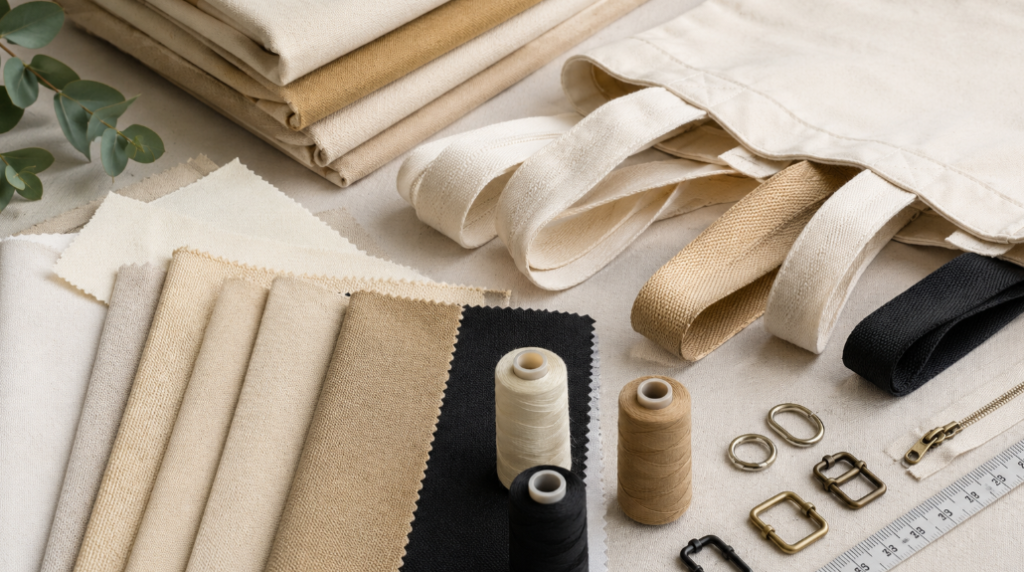
Cotton canvas, cotton-polyester canvas, recycled canvas, washed canvas, and heavy duck canvas can look similar in a photograph but behave very differently during sewing, printing, washing, and daily use.
Fabric weight is commonly described in ounces or GSM. A lighter canvas can work well for promotional shopping bags. A heavier fabric usually gives the bag more body and can support products with a higher load.
Weight alone does not tell the whole story.
Two fabrics with similar GSM can have different weave density, surface texture, stiffness, shrinkage, and yarn quality. These differences affect how the bag feels and how cleanly a logo can be printed.
For a deeper material comparison, you can review our guide to custom bag materials before confirming your specification.
| Product Requirement | What to Confirm |
|---|---|
| Fabric | Cotton canvas, blended canvas, recycled canvas or other |
| Weight | Oz or GSM |
| Surface | Natural, washed, dyed, coated or untreated |
| Hand feel | Soft, firm or structured |
| Color | Stock shade or custom-dyed color |
| Performance | Shrinkage, colorfastness and expected load |
Ask the manufacturer to provide an actual fabric swatch when material feel or color is important. A screen photograph is not enough for final material approval.
Confirm Bag Size, Structure, Handles, and Accessories
Write finished dimensions rather than giving a general description such as “medium tote.”
Length, height, bottom depth, side gusset, opening width, and handle drop should be stated clearly.
Then look at the construction.
Does the bag need a flat bottom or gusset? Should the opening have a zipper, snap button, or remain open? Are the handles made from self-fabric or cotton webbing? Do you need an inner pocket, lining, key hook, metal hardware, woven label, hangtag, or reinforcement panel?
This is where a small structural decision can change manufacturing difficulty.
A large tote carrying books needs a different handle attachment from a lightweight giveaway bag. Box-X stitching, cross stitching, reinforced seams, or extra fabric layers may be needed around stress points.
A capable manufacturer should ask what the bag will carry. If nobody asks, you should bring it up.
Decide on Printing, Embroidery, and Custom Branding
Do not choose a logo process only because you like its appearance.
The technique needs to work with the canvas surface, artwork, order quantity, color requirements, and expected use.
Screen printing is widely used for simple logos and larger production runs. Embroidery adds texture and works well for compact branding, but dense embroidery can pull or distort lighter fabric. Heat transfer can reproduce detailed graphics. Digital printing may work better when the artwork uses many colors or gradients.
Logo size matters too.
A print that looks balanced on a digital mockup can appear too high, too low, or too close to the seam after sewing. Confirm the distance from the logo to the bag edges and seams during sampling.
If branding is an important part of your product, our guide on how to customize a tote bag explains the main customization methods in more detail.
Estimate Your Order Quantity and Future Reorder Needs
Give the supplier a realistic target quantity.
This helps the factory decide how fabric should be sourced, how printing should be arranged, whether custom-dyed material is practical, and how production should be scheduled.
Also tell the manufacturer if you expect reorders.
Repeat production brings a different question: can the supplier reproduce the approved fabric color, logo color, dimensions, accessories, and packaging six months later?
For products you plan to sell for several seasons, ask whether the factory records fabric specifications, Pantone references, artwork files, accessory codes, approved samples, and production notes.
That production record can become far more valuable than choosing a supplier based only on the first order.
2. Where to Find Reliable Canvas Tote Bag Manufacturers in China
There is no single sourcing channel that automatically gives you the best factory.
Google, B2B platforms, trade shows, sourcing companies, and referrals can all work. Your job is to use those channels to build a shortlist and then verify what each supplier can actually do.
Search Through Google and Manufacturer Websites
Google is useful when you want to research a supplier beyond a product listing.
Search terms such as “custom canvas tote bag manufacturer China,” “canvas tote bag factory,” or “OEM canvas bag manufacturer” can lead you to manufacturers with their own websites.
Once you enter the website, look deeper than the homepage.
Check whether the company discusses materials, customization, production processes, quality control, sampling, product categories, and OEM or ODM work in enough detail.
For example, a supplier specializing in custom tote bag manufacturing should be able to explain canvas construction and branding options rather than showing hundreds of unrelated products.
A polished website proves very little by itself. Use it as the start of your investigation.
Use Alibaba and Other B2B Sourcing Platforms
Alibaba and similar platforms can help you build a large supplier list quickly.
The problem is that large lists create noise.
Do not send the same one-line inquiry to twenty factories and choose whoever replies with the lowest number.
Shortlist suppliers whose product range matches your project. Read company information. Look at how long they have focused on bags, the types of customization shown, their main export markets, and whether their factory information is consistent across pages.
Then contact a smaller group with the same specification sheet.
The same request should go to each supplier. That makes their answers much easier to compare.
Visit Trade Shows or Work With Local Sourcing Partners
Trade shows can be useful for projects where fabric feel and workmanship matter.
You can touch canvas samples, inspect seams, compare printing quality, check hardware, and discuss modifications face to face.
A sourcing partner can also help when your project involves several factories, frequent inspections, custom material development, or complex consolidation.
The value of a sourcing company comes from verification and coordination. Ask what they actually inspect, how they select factories, how they manage quality problems, and whether you will know which factory produces your order.
Manufacturer vs. Trading Company: Which Is Better?
A factory is not automatically the better choice for every project.
Direct manufacturers can give you closer access to production, technical staff, sampling, QC, and factory scheduling. They are often suitable when you have an established design and repeat volume.
A capable trading company may work well when you need several different product categories or smaller factories with different strengths.
The question should be: who has the best control over my product?
Ask who purchases the fabric, who makes the sample, where sewing happens, who performs inspection, and who is responsible when production does not match the approved sample.
Those answers matter more than the label “factory” or “trading company.”
3. How to Evaluate a Canvas Tote Bag Manufacturer
Once you have a shortlist, stop looking at marketing claims and start checking manufacturing capability.
Check Their Experience With Canvas Bags
A company that makes bags does not automatically have strong canvas experience.
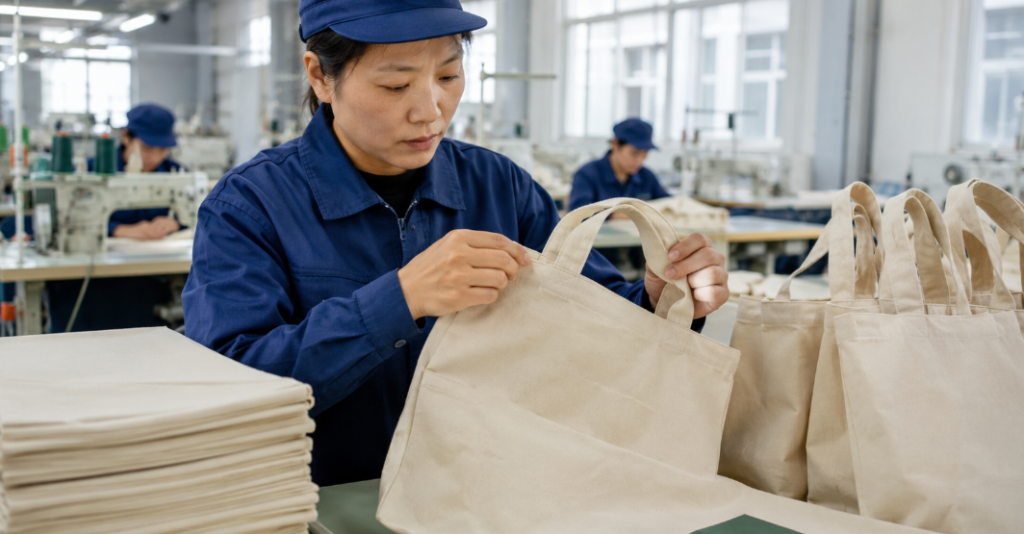
Canvas behaves differently from nylon, PU leather, polyester, and laminated fabrics. Heavy canvas needs suitable sewing equipment and needle selection. Natural cotton may shrink. Thick seam intersections can become bulky. Some untreated fabrics absorb printing ink differently.
Ask to see canvas products similar to your target construction.
Pay attention to corners, handle attachments, top hems, gussets, zipper areas, pocket edges, and seams where several fabric layers meet.
This tells you much more than a catalog image taken from several meters away.
Review Factory Capabilities and Production Equipment
You do not need to become a sewing technician, but you should understand which parts of production the supplier controls.
Ask where cutting, printing, embroidery, sewing, finishing, inspection, and packing take place.
Some processes may be outsourced. That can be normal. What matters is whether the main manufacturer has a reliable system for approving and checking outsourced work.
| Area | What a Buyer Should Verify |
|---|---|
| Material | Incoming fabric inspection and lot control |
| Cutting | Pattern accuracy and cutting consistency |
| Sewing | Equipment suitable for fabric thickness |
| Branding | Print or embroidery sample approval |
| Finishing | Thread trimming, shaping and cleaning |
| QC | Inspection standard and defect handling |
| Packing | Folding, labeling, carton and barcode control |
When possible, ask for recent factory photos, production videos, an online factory tour, or a third-party audit.
Ask About Certifications and Quality Management
Certifications should answer a real procurement requirement.
For textile safety, OEKO-TEX STANDARD 100 covers textiles tested for harmful substances, with testing that can apply from yarn and components through the finished article. OEKO-TEX STANDARD 100
If your product includes certified recycled material, ask what documentation supports that claim. Textile Exchange explains that the Global Recycled Standard (GRS) covers recycled material verification and chain-of-custody requirements through the supply chain. Global Recycled Standard information from Textile Exchange
For factory quality systems, ISO 9001 is a recognized quality-management standard covering processes used to consistently meet customer and applicable requirements. ISO 9001 quality management systems
Do not stop after receiving a certificate PDF.
Check the company name, factory address, certificate scope, issuing body, validity date, and whether the certificate actually relates to your product or material.
Look at Previous Custom Projects and Export Experience
Ask for examples that are technically similar to your project.
If you need a 16 oz zippered canvas tote with lining and embroidery, examples of thin non-woven promotional bags tell you very little.
Export experience also matters because manufacturing and export preparation are different jobs.
The supplier should understand carton markings, barcode placement, individual packing, shipping marks, carton strength, document requirements, and destination-specific instructions.
Experience does not remove risk. It usually reduces avoidable mistakes.
4. What Questions Should You Ask Before Choosing a Supplier?
Your supplier’s answers can reveal how well they understand production before you place an order.
What Is Your MOQ?
Ask what determines the MOQ.
The answer may depend on custom fabric colors, printing setup, hardware, labels, packaging, or whether the factory can use stock material.
A useful supplier explains which component creates the quantity limitation instead of giving you one number without context.
Can You Produce Custom Samples?
For an OEM project, the answer should usually be yes.
Ask what the sample will confirm. Ideally, it should represent the planned material, size, construction, logo method, accessories, and workmanship as closely as practical.
Also ask how changes are recorded after the first sample.
When you approve a revised detail in a chat message but it never reaches the production specification, the bulk order may return to the old version.
What Customization Options Do You Offer?
Do not ask only, “Can you add my logo?”
Ask about fabric, GSM, custom dyeing, dimensions, handle construction, pockets, lining, closures, labels, embroidery, printing, hardware, packaging, hangtags, and barcode requirements.
A manufacturer that understands customization should also tell you when an idea may create a production problem.
That is a good sign. You want technical feedback, not automatic agreement.
What Are Your Production and Delivery Lead Times?
Ask the supplier to separate sample development, material preparation, mass production, inspection, and shipping preparation.
Production time can change when the order includes custom-dyed canvas, unique hardware, complex embroidery, special labels, or several colorways.
Ask what event starts the lead time as well. Is it deposit confirmation, material approval, sample approval, artwork approval, or receipt of all accessories?
A clear starting point prevents arguments later.
How Do You Handle Quality Problems?
Ask this question before there is a problem.
What happens when fabric color is outside tolerance? Who decides whether stitching is acceptable? How are defective pieces separated? Is rework performed before packing? What inspection happens before shipment?
You can also ask whether the supplier has an AQL-based inspection process or can work with an inspection standard provided by your company.
A supplier’s willingness to discuss defects is often more useful than a claim that defects “never happen.”
For more pre-order checks, you can also review 10 things to know before working with a tote bag manufacturer.
5. Always Test Samples Before Placing a Bulk Order
A sample is where specifications become physical.
Do not approve it after looking at the front photo.
Put it on a table. Open it. Pull the handles. Check the inside. Measure it. Look at the seams. Compare the logo against your artwork.
Check Canvas Thickness and Material Quality
Confirm the fabric against the agreed specification.
Feel the surface and check weave consistency. Look for slubs, stains, uneven dyeing, loose yarns, or obvious shade differences.
For cotton canvas, ask about expected shrinkage if the bag may be washed.
If color matters to your brand, approve a physical swatch or defined color reference rather than relying only on a phone screen.
Inspect Stitching, Handles, and Load-Bearing Strength
Handles are one of the first areas I check on a tote sample.
Look at stitch density, reinforcement, symmetry, thread tension, and the distance between handle attachment points.
Then test the bag with a realistic load.
Do not only ask whether the factory has performed a load test. Tell them what the finished bag is expected to carry and how the customer will use it.
A grocery tote, book bag, fashion tote, and promotional giveaway do not need the same construction.
Evaluate Printing and Logo Quality
Check registration, edges, color, placement, opacity, and surface adhesion.
Run your hand over the print. Bend the fabric. Look at areas where the print crosses a natural fabric texture.
Embroidery should also be checked from the inside. Excessive thread tension, poor backing, puckering, or uneven density can change the appearance of the panel.
The goal is not to make a sample look perfect only for photography. It should represent a process that can be repeated during mass production.
Compare Samples From Multiple Manufacturers
If the order is important, compare two or three qualified samples side by side.
Use the same specification.
Look at material, dimensions, stitching, handle alignment, printing, structure, finishing, communication, and the accuracy of each supplier’s interpretation.
The best sample is not always the one that feels the heaviest. Choose the supplier that came closest to what you actually requested.

6. Compare Quotations Beyond the Unit Price
A quotation only has meaning when every supplier is quoting the same product.
If one factory uses 8 oz canvas and another uses 12 oz canvas, you are comparing two different bags.
Understand What Is Included in the Quotation
Ask each supplier to state the material, fabric weight, size, construction, handle type, logo process, accessories, packaging, quantity basis, and trade term.
Keep that document.
It becomes part of your production reference later.
Check Packaging, Printing, and Additional Customization Costs
Find out whether printing screens, embroidery setup, woven labels, hangtags, individual bags, custom cartons, barcode labels, inserts, or special packing instructions are included.
You do not need to focus only on the additional amount.
The bigger issue is discovering unconfirmed items before production begins.
Consider Shipping and Incoterms
Make sure every quotation uses the same trade term when you compare suppliers.
EXW, FOB, CIF, DDP, and other Incoterms divide transport responsibilities differently. A quotation can look attractive simply because fewer logistics responsibilities are included.
Ask where responsibility transfers and which part of shipping you or your freight partner will manage.
Balance Price, Quality, MOQ, and Lead Time
A useful quotation comparison might look like this:
| Factor | What to Compare |
|---|---|
| Specification | Is the product genuinely identical? |
| Material | Fiber, weight, weave and finish |
| Sample | Accuracy against your requirements |
| MOQ | Does it fit your inventory plan? |
| Lead Time | Can the factory support your schedule? |
| QC | Is there a defined inspection process? |
| Communication | Are technical questions answered clearly? |
| Reorders | Can specifications be reproduced? |
The core decision is simple: choose the best manufacturing fit for the product you want to sell.
7. Choose a Manufacturer for Long-Term Cooperation
The first order tells you whether a supplier can make a sample and complete production once.
Repeat orders tell you whether they can become part of your supply chain.
Start With a Trial Order
When possible, use the first production run to verify the factory’s process before expanding the relationship.
Watch how the supplier manages approvals, production updates, inspection findings, packaging instructions, and shipping preparation.
A successful first order should create a clearer process for the second order.
Evaluate Communication and Problem-Solving Ability
Fast replies are useful. Accurate replies are more useful.
A strong supplier should identify missing information, explain manufacturing limitations, confirm changes in writing, and tell you early when something could affect production.
Pay attention to what happens when you request a revision.
Does the team understand the reason? Does the change reach the sample room and production team? Is the final specification updated?
That tells you whether communication is connected to the factory floor.
Confirm Quality Control Before Every Shipment
Do not assume repeat orders no longer need inspection.
Fabric can come from a new production lot. Printing conditions change. Operators change. Accessories may come from another batch.
Keep an approved sample or signed specification as the reference for every production run.
Your inspection standard should cover the points that matter to your brand: measurements, fabric, color, stitching, logo, functionality, cleanliness, labels, packaging, and carton requirements.
Look for a Supplier That Can Grow With Your Business
A suitable Canvas Tote Bag Manufacturer should be able to support more than one successful order.
Ask whether the factory can handle additional colorways, more complex construction, different packaging, increasing volume, new materials, and tighter quality requirements as your business develops.
You also want a manufacturer that keeps records.
Material references, Pantone colors, artwork, patterns, approved samples, accessory specifications, packaging instructions, and inspection standards make repeat production more predictable.
That is the real value of a long-term manufacturing relationship.
8. Conclusion
Finding the right Canvas Tote Bag Manufacturer in China takes more work than collecting quotations from a supplier directory.
Start with the product.
Define your canvas, weight, dimensions, structure, handles, logo, accessories, packaging, quantity, and expected use. Build a small supplier shortlist. Verify real manufacturing capability. Ask technical questions. Test physical samples. Compare quotations using the same specification. Then look carefully at how each supplier manages quality and communication.
The supplier you choose will influence more than how your first batch looks. They will affect how easily you can reorder, improve the design, control defects, introduce new colors, scale production, and maintain a consistent product.
Hetebag is based in Huadu, Guangzhou, China, with its own factory and OEM/ODM bag manufacturing capabilities. The company was established in 2011 and produces tote bags along with other custom bag categories for brands, wholesalers, distributors, and sourcing teams.
If you are currently looking for a Canvas Tote Bag Manufacturer or developing another custom bag project, you can leave your requirements and contact details through our website. Our team will be happy to review your project, discuss the manufacturing details with you, and explore how we can work together.
Frequently Asked Questions
What should I look for in a Canvas Tote Bag Manufacturer?
Look at the manufacturer’s experience with canvas bags, material options, sewing quality, customization capabilities, sampling process, quality control, production capacity, and export experience. A reliable supplier should also be able to explain technical details clearly instead of only giving you a quotation.
What is the typical MOQ for custom canvas tote bags?
MOQ depends on the fabric, bag structure, printing method, accessories, packaging, and level of customization. Standard canvas materials usually allow more flexibility, while custom-dyed fabrics or special hardware may require higher quantities. It is best to confirm the MOQ based on your exact design.
Can I order a sample before mass production?
Yes. A custom sample is highly recommended before placing a bulk order. It allows you to check the canvas thickness, size, stitching, handles, logo placement, printing quality, accessories, and overall workmanship before approving production.
What canvas weight is best for tote bags?
There is no single best weight for every tote bag. Lightweight canvas works well for promotional and everyday shopping bags, while heavier canvas is better for structured bags or products designed to carry more weight. You should also consider weave density, softness, shrinkage, and printing compatibility.
How can I control quality when ordering canvas tote bags from China?
Start with a clear product specification and an approved sample. Before shipment, check material, measurements, stitching, handle strength, logo quality, accessories, cleanliness, packaging, and carton requirements. For larger orders, you can also arrange third-party inspection before shipment.


