
 German
  English
  Italian
  French
  Spanish
  Arabic
 Choosing between 600D and 1680D polyester may look like a simple matter of picking the larger number. In practice, the right choice depends on how the bag will be used, how much weight it must carry, where abrasion occurs, and how the fabric is woven and finished.
600D polyester is lighter, easier to sew, and suitable for many everyday bags. 1680D polyester is heavier and often offers better resistance in demanding applications. Yet a poorly woven or lightly coated 1680D fabric may perform worse than a well-made 600D fabric.
My name is Evan, and I have worked in the bag manufacturing industry for more than 15 years. When reviewing materials for a custom bag, I do not judge fabric by denier alone. I check the finished fabric weight, weave density, coating, surface condition, test results, and how the material works with the bag structure.
This guide explains the practical differences between 600D vs 1680D polyester and shows how to choose a suitable specification for a custom bag project.
1. What Do 600D and 1680D Mean in Polyester Fabric?
The “D” stands for denier. It is a measurement of yarn linear density. One denier means that 9,000 meters of yarn weighs one gram.
A 600D yarn has a nominal mass of 600 grams per 9,000 meters. A 1680D yarn is much thicker, with a nominal mass of 1,680 grams over the same length. This difference usually makes 1680D fabric feel heavier, thicker, and firmer.
Denier describes the yarn, not the complete fabric. It does not tell you the fabric’s exact weight, tensile strength, abrasion resistance, waterproof performance, or service life.
Two suppliers may both offer “600D polyester,” but their fabrics can be quite different. One may use tightly woven yarn with an even PU coating. The other may have a loose weave, thin coating, and inconsistent yarn tension. Their performance will not be equal.
When checking a quotation or fabric sample, ask for these details:
- Yarn specification in both warp and weft directions
- Weave construction and thread density
- Finished fabric weight in grams per square meter, or GSM
- Coating type and coating weight
- Usable fabric width and thickness
- Whether the stated denier uses single-ply or multi-ply yarn
A useful factory check is to weigh several pieces cut to a known area. If a 10 cm × 10 cm piece weighs 3.8 grams, the estimated finished weight is 380 GSM. Test at least five pieces taken from different positions and compare the average with the approved specification.
2. 600D vs 1680D Polyester: Key Differences at a Glance
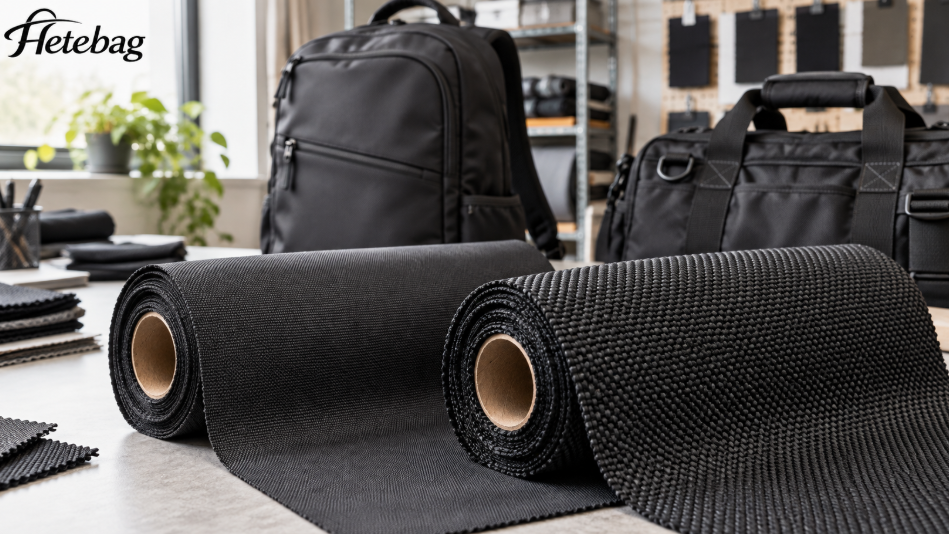
The following comparison gives a quick starting point. Actual results depend on yarn quality, weave, coating, and bag construction.
| Comparison | 600D-Polyester | 1680D Polyester |
|---|---|---|
| Fabric weight | Feuerzeug | Heavier |
| Flexibilität | Softer and easier to fold | Firmer and more structured |
| Abriebfestigkeit | Suitable for normal daily use | Usually better for high-wear areas |
| Bag appearance | Lightweight and versatile | Rugged and substantial |
| Sewing difficulty | Easier to cut, fold, and sew | Needs stronger machines, needles, and seam control |
| Printing suitability | Often easier for full-print projects | Surface texture may limit fine print detail |
| Typische Anwendungen | Backpacks, school bags, promotional bags, gym bags | Tool bags, luggage, laptop bags, equipment cases |
| Best design use | Main body and low-to-medium wear areas | Bottom panels, corners, side panels, and load-bearing areas |
For a normal school bag or promotional backpack, 600D may provide all the performance the buyer needs. For a tool bag that is placed on concrete floors every day, 1680D is usually the stronger starting point.
Do not approve either fabric from this table alone. Place both samples side by side, record their GSM, coating type, abrasion result, color, and hand feel, and then compare them under the same test conditions.
3. How Fabric Denier Affects Bag Performance
Durability, Tear Strength and Abrasion Resistance
Higher-denier yarns are generally thicker and can resist surface wear better, but denier does not guarantee a stronger fabric. Yarn quality, weave density, coating adhesion, and finishing can change the result.
Abrasion and tear strength also describe different failure modes. Abrasion testing measures how the surface reacts to repeated rubbing. Tear testing measures how easily an existing cut or puncture can spread. A thick fabric can have good abrasion resistance but still tear near a needle hole if its weave is loose.
For comparable results, send both materials to the same laboratory and use the same method. ISO 12947-2, for example, describes a Martindale method for determining fabric breakdown under repeated abrasion.
Set the acceptance level before testing. A buyer might require the production fabric to meet or exceed the approved sample result rather than accepting a vague claim such as “heavy-duty.” Test the face fabric and inspect coating damage as well as broken yarns.
At the bag level, load the finished sample to its intended working weight. Hang it for 24 hours, then complete repeated lift, carry, and drop cycles. Check the bottom corners, handle anchors, zipper ends, and seams for yarn movement or elongation.
Weight, Flexibility and Bag Structure
600D is often preferred when a bag needs to stay light, fold for shipping, or conform to the user’s body. It is commonly suitable for daypacks, school bags, promotional bags, and soft travel products.
1680D creates a firmer shell and stronger visual impression. This can work well for tool bags, laptop bags, tactical-style products, and protective cases. The extra weight can become a disadvantage if the entire bag uses the same heavy fabric.
To measure the effect, produce two sample BOMs—bills of materials—with the same lining, foam, webbing, and hardware. Change only the shell fabric. Weigh both finished samples and compare the difference against the target packed weight.
This matters for e-commerce and air shipment. Shipping is often charged by actual weight or volumetric weight, whichever is higher. A standard volumetric formula is:
Volumetric weight = length × width × height ÷ carrier divisor
Use the carton dimensions and divisor confirmed by your carrier. A stiffer 1680D bag may also occupy more carton space because it cannot be compressed as easily.
Wasserbeständigkeit und Beschichtungsoptionen
Neither 600D nor 1680D is automatically waterproof. Water resistance mainly comes from the backing coating, surface treatment, seams, zipper construction, and openings in the finished bag.
PU coating is widely used because it can provide water resistance while keeping the fabric relatively flexible. PVC backing can feel firmer and may offer stronger barrier performance, but it adds weight and can develop odor, cracking, or cold-weather issues if the formulation is unsuitable.
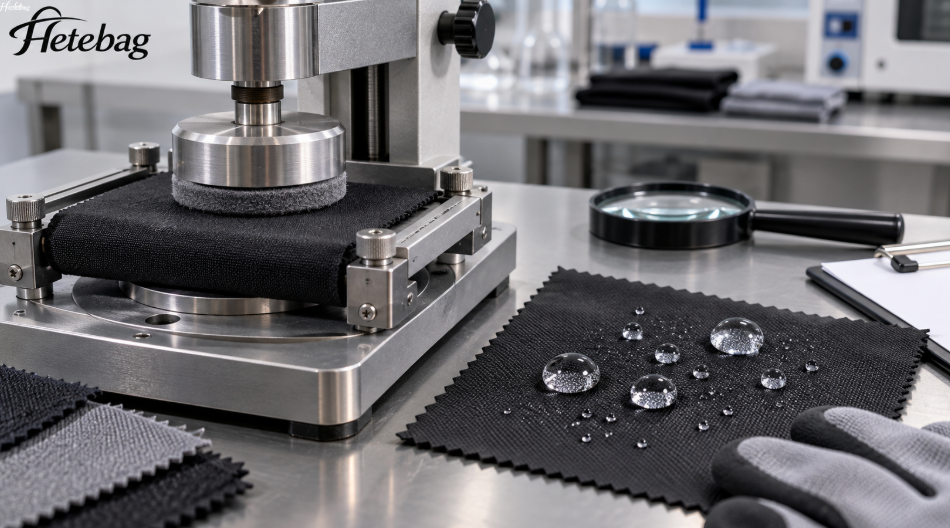
A spray test can help assess surface wetting, but it does not prove that a bag is waterproof. For a measurable fabric specification, hydrostatic pressure testing is more useful. ISO 811 explains a method in which water pressure rises until penetration occurs through the fabric.
The buyer and supplier should agree on the test method, test side, conditioning, unit, and minimum result. Then test the finished bag separately. Fill or spray the bag for the agreed time and place dry absorbent paper inside. Any wet seam, zipper, or needle hole shows where construction—not denier—is the weak point.
4. Which Bags Are Better Suited to 600D Polyester?
600D polyester is a practical choice for bags that need balanced durability, lower weight, easier folding, and controlled manufacturing costs. It should not be treated as a low-grade fabric by default.
A well-made 600D polyester with stable yarn, tight construction, and a suitable PU coating can work well for everyday backpacks, school bags, promotional bags, sports bags, light travel bags, makeup bags, organizers, and general-purpose tool bags. It is also useful when the design requires full-surface printing because its lighter construction is often easier to handle during printing, cutting, and sewing.
Für eine custom backpack project, 600D can be used for the main shell while higher-wear parts receive a second layer, foam support, binding, or heavier reinforcement fabric. This keeps the product lighter without leaving the bottom and shoulder-strap areas underprotected.
Before approving 600D, check whether it passes five practical conditions: the loaded sample holds its shape, the weave does not open beside seams, the coating survives folding, the printed surface resists rubbing, and the bottom shows no early wear during use testing.
One useful sample procedure is to load the bag to the planned working weight plus an agreed safety margin. Hold it for 24 hours, complete repeated carry cycles, and inspect the handle and shoulder-strap connections. The exact load and cycle count should match the product claim. A school bag and a contractor’s tool bag should not share the same acceptance standard.
600D is often the better material when additional fabric weight would bring little benefit to the end user.
5. When Should You Choose 1680D Polyester?
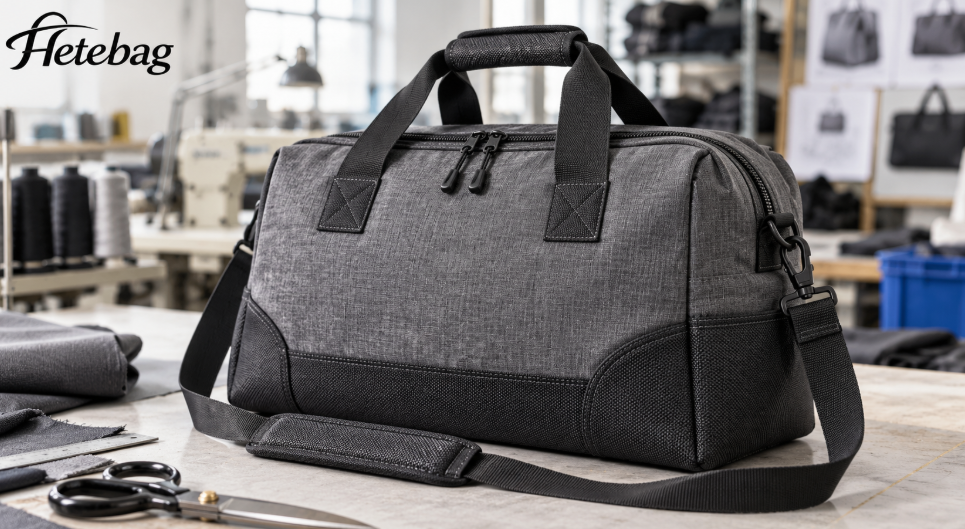
1680D polyester is better suited to products exposed to frequent rubbing, heavier loads, rough surfaces, or repeated transport. Common applications include industrial tool bags, equipment cases, business laptop bags, high-load backpacks, tactical-style bags, medical equipment cases, and reinforced luggage panels.
It is also useful on the bottom, lower corners, side panels, and other areas that touch floors or vehicle surfaces. For many Individuelle Reisetaschen, this zoned approach gives a better result than making the whole product from 1680D.
The material is not an automatic upgrade for every project. Using it across the entire bag can increase finished weight, reduce foldability, create bulky seam intersections, and make fine shapes harder to sew. Thick fabric may also require larger needles, heavier thread, stronger binding, and wider seam allowances.
A factory should make a cross-section sample before producing the full prototype. This small sewing trial should include every layer at the thickest point: outer fabric, lining, foam, webbing, reinforcement, binding, and zipper tape. Bend and stitch the stack using the planned production machine.
Approve the construction only if the needle penetrates cleanly, stitch length remains even, the feed does not shift the layers, and the seam can be turned without cracking the coating. After sewing, pull the seam perpendicular to the stitch line and check for yarn slippage, skipped stitches, and enlarged needle holes.
If the weak point becomes the zipper, webbing, buckle, or seam, changing the shell from 600D to 1680D will not solve the real problem.
6. Why Denier Alone Is Not Enough When Comparing Fabrics
Check the Weave, Yarn and Finished Fabric Weight
A complete material specification should cover more than “600D polyester” or “1680D polyester.” Ask the supplier to state the yarn composition, warp and weft construction, weave density, finished GSM, usable width, coating, color reference, and tolerance.
Some fabrics sold as 1680D use a two-ply or basket-style construction, while others use a different yarn arrangement. Names such as Oxford, ballistic-style, or double-thread fabric are not precise enough for approval.
Compare the supplier’s specification sheet with the physical swatch. Measure the weight and width, examine the weave under magnification, and check samples from the beginning, middle, and end of the roll. If the measured values fall outside the agreed tolerance, stop cutting until the lot is reviewed.
Compare Coating, Colorfastness and Surface Finish
The coating should be even, bonded to the fabric, and suitable for the target climate. Inspect for pinholes, bubbles, white stress marks, uneven gloss, odor, and sticky surfaces.
Fold the same spot repeatedly and then rub the backing with a white cloth. Look for flaking, whitening, or coating transfer. For a more controlled check, agree on a fold count and conditioning temperature before testing.
Color should be approved under controlled light rather than from phone photos. Use a physical color standard and define the acceptable color difference with the fabric mill or testing laboratory. When chemical safety matters, buyers can also request valid material documentation from the nominated supplier. OEKO-TEX STANDARD 100 covers textiles tested for harmful substances, but a certificate must be checked for its scope, article name, and validity. It should never be assumed from a supplier’s general claim.
Test the Actual Fabric and Finished Bag
Laboratory fabric results are useful, but they cannot replace finished-product testing. A bag often fails first at its seams, handles, binding, zipper ends, or reinforcement patches.
| Check | What to Record | Warning Sign |
|---|---|---|
| Fabric weight | Average GSM from several positions | Large variation within one roll |
| Abrasion | Test method, cycles, load, and failure point | Early yarn breakage or coating loss |
| Wasserbeständigkeit | Method, pressure or exposure time | Leakage through fabric or backing |
| Coating adhesion | Fold and rub conditions | Peeling, powder, or sticky transfer |
| Seam performance | Load, duration, and seam movement | Puckering, yarn slippage, enlarged holes |
| Finished-bag load test | Weight, cycles, and drop height | Damage at handles, bottom, or zipper ends |
Keep a sealed approved swatch and a signed finished sample. Production material should be compared with both before cutting and again during inline inspection.
7. How to Choose Between 600D and 1680D for a Custom Bag Project
Start with the product’s real use rather than the material name. Define the normal load, maximum load, use frequency, contact surfaces, desired shape, target packed weight, printing method, destination climate, and shipping method.
The following decision table can help organize the choice.
| Projektanforderung | Better Starting Point | What to Verify |
|---|---|---|
| Lightweight daily or school bag | 600D | Load test and shoulder-strap seams |
| Promotional bag with full print | 600D | Print sharpness, rub resistance, and color |
| Soft gym or travel bag | 600D or mixed construction | Foldability, bottom wear, and packed weight |
| Laptop or business bag | 1680D or mixed construction | Structure, padding, zipper, and handle strength |
| Tool or industrial equipment bag | 1680D | Abrasion, puncture risk, base reinforcement |
| Heavy travel or transport bag | 1680D in wear zones | Carton volume, wheel area, and bottom panels |
| Weight-sensitive but durable design | 600D body with 1680D reinforcement | Seam compatibility between both fabrics |
A useful scoring method is to rate load, abrasion exposure, structure, weight sensitivity, and foldability from 1 to 5. Give extra weight to the product’s main risk. For example:
Material score = load rating × 2 + abrasion rating × 2 + structure rating − weight sensitivity − foldability need
A higher score supports testing 1680D or a mixed structure. A lower score usually points toward 600D. This is a project-screening tool, not a substitute for samples and laboratory tests.
For most custom orders, a mixed construction is the most efficient solution. The body can use 600D, while the base, corners, handle anchors, and other wear zones use 1680D. Reinforcement boards, foam, webbing, and seam design can then be adjusted around the expected load.
You can review more options in HeteBag’s Leitfaden zu Materialien für individuell gestaltete Taschen. For a specific development project, send HeteBag a reference image, technical drawing, intended use, target load, destination market, or existing sample through the Kontaktseite. The material, coating, reinforcement, and construction can then be reviewed as one system instead of being chosen by denier alone.
8. Schlussfolgerung
The main difference in the 600D vs 1680D comparison is that 600D polyester is usually lighter, softer, and easier to manufacture, while 1680D polyester is generally heavier, firmer, and more suitable for high-wear applications.
That difference is only the starting point. Denier measures yarn density; it does not confirm the quality of the yarn, the tightness of the weave, the finished fabric weight, coating performance, seam strength, or durability of the complete bag.
Choose 600D for many daily, promotional, school, sports, and lightweight travel products. Consider 1680D for tool bags, equipment cases, structured business bags, and heavily worn panels. When the product needs both low weight and stronger wear resistance, use 1680D only in the bottom, corners, and load-bearing areas.
The final decision should be based on a written specification, approved swatches, measurable fabric tests, and a loaded finished-bag test. This gives buyers a result they can verify rather than relying on a fabric name.
Häufig gestellte Fragen
Is 1680D polyester always stronger than 600D polyester?
No. It uses thicker yarn, so it often performs better against heavy wear, but actual strength depends on yarn quality, weave density, coating, and finishing. A tightly woven, well-coated 600D fabric can outperform a loosely woven 1680D material in some tests. Compare both fabrics using the same abrasion, tear, and seam test methods.
Is 600D polyester waterproof?
600D polyester is not automatically waterproof. Its water resistance depends mainly on the PU or PVC backing, any surface treatment, and the quality of seams, zippers, and openings. Ask for a measurable hydrostatic pressure requirement and test the finished bag for leakage. Use the term “waterproof” only when the complete construction supports that claim.
Is 1680D polyester the same as ballistic nylon?
No. Denier and fiber type are separate specifications. A fabric described as 1680D polyester is made from polyester yarn, while traditional ballistic nylon uses nylon yarn and a particular heavy woven construction. Suppliers may use “ballistic-style” to describe an appearance, but buyers should confirm the exact fiber, weave, yarn structure, and test data.
Can 600D and 1680D polyester be used in the same bag?
Yes. This is often the most practical construction. Use 600D for the main body to reduce weight and improve flexibility. Add 1680D to the base, corners, side panels, handle anchors, or other high-wear zones. The sample must still be checked for seam balance because the two materials may feed and stretch differently during sewing.
Which fabric is better for printing a custom logo?
600D is often easier for full-surface printing because it tends to have a lighter, flatter construction. The result still depends on surface texture, coating, print process, ink system, and artwork detail. For either fabric, approve a printed strike-off and test it for rubbing, folding, color accuracy, and adhesion before production. Embroidery, woven labels, rubber patches, and screen printing may be better for some 1680D designs.
What information should I send to a bag manufacturer before choosing the fabric?
Provide the bag dimensions, expected contents, normal and maximum load, use frequency, destination market, preferred appearance, printing method, water-resistance need, and shipping method. Reference photos or an existing sample are also useful. Ask the manufacturer to return a written material specification and prototype for approval rather than accepting only the description “600D” or “1680D.”


