
 German
  English
  Italian
  French
  Spanish
  Arabic
 A toiletry bag can look right in a product photo and still disappoint once someone packs it. Bottles may pull a hanging organizer out of shape, the zipper may catch the lining, or spilled shampoo may collect in corners that are difficult to clean.
To choose a manufacturer for custom toiletry bags, look for experience with your intended construction, a clear material specification, useful samples, and a documented approach to bulk quality control. At HeteBag, project discussions can start with your design, reference images, and intended use. A request for “a premium travel bag” leaves the factory guessing about the details that matter to your customers.
What Should You Prepare Before Contacting a Manufacturer?
Start with what the bag needs to carry. A compact dopp kit for weekend travel, a hanging organizer for family trips, and a pouch supplied with a skincare gift set need different dimensions, openings, and internal layouts.
Send the dimensions of the bottles and accessories you expect customers to use. External bag measurements alone do not tell you whether a tall bottle will fit under the zipper or whether an elastic loop will hold a narrow tube.
Your first inquiry should include:
- Reference images or sketches showing the exterior and interior.
- Intended use, target customer, and sales markets.
- Approximate dimensions and a list of items the bag must hold.
- Preferred shell, lining, colors, and logo method.
- Estimated quantity per style and color.
- Packaging requirements and your required delivery date.
- Performance expectations, such as wipe-clean lining or loaded hanging use.
A tech pack keeps the design and production details together in a document both sides can update and approve. If you do not have one yet, mark which features are fixed and which you want the manufacturer to recommend. Ask who will prepare the drawings and specifications, and who owns the resulting patterns and artwork.
For a starting point, HeteBag’s custom makeup and cosmetic bag options include toiletry-style designs. Use those examples to discuss structure, then specify how your own product should differ.
How Can You Tell If a Manufacturer Is a Good Fit?
A broad bag catalog gives you somewhere to start, but ask to see products close to your actual design. A supplier familiar with flat promotional pouches may need a different production setup for a structured organizer with curved zippers, clear pockets, and a reinforced hanging hook.
Ask the toiletry bag manufacturer to explain how a similar product was assembled. Useful answers cover the lining attachment, zipper installation, reinforcement points, and the order in which compartments are sewn. Request permission-cleared photographs or a live video of relevant work rather than confidential customer information.
Understand who will make your order
Confirm the company taking your order, the production location, and which processes are subcontracted. Printing, custom hardware, or certain material treatments may be handled elsewhere; you need to know who checks that work and resolves problems.
A manufacturer working with partner factories can still be a suitable supplier. Your contact should control the specification, communicate changes, and identify the facility responsible for your order. Establish whether moving production to another facility requires your approval.
Pay attention to the questions they ask
A useful supplier will clarify your intended load, bottle sizes, lining requirements, and quantity split before treating a quotation as final. Their response should also distinguish confirmed capabilities from features that need development.
When evaluating a custom toiletry bags factory, ask one practical question: “What would you change in this design before making the sample, and why?” A specific explanation of an awkward opening or an overloaded hook tells you more than a promise to meet every requirement.
Can They Work With Your Materials and Design?
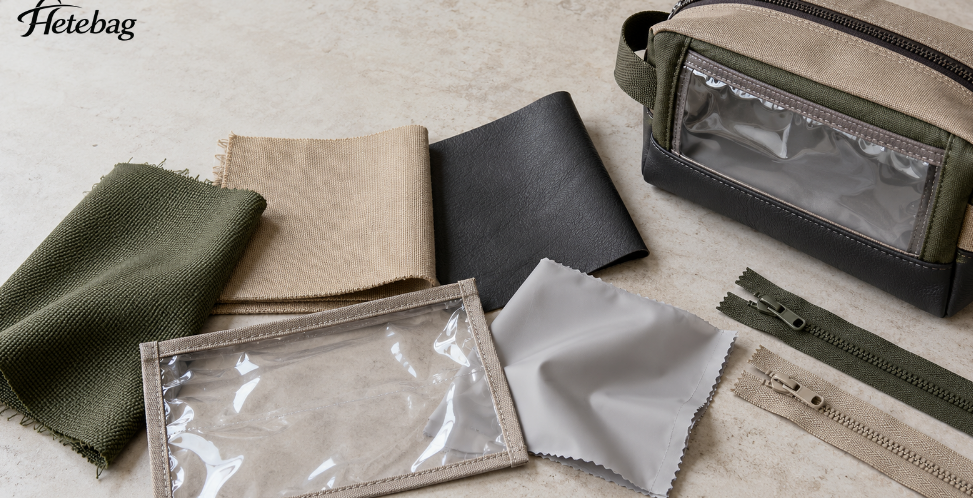
Choose the shell, lining, and reinforcements as a complete construction. Fabric names such as nylon or polyester leave too much open: weight, weave, coating, backing, and finish can all affect how the finished bag behaves.
HeteBag’s Materialien für maßgefertigte Taschen can help you shortlist options. Ask for physical swatches and the specification of the actual material proposed for your order before approving its appearance or performance.
| Material or construction | What to discuss | What to check in the sample |
|---|---|---|
| Nylon or polyester shell | Fabric weight, weave, coating, and backing | Shape, abrasion expectations, and response to moisture |
| Canvas shell | Weight, finish, cleaning instructions, and colorfastness | Bulk at seams and behavior after the agreed cleaning method |
| PU-coated or leather-look shell | Thickness, backing, flexibility, and intended service conditions | Folding, surface marking, and finish at sewn edges |
| Clear film pockets | Film type, thickness, flexibility, and attachment method | Creasing, visibility, seam condition, and pocket access |
| Wipe-clean lining | Exact material, coating, cleaning method, and seam construction | Residue removal and moisture behavior around seams |
Define what “waterproof” means for your product
Ask whether the claim applies to a material swatch, the lining compartment, or the complete bag. A material that blocks water can still be assembled with needle holes and ordinary zipper openings through which liquid can pass.
For everyday travel, you may primarily need a lining that can be wiped clean after a small spill. If you want the bag to contain leaking toiletries or resist water from outside, define the exposure, test method, and pass criteria. Do not approve a whole-bag waterproof claim based only on a fabric description.
Check branding and material claims early
Logo methods affect construction as well as appearance. Embroidery adds needle penetrations, a metal badge needs secure attachment, and a heat-applied decoration must suit the substrate. Review HeteBag’s Optionen für individuelle Logos and approve the chosen method on the actual production material.
If recycled content is part of your brand positioning, specify the component and percentage behind the claim. Textile Exchange’s RCS and GRS guidance explains third-party verification of recycled materials and chain of custody. Request documentation covering the relevant supply chain and order; a supplier’s certificate alone does not establish every claim about your finished bag.
What Should You Ask About MOQ, Costs, and Lead Times?
Ask whether the minimum order quantity applies per design, per color, or to the combined order. A total quantity that seems workable may become difficult when divided between several shell colors, lining colors, and logo versions.
Then ask which component sets the minimum. Custom-dyed fabric, printed lining, bespoke zipper pulls, and individual packaging can have separate purchasing requirements. Available materials and standard hardware may make an initial order easier, but confirm the effect on your design rather than assuming a lower MOQ is available.
Compare quotations against the same specification
Make sure each quotation covers the same shell, lining, zipper, internal pockets, logo, and packaging. Ask suppliers to identify development charges, tooling, testing, inspection, and freight separately, including anything excluded from the quotation.
Request alternatives with their consequences explained. Removing a pocket might simplify production, while changing a lining could change cleaning performance. You should be able to see what you gain or give up before approving a revision.
Separate production time from arrival time
Ask for a schedule covering prototype development, revisions, material procurement, pre-production approval, bulk production, inspection, and transport. Confirm the event that starts each stage, such as receipt of the deposit or written sample approval.
An ex-factory date is not the date stock reaches your warehouse. For a fixed launch, work backward from the required arrival date and allow room for sample corrections and failed inspections. Ask the supplier to flag material availability and production-capacity risks before you commit.
What Should You Look for in a Toiletry Bag Sample?
Pack it with the items from your brief. Close it, reopen it, remove individual bottles, and put them back; this reveals access problems that an empty sample cannot show.
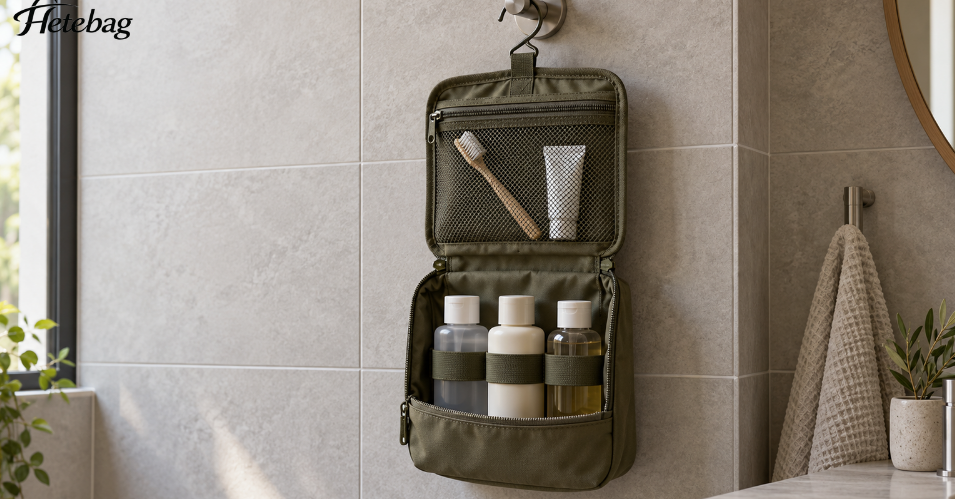
For a hanging design, assess it under the intended load and on suitable supports. Check whether the hook and its attachment remain stable, whether compartments tilt, and whether items stay in place. Agree the load and duration of any formal test rather than relying on an informal tug.
| Check | How to assess it | What to record |
|---|---|---|
| Capacity and access | Pack the intended bottles and accessories | Items that do not fit or obstruct access |
| Reißverschlussbedienung | Open and close the bag both empty and loaded | Snagging, lining capture, or distortion |
| Hanging construction | Use the agreed load and test conditions | Hook movement, seam stress, and compartment sagging |
| Lining cleanup | Use the agreed spill and cleaning procedure | Residue, staining, and moisture reaching other areas |
| Verarbeitung | Examine corners, binding, seams, and pocket edges | Skipped stitches, exposed edges, and uneven assembly |
| Branding and packing | Compare with approved artwork and packaging | Placement errors, surface damage, and lasting creases |
Treat these as development checks. Formal durability, chemical, or performance claims need an appropriate test plan and evidence; passing a quick sample check does not establish them.
Return comments in one numbered list with photographs and measurements. Identify the sample version, request written confirmation of each change, and review the revised version before approval. A sentence such as “move the pocket down by the marked distance” is easier to act on than “make the inside better.”
Before bulk production, confirm that the approved pre-production sample uses the agreed materials and components. Record any substitutions or remaining differences, keep a reference sample, and give the supplier a matching reference. HeteBag’s cosmetic bag manufacturing guide provides further context on the development process.
How Will They Keep Quality Consistent in Bulk Production?
Ask how the approved sample becomes instructions for the production team. The supplier should work from the latest specification, material list, artwork, and inspection criteria rather than a collection of untracked messages.
Incoming checks should address the agreed material specifications and visible batch differences. During assembly, ask how the team checks pocket placement, reinforcement, lining attachment, and zipper operation early enough to correct a repeated problem.
For final inspection, define the features to measure and how defects will be classified. A zipper that cannot close affects use; a small cosmetic variation may need a different acceptance rule. Include packaging and quantity checks, and state who authorizes shipment after inspection.
Intertek’s textile inspection services illustrate checks at incoming, production, and finished-product stages. If your order uses AQL-based sampling, agree the inspection level, defect categories, and acceptance limits with the inspector. Sampling supports an acceptance decision; it does not mean every unit has been checked or that the batch contains no defects.
Also ask what happens after a failed inspection. Confirm responsibility for sorting, rework, replacement, and reinspection, along with the effect on shipment timing. Any proposed material or construction substitution should receive written approval before use.
What Should You Confirm Before Placing an Order?
Before you pay the deposit, put the final decisions in the purchase order and the documents it references. Each style should point to a specific approved sample and specification version, with quantities broken down by color and branding variant.
Confirm:
- Materials, components, dimensions, tolerances, and approved colors.
- Logo artwork, application method, size, and position.
- Sample approval status and any accepted differences.
- Inspection requirements, test scope, and shipment-release procedure.
- Labels, barcodes, individual packaging, and carton requirements.
- Payment milestones and treatment of development or tooling charges.
- The Incoterms rule, named place, and agreed edition.
- Production milestones, shipping responsibilities, and required documents.
- Procedures for defects, shortages, late changes, and repeat orders.
Match documentation to the destination market
For EU-bound products, discuss applicable chemical requirements for the actual shell, coatings, films, prints, and hardware. ECHA’s guidance on Candidate List substances in articles explains that their presence can trigger supply-chain obligations. Have your compliance team or testing partner define the relevant requirements; a general “REACH compliant” statement gives you too little information to assess an order.
For US-bound orders, provide the destination states, intended user group, and retailer requirements to the supplier and testing partner. Ask them to identify applicable requirements before materials are finalized. A test report should identify what was tested and when, so you can judge whether it covers your product and current specification.
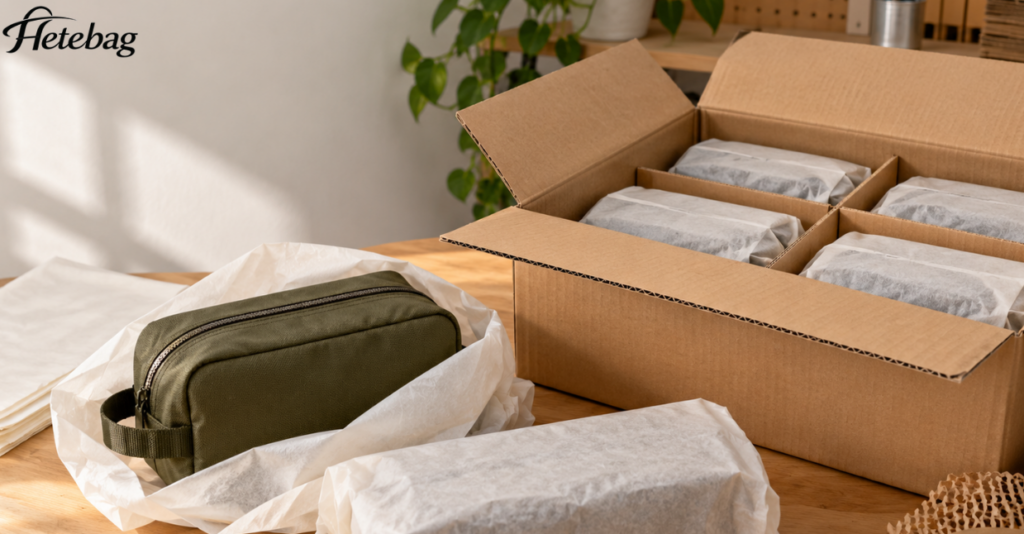
Packing deserves its own approval. Check whether compression leaves lasting creases, whether hardware marks the shell, and whether the packed dimensions match the shipping estimate. Open a packed sample as your customer would receive it, then review its presentation and function again.
Fazit
Choose a manufacturer that can explain how your custom toiletry bags will be developed, tested, and reproduced in bulk. Relevant construction experience, clear specifications, and a useful approval process give you a stronger basis for ordering than a polished catalog alone.
HeteBag works with partner factories and draws on 15 years of bag-manufacturing experience. Share your design, preferred materials, quantities, and target market through the website to discuss your project. Include the items the bag must carry and your delivery deadline so the conversation can focus on practical development requirements.
Häufig gestellte Fragen
Can I develop custom toiletry bags without a finished tech pack?
Yes, you can begin with reference images, sketches, dimensions, and intended contents. Agree who will turn the concept into drawings and specifications, and approve those documents before bulk production. Allow time for development and revisions.
Does MOQ usually apply per color or per design?
It depends on the supplier and the components being purchased. Ask for the minimum per style and color, plus any separate minimums for fabric, hardware, or packaging. Get a written quantity breakdown for your proposed assortment.
Is a waterproof lining enough to call the whole bag waterproof?
No. Seams, needle holes, zipper openings, and pocket connections may allow liquid to pass even when the lining material blocks it. Define the intended claim and verify it against a test appropriate to the finished construction.


