
 English
  Italian
  French
  German
  Spanish
  Arabic
 Choosing a material for a lunch bag looks simple until you begin developing a real product. A supplier may show you polyester, Oxford fabric, canvas, cotton, neoprene, several foam options, and multiple shiny or matte linings. Each sample may look acceptable on a table. Yet the finished bags can perform very differently after repeated use.
That difference comes from the full material system, not one fabric name. The outer shell affects abrasion resistance, shape, color, and branding. Insulation slows heat transfer. Inside the bag, the lining controls cleaning, moisture resistance, odor, and the way spills are contained. Coatings, adhesives, binding tape, zippers, thread, and seam construction also influence how the bag feels and how long it lasts.
After more than 15 years working with bag development and production, I have seen buyers focus too heavily on appearance during sampling. The logo looks sharp, the color matches, and the sample feels thick, so the material is approved. Problems appear later: the lining tears near the zipper, condensation reaches the outer fabric, the bag collapses when loaded, or the printed surface cracks after folding.
You can avoid most of these problems by selecting materials from the user’s point of view. Ask what the bag must carry, how long it should support temperature control, how often it will be cleaned, where it will be stored, and how the customer will judge quality in the first ten seconds. Then translate those answers into a clear material specification.
This guide explains the best materials for Custom Lunch Bags from a buyer’s perspective. It covers shell fabrics, insulation, linings, coatings, decoration, quality checks, sustainability claims, MOQ considerations, and the questions a capable Lunch Bags Manufacturer should answer before production begins. For a broader overview, read our complete guide to custom lunch bags for brands and wholesale buyers.
Why Material Selection Matters for Custom Lunch Bags
Custom Lunch Bags are layered products. Treating them like simple fabric pouches creates weak specifications and unpredictable results. Even when two factories quote the same outer material, one bag may use thin foam, a fragile lining, and loosely woven webbing, while the other uses a balanced construction that performs well in daily use.
The first job of material selection is to define what “good” means for your project. A corporate gift bag may need a clean silhouette and reliable logo reproduction. A school lunch bag needs low weight, easy cleaning, comfortable handles, and materials suited to the intended age group. An outdoor model may require stronger abrasion resistance, thicker insulation, a stable base, and a closure that limits air exchange.
Material choices also affect production consistency. Stock polyester in a common color is usually easier to repeat than a custom-dyed natural canvas. A flat front panel is easier to print than a highly curved neoprene body. A smooth PEVA lining is easier to wipe than a fabric lining, but it can crease or puncture if the pattern and sewing process are poorly controlled. These are not small factory details. They shape customer reviews, return rates, repeat orders, and brand trust.
| Buyer concern | Material decision that matters | What to verify before approval |
|---|---|---|
| Temperature support | Foam type, thickness, density, reflective layer, closure | Test method, ambient conditions, load, duration, and ice-pack use |
| Daily durability | Fabric denier or weight, coating, seam strength, zipper, webbing | Abrasion, seam pull, handle loading, zipper cycling, and edge wear |
| Cleaning | Lining chemistry, surface texture, seam construction | Wipe test, stain test, odor check, and leak-resistance test |
| Brand appearance | Weave, surface finish, color control, print compatibility | Pantone tolerance, print adhesion, rub resistance, and logo placement |
| Sustainability | Fiber source, recycled-content traceability, durability | Scope certificate, transaction documents, component breakdown, and claim wording |
| Production stability | Material availability, custom dyeing, lamination, MOQ | Approved BOM, supplier lot control, substitution rules, and replenishment plan |
A reliable material specification should name each layer. “600D lunch bag with PEVA” is not enough. A stronger specification may state the polyester construction, backing or coating, foam type and thickness, lining weight, zipper size, webbing width, thread type, seam treatment, and decoration method. The exact details will vary, but the principle stays the same: vague specifications transfer risk to the buyer.
You should also separate water resistance, leak resistance, and waterproof construction. A PU-coated polyester shell may resist light splashes. It does not make the entire bag waterproof. A PEVA lining may block liquid through the material itself, yet needle holes in sewn seams can still allow leakage. True leak control often requires a suitable lining plus sealed or welded seams, careful corner design, and a closure that matches the claim.
When reviewing custom lunch bag manufacturing options, compare complete constructions rather than choosing from surface swatches alone. Ask the factory to explain why each layer is used and what could be changed without hurting performance.
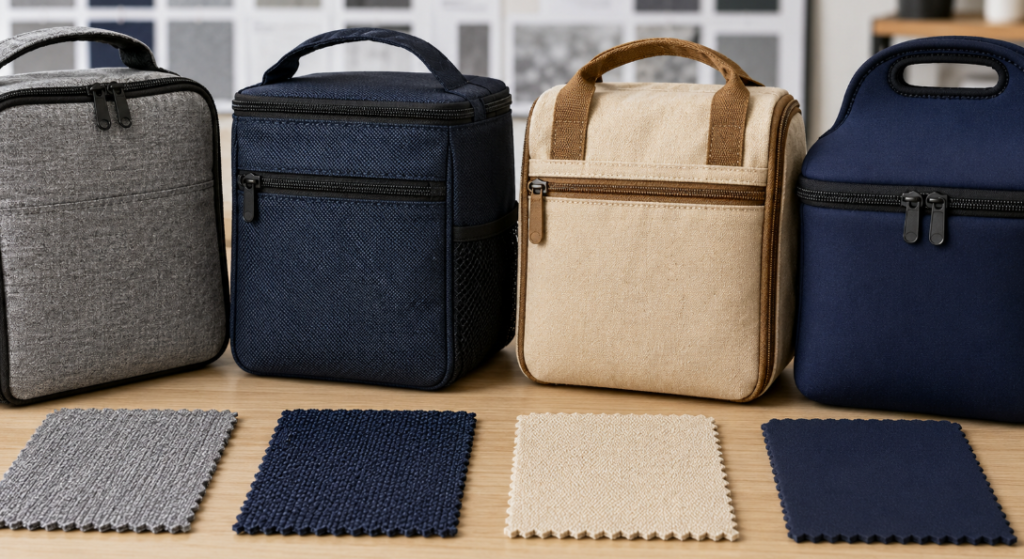
Polyester: A Durable and Cost-Effective Choice
Polyester is the most practical starting point for many Custom Lunch Bags. It is widely available, stable in production, suitable for many decoration methods, and offered in a broad range of weaves, deniers, colors, and finishes. It can serve promotional programs, office products, school designs, subscription kits, retail collections, and everyday meal bags.
The word “polyester,” however, tells you very little by itself. You still need to specify the yarn size, fabric construction, surface texture, backing, coating, weight, and color standard. A 210D polyester can feel light and flexible. Moving to 420D gives the body more support. Many buyers choose 600D when they want a stronger hand and a more substantial appearance. Higher-denier options can add toughness, but they also add bulk and may make small bags feel stiff.
Denier is a yarn measurement, not a complete durability score. A tightly woven 420D fabric with a good coating can outperform a loose 600D fabric with weak adhesion. Fabric density, yarn quality, finishing, and lamination matter. This is why I never approve a shell fabric from the denier number alone. I compare the actual swatch, backing, tear behavior, coating bond, colorfastness, and production history.
Water Resistance Depends on the Backing
Standard polyester is not automatically waterproof. Most lunch bag shells gain water resistance from a PU, PVC, or TPU-related backing or surface treatment. PU coating is common because it can provide useful resistance while keeping the fabric reasonably flexible. The coating specification should match the intended use, folding behavior, and market requirements.
A coating that feels good on a fresh swatch may still fail after repeated creasing. Ask the Lunch Bags Manufacturer to fold and rub the material, especially along the top opening, side gussets, and base corners. Watch for whitening, cracking, peeling, or separation between the fabric and backing. These areas experience more stress than the center of a panel.
The shell also needs a practical seam design. Water can pass through stitch holes even when the fabric itself resists moisture. For ordinary lunch bags, this may be acceptable because the inner lining handles spills. For outdoor or cooler-style products, the construction may need seam tape, welded components, a coated zipper, or a rain flap. Never use “waterproof” in marketing unless the complete product has been tested to support that claim.
Polyester Works Well with Most Logo Methods
Polyester gives buyers flexible branding options. Screen printing works well for simple solid-color logos. Heat transfer supports fine details and multiple colors. Sublimation can create full-coverage graphics when the fabric and print process are designed for it. Embroidery adds texture and perceived quality, though the backing and needle density must be controlled so the panel does not pucker.
Logo selection should happen before the pattern is finalized. Large heat-transfer graphics can stiffen a front panel. Dense embroidery can compress the foam or distort a thin fabric. All-over sublimation requires artwork allowances for seams, binding, and panel alignment. A skilled factory will review logo size, color count, placement, fabric texture, and expected wear before recommending a method.
Dark polyester deserves extra attention. Poor dye fixation can lead to color transfer onto light clothing, labels, or adjacent panels. This risk rises when the bag is damp or rubbed. Colorfastness checks can evaluate resistance to fading and dye transfer under conditions such as washing, light exposure, and rubbing. For a dark or highly saturated launch, request suitable dry-rub and wet-rub checks instead of relying only on visual approval.
Best Uses for Polyester Lunch Bags
Polyester is a strong match when you need balanced performance, repeatable colors, clear logo execution, and manageable production. It is especially useful for medium-volume and large-volume programs because mills and converters usually offer many established constructions.
A lightweight promotional bag can use a lower-denier shell when the expected use is limited and the bag does not carry heavy glass containers. Daily office products often gain a more stable feel from 420D or 600D polyester. For a structured retail bag, combine the shell with suitable foam, binding, base reinforcement, and a shape that remains upright when loaded.
Do not overspecify the shell while underspecifying the rest of the bag. A heavy outer fabric cannot compensate for a weak handle attachment, thin zipper tape, brittle lining, or poorly bonded insulation. The best polyester lunch bag is balanced. Every component should support the same expected service level.
Oxford Fabric: Ideal for Heavy-Duty Lunch Bags
For heavy-duty Custom Lunch Bags, Oxford fabric is often described as if it were one material. It is more accurate to treat Oxford as a fabric construction or visual weave style that can be made from polyester, nylon, or other fibers. In lunch bag production, “Oxford fabric” usually refers to a woven synthetic shell with a noticeable basket-like texture and a coating on the reverse side.
This distinction matters when you compare suppliers. One factory may offer 600D polyester Oxford with PU backing. Another may show a nylon Oxford with a smoother hand and different tear performance. Both may be called Oxford, yet their feel, water resistance, abrasion behavior, decoration options, and production requirements are not identical.
Understanding Common Oxford Specifications
Lighter Oxford fabrics, such as 300D or 420D constructions, can work for compact office bags and school designs. They provide texture without excessive stiffness. A 600D Oxford is a common choice for daily-use lunch bags, tool-style meal bags, and corporate products that need a firm shape. Heavier options such as 900D or 1680D may suit rugged cooler bags, worksite lunch bags, and selected outdoor products, but they can be unnecessary for small formats.
Higher denier does not always mean a better product. Very heavy fabric can create thick seam stacks at corners and zipper ends. Sewing becomes harder, binding may look uneven, and the finished bag may feel bulky. It can also reduce folding efficiency during packing. Choose the lightest construction that still meets your real durability target.
The coating must be specified separately. PU backing is widely used for water resistance and flexibility. PVC backing can create a firmer, more coated hand but may face stricter customer or market requirements. TPU-based solutions may be considered for selected performance projects. The right choice depends on the target market, chemical requirements, desired hand feel, seam process, and the way the bag will be cleaned.
Why Oxford Fabric Performs Well in Demanding Use
The textured weave helps hide minor scuffs and makes a bag look more robust. Oxford also holds shape better than many thin plain-weave fabrics, especially when paired with foam or a supporting interlayer. This makes it useful for wide-opening lunch bags, dual-compartment bags, bottle-friendly designs, and bags that must stand on a desk or shelf.
For worksite or outdoor use, inspect the base and lower side panels carefully. These zones contact floors, benches, vehicle interiors, and rough surfaces. A heavier Oxford or reinforced base panel can improve wear life, but the reinforcement should not create a hard edge that cuts into the adjacent fabric. Rounded transitions, correct seam allowance, and strong binding often matter as much as the fabric upgrade.
Oxford is also a sensible choice for business-focused bags. A fine-textured 420D or 600D construction in a muted color can look clean and professional without becoming fashion-heavy. Pair it with a controlled silhouette, matte hardware, even topstitching, and a logo method that suits the texture. Screen printing may need an underbase or adjusted ink system. Embroidery should be sampled because the weave can affect edge sharpness.
Quality Checks for Oxford Lunch Bags
Start by checking abrasion and surface snagging. Rub the fabric against hook-and-loop tape, rough carton edges, and common work surfaces. Inspect whether the weave catches easily. Then bend the coated fabric repeatedly and look for cracking or delamination on the reverse side.
Seam strength is another priority. A rugged-looking shell encourages users to load more weight. Handle attachments, shoulder-strap anchors, and box-stitch areas must match that expectation. Ask for reinforcement details in the tech pack rather than accepting “reinforced stitching” as a general promise.
Color consistency can be challenging across separate dye lots. Approve a physical color range, not only a digital Pantone reference. For repeat orders, define whether the factory must use the same mill, same base cloth, same coating, and same approved shade band. This reduces the chance that a repeat shipment looks noticeably different from the first one.
Canvas and Cotton: Natural Materials for Premium Designs
Canvas and cotton are popular for Custom Lunch Bags when a brand wants a natural, tactile, lifestyle-driven look. The materials feel familiar and photograph well. Their textured surfaces also support embroidery, screen printing, woven labels, patches, and other craft-focused details. Used correctly, they can make a lunch bag feel more like part of a daily outfit and less like a basic utility item.
The terms are often mixed together. Cotton describes the fiber. Canvas describes a strong woven construction that may be made from cotton, polyester, recycled fibers, or a blend. A “cotton lunch bag” may use a light plain weave, while a cotton canvas bag uses a heavier and more structured fabric. Your specification should state both fiber content and fabric weight.
Fabric Weight and Construction Affect the Result
Natural fabrics are commonly specified by grams per square meter or ounces per square yard. A lighter cotton can work for an uninsulated snack pouch or outer decorative layer. A heavier canvas provides more shape and supports larger logos, but it also adds weight and creates thicker seams.
Do not choose the heaviest canvas by default. Thick fabric can compete with the insulation layer, making turned seams bulky and zipper installation difficult. It may also absorb more moisture and take longer to dry. A well-chosen medium-weight canvas with proper backing can produce a cleaner lunch bag than an extremely heavy cloth.
Canvas can be used as a full exterior or as an accent. A canvas front panel combined with coated polyester side panels can deliver a natural look while improving wipeability around high-contact areas. A cotton body with a synthetic base can reduce staining where the bag touches tables and floors. Mixed-material designs are often more practical than a purist approach.
Natural Appearance Does Not Automatically Mean Sustainable
Buyers should be careful with environmental language. Cotton is renewable, but its overall impact depends on fiber source, farming practices, processing, dyeing, finishing, product durability, and end-of-life realities. A natural-looking bag is not automatically a lower-impact bag.
When sustainability is central to the project, define the claim before sourcing the fabric. Do you need organic content, recycled content, undyed fabric, lower-impact dyeing, plastic-free packaging, or a long-life reusable product? These goals lead to different materials and documentation.
For textile chemical screening, OEKO-TEX® STANDARD 100 covers textiles tested for harmful substances, from components to finished articles. It is useful evidence when it applies to the relevant material or product scope. It should not be presented as a food-contact approval, because its purpose is textile safety rather than authorization for direct food contact.
If you use organic or recycled claims, request current certificates and verify that the exact supply chain is covered. A mill’s certificate does not automatically authorize a finished-product claim for every buyer. The certificate holder, scope, product category, validity period, and transaction documents all matter.
Printing and Embroidery on Canvas and Cotton
Canvas accepts screen printing well because the surface has grip and visual depth. Fine lines may need adjustment on coarse weaves. Water-based inks can support a softer hand, while other systems may provide stronger opacity depending on the color and end-use requirements. Every ink system should be reviewed for the intended market and cleaning method.
Embroidery looks strong on canvas, especially for compact logos and premium marks. Stabilizer selection is important. Without enough support, the fabric can pucker around dense stitching. Too much backing can make the front panel stiff and uncomfortable. Logo samples should use production fabric, production thread, and the actual foam or backing layers.
Natural fabrics can shrink, skew, or change shade after moisture exposure. Pre-shrinking or controlled finishing may be needed. Ask for dimensional stability checks when the product is marketed as washable. A bag can survive washing yet still become unacceptable if the outer shell shrinks more than the lining and causes twisting.
Cleaning and Maintenance Requirements
Canvas and cotton show oils and food stains more easily than coated synthetic fabrics. Light colors amplify the problem. If the buyer expects frequent wiping, consider a protective finish or a mixed-material construction. Any finish should be reviewed for hand feel, appearance, durability, and applicable chemical requirements.
Machine-wash claims need caution. Insulated lunch bags contain adhesives, foam, linings, bindings, printed logos, and hardware that may react differently to heat and agitation. A washable outer fabric does not make the finished bag machine washable. Test the entire product under the exact care instruction you plan to publish.
For premium lifestyle designs, canvas and cotton can be excellent. They work best when the brand accepts more natural variation and gives users realistic care guidance. They are less suitable when the main priorities are rapid wipe cleaning, strong rain resistance, or very low product weight.
Neoprene: Flexible, Lightweight and Insulating
Neoprene Custom Lunch Bags have a distinct feel. They are soft, stretchy, cushioned, and easy to carry. The material can wrap closely around containers, which makes it attractive for bottle-shaped bags, slim meal carriers, children’s designs, and sporty products.
In bag manufacturing, neoprene usually means a synthetic rubber foam laminated with fabric on one or both sides. The surface fabric may be polyester or nylon. This laminated construction affects print quality, stretch, color, odor, edge finishing, and durability. Buyers should specify thickness, foam quality, lamination, surface fabric, and acceptable odor level.
Thickness Changes Shape and Thermal Performance
Common bag constructions may use neoprene around 2 mm, 3 mm, 4 mm, or 5 mm thick. Thin material folds easily and keeps the bag light. Thicker material gives more cushioning, more body, and somewhat stronger thermal support. It also increases seam bulk and may make handles or zipper curves harder to sew cleanly.
Neoprene offers useful insulation because its foam structure slows heat transfer. Still, it should not be treated as equal to a fully engineered cooler system. A simple neoprene tote with an open top or short zipper may lose temperature quickly through the opening. Closure design, surface area, load temperature, ambient conditions, and ice packs still control real performance.
The material’s stretch can be either helpful or harmful. It creates a snug fit and allows a compact bag to hold irregular containers. Too much stretch can make the bag sag when loaded. Handle reinforcement and panel direction must be planned so the bag does not lengthen or distort during carrying.
Branding Options for Neoprene
Screen printing works for simple graphics when the ink system is compatible with the laminated surface and expected stretch. Sublimation is useful for full-color designs on suitable light-colored polyester-faced neoprene. Heat transfer can work, but temperature and pressure must be controlled so the foam does not flatten or the lamination does not weaken.
Edge construction is highly visible. Some neoprene lunch bags use bound edges. Others use flatlock-style seams or turned construction. Raw-cut edges may be possible for selected designs because the foam does not fray like woven fabric, but exposed edges can still look rough, collect dirt, or separate if the lamination quality is poor.
Odor is a common approval issue. Fresh neoprene and lamination adhesives can have a noticeable smell. Ask the supplier to air samples before evaluation, then repeat the odor check after the bag has been sealed in packaging. A sample that smells acceptable in an open showroom may smell stronger after several days inside a polybag and carton.
Best Markets for Neoprene Lunch Bags
This material is useful for compact lunches, bottle carriers, branded wellness programs, and designs that benefit from a close fit. Because the foam and surface textile are already laminated, it can also reduce the number of separate layers.
Neoprene is not the best choice for every project. It can be less structured than Oxford, harder to keep upright, and more sensitive to compression marks during packing. It may also require higher material MOQ for custom colors or custom laminated prints. Confirm stock color availability and print limitations early.
A good neoprene lunch bag feels clean, resilient, and balanced. It should return to shape after compression, carry the intended weight without excessive stretch, and show no bubbling or separation between fabric and foam.
Insulation and Lining Materials to Consider
The insulation and lining system determines whether Custom Lunch Bags are merely decorative or truly functional. Buyers often spend most of their time comparing exterior fabrics because those materials are easy to see. From a performance standpoint, the hidden layers deserve equal attention.
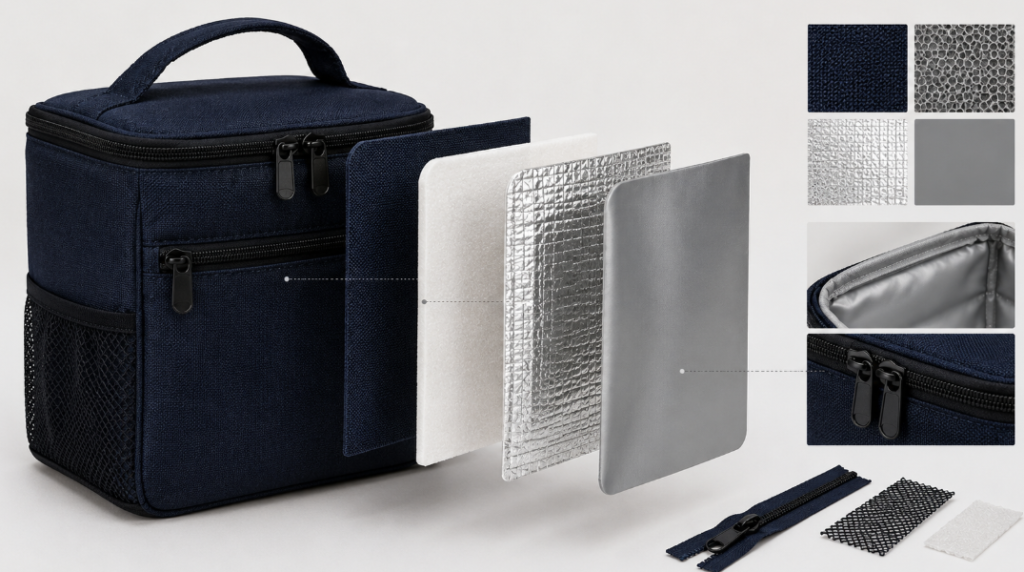
A typical insulated lunch bag may combine an outer shell, a foam layer, a reflective film or support layer, and an inner lining. Some designs use fewer layers. Others add rigid boards, nonwoven reinforcement, gel elements, or multiple foams. More layers do not automatically mean better performance. Each layer must serve a clear purpose and remain stable after sewing, folding, cleaning, and repeated use.
EPE Foam and PE Foam
EPE stands for expanded polyethylene. It is a type of polyethylene foam, so “EPE foam” and “PE foam” are not always two completely separate categories. Suppliers may use “PE foam” as a broad term and “EPE” for a particular expanded structure. Buyers should ask for the actual material type, density, thickness, and cell structure instead of relying on a short label.
EPE is popular because it is light, flexible, easy to cut, and suitable for many standard lunch bags. It adds cushioning and slows heat transfer without making the product too heavy. Common thicknesses vary by design, but the correct thickness should be determined by the bag size, target performance, and seam construction.
Thicker foam can improve insulation, yet the gain is not unlimited. Large openings, poor zipper coverage, unsealed seams, and excessive empty space can cancel out the benefit. Thick foam also increases corner bulk. It may create uneven binding or force the sewing team to compress layers, reducing the effective thickness near seams.
Density matters as well. A low-density foam may feel thick in the sample but compress quickly. A more stable foam can maintain loft and shape under repeated loading. Ask the factory to provide both thickness and density, then check recovery after compression.
Aluminum Film and Foil Linings
Reflective aluminum-colored films are common in insulated bags. They can help reduce radiant heat transfer and create a familiar “thermal” appearance. Some are laminated to plastic film, woven material, foam, or bubble structures. The word “foil” is used loosely, so the buyer should confirm the exact construction.
These linings can be lightweight and easy to wipe, but quality varies. Thin film may crease, puncture, or tear near zipper ends. Printed or metallized layers can wear away after repeated rubbing. Adhesive bonding may separate if the material is folded sharply or exposed to unsuitable cleaning conditions.
A reflective surface is most useful as part of a complete insulation system. It cannot make an open, loosely constructed bag perform like a sealed cooler. Ask for a finished-product temperature test, not a material-only claim.
PEVA Linings
PEVA is widely used as an inner lining for Custom Lunch Bags because it is flexible, moisture resistant, and relatively easy to clean. It can be produced in different weights, colors, textures, and laminated constructions. A smooth light-colored PEVA makes crumbs and spills easy to see, while a thicker embossed option may feel more durable.
PEVA quality should be evaluated at folds and stitch lines. Thin material can tear around needle holes, especially where the lining is pulled tight over foam. Poor-quality film may become brittle, develop strong odor, or show surface whitening. The pattern should allow enough ease so the lining does not carry structural tension.
Do not accept the phrase “food-grade PEVA” without documents. PEVA is a material family, not a universal compliance certificate. The exact formulation, intended contact, target market, and conditions of use determine what evidence is needed. The U.S. Food and Drug Administration guidance on food-contact substances explains that food-contact substances include packaging and components that contact food, and authorization depends on the specific intended use. For lunch bags, clarify whether food will always remain inside separate containers or whether direct contact is reasonably expected.
A test report should match the supplied material and the relevant regulation. Check the sample description, color, thickness, supplier, test date, test method, and conclusion. A report for clear film should not be used to justify a dark printed lining without technical review. A report for one supplier does not automatically cover a substitute material.
Other Food-Safe and Easy-Clean Linings
Some projects use EVA, TPU, PVC, coated fabrics, or other polymeric linings. Each option has a different balance of flexibility, odor, chemical profile, welding compatibility, stain resistance, and cost. The best choice depends on the market and intended use.
“BPA-free” is not a complete safety statement. It addresses one group of concerns and does not prove overall compliance. The buyer should define the destination market and ask for relevant material declarations and testing. Children’s products may need extra review because age grading, small parts, chemical restrictions, and labeling requirements can differ.
Food-safe language also needs precision. Most lunch bags carry closed containers, wrapped food, bottles, or ice packs. The lining may have incidental rather than direct food contact. Your risk assessment and product claim should reflect the actual use. A responsible Lunch Bags Manufacturer will ask about the market and contact scenario before promising compliance.
| Layer material | Main strengths | Main limitations | Best purchasing question |
|---|---|---|---|
| EPE foam | Light, flexible, cushioning, widely used | Can compress; performance varies by density and construction | What are the thickness, density, and recovery after compression? |
| Other PE foam constructions | Broad range of densities and structures | Supplier terminology may be vague | What exact foam grade and cell structure are supplied? |
| Aluminum-colored film or foil laminate | Reflective surface, familiar thermal look, easy-wipe options | Can crease, puncture, abrade, or delaminate | What is the full laminate structure and tear resistance? |
| PEVA lining | Flexible, moisture resistant, wipe-clean surface | Quality, odor, thickness, and compliance vary | Which report covers this exact color, thickness, and intended use? |
| EVA or TPU-related lining | Flexible options; some can support welding | Material and process requirements may raise MOQ | Can the seams be welded, and what market-specific documents apply? |
| Coated textile lining | Better textile hand and puncture resistance in some designs | Sewn seams may leak; coating can wear | Is the claim water resistant or leak resistant at finished-product level? |
Seam Construction Can Be More Important Than Lining Choice
A lining can resist liquid while the finished bag still leaks. Standard sewing creates needle holes. At corner junctions, several seams meet and create channels. If spilled liquid reaches these points, it may pass into the foam and remain there, causing odor and slow drying.
For basic daily-use bags, a sewn lining may be acceptable when the product is marketed as easy to wipe rather than leakproof. For stronger leak claims, consider heat-welded, radio-frequency-welded, or seam-sealed constructions where the material and design permit. These processes need different patterns, tooling, and MOQ planning.
The zipper area also matters. A watertight lining below a standard fabric zipper will not contain a bag that tips over. A raised lining wall, covered zipper tape, or roll-top design may provide better control. Claims should match the weakest point in the system.
Thermal Claims Need a Test Protocol
Statements such as “keeps food cold for eight hours” sound clear but are incomplete without test conditions. Results change with ambient temperature, starting food temperature, number of ice packs, bag fullness, opening frequency, product size, and pass-or-fail threshold.
Before publishing a time claim, define the test. Record the bag model, sample condition, load, sensor location, ambient environment, starting temperature, ice-pack specification, opening schedule, and acceptance limit. Repeat the test on more than one sample. A single favorable reading is not a robust product claim.
For most buyers, comparative testing is useful during development. Test two foam options in the same shell and structure. Test the same foam with different closures. This shows where the design change creates real value and where it only adds bulk. To review how those choices work with the bag’s size, opening, and intended use, follow our insulated lunch bag customization checklist.
How to Choose the Right Material for Your Project
The best material is the one that meets the user’s real needs with stable production and defensible claims. Start with the project brief, not the fabric catalog. A good brief allows the factory to recommend a construction. A vague brief forces the factory to guess.
Define the Use Scenario First
Write down who will use the bag, what they will carry, and where the bag will travel. Include container dimensions, bottle height, total loaded weight, expected carrying time, climate, cleaning habits, and storage conditions. A lunch bag for a short office commute does not need the same construction as a bag for outdoor workers in hot conditions.
Think about behavior, not ideal behavior. Users may overfill the bag. Children may drag it. Commuters may place it inside a backpack. Employees may leave it in a vehicle. Spills may stay inside for hours before cleaning. Your material system should tolerate the most likely misuse without becoming needlessly heavy.
Bag size and insulation are connected. A larger internal volume usually needs more cooling capacity and may have more surface area for heat transfer. Extra empty space can allow air movement. Design the size around common containers rather than choosing a generic capacity. You can review broader sizing factors through Hetebag’s material and product development resources, including its guide to custom bag materials.
Match the Material to the Target Customer
A promotional buyer may prioritize a clean logo, light weight, and straightforward function. Polyester with EPE and PEVA can be appropriate. A retail lifestyle brand may prefer canvas, cotton, or a mixed-material body for stronger visual identity. An outdoor brand may need high-denier Oxford, reinforced webbing, a stable base, and a better closure.
For school programs, look beyond bright colors. Check weight, edge softness, handle width, lining odor, cleanability, and age-appropriate components. For corporate use, the bag should sit neatly, open easily, and look suitable in an office. For meal-prep customers, internal dimensions and leak management often matter more than decorative pockets.
Set a Realistic Temperature Requirement
Decide whether the bag needs light thermal support, ordinary lunch-hour cooling, or cooler-level performance. Light support may be met by neoprene or thin foam. Standard daily use often suits EPE or another PE foam with a wipe-clean lining. Longer or more demanding use may require thicker and denser insulation, improved closure, less thermal bridging, and validated ice-pack compatibility.
Do not demand a long duration while also requiring an ultra-thin fold-flat body, a wide open top, and no ice pack. Those goals conflict. Product development is the process of choosing which requirement leads.
Balance Appearance and Cleanability
Light cotton canvas looks premium but shows stains. Dark coated polyester hides marks but may feel more technical. Matte linings look refined but can be harder to wipe than smooth films. Metallic interiors communicate insulation but may crease visibly.
Choose where you want the product to look premium and where it must work hard. A canvas exterior can be paired with a coated base and smooth lining. A polyester shell can use a woven label, structured pattern, and higher-quality hardware to avoid a generic promotional look.
Plan the Logo with the Fabric
Provide vector artwork and desired physical dimensions early. Ask the factory for the recommended decoration process on the actual shell. Approve color, edge sharpness, adhesion, stretch behavior, and placement on a complete sample.
A logo test on flat fabric is not enough when the panel later curves around foam. Zipper installation and binding may shift the visual center. Confirm the logo after the bag is filled with the intended containers. This is the shape the customer will see.
Consider MOQ Before Locking the Material
MOQ is not only a factory policy. It often comes from the material supply chain. Stock fabric colors can support smaller development runs. Custom-dyed fabric, custom-printed lining, special foam density, custom lamination, or branded hardware may require larger material commitments.
Ask which parts of the design drive MOQ. One option is to keep a standard foam and lining while customizing the outer print. Stock webbing can be paired with a custom woven label. An existing RPET construction may also be more practical than developing a new recycled fabric from the yarn stage.
The key is controlled value engineering. Protect the features the customer notices and the functions the product needs. Simplify hidden complexity that does not create meaningful benefit.
Verify Environmental Claims Before Production
RPET polyester can be a strong alternative to virgin polyester when the recycled content is traceable and the fabric still meets durability needs. The Global Recycled Standard from Textile Exchange provides third-party criteria for recycled materials and chain of custody, with added processing, social, environmental, and chemical requirements. A buyer should confirm that the relevant organizations and transactions are covered before making a product claim.
Ask for a component-level breakdown. The shell may be recycled polyester while the foam, lining, zipper tape, webbing, thread, and labels are not. Marketing should describe the verified part accurately. Avoid broad statements such as “100% recycled lunch bag” unless every relevant component and claim requirement supports them.
Durability is part of sustainability. A bag that uses recycled fabric but fails quickly may create more waste than a well-built product with a longer service life. Include abrasion, seam, zipper, and cleaning performance in your sustainability review.
Use a Material Stack That Fits the Project
| Project type | Recommended starting construction | Why it works | Watch points |
|---|---|---|---|
| Corporate or office program | 420D–600D polyester, moderate PE foam, smooth PEVA lining | Clean appearance, stable branding, easy daily care | Handle comfort, upright shape, dark-color rub fastness |
| School lunch bag | Lightweight polyester or Oxford, resilient foam, easy-clean light lining | Low carry weight, practical cleaning, broad color options | Odor, edge softness, age-market compliance, zipper pull design |
| Rugged worksite bag | 600D–900D Oxford, denser foam, reinforced base, robust lining | Better abrasion resistance and load support | Seam bulk, anchor reinforcement, overall weight |
| Premium lifestyle bag | Cotton canvas or mixed-material shell, hidden insulation, refined lining | Natural hand feel and stronger fashion positioning | Staining, shrinkage, shade variation, care instructions |
| Sport or wellness program | 2–4 mm neoprene or polyester-neoprene combination | Soft, flexible, compact, easy to carry | Odor, stretch, lamination, compression marks |
| Sustainability-led program | Verified RPET shell, tested foam and lining, low-complexity trims | Traceable recycled content with practical performance | Certificate scope, transaction documents, accurate claim wording |
These are starting points, not fixed formulas. Your factory should adjust the construction after reviewing size, load, opening, target duration, logo, market, and MOQ.
A Buyer’s Sampling and Testing Checklist
A material decision should end with evidence. The approved sample is the reference for bulk production, but it should be supported by a bill of materials and measurable requirements. Otherwise, the factory may reproduce the appearance while changing hidden components.
Confirm the Bill of Materials
List the outer fabric, coating, foam, lining, reinforcement, webbing, zipper, puller, thread, binding, label, logo method, and packaging. Include color references, weights, thicknesses, widths, and supplier codes where useful.
Define substitution rules. State that no material may be replaced without written approval. This is especially important for foam density, lining formulation, zipper grade, adhesive, and recycled-content materials. Substitutions in these areas may not be visible during a quick inspection.
Test the Finished Bag, Not Only the Swatches
Run a loaded carry test at the intended weight. Check handle elongation, stitch opening, panel distortion, and user comfort. Cycle the zipper through the full curve. Fill the bag with real containers and verify that the lid closes without excessive compression.
Perform a wipe and stain test using likely spills. Check oil, sauce, colored drinks, and condensation. Leave the contamination for a realistic period before cleaning. Inspect whether odor remains in seam areas.
For leak resistance, place a controlled amount of water inside the lined compartment and hold the bag in several orientations. Do not confuse this with a waterproof test. Record where leakage begins: material, seam, zipper, or corner.
Thermal testing should follow the protocol defined for your claim. Use several samples and document the conditions. Compare pre-production and production samples if temperature performance is a selling point.
Review Color and Odor After Packaging
Bulk bags spend time compressed in polybags and cartons. Materials can transfer color, take compression marks, or trap odor. Pack the sample in production-style packaging for several days, then open it and inspect immediately.
This simple check often reveals issues that are invisible on an open sample. Neoprene odor may intensify. PEVA may stick to itself. Heat-transfer graphics may mark an adjacent surface. Foam may not recover. Dark webbing may transfer dye to a light shell.
Use Third-Party Testing Where Risk Justifies It
Not every project needs the same laboratory plan. Testing should follow the product claim, destination market, customer requirements, age group, and material risk. Common areas include colorfastness, restricted substances, seam strength, tear strength, zipper performance, coating adhesion, and food-contact evaluation when relevant.
Ask the laboratory to test the exact production material or finished article. Reports should identify samples clearly. A general supplier certificate can support due diligence, but it does not replace batch-specific or product-specific testing when the risk is high.
Common Material Selection Mistakes Buyers Should Avoid
The first mistake is choosing by appearance alone. A thick sample may use low-density foam. Shiny lining can still tear easily, and rugged-looking Oxford may have weak coating adhesion. Touch and appearance are useful, but they are not performance tests.
The second mistake is treating a material name as a specification. “Canvas,” “600D,” “PEVA,” and “food-grade” are incomplete descriptions. Ask for fiber content, weight, thickness, backing, formulation, supplier, and applicable documents.
The third mistake is chasing the longest insulation claim without defining conditions. A number without a protocol creates marketing risk and supplier disputes. Build the test before building the claim.
The fourth mistake is ignoring cleaning. Lunch bags face crumbs, oil, condensation, and spills. A product that looks excellent before use can become unpleasant quickly if seams trap liquid or the lining holds odor.
The fifth mistake is using sustainability language that is broader than the evidence. Verify the exact recycled or organic component, chain of custody, and certificate scope. Precise claims build more trust than vague green language.
The sixth mistake is approving a sample without an approved BOM. A sample can be copied visually with different hidden layers. Written specifications protect consistency across production and repeat orders.
The seventh mistake is asking for every premium feature at once. Heavy fabric, thick foam, rigid boards, multiple pockets, large embroidery, water-resistant zippers, and reinforced trims can create a bulky product that is hard to sew and uncomfortable to carry. Choose features that serve the user.
The final mistake is selecting a supplier only by the first quotation. A capable Lunch Bags Manufacturer should explain trade-offs, identify claim risks, propose testable options, and document the construction. That production judgment is often more valuable than a long list of materials.
Conclusion
The best materials for Custom Lunch Bags are not selected from a single ranking. Polyester is often the most balanced option. Oxford fabric is strong for structured and heavy-duty designs. Canvas and cotton create a natural premium appearance when care requirements are acceptable. Neoprene works well for soft, flexible, close-fitting bags. EPE or other PE foams, reflective films, PEVA, and alternative linings must then be combined around the required temperature support, cleaning method, and compliance needs.
Your strongest buying process is simple to describe, though it requires discipline: define the use scenario, specify every layer, match the logo to the fabric, verify claims, test the finished bag, and lock the approved BOM before mass production. This approach reduces quality drift and makes supplier comparisons far more meaningful.
Hetebag is a custom bag manufacturer based in Huadu, Guangzhou, China, with more than 15 years of industry experience and production partnerships across specialized bag categories. The team supports material selection, product development, sampling, OEM and ODM production, and quality control for international buyers.
If you are looking for a dependable Lunch Bags Manufacturer for a new collection, wholesale program, branded gift, or custom product line, you can contact our team and leave your phone number and project details. We will be glad to review your intended use, recommend a practical material construction, and explore how we can work together.
Frequently Asked Questions
What is the best material for custom lunch bags?
Polyester is a popular choice because it is durable, lightweight, water resistant, and easy to print. Oxford fabric is better for heavier use, while canvas and neoprene are suitable for premium or flexible designs.
Which material provides the best insulation?
Insulation performance depends on the full structure of the bag. EPE foam, PE foam, aluminum film, and PEVA lining are commonly used together to help maintain temperature.
Are custom lunch bags waterproof?
Most custom lunch bags are water resistant, not fully waterproof. Waterproof performance depends on the outer coating, lining, zipper, seam construction, and whether the seams are sealed.
Is PEVA lining safe for lunch bags?
PEVA is widely used because it is flexible and easy to clean. Buyers should still request test reports that match the exact material, color, thickness, and target market.
Can recycled materials be used for custom lunch bags?
Yes. RPET polyester is commonly used for recycled lunch bags. Buyers should verify recycled content with valid documents and avoid making claims that are broader than the available proof.


