
 English
  Italian
  French
  German
  Spanish
  Arabic
 When you are looking for a supplier of insulated lunch bags, you may soon receive multiple product catalogs, material options and customization instructions. The real challenge is not finding a factory that is willing to quote a price, but rather determining whether this factory can understand your product positioning, whether it can convert design requirements into stable production standards, and whether it has the ability to solve problems when they arise.
Although insulated lunch bags are common soft packaging products, they involve outer fabric, insulation materials, inner lining, zippers, load-bearing structure and brand craftsmanship. Different materials need to be coordinated with each other. Even seemingly minor adjustments in the samples can change the production process, material usage and delivery schedule. It is difficult to make a reliable supplier judgment based on just one quotation.
This guide focuses on the decisions that matter before you place a custom order. It is written for brand owners, importers, wholesalers, corporate buyers, promotional companies, and sourcing teams that need practical answers rather than a simple product description. For a wider view of product types, development steps, and wholesale planning, you can also read our complete guide to Custom Lunch Bags for brands and wholesale buyers.
What Are Custom Insulated Lunch Bags?
Custom Lunch Bags with insulation are reusable soft bags designed around a buyer’s functional, visual, and commercial requirements. Customization may include the shape, dimensions, outer fabric, insulation material, lining, color, handle, shoulder strap, zipper, pockets, logo, labels, packaging, and carton markings. A stock bag with a printed logo is one form of customization, but it is not the same as developing a product around a controlled specification.
Most insulated lunch bags use a three-layer construction. The outer layer provides appearance, abrasion resistance, and basic protection from moisture. Inside it, the middle layer slows heat transfer and gives the bag softness or structure. A separate inner lining creates the food-side surface and helps with cleaning, moisture control, and spill management. These layers are joined by stitching, binding, lamination, or a mix of methods.
The bag does not actively cool or heat food. It reduces the speed at which the contents move toward the surrounding temperature. Real performance depends on the full construction, the starting temperature of the food, the use of ice packs, how full the bag is, the ambient temperature, and how often the zipper is opened. This is why a serious Lunch Bags Manufacturer should discuss a test method instead of promising a fixed number of hours without conditions.
Common applications include office meal programs, school lunches, retail collections, sports and wellness products, employee gifts, event merchandise, subscription kits, outdoor use, and promotional campaigns. Each use creates different priorities. A school bag needs easy cleaning, light weight, child-friendly handling, and careful material review. For retail, a lunch tote may need a stronger visual identity and a more refined hand feel. Promotional programs often call for efficient packing, a broad print area, and simple construction that remains reliable in bulk.
The key difference between custom and ready-made products is control. With a stock item, you accept an existing size, material system, and construction, then add branding. With a full custom project, you can define the load, user experience, appearance, and performance from the beginning. That extra control is valuable, but it also requires better specifications and a more disciplined approval process.
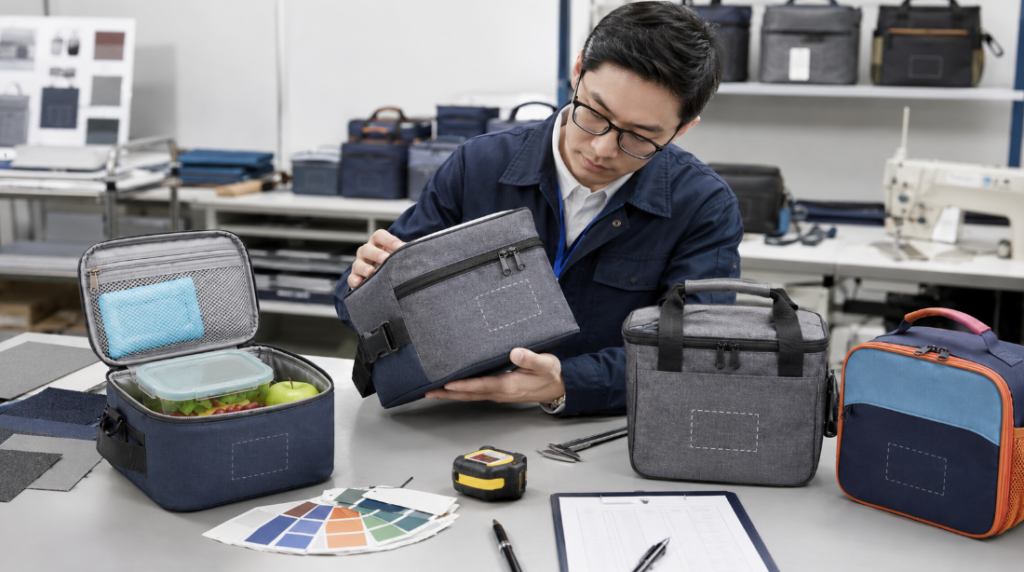
Define the Purpose of Your Insulated Lunch Bags
Before discussing fabric or logo methods, write one clear sentence that explains the product’s purpose. For example: “This bag is for office workers carrying one rectangular meal box, a drink bottle, cutlery, and one slim ice pack during a daily commute.” That sentence gives the factory more useful direction than asking for a “high-quality insulated lunch bag.”
Start with the usage environment. Will the bag sit in an air-conditioned office, a school locker, a hot vehicle, a construction site, or an outdoor sports area? Consider whether users will carry it for ten minutes or more than an hour. Then decide whether it will go inside a backpack, travel by hand, or hang from the shoulder. These questions influence coating, insulation, opening style, handle reinforcement, base structure, and overall weight.
Next, define the target user. Children usually need a smaller bag, simple zipper access, low carry weight, and a handle that suits a smaller hand. Adult commuters may prefer a clean shape that looks appropriate beside a work bag. Fitness users often carry meal-prep boxes, shaker bottles, snacks, and supplements, which creates a need for wider openings and better internal organization. Families may need a larger capacity, stronger handles, and a stable base.
Corporate gifts, promotional giveaways, and retail products should not use the same development logic. A corporate gift needs broad appeal, dependable branding, and a useful size that works for many users. Promotional items must balance print impact, packing efficiency, and repeat use. Retail products need stronger differentiation, better finishing, clearer feature benefits, and consistent performance that can support customer reviews and repeat orders.
Purpose also controls the material choice. A light polyester shell may be suitable for an event giveaway, while a dense Oxford fabric may be better for daily worksite use. A lifestyle brand may prefer canvas for texture, even though canvas is heavier and can show stains more easily. An RPET shell may support a recycled-material program, but the claim must match valid supply-chain documents.
Do not begin with a list of fashionable features. Begin with the job the bag must do. Well-planned Custom Lunch Bags grow from that job, not from a crowded feature list. Once that job is clear, useful features become easier to select and unnecessary features are easier to remove.
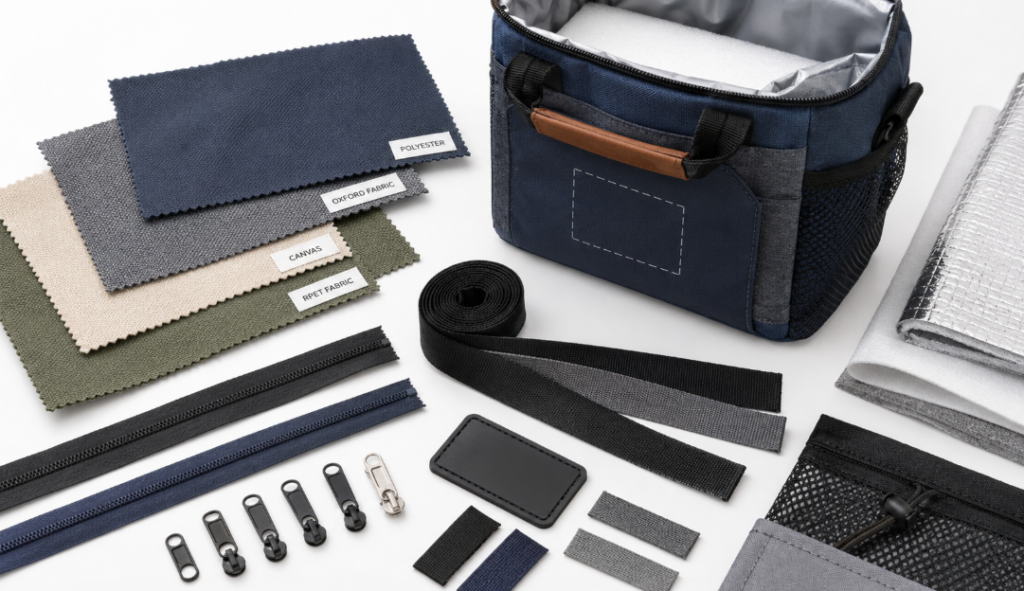
Choose the Right Outer Material
The outer material controls the first impression, but it also affects cutting, sewing, printing, cleaning, weight, shape, and long-term wear. Many buyers choose fabric by looking at a small swatch. That is not enough. A swatch does not show how the material behaves around foam, corners, zipper curves, binding, and load-bearing seams.
Polyester is the most common starting point for Custom Lunch Bags because it is light, widely available, stable in color, and suitable for many printing methods. Denser polyester Oxford fabrics can create a firmer, more durable body. Lighter polyester works well for compact or foldable designs, though it may show foam lines and wrinkles more easily.
Oxford fabric is not one single material. The term describes a woven construction and is often paired with specifications such as 300D, 600D, or 900D. Higher denier can suggest a heavier yarn, but denier alone does not prove abrasion resistance or coating quality. Ask about fabric weight, backing, water-repellent finish, tear strength, colorfastness, and the approved production lot.
Canvas offers a natural texture and a strong surface for screen printing, embroidery, and patches. It can suit lifestyle brands, gift collections, and reusable product lines. Yet it absorbs moisture more readily than coated synthetic fabric, may show dirt, and can vary in shade. Cotton-rich canvas may also shrink or change hand feel after cleaning. The factory should consider these points during pattern development.
RPET is recycled polyester made with recycled input. Its physical behavior can be similar to virgin polyester, but the environmental claim requires traceability. The Global Recycled Standard explained by Textile Exchange covers recycled content and chain-of-custody requirements, with added processing criteria under GRS. Do not rely on a fabric hangtag or a verbal statement. Check the certificate scope, supplier name, material description, validity, and transaction documents where required. buyer’s guide to the best materials for Custom Lunch Bags explains how outer fabric, foam, and lining work together. The table below gives a practical starting point.
| Outer material | Main strengths | Risks to control | Suitable positioning |
|---|---|---|---|
| Polyester | Lightweight, stable color, broad print compatibility | Thin fabric may wrinkle or show foam lines | Promotions, schools, office use, general retail |
| Oxford fabric | Structured appearance, abrasion resistance, water-repellent options | Stiff corners, coating variation, extra seam bulk | Work, outdoor, box-shaped lunch bags |
| Canvas | Natural texture, strong branding surface, premium casual feel | Staining, weight, shrinkage, shade variation | Lifestyle retail, gifting, reusable collections |
| RPET polyester | Familiar performance with recycled-content potential | Traceability gaps and unsupported claims | Sustainability-led programs and branded campaigns |
Water-repellent is not the same as waterproof. A coated shell may resist light rain, while water can still enter through seams, zipper tape, needle holes, or openings. Ask the supplier to define the test method and acceptance level. Marketing words should always connect to a measurable construction or test.
Choose the material after reviewing the bag’s purpose, expected lifetime, cleaning method, logo process, target market, and packing method. The best fabric is not the most expensive or the heaviest. It is the one that supports the product’s real job with the fewest hidden risks.
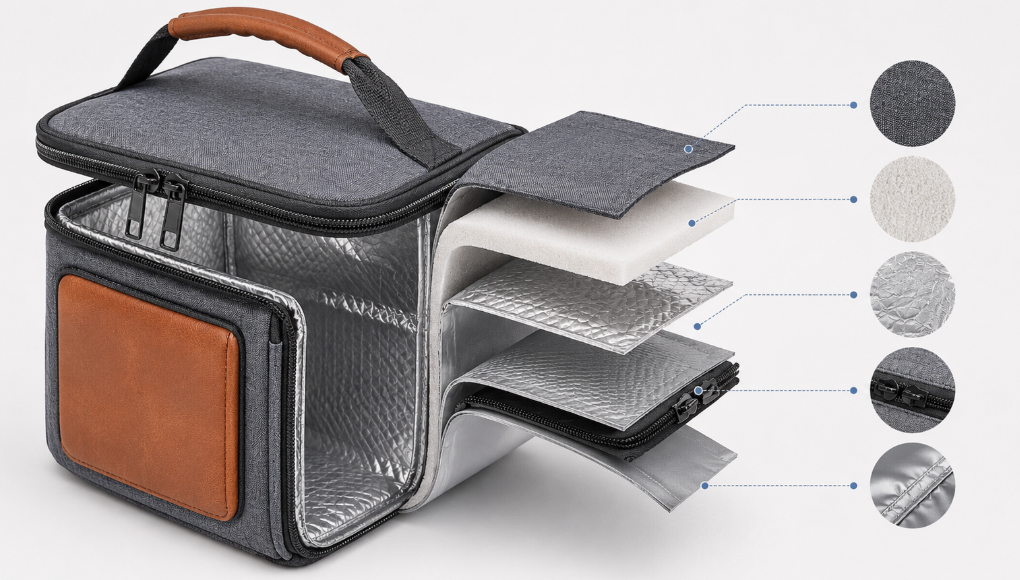
Pay Attention to the Insulation and Inner Lining
The insulation system is the part buyers cannot judge from product photos. Two bags may look almost identical while using very different foam density, lining thickness, coverage, and seam construction. Those hidden details often decide whether the bag feels stable, cleans well, and performs consistently.
EPE foam is widely used because it is light, flexible, and available in several thicknesses. Thin EPE can support compact promotional bags. A thicker or denser foam can improve structure and thermal resistance, but it also creates more bulk at corners and seams. Poor pattern allowance can compress the foam heavily, making the finished bag uneven.
EVA foam has better resilience in some constructions and can create a firmer hand feel. It may suit products that need stronger shape recovery. Odor, flexibility, lamination quality, and low-temperature behavior should be checked during sampling. Generic terms such as “high-density foam” are not enough. Request the material type, thickness, density where relevant, and an approved physical sample.
Aluminum-colored films are familiar because they give a thermal appearance and are easy to wipe. They are usually part of a laminate rather than a thick metal foil. Thin grades can crease, puncture, or separate from the backing. They should not be treated as the only insulation layer.
PEVA is a common lining for insulated lunch bags. It is flexible, moisture resistant, and easy to clean when the surface and construction are suitable. Quality varies. Thin PEVA may tear around needle holes, whiten at tight folds, or carry unwanted odor. A good pattern gives the lining enough ease so it is not pulled tight over the foam.
For textile and accessory safety, OEKO-TEX STANDARD 100 is one useful reference because certified articles are tested for harmful substances. A certificate still needs to match the exact material or component being supplied. Check the certificate number, validity, product class, article description, color range, and covered facility. Never assume that one certificate covers every lining, print, zipper, and accessory in a finished bag. anguage requires special care. Many lunches remain inside sealed food containers, so the bag lining may have indirect rather than direct food contact. Your specification should state the intended use and destination market. Ask for test reports that match the actual lining formulation, color, thickness, supplier, and use condition. The phrase “food-grade lining” has little value without supporting documents.
Leak resistance also depends on construction. A wipeable PEVA lining with normal stitched seams can still allow liquid to pass through needle holes. A separate drop-in liner, taped seams, welded construction, or sealed insert may improve control, but each option changes the production method and product feel. Define whether the bag needs to handle condensation, small spills, or standing liquid. These are different performance levels.
Thermal testing should use agreed conditions. Record the bag size, load, starting temperature, number of ice packs, ambient temperature, test duration, opening frequency, and measurement position. Without a controlled method, “keeps food cold for hours” is too vague for a procurement decision.
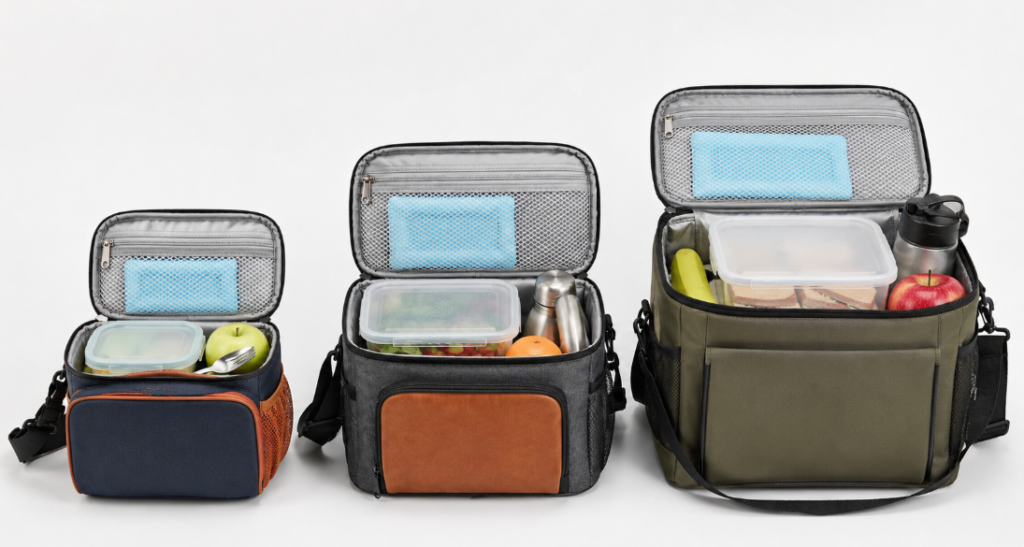
Select the Right Size and Capacity
Size errors are common because buyers often approve only external dimensions. Insulation, lining, seam allowance, binding, zipper curves, and wall thickness all reduce the usable internal space. A bag that measures 25 centimeters wide on the outside may not accept a 25-centimeter container.
Begin with the actual load. Collect the meal boxes, drink bottles, cutlery sets, fruit containers, snacks, and ice packs that users are likely to carry. Measure them in the packing position. A tall bottle requires headroom and a stable base. A wide bento box requires a large zipper opening. Several meal-prep containers may need a rectangular body and a reinforced bottom.
Capacity in liters can help compare general size, but it does not confirm fit. Shape matters. A narrow, tall bag and a wide, low bag may have similar volume while serving completely different containers. Internal corner radius also matters because rigid food boxes do not bend around curved seams.
Children’s lunch bags usually need less capacity, yet the design should leave enough room for easy packing. When a bag is filled too tightly, the zipper becomes difficult to close and the lining receives more stress. Adult office bags may need space for one main meal, a bottle, a snack, and an ice pack. Large-capacity bags may serve meal-prep users, families, field teams, or outdoor activities.
| Size category | Typical load | Design priorities | Common mistake |
|---|---|---|---|
| Small | Snack box, small drink, slim ice pack | Low weight, easy zipper, compact handle | Making the opening too narrow |
| Standard | Main meal box, bottle, cutlery, snack, ice pack | Balanced capacity, stable base, comfortable carry | Using external dimensions as usable space |
| Large | Multiple containers, large bottle, several ice packs | Reinforced handles, wide access, load balance | Adding volume without structural support |
A physical loading test should happen before bulk production because Custom Lunch Bags are judged by usable space, not catalog dimensions. Place the real containers inside the sample, close the zipper, carry the bag, set it down, and remove each item. Check whether the bag tips, bulges, strains at the zipper, or hides small items in deep corners. Test with the ice pack included because it takes meaningful space.
Allow practical clearance, but do not make the bag larger without reason. Excess empty air can reduce load stability and make the product feel bulky. Larger dimensions also affect fabric consumption, carton size, shipping volume, and display presentation. The right size feels easy to pack, easy to carry, and appropriate for the user’s routine.
Decide on the Structure and Functional Features
For Custom Lunch Bags, a strong feature list is not the same as a strong product. Every pocket, strap, divider, buckle, and zipper adds material, sewing operations, inspection points, and possible failure areas. Choose features that solve a defined user problem.
A single-compartment structure is easy to pack and clean. It works well when users carry one main container and a few small items. Multi-layer or divided bags can separate hot and cold items, dry and wet items, or meals and accessories. The divider must be positioned around real containers. A compartment that looks useful in a drawing may become too narrow after insulation and seams are added.
Handles should be designed for the expected load. Webbing can wrap under the bag or end at reinforced anchor points. Short stitch boxes on a thin outer panel may pull loose when the bag is full. For heavier styles, ask how the load travels from the handle into the body. Reinforcement should be part of the pattern, not added only after a test fails.
An adjustable shoulder strap improves carrying comfort for commuters and outdoor users. It also adds hardware, webbing ends, side attachment points, and twisting risk. Check strap width, adjustment range, hook shape, and anchor position. A strap attached too high can make the bag roll. A strap attached too low can distort the side panels.
Front pockets are useful for napkins, cutlery, or a phone, but the content should not press against food containers. Side mesh pockets can hold bottles, though the pocket depth and elastic recovery must match the bottle. Internal mesh pockets work well for ice packs or small accessories, provided they are easy to clean and do not trap crumbs.
Two-way zippers can improve access on wide openings. The zipper gauge, tape, slider, puller, and curve radius must work together. A strong zipper cannot fix a poorly shaped opening. Tight curves create slider resistance and extra stress. During sample review, open and close every zipper repeatedly with the bag empty and fully loaded.
Reinforced stitching matters at handles, strap anchors, zipper ends, and high-tension corners. Ask for the stitch type and reinforcement pattern rather than a general promise of “strong sewing.” Foldable designs need another type of review. Check whether the foam recovers after compression, whether the lining forms sharp permanent creases, and whether the closure keeps the folded bag secure.
Keep the product focused. A clean bag with a stable base, useful opening, comfortable handle, and easy-clean lining often creates more value than a crowded design with six weak features.
Choose the Best Logo Customization Method
Branding on Custom Lunch Bags must suit the fabric, artwork, bag structure, order quantity, expected use, and brand position. The same artwork can look sharp on smooth polyester and uneven on coarse canvas. A logo that works on a flat panel may distort after that panel is sewn around insulation.
Screen printing is suitable for simple artwork with solid colors and clear shapes. It can produce strong coverage on polyester, Oxford fabric, and canvas when the ink system and surface preparation are correct. Fine lines, small reversed text, and colors close to the fabric shade need careful testing.
Heat transfer works well for detailed graphics, gradients, and multicolor artwork. The press temperature and time must suit the outer fabric and coating. Too much heat can create shine, flatten texture, cause coating marks, or distort a laminated panel. A transfer should be tested for edge lifting, cracking, color change, and adhesion after flexing.
Embroidery creates texture and a premium appearance. It is often better for small to medium logos than large filled areas. Dense embroidery can stiffen the panel, compress the insulation, and cause puckering. The factory may need backing material or a separate patch construction to protect the lining and maintain a clean interior.
Woven labels are useful when the artwork includes small details or when you want a consistent private-label look across several products. Rubber or silicone patches can create a raised, durable finish, especially on outdoor or sporty designs. These patches require attention to mold detail, attachment method, edge comfort, and placement near folds.
Our custom logo bags guide covers the main branding methods and their use across different fabrics. Use the following table as a first screening tool, then approve a physical strike-off or sample.
| Logo method | Best for | Main advantages | Watch points |
|---|---|---|---|
| Screen printing | Simple solid-color logos | Clear, durable, efficient for repeated artwork | Ink coverage, fine details, color matching |
| Heat transfer | Detailed or multicolor designs | High detail and broad color range | Heat marks, adhesion, cracking, edge lift |
| Embroidery | Premium small or medium logos | Texture and strong perceived value | Puckering, panel stiffness, lining protection |
| Woven label | Private label branding and small details | Consistent appearance across product lines | Edge finish, label size, attachment quality |
| Rubber or silicone patch | Outdoor and sporty styles | Raised effect and good abrasion resistance | Mold detail, weight, placement, attachment |
Confirm logo size with a printed paper template placed on the sample. Digital mockups often make logos appear larger or better centered than they are in real life. Measure the distance from seams, zippers, pockets, and panel edges. Set color references using Pantone or an approved physical standard, and remember that ink color can shift on dark or textured fabric.
Logo approval should include position, dimensions, color, method, surface feel, and durability expectation. Keep the approved artwork file under revision control. A small artwork change after sampling can alter screens, transfers, stitch counts, labels, and the production schedule.
Understand MOQ and Customization Costs
Minimum order quantity is not only a factory rule. It is often created by the material supply chain. Fabric mills, coating suppliers, zipper dye houses, webbing suppliers, label makers, patch molders, and packaging printers may each have their own production minimums. A small bag order can still require a larger quantity of a custom component.
There is a major difference between adding a logo to an existing style and developing a fully custom product. An existing style may use available patterns, standard materials, regular colors, and established sewing methods. Full customization may require new patterns, several prototypes, custom-dyed fabric, printed lining, special hardware, unique zipper colors, molded pullers, custom labels, and new packaging.
Material selection is one cost driver, but construction complexity can be just as important. A thicker insulation layer creates more cutting and sewing difficulty. Multiple compartments require more panels, binding, and assembly steps. A leak-resistant insert may need different machinery or a specialist process. Reinforced handles, adjustable straps, shaped pockets, and custom hardware add operations and inspection points.
Logo design also affects the production plan. Several screen-print colors require separate screens and alignment. Large embroidery areas increase stitch count and may need stronger backing. Rubber patches can require a mold. Full-surface printing needs artwork setup, color control, and fabric compatibility testing.
Sampling, testing, packaging, inspection, and shipping preparation belong in the project plan even when no financial figures are included. A sample may use hand-cut materials or small-batch processes that differ from bulk efficiency. Packaging choices affect product protection, carton use, labeling, and warehouse handling. Third-party testing or inspection requires enough time and correct sample selection.
Ask the Lunch Bags Manufacturer to explain what drives the MOQ. Could stock fabric be used while keeping a custom logo? Can several colorways share the same lining, zipper, or webbing? Would a standard puller with a branded woven label work better than a new molded puller? Can one outer construction support two sizes? These questions reduce unnecessary complexity without weakening the product.
Avoid removing the features users notice most. Value engineering should protect fit, carrying comfort, zipper access, lining quality, logo appearance, and structural strength. Simplify hidden details that do not improve performance or brand value. That is a better approach than reducing every specification at the same time.
Confirm the Sample and Production Lead Time
For Custom Lunch Bags, a sample is not just a sales tool. It is the physical standard that connects your idea to bulk production. Approving it carefully reduces disputes because the factory, buyer, inspector, and production team can work from the same reference.
Complex projects may need more than one sample stage. A material swatch or print strike-off can confirm color and surface. The first prototype can test size, shape, opening, and structure. Your revised pre-production sample should use the approved materials, logo, accessories, labels, and packaging as closely as possible.
Check dimensions at several points, not only width, height, and depth. Measure the opening, base, pocket size, handle drop, strap range, zipper length, and internal usable space. Compare the material to the approved swatch. Review color under suitable light. Smell the lining and foam. Look for whitening, creasing, delamination, or tension near corners.
Logo approval needs physical review. Confirm size, color, position, edge quality, adhesion, stitch density, and surface feel. A photo can hide shine, texture, puckering, and minor color differences. When function matters, do not approve only from photographs or video.
Load the sample with the intended containers and ice packs. Carry it by the handle and shoulder strap. Open the zipper with one hand. Wipe the lining. Fold the bag if foldability is part of the design. Repeat these actions. The first use often feels fine; repeated handling reveals rubbing, twisting, weak anchors, and difficult corners.
Once approved, identify one “golden sample.” Sign or seal it and record the approval date. The purchase order, specification sheet, bill of materials, artwork, color references, label files, packaging instructions, test requirements, and inspection criteria must match the same revision. Mixed versions are a common source of production errors.
A capable Lunch Bags Manufacturer should show production lead time as milestones rather than one final date. Important stages include material booking, material approval, cutting, logo application, sewing, inline inspection, final inspection, packing, and shipment readiness. Late artwork, color changes, failed tests, or delayed packaging can stop the critical path.
A professional schedule includes buffer for correction. Fabric may arrive off shade. A print may need adjustment. Zipper tape may not match the approved color. Inline inspection may find a sewing issue that requires rework. Early communication is more valuable than an unrealistic promise that ignores normal manufacturing risk.
Choose a Reliable Insulated Lunch Bag Manufacturer
A reliable Lunch Bags Manufacturer should understand both bag making and the special risks of insulated construction. Ask how long the team has produced lunch bags, cooler bags, and other foam-lined products. Review products with similar shapes, materials, zipper curves, lining methods, and load requirements. A broad catalog is less useful than proof of relevant production knowledge. For a more detailed supplier review, see how to choose a reliable custom lunch bag manufacturer.
Confirm whether the supplier provides OEM and ODM services. OEM means the factory can follow your design, specification, and artwork accurately. ODM support should include pattern development, material advice, structural improvement, sampling, and production engineering. A good development team will question conflicting requests rather than simply agree to everything.
Inspect the factory’s control over key processes. Pattern making, cutting, printing coordination, sewing, lining insertion, reinforcement, inspection, packing, and corrective action should have clear owners. Specialized processes may be completed by approved partner factories, but the main supplier must control specifications, samples, incoming quality, and final acceptance.
Quality control should begin before sewing. Incoming Quality Control checks fabric, foam, lining, zippers, webbing, labels, and accessories against approved standards. In-Process Quality Control checks cutting accuracy, logo placement, foam alignment, seam quality, handle attachment, and color consistency before defects multiply. Final Quality Control verifies dimensions, appearance, zipper operation, structural strength, lining condition, packaging, and order quantity.
Ask to see the inspection checklist used for insulated lunch bags. It should include more than loose threads. Useful checkpoints cover internal dimensions, foam coverage, lining tension, zipper movement, handle reinforcement, pocket position, logo accuracy, odor, stain control, and leak testing when specified.
Certificates and audits need verification. ISO 9001 can show that a factory has a structured quality management system, but it does not prove that one product is thermally effective or leak resistant. Material reports apply only to the tested article and scope. Social audit programs also require careful review. The official amfori BSCI framework is designed to help businesses identify, assess, verify, and address social risks in supply chains. Check the audited legal entity, factory address, audit date, result, follow-up status, and whether the report is accepted by your customer. certificates as images in a sales presentation without checking the details. Match the company name and site address. Confirm validity with the issuing body or available database. Review whether subcontracted printing, welding, or other critical processes are covered by your supplier-control plan.
Communication is part of manufacturing quality. A dependable Lunch Bags Manufacturer should provide clear questions, written confirmations, revision control, realistic timing, and early warnings. Pay attention to how the supplier handles problems during sampling. A team that explains the cause, correction, and prevention method is more useful than one that hides issues until final inspection.
After-sales support should also be defined. Agree on how quality claims will be documented, what evidence is needed, who investigates the cause, and how corrective action will be managed. The goal is not to expect zero discussion. The goal is to choose a partner with a fair and organized process when something needs attention.
Conclusion
Customizing insulated lunch bags requires more than selecting a color and placing a logo. You need to define the user, load, environment, insulation goal, cleaning method, target market, and brand position. Those decisions guide the outer material, foam, lining, dimensions, opening, carrying system, pockets, reinforcement, and logo process. You can review HeteBag’s custom lunch bag manufacturing options when preparing the specification for your project.
Treat the sample as a working product, not a display piece. Load it with real containers. Test the zipper, handles, lining, balance, and usable space. Confirm every approved detail in one controlled specification before bulk production starts. This step protects both the buyer and the factory.
MOQ, development effort, and production timing become easier to manage when the design has a clear priority order. Protect the features that users feel every day: fit, comfort, access, cleanability, insulation, strength, and branding. Simplify details that add complexity without adding real value.
Supplier selection should go beyond catalog images and sales promises. Review relevant manufacturing experience, OEM and ODM capability, material documents, audit scope, quality checkpoints, sample discipline, and problem-solving methods. A reliable partner should help you identify risk before production, not only inspect defects after the order is finished.
Hetebag is based in Huadu, Guangzhou, China, and operates its own production facility for custom bag development and manufacturing. With 15 years of industry experience since 2011, our team has developed OEM and ODM bags for international brands, wholesalers, distributors, and sourcing teams. We also coordinate with established manufacturing partners when a project needs specialized processes. Our work covers material selection, product development, sampling, production management, inspection, packing, and export support. oking for a dependable manufacturer for Custom Lunch Bags or other custom bag categories, you can leave your phone number and project details through our website. Tell us what the bag needs to carry, who will use it, your preferred materials, logo artwork, quantity plan, and target schedule. We will be glad to review the project with you and explore how we can work together.
Frequently Asked Questions
What is the difference between stock lunch bags and fully custom lunch bags?
Stock lunch bags use an existing design and usually only allow logo printing or simple color changes. Fully custom lunch bags can be developed with your own size, materials, structure, features, colors, and packaging.
What materials are commonly used for insulated lunch bags?
Common outer materials include polyester, Oxford fabric, canvas, and RPET polyester. The insulation layer often uses EPE or EVA foam, while PEVA or aluminum-style film is commonly used for the inner lining.
How do I choose the right lunch bag size?
Start with the actual food containers, drink bottles, cutlery, and ice packs that users will carry. Test these items inside a physical sample before approving the final size.
Can I add my logo to insulated lunch bags?
Yes. Common logo methods include screen printing, heat transfer, embroidery, woven labels, and rubber patches. The best option depends on the fabric, artwork, logo size, and order requirements.
How long can an insulated lunch bag keep food cold?
The result depends on the insulation thickness, lining, bag size, ambient temperature, ice packs, starting food temperature, and how often the bag is opened. A clear test method should be agreed before production.


