
 Arabic
  English
  Italian
  French
  German
  Spanish
 A material swatch can look right and still produce a bag that is too heavy, too soft, difficult to clean, or costly to make consistently. Buyers comparing materials for custom bags need to connect fabric and leather choices with the finished structure, carrying load, branding method, and order quantity.
This guide compares ten common material families and explains what to confirm before approving samples. Use it as the main material-selection guide, then follow the focused comparisons below when your project needs more detail.
Find the Right Material Comparison for Your Project
| Buyer decision | Focused guide | What to compare |
|---|---|---|
| Natural textile or technical synthetic? | Canvas vs Nylon Bags | Weight, handle feel, construction, branding, and care |
| Which polyester specification suits the load? | 420D vs 600D Polyester | Denier, GSM, weave, coating, and sample performance |
| Which material fits a handbag collection? | Materials for Custom Ladies Handbags | Drape, reinforcement, finish, hardware, and production consistency |
| Which environmental claim can be supported? | Eco-Friendly Materials for Custom Bags | Component composition, traceability, durability, and claim scope |
Compare available material directions on our مواد تصنيع الحقائب حسب الطلب page before requesting project-specific swatches.
What Makes a Material Suitable for Custom Bags?
Before diving into individual materials, it helps to understand the evaluation criteria that matter most in a B2B context. Consumer buyers judge bags by aesthetics. Procurement teams and brand managers need to think more systematically.
Durability and Load-Bearing Capacity
Material suitability depends on the actual construction, not its name alone. A 600D polyester Oxford may be a candidate for a backpack or tool bag, but the weave, coating, reinforcement, expected load, and agreed performance checks determine suitability. Compare equivalent specifications and evaluate the completed bag under its intended use conditions.
Water Resistance and Ease of Cleaning
Not all water resistance is the same. There is a significant difference between a fabric with a DWR (durable water repellent) coating, a PU-laminated fabric, and a fabric woven tightly enough to resist light rain on its own. Understanding this distinction helps you communicate requirements clearly to a manufacturer and verify that what you are receiving matches what was specified.
Appearance, Texture, and Brand Positioning
Material communicates brand values before a customer reads a single word of copy. Recycled PET fabric signals environmental responsibility. Full-grain leather signals craftsmanship and longevity. Canvas signals a casual, heritage quality. Whatever your brand story, there is a material that reinforces it — and a material that undermines it. This alignment is not a soft consideration; it directly affects customer perception and repeat purchase rates.
Cost, MOQ, and Customization Options
Raw material cost is only part of the production equation. Cutting complexity, seam density, hardware requirements, and finishing processes all affect total unit cost. Some materials are also difficult to source at low quantities, which matters significantly for brands testing new SKUs. When evaluating a material, always ask your manufacturer about the minimum viable run for that material at your target specification.
Cotton Canvas
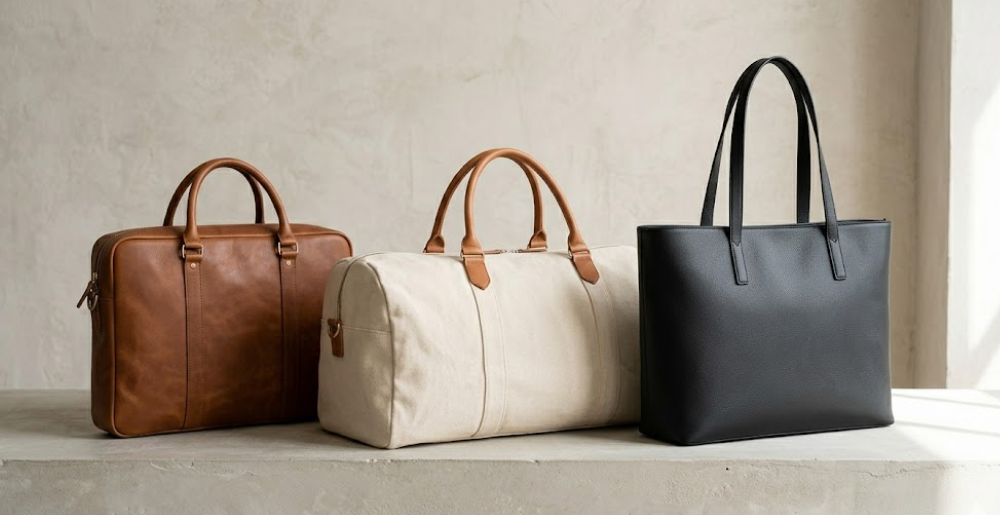
Cotton canvas has been used in bag manufacturing for well over a century — and it earns its place. The material is made from tightly woven natural cotton fibers, which gives it a characteristic weight and texture that synthetic alternatives cannot fully replicate. For brands building around a natural, heritage, or artisanal aesthetic, canvas is often the obvious choice.
Key Features and Advantages
Canvas is breathable, biodegradable, and holds dye well. It has good structural integrity under moderate loads and softens with use in a way many consumers find appealing. Heavy-weight canvas (12oz to 16oz and above) has meaningful durability; lighter weights (6oz to 8oz) work well for fashion totes where weight and drape matter more than load-bearing strength.
One practical advantage from a production standpoint: canvas is easy to work with. It cuts cleanly, sews consistently, and accepts a wide range of finishing treatments including waxing for water resistance and heat-pressed laminates for added strength.
Best Uses for Tote Bags, Shopping Bags, and Promotional Bags
Canvas is the preferred material for حقائب حمل مخصصة, reusable shopping bags, and promotional items at trade shows and events. The surface accepts high-quality screen printing exceptionally well, making logos and artwork vivid and sharp. Embroidery also sits beautifully on canvas without puckering, which matters for brands that want a premium hand-feel on a moderate budget.
Printing and Embroidery Options
Screen printing is the most cost-effective decoration method for large runs on canvas. For shorter runs, DTG (direct-to-garment) digital printing works well and allows full-color complexity without screen setup costs. Embroidery adds tactile depth and perceived value; it works particularly well on canvas with a weight of 10oz and above.
One note on canvas and water resistance: untreated cotton canvas will absorb moisture. If water resistance is a specification requirement, your manufacturer should apply either a wax treatment or a synthetic coating. Both change the hand of the material somewhat, so request a sample before approving production.
البوليستر
Polyester is the workhorse of the custom bag industry. It is affordable, available at virtually any weight and weave, accepts dye and coatings reliably, and performs well across a broad range of end uses. If you have ever received a branded backpack at a corporate event or purchased a budget travel duffel, there is a very good chance it was made from some form of polyester.
Durability, Affordability, and Water Resistance
Polyester can offer useful dimensional stability and relatively quick drying, depending on its construction and finish. Coatings may improve resistance to water penetration, but sustained-rain and colorfastness claims require relevant evidence. Seams, closures, lining, and the completed bag must also be evaluated where weather protection matters.
The cost advantage of polyester is real and material in pricing decisions. A polyester backpack can be produced at a fraction of the cost of an equivalent design in nylon at the same weight class, which makes it attractive for promotional campaigns and volume-driven programs where per-unit cost is the primary constraint.
Common Fabric Specifications and Coatings
In manufacturing, polyester is typically specified by its denier rating — a measure of fiber thickness. Lower denier fabrics (150D, 210D) are lighter and more suitable for fashion-oriented products. Higher denier fabrics (600D, 1200D) are significantly heavier and more abrasion-resistant. Common coatings include PU (polyurethane) for water resistance, PVC for rigidity and heavy-duty protection, and TPU for a more flexible waterproof finish.
Best Uses for Backpacks, Travel Bags, and Sports Bags
Polyester’s combination of durability, printability, and cost efficiency makes it ideal for custom backpacks, travel duffels, and sports bags. For a more detailed comparison with other synthetic options, the article on backpack materials — nylon vs. polyester vs. canvas provides a thorough breakdown of performance trade-offs that many procurement teams find useful during specification reviews.
النايلون
Nylon sits at the premium end of synthetic bag fabrics. It costs more than polyester, but it earns that premium in specific performance categories — particularly abrasion resistance, tear strength, and weight efficiency. For applications where durability relative to fabric weight is the priority, nylon is frequently the correct specification.
Lightweight Strength and Abrasion Resistance
Nylon can be a useful candidate when strength relative to weight and abrasion performance matter. However, equal denier does not establish equal weave, GSM, yarn quality, or coating. Compare physical samples and relevant test results before ranking nylon against polyester for a specific bag.
Nylon also has a characteristic sheen and smooth hand that many brands associate with a premium aesthetic. The material drapes well and maintains its appearance after repeated use, which matters in categories like luggage, laptop bags, and commuter bags where the product is highly visible in professional settings.
Common Nylon Types Used in Bag Manufacturing
The two nylon variants you will encounter most often in bag production are Nylon 6 and Nylon 6,6. Nylon 6,6 has a higher melting point and slightly better abrasion resistance; it is commonly used in higher-specification technical products. Ripstop nylon — woven with a reinforcing cross-hatch pattern to prevent tears from propagating — is widely used in outdoor and travel applications where puncture resistance matters. Ballistic nylon, originally developed for military use, offers exceptional toughness and is used in premium laptop bags and heavy-duty luggage.
Best Uses for Outdoor, Sports, and Technical Bags
Nylon is the material of choice for hiking packs, technical daypacks, gym bags built for durability, laptop backpacks, and travel bags intended for frequent air travel. Its higher cost per yard is generally justified in any product positioned above entry-level pricing, where the end user expects multi-year performance.
قماش أكسفورد
Oxford fabric is a basket-weave construction — typically woven in a 2×2 or 4×4 pattern — that produces a distinctive visible texture and a more substantial hand than standard plain-weave fabrics. It is one of the most widely used bag fabrics globally, across categories from budget promotional bags to mid-range travel products.
Fabric Structure and Performance
The basket-weave structure of Oxford fabric creates air pockets between fiber bundles that add bulk and visual texture without proportionally increasing material weight. The result is a fabric that looks and feels more substantial than its denier count might suggest. This makes it popular in categories where perceived quality matters — you want the bag to feel solid in the customer’s hands before they have used it for a single day.
Oxford fabric also takes coating well. PU-coated Oxford is water-resistant and abrasion-tolerant, which extends its usable range into outdoor and travel applications. The fabric tends to hold its shape better than lighter synthetics, which benefits structured bag designs.
Differences Between Polyester and Nylon Oxford Fabric
Oxford fabric can be woven from either polyester or nylon fiber, and the choice matters. Polyester Oxford is more affordable and color-stable; it is the dominant option for promotional products and budget-tier travel bags. Nylon Oxford is stronger, more abrasion-resistant, and has a slightly richer appearance. For premium products where the budget allows, nylon Oxford is worth the additional cost. For high-volume programs where per-unit economics are the constraint, polyester Oxford delivers strong value.
Best Uses for Backpacks, Tool Bags, and Travel Bags
Oxford fabric is a reliable specification for custom backpacks, laptop bags, tool bags, and mid-range travel duffels. Its texture creates a visual interest that plain fabrics lack, and its performance profile is well-matched to everyday utility applications. It is one of the most forgiving fabrics to source — available at a wide range of weights, coatings, and price points from a broad supplier base.
جلد طبيعي
Genuine leather occupies a category of its own in bag manufacturing. It is the only material on this list that improves with use — developing a patina over time that reflects the individual owner’s life and care. For brands building in the premium or luxury segment, leather is often not a question of preference but of category expectation.
Premium Appearance and Long-Term Durability
High-quality leather is remarkably durable. A well-made leather bag, properly cared for, can last decades — and the best examples become heirlooms. This durability story is a genuine product advantage that no synthetic material can replicate authentically. From a brand equity perspective, leather communicates investment, permanence, and craft in a way that resonates with premium buyers.
The key quality differentiation in leather is the hide grade. Full-grain leather retains the complete outer layer of the hide, with all its natural texture and fiber density. It is the most durable grade and develops the most attractive patina over time. Top-grain leather has the outer layer sanded or buffed for a more uniform appearance; it is slightly less durable but more consistent-looking. Genuine leather and bonded leather sit below these grades and are used in more affordable price tiers where leather aesthetics matter but cost must be controlled.
Common Leather Types and Finishing Options
The most commonly used leather types in bag manufacturing include cowhide (the most widely available, with consistent quality across grades), lambskin (extremely soft and supple, preferred for fashion bags and small leather goods), pebbled leather (embossed with a texture that hides scratches well and suits everyday bags), and saffiano leather (cross-hatch embossed, scratch-resistant, widely associated with premium fashion brands).
Finishing options are extensive: vegetable tanning (slower, more sustainable, produces stiffer leather with excellent aging characteristics), chrome tanning (faster, more consistent, produces softer leather), and various surface treatments including waxes, oils, and lacquers that affect both appearance and water resistance. Brands working on حقائب يد مصنوعة حسب الطلب in leather should expect longer lead times for sampling and material sourcing compared to synthetic options — quality leather supply chains require more planning.
Best Uses for Handbags, Briefcases, and Luxury Collections
Leather is the specification for premium handbags, business briefcases, luxury travel accessories, and any product positioned at a price point where the customer expects natural material quality. It requires more skilled craftsmanship to work with than synthetics, and production costs are higher — but the margin and brand positioning premium in this category more than compensates for serious brand builders.
جلد PU
PU leather — polyurethane leather — is a synthetic material engineered to replicate the visual and tactile qualities of genuine leather at a fraction of the cost. The quality range in PU leather is genuinely wide; at the lower end, the difference from genuine leather is obvious. At the upper end, well-engineered PU leather can be difficult to distinguish from mid-grade genuine leather in photographs and first handling.
Cost-Effective Alternative to Genuine Leather
The economics of PU leather make it attractive for brands that want leather aesthetics without genuine leather budget requirements. Production costs are substantially lower, MOQs are more accessible, and consistency is actually more predictable than genuine leather since the surface is manufactured rather than sourced from natural hides that vary between animals and seasons.
The primary limitations of PU leather are longevity and feel over time. High-quality genuine leather improves with age; PU leather does not. Cheaper grades will peel, crack, or delaminate with use. When sourcing PU leather, always request durability test results and specify the thickness and substrate backing you expect.
Available Textures, Colors, and Finishes
PU leather offers almost unlimited surface variety. It can be embossed to replicate virtually any leather grain — pebble, saffiano, croc, snake, ostrich, and smooth. It is available in a far broader color range than genuine leather, including fashion colors that would be difficult or impossible to achieve with natural dye on animal hides. Metallic, matte, and gloss finishes are all accessible. This makes PU leather particularly well suited to fashion-driven categories where trend responsiveness and color flexibility matter as much as material authenticity.
Best Uses for Fashion Bags, Cosmetic Bags, and Gift Bags
PU leather is widely used in fashion handbags, custom makeup bags, cosmetic pouches, and corporate gift sets. Its combination of leather-like aesthetics, color flexibility, and accessible cost makes it one of the most versatile materials in the B2B custom bag market. For buyers working with mid-range budgets who need a premium-looking product, PU leather frequently delivers the best balance of visual impact and unit economics.
نسيج RPET
RPET — recycled polyethylene terephthalate — is polyester fabric produced from post-consumer plastic bottles. It has become one of the most strategically important materials in the custom bag industry over the past several years, driven by brand sustainability commitments and the growing purchasing influence of environmentally conscious buyers.
How Recycled Polyester Is Produced
The production process involves collecting post-consumer PET plastic (primarily water and beverage bottles), cleaning and shredding them into flakes, melting and extruding the flakes into fiber, and then spinning and weaving that fiber into fabric. The process requires significantly less energy and water than virgin polyester production and diverts plastic from landfill and ocean waste streams.
In manufacturing terms, RPET fabric behaves very similarly to virgin polyester. The performance characteristics — tensile strength, abrasion resistance, dyeability, coating acceptance — are comparable. The difference is in the origin of the raw material, not the end performance.
Sustainability Benefits and Certification Considerations
From a brand positioning standpoint, RPET carries meaningful sustainability credentials. The Global Recycled Standard (GRS), administered by Textile Exchange, is the most widely recognized third-party certification for RPET content claims. If you plan to communicate recycled content in your product marketing, working with a manufacturer who can supply GRS-certified fabric and documentation is essential. Without chain-of-custody certification, sustainability claims are difficult to substantiate and carry regulatory and reputational risk.
RPET is also compatible with other certification frameworks including OEKO-TEX STANDARD 100 for chemical safety, which many brands now require as standard across their supply chains.
Best Uses for Eco-Friendly Branded Bags
RPET is the natural specification for brands with public sustainability commitments — consumer goods companies, outdoor brands, corporate gifting programs with ESG reporting requirements, and any organization targeting environmentally aware demographics. It works well across a wide range of bag types: totes, backpacks, duffels, and travel bags can all be produced in RPET with performance equivalent to conventional polyester.
Neoprene
Neoprene is a synthetic rubber material that has found a specific and durable niche in bag manufacturing. Its softness, flexibility, and compression-resistance make it well suited to protective applications — bags and sleeves where the primary job is cushioning and conforming around the contents rather than carrying heavy loads.
Softness, Flexibility, and Protective Performance
Neoprene compresses under force and returns to its original shape when pressure is released. This resilience is what makes it valuable in protective bag applications. A laptop sleeve or tablet case in neoprene absorbs incidental impacts — being dropped into a bag, knocked against a table edge — in a way that fabric bags cannot. The material is also naturally water-resistant at the surface level, which adds protective value in everyday environments.
Neoprene has a distinctive soft, slightly stretchy hand that many users find appealing. It conforms to the object it contains, which creates a snug fit and reduces internal movement — another protection benefit. These qualities make neoprene feel like a considered, functional material choice rather than a cost-driven one.
Best Uses for Laptop Sleeves, Bottle Bags, and Lunch Bags
Neoprene is well matched to laptop sleeves, tablet cases, wine bottle carriers, حقائب غداء مخصصة, and camera pouches. Its thermal insulation properties — modest but real — make it particularly relevant for food and beverage applications where temperature maintenance adds value. For corporate gifting programs that include tech accessories, neoprene laptop sleeves are a high-perceived-value item that can be produced in custom colors and with logo decoration.
Logo and Color Customization Options
Neoprene accepts several decoration methods. Screen printing works on flat panels before construction and produces clean, precise results. Sublimation printing can achieve full-coverage photographic quality on polyester-faced neoprene, which is the most common variant used in bag manufacturing. Embossing is also possible on thicker neoprene. The material is available in a broad range of base colors and can be laminated with fabric on one or both faces for different aesthetic effects.
Non-Woven Fabric
Non-woven fabric is produced by bonding fibers together through heat, chemical, or mechanical processes rather than weaving or knitting. The result is a fabric-like material that is lightweight, inexpensive to produce, and extremely versatile for low-cost promotional applications.
Lightweight Construction and Low Production Cost
The cost advantage of non-woven fabric is its most significant attribute. It can be produced rapidly at very high volumes and cut and constructed with minimal labor intensity. This makes non-woven bags — particularly the familiar reusable shopping bags seen at retail checkouts and trade show giveaways — among the lowest-cost custom bag options available.
Weight is measured in grams per square meter (GSM), and the typical range used in bag production runs from around 70 GSM (very lightweight, suitable for single-use applications) to 120 GSM and above (more substantial, with better durability for repeated use). Polypropylene is the most common fiber used, though polyester and other fibers are also processed into non-woven fabrics.
Best Uses for Promotional, Shopping, and Event Bags
Non-woven bags are best deployed where cost and volume are the primary objectives: retail checkout bags, conference and trade show giveaways, supermarket promotions, and event merchandise. The low per-unit cost enables large-quantity programs that would be prohibitive in woven fabrics.
Limitations in Durability and Premium Positioning
Non-woven fabric has real limitations that should be understood before specification. It is significantly less durable than woven fabrics — the bonded fiber structure breaks down with repeated use and washing in a way that woven materials do not. It also has a less premium hand and appearance that positions it firmly at the promotional rather than branded product end of the market. For brands where product quality and longevity are central to positioning, non-woven is unlikely to be the right choice beyond promotional applications.
Cork Fabric
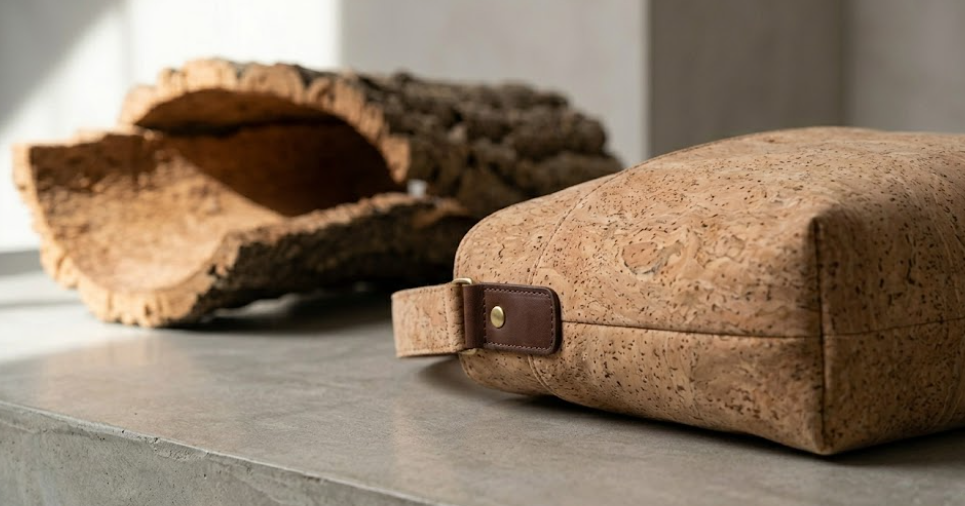
Cork fabric is one of the more interesting emerging materials in custom bag production. Harvested from the bark of cork oak trees — a renewable process that does not harm the tree — cork is processed into a thin, flexible sheet that can be laminated onto a textile backing for use as a bag exterior material. It has a distinctive natural texture that is immediately recognizable and strongly associated with sustainability.
Natural Texture and Sustainable Appeal
The visual and tactile quality of cork is genuinely distinctive. Its natural grain pattern, warm earthy tones, and slightly waxy surface create an aesthetic that synthetic materials cannot convincingly replicate. For brands building around environmental values or natural materials, cork offers a tangible material story — customers can see and feel the sustainability claim rather than just reading it on a hang tag.
Cork oak forests in Portugal and Spain are one of Europe’s most important biodiversity habitats. Harvesting cork bark is a traditional, low-impact practice that has been conducted for centuries. The ecological credentials of cork are well established and verifiable, which matters for brands that face scrutiny around greenwashing claims.
Durability, Water Resistance, and Maintenance
Cork fabric is more durable than many people expect. The natural cellular structure of cork is resistant to moisture, and the surface does not stain as readily as untreated canvas. It is, however, more susceptible to cracking or surface damage under stress concentrations than synthetic materials. Design details — reinforced corners, careful hardware placement, and avoiding tight radii at fold points — matter more with cork than with synthetic fabrics.
Best Uses for Fashion Bags and Eco-Focused Brands
Cork is most compelling in fashion bags, small leather goods, and accessories for brands explicitly positioned around natural materials and sustainability. Clutches, mini crossbody bags, card holders, and fashion totes are well-suited to cork because the bag size and typical use pattern align with the material’s performance characteristics. For heavy-duty or large-format bags where structural integrity under load is essential, cork would typically not be the first recommendation.
Custom Bag Material Comparison
The following table summarizes the key performance, cost, and sustainability attributes of each material discussed in this guide. Use it as a quick reference when narrowing down your specification options.
| المواد | المتانة | مقاومة الماء | مستوى التكلفة | Sustainability | Recommended Bag Types |
|---|---|---|---|---|---|
| Cotton Canvas | متوسط | Low (untreated) / Medium (coated) | Low–Medium | High (natural fiber) | Totes, shopping bags, promotional bags |
| البوليستر | Medium–High | Medium–High (coated) | منخفض | Medium (RPET variant: High) | Backpacks, sports bags, travel bags |
| النايلون | مرتفع | Medium–High | Medium–High | متوسط | Outdoor, technical, laptop bags |
| قماش أكسفورد | Medium–High | Medium–High (PU coated) | Low–Medium | متوسط | Backpacks, tool bags, everyday bags |
| جلد طبيعي | مرتفع جدًّا | Medium (finished) | مرتفع | Medium (natural, long-lasting) | Handbags, briefcases, luxury goods |
| جلد PU | متوسط | مرتفع | Low–Medium | Low–Medium | Fashion bags, cosmetic bags, gift bags |
| نسيج RPET | Medium–High | Medium–High | Low–Medium | Very High (certified recycled) | Eco branded bags, totes, backpacks |
| Neoprene | متوسط | High (surface level) | متوسط | متوسط | Laptop sleeves, lunch bags, bottle bags |
| Non-Woven Fabric | منخفض | Low–Medium | Very Low | Low–Medium (PP-based) | Promotional bags, event giveaways |
| Cork Fabric | متوسط | متوسط | Medium–High | High (renewable harvest) | Fashion bags, eco accessories, clutches |
How to Choose the Right Material for Your Custom Bag
Material selection decisions are rarely made in isolation. The right choice emerges from the intersection of your product requirements, your brand positioning, your production budget, and your supply chain realities. Here is a practical framework that has guided hundreds of product development conversations over the course of my career.
Start with the End Use Environment
Where will this bag be used, and what conditions will it face? A beach bag needs moisture and salt tolerance that a corporate laptop bag does not. A promotional trade show bag that will be used once or twice needs to survive the event and little more. A premium travel bag needs to handle checked-luggage systems, overhead bins, and outdoor exposure across years of trips. Each use environment points toward a different material profile.
Define Your Non-Negotiable Performance Requirements
Write down the performance attributes that would constitute a product failure if absent — not preferences, but minimums. Waterproofing to a specific hydrostatic head rating. Tensile strength at the handle attachment point. Colorfastness after a defined number of wash cycles. Weight under a certain threshold. Once you have this list, use it to screen out materials that cannot meet the threshold rather than trying to rank materials against each other across all criteria simultaneously.
Align Material to Price Point and Margin Structure
The material cost needs to work within your target retail price and margin. A useful rule: if you are uncomfortable with the material cost relative to your target FOB price for the finished bag, the material is probably wrong for this product. Either the margin will suffer or the retail price will be hard to justify. Neither outcome serves the brand. Material cost and production complexity tend to move together, so a switch to a more expensive material will typically also increase labor and production time — both are worth factoring.
Check Certification Requirements Early
If your product needs to carry sustainability claims, chemical safety certifications, or comply with import regulations in your target market, the material you choose must be able to support those requirements. Certifications like OEKO-TEX STANDARD 100, GRS for recycled content, and BSCI audit compliance all depend on supply chain traceability that must be established at the material sourcing stage. Trying to retrofit certification to a material choice made without these requirements in mind is significantly more difficult and sometimes impossible.
Request Physical Samples Before Committing to Production
This should be obvious, but it is overlooked often enough to state explicitly. Material performance data from spec sheets is useful. A physical sample in your hands — evaluated for hand, weight, colorfastness, water resistance, and seam behavior under load — is essential. No amount of denier rating or coating specification data fully substitutes for holding the material and stress-testing it against your requirements.
What to Include in a Material Approval Brief
Identify the bag type, intended load, cleaning method, target market, and quantity by design and color. Specify the fiber or leather construction, GSM or thickness, weave, backing, coating, color, lining, logo method, and an approved swatch reference. Agree which material and finished-bag checks are needed, their conditions, and acceptance criteria before bulk approval.
Record any substitute material used in a prototype. It may demonstrate shape without proving the final material’s appearance or performance. Keep approved swatches, sample revisions, and supplier material codes together so repeat orders can be checked against the same specification.
الخلاصة
Material selection in custom bag development is not a decision to rush. The fabric or substrate you choose defines what is achievable in terms of performance, aesthetics, sustainability, and cost — and it cascades into every other production decision that follows. The ten materials covered in this guide represent the options that professional buyers, brand managers, and product developers encounter most frequently in real sourcing conversations.
Each has genuine strengths in the right context, and genuine limitations in the wrong one. Cotton canvas delivers natural warmth and print quality that no synthetic can match, but it needs coating to perform in wet conditions. Nylon outperforms polyester on abrasion resistance and premium aesthetics, but the cost premium needs to be justified by the product positioning. Genuine leather provides longevity and brand equity that no synthetic alternative authentically replicates, but it demands skilled manufacturing and longer lead times. RPET delivers sustainability credentials that are increasingly essential for brands with public environmental commitments. Understanding these trade-offs clearly — rather than defaulting to whatever was used in the last product — is what separates strong product development from reactive sourcing.
If you are at the material selection stage and want to move forward with confidence, the next practical step is to work with a manufacturer who has genuine experience across these materials — not just the ability to source whichever you request, but the technical knowledge to advise you when your specification might create problems downstream in production or in the field.
Work With an Experienced Custom Bag Manufacturer
هيتباغ هو custom bag manufacturer based in Huadu, Guangzhou, with over 15 years of production experience and an established export network reaching more than 70 countries. The facility works across all the material categories covered in this guide — from recycled RPET to full-grain leather — and has built production partnerships with multiple specialized factories to handle the full range of bag types and complexity levels that international buyers require.
If you are evaluating suppliers for your next custom bag program, you are welcome to reach out directly through the website. Leave your contact details and a brief description of your project, and the team will be in touch to discuss your requirements. Whether you are at the early material exploration stage or ready to move to sampling, a conversation with people who have made these products for 15 years costs nothing and tends to save significant time and budget downstream.
Connect with Hetebag: hetebag.com/contact-us/
الأسئلة الشائعة
What is the best material for custom bags?
The best material depends on carrying load, structure, cleaning, appearance, logo method, and production requirements. Compare representative swatches and a completed sample rather than selecting by material name alone.
Is polyester or nylon better for bags?
Neither is always better. Compare yarn construction, GSM, weave, finish, coating, and relevant test results for equivalent applications. Denier alone does not prove that one fabric will outperform the other.
Which bag material is water-resistant?
Coated or laminated fabrics may improve water resistance, but the finished bag also depends on seams, zippers, closures, and assembly. Define the intended exposure and verify the complete construction before making a waterproof claim.
What is the best eco-friendly bag material?
Consider the specific objective: recycled content, certified organic fibers, reduced material use, or repeated use. Check the component composition, documentation, durability, and disposal conditions; a material name alone does not establish lower overall impact.


