
 English
  Italian
  French
  German
  Spanish
  Arabic
 If you are planning to customize a batch of drawstring backpacks for a brand, event, school, fitness program or retail business, you will soon encounter a problem: Products that look similar can have such a big difference when you actually receive them.
Over the years that we have been making drawstring backpacks, we have found that when many buyers first contact the factory, the first question they usually ask is “Can you make it according to this picture?” In fact, the picture can only solve the appearance issue. What truly determines whether a bag can be well-made and whether it can be steadily mass-produced is the details that are not shown in the picture.
For example, the same black drawstring backpack made with 210D polyester, 420D polyester or cotton fabric will have completely different hand-feel, load-bearing capacity, printing effect and usage scenarios. The logo may only be placed on the front, but when it is changed to screen printing, heat transfer printing or embroidery, the requirements for the fabric and production method will also change.
This is a key point: Customizing drawstring backpacks is not simply choosing an existing style and then printing the logo. Usually, in a successful project, the size, material, structure, process and inspection standards are usually confirmed before mass production. In this article, from the perspective of actual production, we hope it will be helpful to you.
1. Understanding Your Custom Drawstring Backpack Requirements
Before asking a factory to quote or prepare a sample, define how the backpack will actually be used. This affects almost everything that comes later.
A lightweight promotional backpack made for brochures and event giveaways does not need the same construction as a sports drawstring backpack carrying shoes, clothing, and a water bottle. A cotton drawstring bag sold by a lifestyle brand may focus more on hand feel and printing quality. A gym bag may need stronger fabric, reinforced corners, and a cord that stays comfortable when the bag is loaded.
Your specification should connect the design to the intended use rather than simply listing dimensions and colors.
Define Size, Capacity, and Intended Use
Start with the finished width and height of the backpack. If capacity matters, think about what the customer is expected to put inside rather than relying only on a liter measurement.
You should also confirm whether the stated dimensions are finished dimensions or cutting dimensions. Buyers normally need finished measurements. Cutting dimensions are larger because fabric is consumed by seams, hems, channels, and folded edges during production.
Load requirements deserve attention too. Thin polyester can work perfectly well for lightweight promotional use, while a bag carrying sports equipment may require denser fabric and stronger stress-point construction.
Look closely at the bottom corners. On many simple drawstring backpacks, the cord passes through reinforced fabric loops, metal eyelets, or stitched corner patches. This area takes much more stress than the center panel. Weak reinforcement can cause tearing even when the main fabric is strong.
If you are still deciding on dimensions, our custom bag sizes guide can help you think about bag proportions and practical capacity before sample development begins.
Determine Order Quantity and Target Quality Level
Order quantity affects more than production scheduling. It can influence fabric purchasing, custom dyeing, printing preparation, accessory sourcing, labels, packaging, and the number of production processes that make sense for the project.
Our typical MOQ for many custom bag projects is around 300 pieces, although the actual MOQ depends on the product and customization requirements. Standard fabrics and common colors are usually easier to arrange. Custom-dyed material, special hardware, unique cord colors, molded rubber patches, or uncommon packaging can require different minimum quantities.
Quality level should also be defined early.
That does not mean choosing between a “good bag” and a “bad bag.” It means deciding what construction is appropriate for the intended market. Promotional merchandise, branded retail products, sports accessories, and premium lifestyle bags may use different fabric specifications, stitches, trims, labels, and inspection requirements.
A useful specification should answer questions such as:
- What will the backpack normally carry?
- How frequently will it be used?
- Does it need water resistance?
- Will it have direct skin contact?
- Is color accuracy important to the brand?
- Does the logo need to survive repeated washing or abrasion?
- Will the backpack be sold individually or used as promotional merchandise?
2. Choosing the Right Materials for Drawstring Backpacks
Fabric selection is one of the most important parts of custom drawstring backpack manufacturing because the material changes the appearance, weight, durability, printing performance, and user experience at the same time.
There is no single “best” material. The right choice depends on what you want the bag to do.
| Material | Durability | Weight | Water Resistance | Common Applications |
|---|---|---|---|---|
| Polyester | Medium to high | Light | Good with coating | Promotions, sports, events, everyday bags |
| Nylon | High | Light | Good to very good | Sports, travel, outdoor and reusable bags |
| Cotton | Medium | Light to medium | Low | Lifestyle, retail, promotional and reusable bags |
| Canvas | High | Medium to heavy | Low to medium | Premium retail, lifestyle and heavy reusable bags |
| RPET | Depends on fabric construction | Light to medium | Can be coated | Sustainable collections and branded merchandise |
| Non-woven | Low to medium | Very light | Limited | Events, giveaways and lightweight promotional use |
Polyester is one of the most practical options when you need a lightweight bag with good printability and a wide choice of colors. Different deniers, weaves, and coatings can give polyester very different characteristics, so “polyester” alone is not a complete material specification.
Nylon usually offers good abrasion resistance and strength for its weight. It works well when the bag is expected to receive more frequent use. Surface texture and coating still matter, especially when screen printing or heat-transfer graphics are involved.
Cotton has a softer and more natural feel. Brands often choose it when the material itself is part of the product’s visual identity. Cotton can absorb ink differently from synthetic fabric, so logo testing should be done on the actual production material rather than on a substitute fabric.
Canvas gives a heavier, more structured feel. It can make a simple drawstring construction feel more substantial, but the thicker material also changes sewing, folding, cord-channel construction, and shipping weight.
RPET is often chosen when recycled materials are part of the product specification. Buyers should go deeper than simply asking whether a fabric is “recycled.” If your brand needs a verified recycled-content claim, ask which part of the supply chain is certified and which documents can support the claim. Textile Exchange explains how the Global Recycled Standard (GRS) verifies recycled materials and chain of custody across the supply chain. Review Textile Exchange’s GRS guidance
Non-woven polypropylene works for lightweight promotional programs where low bag weight and simple construction matter more than long-term wear. It should not automatically be treated as a substitute for woven polyester simply because both can be used for inexpensive drawstring bags.
You can compare more fabric options in our custom bag materials guide. When requesting samples, ask the manufacturer to identify the actual fabric specification rather than sending only a material name.
Water resistance also needs clear wording. A water-resistant fabric does not automatically make a waterproof backpack. Water can still enter through seams, stitching holes, openings, and the drawstring channel. If protection from rain matters, ask about both the base fabric and its coating, then discuss how the bag is constructed.
Material safety may matter for children’s products, school programs, or bags with frequent skin contact. When this is part of your compliance requirements, you can ask whether the relevant textile or components have suitable testing. OEKO-TEX STANDARD 100, for example, covers testing of textiles and components against harmful substances. See the official OEKO-TEX STANDARD 100 information
3. Customization Options for Drawstring Backpacks
Logo customization gets most of the attention during development, but a well-designed custom backpack involves much more than placing artwork on the front panel.
Screen printing remains a practical choice for many simple logos, especially designs with solid colors and relatively large print areas. The result depends on ink, mesh, fabric surface, curing conditions, and artwork construction. Very fine details may not reproduce the same way on coarse fabric as they do on a computer screen.
Heat transfer works well for multicolor graphics, gradients, and more detailed artwork. The factory needs to test temperature, pressure, transfer film, and fabric compatibility because excessive heat can affect some coated synthetic materials.
Embroidery adds texture and a more permanent stitched appearance. It also adds weight and stiffness to the logo area. Dense embroidery on very thin fabric can pull or wrinkle the panel, so the backing material and stitch density need to match the backpack fabric.
Woven labels are useful when you want a quieter branding treatment rather than a large front graphic. Rubber or silicone patches can create a more dimensional appearance, although custom molds and attachment methods need to be confirmed before production.
| Branding Method | Best Suited To | What You Should Check |
|---|---|---|
| Screen printing | Simple logos and solid colors | Ink coverage, registration and adhesion |
| Heat transfer | Detailed or multicolor artwork | Edge quality, adhesion and fabric compatibility |
| Embroidery | Premium or textured branding | Stitch density, puckering and backing |
| Woven label | Subtle brand identification | Label size, folding and stitching position |
| Rubber patch | Sports and lifestyle designs | Mold detail, attachment and surface finish |
Logo positioning should be specified with measurements rather than phrases such as “centered on the front.” Give the factory the distance from the logo to the top, bottom, or side reference points. This reduces interpretation during printing setup.
Our custom logo bags guide explains more branding options if you are comparing printing, embroidery, labels, and other logo treatments.
The rest of the backpack can also be customized. You may add a front zipper pocket, internal pocket, mesh section, lining, reflective details, name label, key clip, separate shoe compartment, reinforced bottom, or different cord construction.
Each feature changes manufacturing complexity. A front zipper pocket, for example, is not simply an extra zipper. It requires additional fabric panels, cutting patterns, sewing steps, zipper specifications, and alignment control. This is why it is better to finalize functional features before the sample rather than adding them after the production pattern has already been confirmed.
4. From Design to Sample: How the Development Process Works
Sample development is where an idea becomes a manufacturable product.
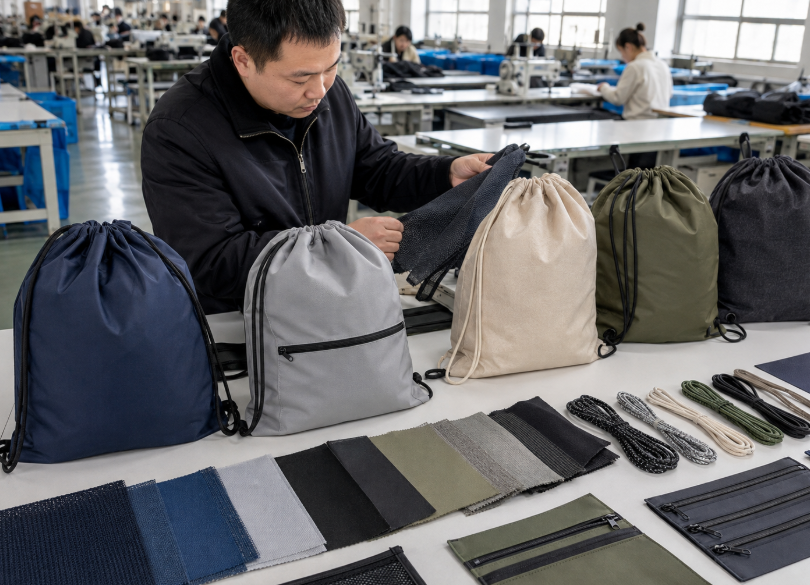
A clear development file normally includes finished dimensions, material specifications, fabric color, logo artwork, logo size and position, cord type, reinforcement details, pockets, labels, accessories, stitching requirements, packaging, and any special performance expectations.
Vector artwork is usually preferable for logo production because it gives the factory clean edges and scalable dimensions. Brand colors should be supported by a recognized color reference when close matching matters. A screen color viewed on different monitors is not a reliable production standard.
The factory then reviews whether the requested construction can be manufactured consistently. This step matters. A good Drawstring Backpack Factory should not simply accept every design detail without discussion. If a logo is too close to a seam, the fabric is too thin for dense embroidery, or a pocket construction is likely to deform the front panel, those issues should be raised before the sample is made.
After materials and details are confirmed, the pattern is prepared and the first sample is produced. Some projects can move quickly from the first sample to approval. Others need adjustments to dimensions, fabric stiffness, print size, cord length, reinforcement, or internal construction.
Changes should be documented rather than discussed only through chat messages. Once the final sample is approved, the confirmed version should become the production reference.
What to Check Before Approving a Sample
Do not approve a sample based only on how it looks in a photo.
Measure the actual finished width and height. Load the bag with objects similar to what the final customer will carry. Pull the cords several times, check how smoothly the opening closes, and look at the points where the cords connect to the lower corners.
Inspect the logo at normal viewing distance and close range. Check whether the print is straight, whether small details remain clear, whether embroidery causes puckering, and whether the color matches the approved reference.
Turn the bag inside out if the construction allows it. Sewing quality is often easier to judge from the inside. Look at seam allowance, loose threads, skipped stitches, raw edges, reinforcement, and areas where several layers of fabric meet.
The sample should also answer a practical question: can this exact construction be repeated hundreds or thousands of times without creating unnecessary production risk?
That question matters more than making one sample look perfect.
5. How Custom Drawstring Backpacks Are Manufactured
Once the pre-production sample and specifications are approved, material preparation begins. Fabric, cord, labels, zippers, eyelets, thread, packaging, and other accessories need to match the approved requirements before bulk assembly moves forward.
Fabric is normally inspected and then spread for cutting. Cutting accuracy affects the final dimensions and symmetry of the backpack. Small deviations at this stage can become much more visible after the panels are folded and sewn together.
Printing or embroidery is often completed before the main panels are assembled. Working with flat fabric makes positioning easier and gives the operator better control over the decoration area. The printed or embroidered panels should be checked before they enter sewing so obvious defects are not carried through the rest of production.
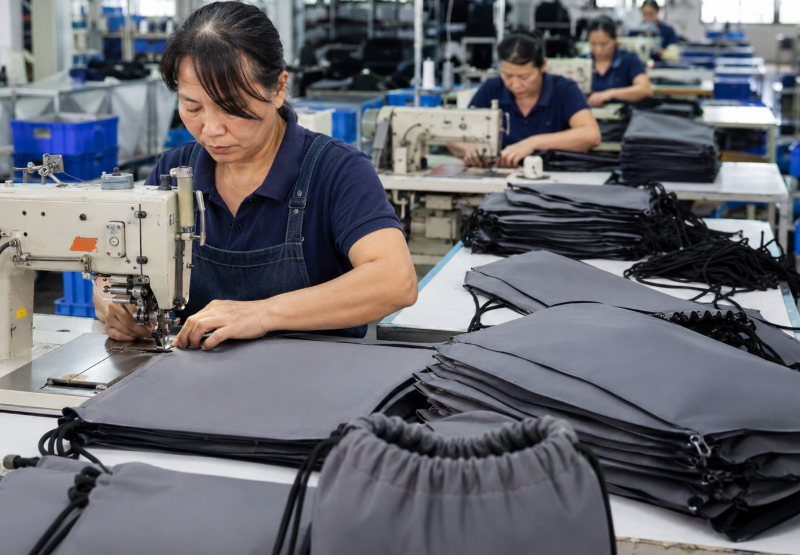
Sewing follows the construction sequence defined for the product. On a basic drawstring backpack, this may include preparing the top cord channel, sewing side seams, creating bottom reinforcement, attaching corner loops or eyelets, and closing the remaining seams. More complex versions may require pockets, lining, zipper installation, binding, or several reinforcement operations.
Cord installation comes after the main body is ready. Cord length needs to match the bag dimensions and wearing style. Too short and the opening becomes difficult to use; too long and the backpack may hang incorrectly.
Finished bags then go through thread trimming, cleaning, shaping, inspection, and packing. Pressing or controlled heat may be used on some materials, while heat-sensitive or coated fabrics require more careful handling.
A professional factory should treat these stages as a connected process. Quality cannot be created only at the final inspection table. If cutting, printing, sewing, and accessory preparation are poorly controlled, final inspectors can identify defects but cannot efficiently repair an entire production lot.
6. Quality Control Before Mass Production and Shipping
Quality control should begin before mass production rather than after the bags are packed.
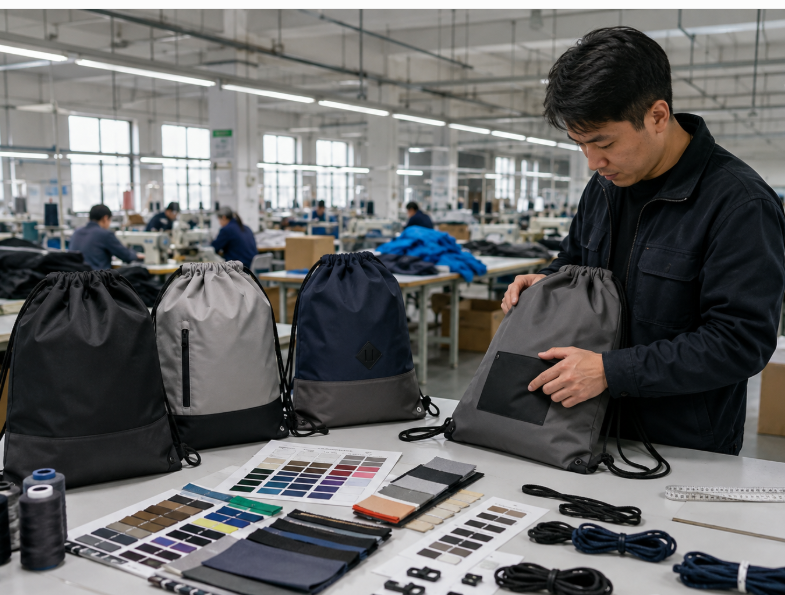
The approved sample, specification sheet, color reference, material swatches, logo artwork, and packaging instructions should form the production standard. Production teams and inspectors need to work from the same information.
Dimensions are one of the first items to control. Textile products naturally have some manufacturing tolerance because fabric moves during cutting and sewing, but the acceptable range should be agreed before production. Do not leave the factory to decide the tolerance after the goods are finished.
Logo position also needs measurable tolerance. A print that shifts slightly may still be acceptable on a plain promotional backpack, while a retail product with strong visual symmetry may need tighter control.
Stitching inspection should cover more than whether the seams are closed. Look for skipped stitches, broken threads, loose tension, inconsistent seam width, weak backstitching, puckering, and insufficient reinforcement at stress points.
Drawstring strength deserves separate attention. Inspect the cord itself, the stitched loop or eyelet area, and how the load transfers into the bag body. Pull testing or simple load testing can reveal construction weaknesses that are difficult to see during a visual inspection.
Color consistency should be checked between bags and between different material components. Fabric, cord, zipper tape, labels, and printed colors may come from different suppliers. Two components called “black” or “navy” are not automatically the same shade.
Final inspection should also cover fabric stains, weaving defects, print contamination, damaged coatings, crooked labels, loose threads, incorrect packaging, carton quantities, and assortment errors.
Many international buyers use an AQL-based sampling plan instead of inspecting every finished unit. ISO 2859-1 provides the international framework for lot-by-lot acceptance sampling by attributes. The sampling level and acceptance criteria still need to be agreed between buyer and supplier; using the word “AQL” alone is not enough. Review the ISO 2859-1 sampling standard
The key is to define what counts as a critical, major, or minor defect for your product before inspection starts. A wrong brand logo may be treated very differently from a small removable thread end.
7. How to Choose a Reliable Custom Drawstring Backpack Manufacturer
A reliable manufacturer is not simply a factory that can sew a drawstring bag. You need a supplier that can understand your specification, identify production risks, source consistent materials, develop samples, control bulk production, and communicate when something changes.
Start by looking at manufacturing experience with similar materials and constructions. A factory producing mainly fashion handbags may have strong sewing capability but limited experience with lightweight sports fabrics and heat-transfer printing. The opposite can also be true.
Ask how the manufacturer sources fabric. Consistent access to polyester, nylon, cotton, canvas, RPET, cords, zippers, labels, and trims makes a noticeable difference when you move from sampling to repeat production.
Sample development capability is another strong indicator. Pay attention to the questions the supplier asks. Good product-development teams normally want to understand dimensions, fabric, intended use, logo process, loading, packaging, and target market before finalizing a sample.
You can also evaluate these areas:
Material control: Can the factory provide clear fabric specifications and arrange relevant testing or documentation when required?
Customization capability: Are printing, embroidery, labels, patches, pockets, lining, zippers, and other processes managed consistently?
Production control: Is there a clear approved sample or production standard before bulk sewing begins?
Quality inspection: Are incoming materials, printing, sewing, finished goods, and packing checked at suitable stages?
Communication: Does the supplier confirm details in writing and raise problems early, or do you receive unclear answers only after you ask several times?
Delivery planning: Does the factory consider material lead time, sample approval, production scheduling, inspection, packing, and shipment together?
You should also pay attention to how the supplier responds when your specification is incomplete. Experienced manufacturers normally explain what information is missing rather than quietly choosing whatever is easiest to produce.
If you are comparing backpack suppliers more broadly, our guide to custom backpack manufacturers in China provides another useful reference for supplier evaluation.
The goal is not to find a factory that says yes to everything. You want one that understands which details matter and can explain why.
8. Conclusion
Successful Custom Drawstring Backpack manufacturing comes down to getting several connected decisions right: intended use, fabric, construction, logo method, sampling, production control, and final inspection. When these details are settled before mass production, communication becomes clearer and the risk of receiving a product that is technically acceptable but commercially unsuitable becomes much lower.
If you are developing a new drawstring backpack, spend more time on the specification and sample than you think you need. Check how the bag feels when loaded, how the cord pulls against the corners, how the logo behaves on the actual fabric, and whether the construction can be repeated consistently during bulk production. Those details often tell you more than a polished product photo.
HETEBAG is based in Huadu, Guangzhou, China, with our own manufacturing facility and more than 15 years of experience in bag development and production. We support OEM and ODM projects and work with an established manufacturing and supply network to develop different types of bags for brands, wholesalers, distributors, and sourcing teams.
If you are looking for a dependable Drawstring Backpack Factory or need help developing another custom bag, you can leave your contact details and project requirements through our website. Our team will be glad to review your design, material needs, quantity, logo requirements, and production details. We look forward to learning more about your project and exploring the possibility of working together.
Frequently Asked Questions
What information should I send a manufacturer before requesting a custom drawstring backpack sample?
Send the finished bag dimensions, intended use, approximate order quantity, preferred material, fabric color, logo artwork, logo dimensions, printing or embroidery preference, cord style, pockets or additional features, packaging requirements, and target delivery schedule. If some details are undecided, explain how the bag will be used so the factory can recommend suitable specifications.
What is the typical MOQ for custom drawstring backpacks?
Our MOQ for many custom bag projects starts at around 300 pieces, but the actual quantity depends on the design and materials. Standard fabrics and existing colors are usually easier to arrange, while custom-dyed fabric, special accessories, molded logo patches, unique packaging, or uncommon materials may require a different MOQ.
How should I choose between polyester, nylon, cotton, canvas, and RPET?
Polyester works well for many promotional and sports applications because it is lightweight and easy to customize. Nylon is useful when higher abrasion resistance and lightweight strength are priorities. Cotton and canvas offer a more natural appearance and are common in lifestyle products. RPET can suit sustainability-focused programs, especially when the recycled-content claim and supporting supply-chain documentation are clearly defined.
How much size variation should I expect in mass-produced drawstring backpacks?
Fabric products cannot normally be manufactured with the same dimensional precision as molded plastic or machined components. The acceptable tolerance depends on the bag dimensions, fabric behavior, construction, and buyer requirements. Agree on the finished measurement method and acceptable tolerance before mass production, then inspect bulk goods against that same standard.
Should I approve production based only on photos of the sample?
Physical sample approval is preferable when dimensions, hand feel, fabric thickness, color, cord comfort, printing quality, or construction are important. Photos and videos can help confirm visual details, but they cannot fully show fabric feel, actual size, loading performance, seam strength, or how the backpack sits when worn.
What should be included in the final inspection before shipment?
A useful final inspection should cover dimensions, workmanship, fabric defects, logo size and position, color consistency, stitching, reinforcement, cord attachment, zippers or accessories when applicable, stains, loose threads, packaging, carton quantities, and labeling. Buyers using random sampling should also define the inspection level and acceptable defect limits before the inspection is arranged.


