
 English
  Italian
  French
  German
  Spanish
  Arabic
 There are more types of cosmetic bags than many people realize. Simple zippered pouches, square makeup cases, double-layered storage bags, transparent cosmetic bags, and travel tote bags may all seem to belong to the same product category, but their actual usage differs greatly. Sometimes you might think two bags look very similar, but one can hold bottles and jars upright, keep brushes clean, and make them easy to wipe; while the other becomes unusable after only a few weeks. Size, opening width, lining, reinforcement methods, zipper selection, and internal layout all affect a bag’s performance.
Having worked in the bag industry for over 15 years, cosmetic bags are a category whose structural details are far more important than many buyers realize. Brands usually start with a reference photo. Once development begins, the real questions become more practical: What cosmetics will the bag hold? Does the bag need to stand upright? Does the lining need to protect against foundation stains? Does the brushes need a separate compartment? How strong should the bag be?
This guide will explain what a makeup bag is, its main styles and materials, how its storage functions work, and what buyers should pay attention to when customizing a makeup bag.
1. What Is a Makeup Bag?
A makeup bag is a small or medium-sized bag designed to organize cosmetics, beauty tools, skincare products, and related personal items. Most designs use a zipper closure and include a washable or wipeable lining. The structure can range from a soft single-compartment pouch to a rigid organizer with adjustable dividers.
Its purpose goes beyond putting several cosmetics into one pouch. Good design keeps products separated, protects containers from impact, reduces leaks spreading through luggage, and helps the user find small items without emptying the entire bag.
Manufacturing requirements change according to that purpose. A flat promotional pouch can be made with a simple outer fabric, lining, and zipper. A travel organizer may require foam reinforcement, piping, multiple zipper panels, mesh pockets, elastic loops, and removable dividers. Those added parts affect sampling, sewing accuracy, inspection, and production time.
What Is a Makeup Bag Used For?
Daily users usually carry lipstick, mascara, powder, concealer, eyebrow products, and several small brushes. These products suit a compact pouch with one main compartment and perhaps one internal pocket.
Travel creates different demands. Bottled skincare products need more vertical space. Brushes should be separated from liquids. Palettes need protection against pressure. Larger travel designs may also need a handle, wide opening, waterproof or water-resistant lining, and enough reinforcement to hold their shape inside a suitcase.
Beauty brands use makeup bags in several other ways. They can become part of a gift set, a seasonal collection, promotional merchandise, travel kits, private-label accessories, or packaging that customers continue using after the original cosmetics are finished.
Makeup Bag vs. Cosmetic Bag vs. Toiletry Bag
The three terms overlap, but their usual product structures are slightly different.
| Bag Type | Typical Contents | Common Structure | Main Design Priority |
|---|---|---|---|
| Makeup Bag | Cosmetics, brushes, small beauty tools | Small to medium, soft or structured | Organization and easy cleaning |
| Cosmetic Bag | Makeup, skincare, beauty accessories | Broad category with many structures | Beauty product storage |
| Toiletry Bag | Shampoo, razors, toothbrushes, grooming items | Usually medium to large | Bottle storage and travel use |
“Cosmetic bag” is often used as the broader commercial term. A Makeup Bag usually focuses more heavily on makeup products and beauty accessories, while toiletry bags tend to accommodate larger personal-care containers.
The name alone should not determine your specification. Product dimensions, contents, target customer, and intended use give a factory much more useful information than simply requesting “a cosmetic bag.”
2. Popular Types and Styles of Makeup Bags
Style affects much more than appearance. It changes material consumption, zipper length, sewing operations, packing volume, storage capacity, and the difficulty of maintaining consistent dimensions during production.
Buyers comparing more design directions can also review this guide to the most popular makeup bag styles, which looks at additional structures used in retail and wholesale projects.
Classic Zipper Makeup Pouches
The zipper pouch remains one of the easiest styles to adapt for different markets. Common shapes include rectangular, trapezoid, curved-top, semicircular, and gusseted designs.
Small versions usually need little internal organization. Adding too many pockets to a compact pouch can actually make it harder to use because seams and pocket layers reduce usable space.
Surface design becomes more important on simple bags. Printed polyester supports detailed artwork. Canvas gives the product a more natural textile feel. PU leather suits embossed logos and cleaner fashion positioning. Quilting can create more volume without changing the basic construction.
Box-Shaped and Structured Makeup Bags
Box-shaped designs give bottles, jars, palettes, and brushes more predictable storage space. Many use an EVA or foam layer between the outer fabric and lining to maintain their shape.
Common starting points in product development include roughly 2–5 mm EVA or other foam reinforcement, depending on the desired firmness. The final thickness should be confirmed through sampling because the same thickness can feel very different when combined with PU, polyester, quilting, or a thick lining.
Structured bags also need more careful pattern development. Corners, zipper curves, piping, and lid alignment become visible immediately when sewing tolerances vary. If a structured Custom Makeup Bag is expected to look clean on a retail shelf, sample review should include shape symmetry and panel alignment, not just material color.
Travel, Hanging, and Clear Makeup Bags
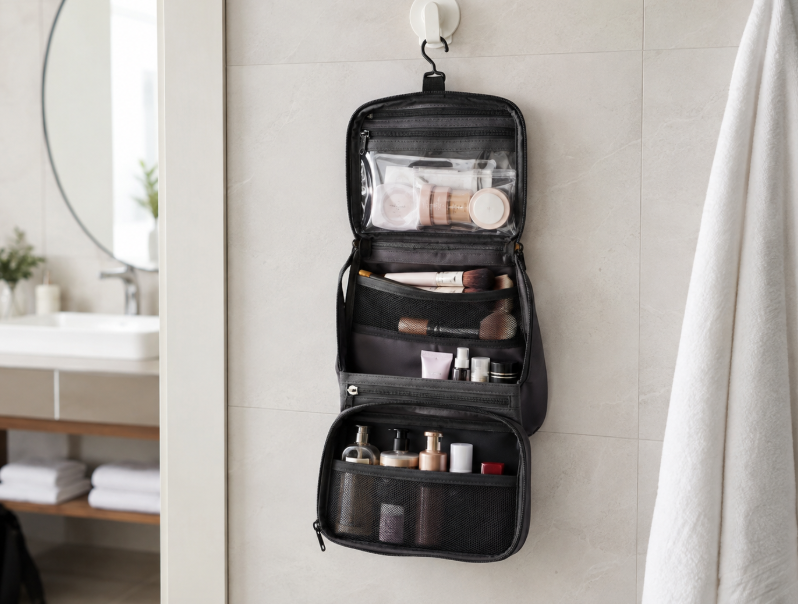
Travel organizers usually provide the highest level of internal organization. Double-layer designs, brush sections, mesh pockets, removable dividers, and carrying handles are common.
Hanging bags use a hook so the bag can open vertically in a bathroom or hotel room. Weight distribution deserves attention here. A fully loaded bag places much more force on the hook attachment and upper seam than an empty sample suggests.
Clear PVC and TPU makeup bags solve another problem: visibility. Users can see contents without opening every compartment. TPU generally feels softer and more flexible than conventional PVC, while both can be made into wipe-clean transparent panels. The film thickness, surface clarity, cold resistance, odor, and welding or stitching method should all be checked before bulk production.
| Style | Organization | Structure | Good Fit |
|---|---|---|---|
| Zipper Pouch | Low | Soft | Daily makeup, promotions |
| Box-Shaped Bag | Medium | Semi-structured | Cosmetics and skincare sets |
| Double-Layer Bag | High | Soft or structured | Brushes plus cosmetics |
| Hanging Bag | High | Soft | Travel and bathroom use |
| Clear Bag | Low to medium | Soft | Visible storage and travel |
| Makeup Case | High | Structured | Larger beauty collections |
3. What Materials Are Makeup Bags Made From?
Material selection should begin with the way the bag will actually be used. Appearance matters, but cosmetics introduce oil, pigments, liquids, powders, and frequent handling. Cleanability and construction compatibility deserve equal attention.
Polyester, Nylon, and Canvas
Polyester is widely used because it offers good printability, color consistency, low weight, and broad construction options. Common specifications for makeup bags can include 210D, 300D, 420D, or 600D fabrics, though denier alone does not tell you whether a material is suitable. Weave density, coating, backing, hand feel, and finishing also affect performance.
Nylon generally offers a smoother, slightly more technical appearance. Lightweight nylon works well in quilted pouches and soft travel organizers, while heavier fabrics can support more functional designs.
Canvas creates a different feel. Cotton or cotton-blend canvas works well for lifestyle, natural, and gift-oriented collections. Common projects may use around 8–12 oz canvas, with heavier or lighter constructions chosen according to the shape. Canvas absorbs moisture more readily than coated synthetic fabrics, so lining selection becomes more important in a makeup application.
Buyers deciding between these fabrics can compare the construction differences in this canvas vs. nylon bag material guide.
PU Leather and Genuine Leather
PU leather can give a Makeup Bag a cleaner fashion appearance while remaining easier to wipe than many untreated woven fabrics. Different PU constructions vary greatly in softness, backing strength, surface finish, hydrolysis resistance, and crease behavior.
Thickness around 0.8–1.2 mm is a common development range for some small bag projects, but it should never be treated as a fixed specification. Soft pouch designs and structured cases need different materials.
Genuine leather is less common for entry-level cosmetic storage but can work well for premium accessories. Buyers need to consider leather thickness, surface finish, color consistency, edge finishing, lining, and how the material reacts to cosmetics.
Material safety requirements also depend on your market and product specification. When chemical testing or textile safety is part of your sourcing requirements, standards such as OEKO-TEX® STANDARD 100 can provide a useful reference for textiles tested for harmful substances. Certification should always be verified for the exact supplier, material, component, and certificate being offered rather than assumed from a general material description.
PVC, TPU, and Other Easy-Clean Materials
PVC and TPU are frequently selected for transparent makeup bags because they resist liquid penetration and can be wiped quickly. Clear film around 0.3–0.5 mm may be used in some designs, although structure, softness, temperature performance, and sewing method can require a different specification.
EVA is another useful material, especially as hidden reinforcement. It can sit between fabric layers to create a more stable body while keeping the outside surface textile-based.
Recycled polyester is also available when a brand has traceability requirements. Buyers making recycled-content claims should request supporting documentation instead of relying on a verbal statement that the fabric is “recycled.” The Global Recycled Standard information from Textile Exchange explains how GRS addresses recycled material verification and chain of custody.
| Material | Main Strength | Cleaning | Typical Positioning |
|---|---|---|---|
| Polyester | Versatile and printable | Easy | Mass retail, printed collections |
| Nylon | Lightweight and durable | Easy | Travel, functional designs |
| Canvas | Natural texture | Moderate | Lifestyle and gift collections |
| PU Leather | Smooth fashion finish | Easy | Fashion and premium retail |
| Genuine Leather | Natural premium feel | Depends on finish | Higher-end accessories |
| PVC | Clear and water-resistant | Very easy | Transparent organizers |
| TPU | Clear, flexible feel | Very easy | Modern travel designs |
4. Important Storage Features in a Makeup Bag
More compartments do not automatically create a better product. Internal organization should match what the user carries and how often each item needs to be accessed.
Compartments, Pockets, and Adjustable Dividers
One large compartment works well for small daily pouches. Medium and large designs benefit more from separation.
Flat slip pockets are useful for compact products, tissues, and small packets. Mesh zipper pockets keep smaller items visible. Side pockets can hold bottles upright if their dimensions are matched to the intended container.
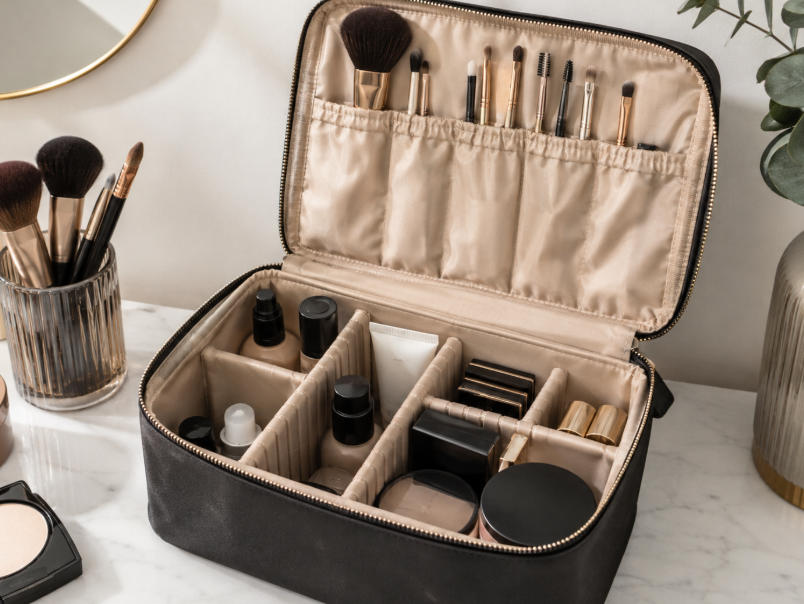
Adjustable dividers are normally used in structured makeup cases. Hook-and-loop attachment lets users change compartment size, but the divider needs enough stiffness to stay upright once the bag is moving. Thin dividers may look fine in an empty sample and collapse once bottles are loaded.
Interior development should start with actual product dimensions whenever possible. Asking a factory to “add six compartments” is less useful than giving the diameter and height of the bottles, palette dimensions, brush lengths, and desired arrangement.
Brush Holders and Elastic Loops
Brush storage deserves its own design review. Elastic loops need to hold different handle diameters without becoming so tight that brushes are difficult to remove.
Spacing also matters. When loops sit too close together, brush heads overlap and the section becomes bulky. Wide spacing wastes interior area. Elastic recovery should be checked during sampling because poor elastic can stretch after repeated use.
Many brush panels include a clear or fabric protective flap. This prevents residual powder from touching the rest of the bag and also stops brush bristles from catching in the zipper.
Waterproof Linings and Easy-Clean Interiors
The phrase “waterproof lining” is often used too casually. A coated lining may resist liquid penetration, yet needle holes and seams can still allow leakage. If a buyer requires truly leak-resistant construction, the stitching method and seam treatment must be discussed separately.
Smooth polyester, coated polyester, PEVA, TPU, or other wipeable materials can work well depending on the design. Light-colored linings make small products easier to find, but foundation, lipstick, and eyeliner stains become more visible.
During sampling, we normally recommend checking the lining with the type of product the customer actually expects the bag to carry. Wiping foundation or cosmetic oil from a swatch can tell you more than judging the lining only by touch.
5. How Size and Construction Affect Makeup Bag Function
Size should be developed around contents rather than choosing dimensions because another brand uses them. Even a 1–2 cm change in gusset width can noticeably change usable capacity.
Small Makeup Bags for Daily Essentials
Compact pouches often fall somewhere around 15–20 cm in width, although there is no universal makeup bag size. Lipstick, mascara, compact powder, and several small tools can fit comfortably when the opening is wide enough.
Opening design deserves attention. A bag may have enough internal volume but still feel cramped if the zipper opening is too short. Extending the zipper slightly down the side panels can improve access without increasing the overall bag size.
Small bags also benefit from lighter construction. Thick foam, multiple internal pockets, piping, and several layers of binding can consume a surprising amount of usable space.
Medium and Large Bags for Travel
Travel makeup organizers usually need enough height for bottles and enough width for palettes. Internal loading becomes more important than exterior dimensions.
Bottle orientation is one useful starting point. If the intended containers must stand upright, their height plus closure clearance should be checked before the sample pattern is finalized.
Larger Custom Makeup Bag designs also require more attention to the bottom panel. Once bottles, skincare products, and tools are added, the base may sag unless the fabric, foam, board, or layered construction provides enough support.
Soft-Sided vs. Structured Makeup Bags
Soft bags are lighter, easier to pack, and usually use fewer reinforcement materials. They work well inside a handbag or suitcase because they can compress around other items.
Structured designs protect contents better and create a stronger retail presentation. Their shape also makes divider systems easier to use. The tradeoff is additional material, more sewing operations, larger shipping volume, and stricter dimensional control during production.
Neither construction is automatically better. The right decision comes from the contents, selling position, packaging method, and customer expectations.
6. What to Look for When Choosing or Customizing a Makeup Bag
Buyers should judge a sample as a future production product, not as a single attractive piece. Check what could become inconsistent when hundreds or thousands of units are sewn.
Material Durability and Ease of Cleaning
Begin with abrasion, surface marking, coating quality, odor, color transfer, and stain removal. Printed materials should also be checked for print alignment and color consistency.
Recycled or certified materials need document verification when those claims will appear on packaging or product pages. A supplier offering an RPET fabric is not automatically proving that your finished product qualifies for a particular certification or consumer claim.
Zippers, Stitching, Lining, and Hardware
Zippers receive repeated use and are one of the first parts customers notice when something feels wrong. Compact pouches may use No. 3 zippers, while larger organizers often move toward No. 5 or other constructions depending on the opening and material thickness.
Buyers specifying branded zipper components can review the technical and quality information published by YKK. YKK describes strength testing and global quality controls for its fastening products, which also illustrates why zipper specification deserves attention rather than being left as an unspecified accessory.
Stitching should be checked around zipper ends, handles, gusset intersections, internal dividers, and other high-stress areas. Loose thread is easy to notice, but uneven seam allowance and distorted panels can cause bigger problems because they change the finished shape.
Lining should sit cleanly inside the body without excessive loose fabric. Structured models need even more control because wrinkles and uneven binding become visible each time the lid opens.
Logo, Color, Size, and Interior Layout Customization
A good Custom Makeup Bag project usually develops several elements together:
- Exterior material, weight, thickness, and finish
- Finished dimensions and gusset depth
- Exterior and lining colors
- Zipper type, tape color, slider, and puller
- Printing, embroidery, woven label, metal logo, embossing, or debossing
- Internal pockets and compartment dimensions
- Brush loops and protective flaps
- EVA, foam, board, or other reinforcement
- Handle and hardware details
- Individual packaging and carton requirements
Logo technique should fit the material. Screen printing works well on many fabrics. Embroidery adds texture but also creates backing and needle penetration inside the panel. Embossing and debossing work better on suitable PU or leather surfaces. Metal logos create a different look but require attention to attachment points and backing.
Sampling is where these decisions should be tested together. A material can look good as a swatch and behave very differently after folding, sewing, turning, binding, and adding reinforcement. Our guide to cosmetic bag manufacturing explains more of the production stages buyers should understand before bulk ordering.
Most of our custom bag projects start around an MOQ of 300 pieces, while the actual quantity depends on material availability, custom colors, printed fabrics, hardware development, structure, and packaging requirements. A stock material with a standard zipper is easier to arrange at a lower quantity than a project requiring custom-dyed fabric, molded hardware, or specially developed components.
Before approving bulk production, I would check the sample in roughly this order: finished dimensions, loading capacity, opening access, zipper movement, lining, internal organization, stitching, logo position, color, surface quality, and packaging. The key question is not only “Does this sample look right?” Ask whether the same specifications can be controlled repeatedly during production.
7. Conclusion
A Makeup Bag is a relatively small product, but good development involves more than selecting a shape and adding a logo. Material thickness changes how the body feels. Reinforcement changes how the bag stands. Pocket dimensions determine whether bottles remain upright. Zipper construction affects access, while the lining determines how easily cosmetic residue can be cleaned.
Brands developing a Custom Makeup Bag should define the contents and usage first, then build the size, material, structure, and storage system around them. That approach usually produces a better product than starting from an attractive reference image and trying to solve functional problems later.
Hetebag is a factory-backed bag manufacturer based in Huadu, Guangzhou, China. Our team has more than 15 years of bag manufacturing experience and works with specialized production partners across different bag categories. We support OEM and ODM development, including materials, samples, sizes, colors, logos, hardware, internal structures, bulk production, and quality control.
If you are developing makeup bags for a brand, wholesale program, retail collection, or promotional project, you can leave your contact information and project requirements here. Tell us what you plan to put inside the bag, your preferred material, target size, and any reference designs you already have. We would be glad to discuss the project with you and explore how we can work together.
Frequently Asked Questions
What MOQ should I expect for a custom makeup bag?
Many of our projects begin at around 300 pieces per design, but MOQ depends on the actual specification. Stock fabrics and standard hardware are easier to arrange at lower quantities. Custom-dyed fabric, exclusive printing, special zipper colors, molded hardware, or complicated structures may require a higher quantity because upstream material suppliers also have production minimums.
What information should I send a manufacturer before requesting a sample?
Send the finished dimensions, reference photos or drawings, preferred exterior material, lining material, color, logo method, internal layout, zipper requirements, packaging, and expected contents. Product dimensions are especially useful. If your bag needs to hold six bottles and a palette, giving the factory those measurements makes compartment development much more accurate.
Which lining is best for a makeup bag that may get dirty?
Smooth coated polyester, PEVA, TPU, and similar wipeable surfaces are common options. The best choice depends on your outer construction and required feel. Ask for lining swatches and test them with foundation, cosmetic oil, lipstick, or other products your customers commonly use. A material that looks clean in a catalog may behave differently once exposed to pigments and oils.
Can a makeup bag be made fully waterproof?
Water-resistant materials are easy to source, but a normally sewn makeup bag should not automatically be described as fully waterproof. Needle holes, zipper openings, and seams can allow liquid through. Projects that require stronger leak resistance need suitable materials plus attention to seam construction, zipper design, and sometimes welding or seam sealing.
How should I inspect a makeup bag sample before bulk production?
Load it with the actual products first. Open and close the zipper repeatedly, lift the bag by its handle, check whether bottles stay upright, test the dividers, examine the lining, inspect stressed seams, and confirm finished dimensions. Logo placement, color, hardware finish, surface marks, odor, and packaging should also be approved. Keep the final approved sample as the reference for bulk inspection.
What makes a custom makeup bag more expensive or difficult to manufacture?
Structure usually has more impact than buyers expect. Extra zipper layers, piping, EVA reinforcement, adjustable dividers, brush panels, custom hardware, quilting, shaped corners, and multiple materials all add production steps. They also create more points where dimensional or visual variation can occur. Simplifying features that the customer does not actually use can often improve consistency without weakening the design.


