
 English
  Italian
  French
  German
  Spanish
  Arabic
 During the development of our makeup bags, we often receive reference pictures sent by some customers. However, based on just one picture, it is difficult to determine whether this style truly suits their products. Similar appearances may result in completely different usage effects due to differences in size, opening, or internal structure.
For instance, the small bag used to store lipsticks and powder compacts doesn’t need complex compartments. However, the cosmetic bag for travel usually needs to consider the classification and storage of bottled skin care products, brushes and eyeshadow palettes. Different usage scenarios have different requirements for materials and structure.
Therefore, in this article, we will introduce 10 common types of makeup bags, and based on the actual product development needs, analyze their capacity, structure, materials and applicable scenarios, providing more practical references for brand selection and customization!
Quick Comparison of Popular Makeup Bag Styles
| Makeup Bag Style | Capacity | Organization Level | Best For | Common Materials |
|---|---|---|---|---|
| Classic Zipper Makeup Pouch | Small | Basic | Daily cosmetics and promotions | Canvas, nylon, polyester, PU |
| Travel Makeup Organizer | Large | High | Travel and complete beauty sets | Nylon, polyester, RPET |
| Toiletry-Style Cosmetic Bag | Medium to Large | Medium | Skincare, grooming, and travel kits | Polyester, nylon, PU |
| Clear Makeup Bag | Small to Medium | Basic | Product visibility and travel | PVC, TPU |
| Box-Shaped Makeup Bag | Medium | Medium | Bottles, palettes, and home storage | Polyester, nylon, PU |
| Structured Makeup Case | Medium to Large | High | Premium and professional products | EVA, PU, fabric composites |
| Makeup Case with Mirror | Medium to Large | High | Travel and premium beauty retail | EVA, PU, polyester |
| Quilted Makeup Bag | Small to Medium | Medium | Fashion, lifestyle, and gift collections | Nylon, polyester, velvet, PU |
| Double-Layer Makeup Bag | Medium to Large | High | Brushes, bottles, and organized travel | Nylon, polyester, PU |
| Fashion and Patterned Cosmetic Pouch | Small to Medium | Basic to Medium | Seasonal retail and branded collections | Canvas, polyester, nylon, PU |
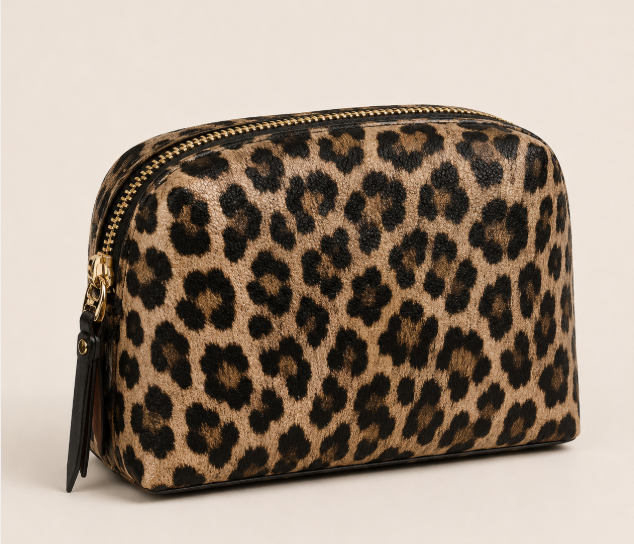
1.Classic Zipper Makeup Pouch
The classic zipper pouch remains one of the most flexible makeup bag styles. It normally has a rectangular, curved, trapezoid, or slightly rounded body with one main zipper opening. The construction is simple, lightweight, and easy to carry inside a handbag, backpack, or suitcase.
This style works well for lipstick, compact powder, mascara, small brushes, and other daily essentials. It does not need a complicated internal layout. A basic lining and one small slip pocket may be enough.
Its simplicity also gives brands more freedom with surface design. Canvas can support printed artwork and woven labels. Polyester works well for bright colors and repeating patterns. Nylon creates a practical travel look. PU gives the same basic shape a cleaner and more refined finish.
The most important manufacturing detail is the opening. A zipper that is too short makes the bag difficult to use, even when the overall dimensions look correct. Extending the zipper farther down each side can improve access, but it also changes the sewing process and seam structure.
Brands should also check whether the base needs a gusset. A flat pouch looks slim but holds less than many buyers expect. Adding a narrow bottom gusset creates more usable volume without making the bag feel bulky.
This style is often suitable for:
- Daily cosmetic essentials
- Beauty subscription products
- Retail counter accessories
- Event merchandise
- Promotional projects
- Small gift-with-purchase collections
A classic pouch is a strong option when the project needs broad customer appeal and a large area for logo placement. It is less suitable when the product set includes tall bottles, glass containers, or many separate tools.
2. Travel Makeup Organizer
A travel makeup organizer is designed for customers who carry more than a few basic cosmetics. It may hold skincare bottles, palettes, makeup brushes, cotton pads, beauty tools, and personal care items in one organized system.
The interior is what separates a true travel organizer from a large pouch. Common features include mesh pockets, elastic bottle holders, brush loops, transparent sections, removable dividers, and zipped compartments. Each feature should have a clear purpose. More pockets do not always create a better bag.
Poorly planned organizers often waste space. Dividers may be too thick, elastic loops may be too tight, or mesh pockets may sit directly against fragile products. Before sampling begins, buyers should list the main items that the bag must hold and provide approximate dimensions for each item.
The exterior also needs careful planning. A carrying handle should be connected to reinforced fabric or internal webbing, not only stitched to the outer material. The zipper opening must be wide enough to show the interior clearly. If the lid contains brush holders, it may need a protective flap to keep powder away from the rest of the bag.
Polyester and nylon are common choices because they are light, durable, and easy to line. RPET can support a recycled-material product direction when valid traceability documents are available. PU trim may be added around handles, zipper panels, or logo areas to improve visual structure.
A travel organizer suits:
- Travel accessory brands
- Skincare collections
- Beauty retailers
- Subscription programs
- Hotel and wellness products
- Complete cosmetic gift sets
For travel-focused products, the organizer should be tested while fully packed. An empty sample can appear stable, yet change shape once bottles and palettes place pressure on the walls.
3. Toiletry-Style Cosmetic Bag
A toiletry-style cosmetic bag usually has a wider base and a larger opening than a standard makeup pouch. It is designed to store both cosmetics and personal care items, including facial cleansers, shampoo bottles, shaving tools, deodorant, and skincare products.
This style sits between a soft cosmetic pouch and a structured travel organizer. It offers more capacity than a flat bag but does not always require detailed internal dividers.
The base is especially important. A reinforced or lightly padded bottom helps the bag stand while the user removes products. A weak base may fold inward when the bag is partially filled. This makes the bag feel less stable and reduces usable space.
Water-resistant lining is commonly requested because toiletry products may leak. The lining should still be easy to sew and flexible enough to turn during production. Very stiff coated materials can create bulky seams, especially around corners.
Buyers should also distinguish between a water-resistant bag and a fully waterproof bag. A coated outer fabric may resist light moisture, but water can still enter through stitching holes, zipper tape, and seams. A makeup bag factory should not describe a product as waterproof unless the complete construction has been designed and tested for that purpose.
This style is often selected for:
- Hotel amenity sets
- Travel kits
- Skincare gift sets
- Men’s grooming collections
- Airline or hospitality products
- Wellness and personal care brands
A handle on one side can improve portability. Double zipper sliders may provide easier access on larger versions. Internal bottle loops can be useful, but their position should match the height and width of the intended containers.
4. Clear Makeup Bag
Clear makeup bags allow users to see their products without opening every compartment. They are commonly made from PVC or TPU and combined with fabric binding, colored zipper tape, printed trim, or branded handles.
Visibility is the main benefit. It helps users find small products quickly and makes the bag suitable for product sets where the contents are part of the visual presentation.
PVC usually creates a firmer and more structured surface. TPU often feels softer and more flexible. Material thickness affects clarity, hand feel, folding resistance, and sewing difficulty. A thin transparent sheet may look clear when flat but wrinkle after sewing. A very thick sheet can make corners stiff and difficult to turn.
Clear material also needs proper storage during production. Scratches, pressure marks, dust, and fingerprints are easier to see than they are on woven fabric. Protective film may be needed during cutting and assembly.
Brands should not assume that every clear bag automatically meets airport security rules. Requirements for liquids and bag dimensions may vary by country, airport, and security authority. The product specification should state the intended dimensions rather than rely on a broad “travel approved” claim.
Clear makeup bags are suitable for:
- Beauty gift sets
- Retail packaging
- Travel accessories
- Promotional collections
- Product sampling programs
- Bathroom and vanity storage
Logo methods should be selected carefully. Printing directly on transparent material can work well, but the ink must be compatible with the surface. A woven label, printed fabric panel, or branded zipper pull can provide a safer alternative when direct printing is not suitable.
5. Box-Shaped Makeup Bag
A box-shaped makeup bag uses a three-dimensional rectangular body to create more usable internal space. Unlike a flat pouch, it can hold bottles, palettes, jars, and larger cosmetic items without forcing them into a narrow opening.
The shape may look simple, but accurate pattern development is important. The top, side panels, base, zipper panel, and lining must fit together correctly. Even a small pattern error can cause twisted corners, an uneven zipper, or a bag that leans to one side.
Some box-shaped bags open only at the top. Others use a zipper that extends around three sides. A wider opening improves visibility and access, but it may require additional binding or reinforcement to maintain the shape.
The interior can remain open or include mesh pockets, brush sections, elastic straps, and removable dividers. For daily retail use, one main compartment and a lid pocket may be enough. For travel, bottle holders and a wipe-clean lining provide more value.
The box shape works especially well when the brand wants a bag that can sit upright on a dressing table. It also provides clear front and top panels for embroidery, printing, labels, or metal logo plates.
Common applications include:
- Home cosmetic storage
- Travel beauty sets
- Skincare collections
- Retail makeup accessories
- Nail care products
- Subscription and gift boxes
Buyers should test the bag with real products before approving its dimensions. External measurements do not equal internal storage space. Padding, lining, seam allowances, binding, and dividers all reduce the usable interior.
6. Structured Makeup Case
A structured makeup case uses semi-rigid or hard-sided materials to protect the contents and maintain a defined shape. EVA is frequently used as the internal support layer, then covered with PU, polyester, nylon, or another decorative surface.
This style is suitable when protection is more important than minimum weight. The case can help reduce pressure on palettes, glass bottles, compact powders, and other fragile beauty products during transport.
The level of structure can vary. A thin EVA layer gives the bag a firm shape while keeping it flexible. A thicker molded shell creates stronger protection but changes the tooling, sampling, storage, and packaging requirements.
A structured case often uses double zippers, reinforced handles, internal dividers, brush panels, and molded compartments. These features should be planned as one system. For example, a deep lower compartment may need a lid panel that prevents tall items from moving when the case is carried vertically.
Zipper quality deserves close attention because the zipper follows a curved and sometimes stiff edge. The slider should move smoothly around corners without pulling the outer fabric into the teeth. Buyers considering branded fastening components can review the official YKK Fastening Products Group range and discuss suitable zipper types with their manufacturer. YKK provides zippers and other fastening products through global production and quality-control systems.
Structured makeup cases are often used for:
- Premium cosmetic collections
- Professional beauty tools
- Travel sets
- Nail and skincare equipment
- Influencer or artist kits
- High-value branded accessories
The case should be checked for shape recovery, zipper alignment, handle strength, interior odor, surface marks, and the fit of every divider.
7. Makeup Case with Mirror
A makeup case with a built-in mirror combines storage and product application in one item. It is often developed as a structured case because the mirror requires a stable panel and proper protection.
The mirror may be fixed inside the lid, placed in a removable panel, or supported by an adjustable stand. Each approach creates different production requirements.
A fixed mirror looks clean and is easy for the customer to use, but it adds weight and must be protected during transport. A removable mirror gives the user more flexibility, though the pocket or attachment system must hold it securely. An adjustable mirror needs stronger hinges, straps, or support panels.
Safety should guide the material choice. Acrylic mirrors are lighter and less likely to shatter than traditional glass, but the reflection quality may differ. Buyers should approve the actual mirror sample rather than relying only on photographs.
The interior often includes:
- Adjustable dividers
- Brush holders
- Mesh pockets
- Elastic straps
- Covered compartments
- Removable trays
The depth of the lower compartment should match the intended products. A mirror and brush panel can make the lid heavy, so the body must stay stable when the case is open. If it tips backward during use, the design needs better weight distribution.
This style suits premium beauty collections, professional makeup users, travel products, vanity storage, and gift programs. It creates a higher-value appearance, but it also requires more careful sampling and packaging than a basic cosmetic pouch.
Protective film should remain on the mirror during production. Final inspection should check scratches, distortion, adhesive marks, loose edges, and movement inside the mirror frame.
8. Quilted Makeup Bag
A quilted makeup bag is recognized by its padded surface and stitched pattern. Common patterns include diamonds, channels, waves, squares, and custom geometric designs.
The soft surface gives the bag a fashion-focused appearance. It can also provide light protection for the contents, though quilting alone should not be treated as strong impact protection.
Polyester and nylon are widely used because they support different surface finishes and colors. Velvet creates a softer, gift-oriented look. PU can produce a cleaner fashion style, but the quilting process must be adjusted to prevent surface damage or uneven stitches.
Quilting may be completed before the main bag panels are cut, or it may be produced on individual panels. Pattern alignment needs attention, especially on the front, back, and zipper sections. A diamond pattern that changes direction at the side seams can make a finished bag look poorly assembled.
The padding thickness affects both appearance and sewing. Thick foam creates a full, soft surface but increases seam bulk. Thin padding is easier to sew but may not produce the visual depth shown in a design drawing.
Quilted bags are suitable for:
- Beauty and fashion retailers
- Lifestyle brands
- Seasonal collections
- Gift programs
- Boutique skincare products
- Premium promotional products
Logo methods may include embroidery, a metal plate, a rubber patch, a woven label, or a custom zipper pull. Embroidery should be tested before cutting because dense stitching can compress the padding and change the quilted pattern.
Color matching is also important. The outer fabric, zipper tape, lining, thread, label, and hardware may all come from different suppliers. A physical color standard helps prevent small differences from becoming visible in the final product.
9. Double-Layer Makeup Bag
A double-layer makeup bag separates products into two main sections. The upper area may hold cosmetics, palettes, or skincare products, while the lower section stores brushes, bottles, tools, or accessories.
This structure improves organization without making the bag as rigid as a professional case. It is especially useful for frequent travelers and users who want to keep brushes away from liquid products.
The main design challenge is balance. If the lower section is too shallow, it provides little practical value. If it is too deep, the upper compartment becomes cramped. Buyers should define which products belong in each layer before deciding the final dimensions.
A brush section may include elastic loops, a transparent protective flap, and a wipe-clean base. The elastic should fit more than one handle diameter. Loops that are all the same size may not hold both thin eyeliner brushes and larger face brushes securely.
For bottle storage, the lower compartment can use padded dividers or elastic straps. The zipper should open far enough for the customer to remove items without bending them against the side walls.
This design is commonly selected for:
- Travel makeup collections
- Professional beauty tools
- Large skincare sets
- Brush and cosmetic bundles
- E-commerce beauty accessories
- Organized home storage
The connection between the two layers must be reinforced. When the bag is full, the center seam and zipper area carry more weight than they do in a single-compartment pouch.
A double-layer custom cosmetic bag should be tested in several positions: standing upright, lying flat, carried by the handle, and packed inside luggage. These checks can reveal movement or pressure problems that are not visible during a simple appearance inspection.
10. Fashion and Patterned Cosmetic Pouch
Fashion and patterned cosmetic pouches use color, print, texture, and decorative details to create a clear visual identity. The basic structure may be simple, but the surface design makes the product feel specific to a customer group, season, or collection.
Popular directions include floral artwork, animal patterns, geometric prints, soft pastel colors, bright contrast trims, metallic surfaces, textured PU, and custom illustrations. Trends can change quickly, so brands should connect the pattern to their own identity rather than copy a temporary look without a clear reason.
Print placement needs to be decided early. A repeating print can reduce alignment concerns. A centered graphic requires accurate panel cutting. Large artwork may cross seams or disappear around the base. A manufacturer should provide a print-position drawing before production.
Different materials support different results:
- Canvas gives prints a natural, textured appearance.
- Polyester supports clear colors and detailed patterns.
- Nylon produces a smooth, practical look.
- PU works well with embossing, debossing, and selected printing methods.
- Velvet supports embroidery and decorative labels.
Patterned pouches are useful for seasonal campaigns, beauty gift sets, fashion retail, youth collections, event products, and branded merchandise.
Decorative details should not reduce usability. Large charms may feel heavy. Sharp metal ornaments can scratch other items. Thick embroidery can make the lining uneven. Loose glitter or unstable coatings may transfer onto the customer’s hands.
The best fashion pouch combines personality with a practical shape. The customer should notice the design first, then continue using the bag because the opening, lining, zipper, and capacity work well.
Which Makeup Bag Style Is Best for Different Uses?
There is no single style that works for every project. The right choice depends on what the customer carries, how often the bag is used, and where it will be stored.
| Intended Use | Recommended Styles | Main Design Priority |
|---|---|---|
| Daily makeup essentials | Classic zipper pouch, small quilted bag | Compact size and quick access |
| Travel | Travel organizer, toiletry bag, double-layer bag | Capacity, lining, and organization |
| Professional makeup | Structured case, mirror case, large organizer | Protection and adjustable storage |
| Beauty gift sets | Clear bag, quilted bag, patterned pouch | Product presentation and branding |
| Promotional projects | Zipper pouch, canvas bag, polyester pouch | Logo visibility and simple construction |
| Skincare collections | Box-shaped bag, toiletry-style bag | Bottle storage and easy cleaning |
| Premium retail | Structured case, mirror case, PU quilted bag | Finish, hardware, and shape stability |
For Everyday Makeup Essentials
A compact zipper pouch is usually the most practical option for daily use. It fits inside other bags, opens quickly, and does not require the customer to manage several compartments.
Small quilted bags and flat cosmetic pouches also work well when the collection needs more visual character. Keep the bag light and avoid unnecessary pockets that reduce internal space.
The dimensions should be based on common daily products such as lipstick, compact powder, mascara, and a small mirror. A sample filled with these items will give a more accurate result than an empty measurement review.
For Travel
Travel organizers, toiletry-style cosmetic bags, clear bags, and double-layer designs provide more capacity and control.
Choose a wider opening so users can find products without removing everything. Water-resistant lining, strong zipper tape, reinforced handles, and separate areas for brushes or bottles make the bag easier to use.
A hanging organizer may also suit customers who stay in hotels or have limited bathroom counter space. The hook and top panel must support the weight of the fully packed bag.
For Professional Makeup Artists
Professional users usually need structured cases, large organizers, or mirror cases with adjustable dividers.
The interior must adapt to products of different sizes. Fixed compartments can look neat but may become useless when product packaging changes. Removable dividers give the user more freedom.
Handle strength, zipper durability, cleanable surfaces, and fast access are more important than decorative details. The case should also remain stable while open.
For Beauty Gift Sets
Clear makeup bags allow the products inside to remain visible. Quilted, PU, and patterned bags can make the set feel more complete and suitable for retail display.
The bag dimensions should match the gift set rather than use a standard size. Too much empty space makes the set feel poorly planned. A tight fit can place pressure on caps, pumps, and glass containers.
Packaging must also protect both the cosmetics and the bag surface during transport.
For Promotional Projects
A simple zipper pouch in canvas, polyester, or lightweight nylon usually provides the clearest logo area and the most flexible design.
Before choosing a style, decide whether the bag will be used once at an event or kept as a practical daily item. A product that remains useful gives the brand longer visibility.
The logo method should match the material. Screen printing may suit flat fabric panels, while woven labels or heat-transfer graphics may work better for more detailed branding.
What Should Brands Consider When Choosing a Makeup Bag Style?
Target Customer
Start with the person who will use the bag. Consider age group, daily routine, travel habits, product preferences, and where the bag is likely to be stored.
A young customer carrying a few cosmetics may prefer a compact pouch with a bold pattern. A skincare customer may need space for bottles and jars. A professional user values access and organization more than a small external size.
Avoid choosing a style only because it performs well for another brand. The same design may not match your audience, product range, or retail position.
Write a short customer profile before contacting a makeup bag manufacturer. It will help the development team understand the product more clearly.
Storage Capacity
Capacity should be defined by real objects, not only by length, width, and height.
Provide a list of intended items. Include the largest bottle, longest brush, widest palette, and any products that must remain upright. When possible, send product samples or accurate packaging dimensions to the factory.
Remember that lining, padding, binding, pockets, and dividers reduce internal space. A bag with the same external size can have very different usable capacity depending on its construction.
Extra space is not always better. Products that move too freely may collide or leak during travel.
Internal Organization
Every compartment should solve a specific storage problem.
Brush loops keep handles in place. Mesh pockets make small items visible. Elastic straps hold bottles upright. Transparent sections help users locate products. Removable dividers support different layouts.
Too many features can make the bag heavy, expensive to assemble, and difficult to clean. They may also reduce the main storage area.
Ask your supplier to show the internal dimensions, not only the external appearance. During sample review, place products inside every pocket and close the bag fully.
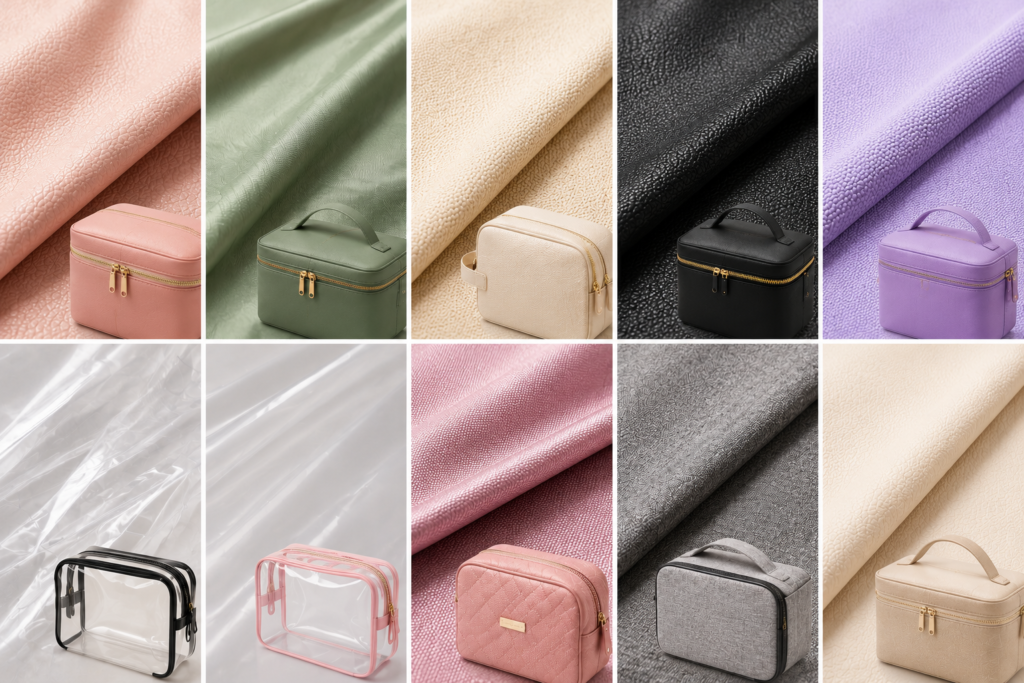
Material and Cleaning Requirements
Makeup bags frequently come into contact with powder, foundation, oil, water, and skincare products. Material selection should reflect that reality.
PU, coated polyester, TPU, and PVC are usually easier to wipe than untreated canvas or velvet. A washable-looking fabric does not guarantee that the complete bag can be placed in a washing machine. Padding, metal parts, printed logos, mirrors, and internal boards may require spot cleaning.
Our guide to custom bag materials can help buyers compare common outer fabrics before selecting a direction.
When chemical safety or skin contact is important, ask suppliers for valid test reports tied to the exact material, color, and production batch where required. OEKO-TEX STANDARD 100 tests textile materials for harmful substances based on their intended use. A material should not be described as certified unless the supplier can provide valid supporting documentation.
Brand Positioning
The material, structure, and hardware should communicate the same brand message.
A natural canvas pouch may suit a simple lifestyle or wellness collection. A quilted nylon bag can feel soft and fashion-focused. A structured PU case with a metal logo may support a more premium position. A clear TPU bag can create a clean, modern appearance.
Premium positioning does not come from one decorative element. It comes from consistency across the material, stitching, edge finish, lining, zipper, logo, packaging, and product photography.
A heavy metal logo on thin fabric rarely feels premium. It usually makes the bag sag. The structure must support the decoration.
Logo and Decorative Details
Common branding options include:
- Screen printing
- Heat-transfer printing
- Embroidery
- Woven labels
- Rubber patches
- Metal plates
- Custom zipper pullers
- Debossed or embossed PU
- Printed lining
- Branded hardware
Each method creates a different appearance and production process. Buyers can review our custom logo bag options before selecting a method.
Logo size should be confirmed on a physical sample. A logo that looks balanced on a computer screen may appear too large on a small pouch. The logo must also remain clear when the bag is full.
Metal components should be checked for sharp edges, coating consistency, attachment strength, and possible contact with the cosmetics inside.
Material Traceability and Sustainability Claims
Brands using recycled polyester, recycled nylon, or other recycled materials should request more than a fabric description.
Ask where the material comes from, what percentage is recycled, and whether the supply chain can provide transaction documents where required. The Global Recycled Standard provides third-party criteria for recycled content and chain-of-custody tracking, together with social, environmental, and chemical-processing requirements.
Do not place a GRS logo or recycled certification claim on packaging simply because the factory offers RPET fabric. The exact material, supplier, production route, and final product may need to meet specific certification conditions.
A clear and limited claim is safer than a broad claim that cannot be supported.
Factory Capability and Quality Control
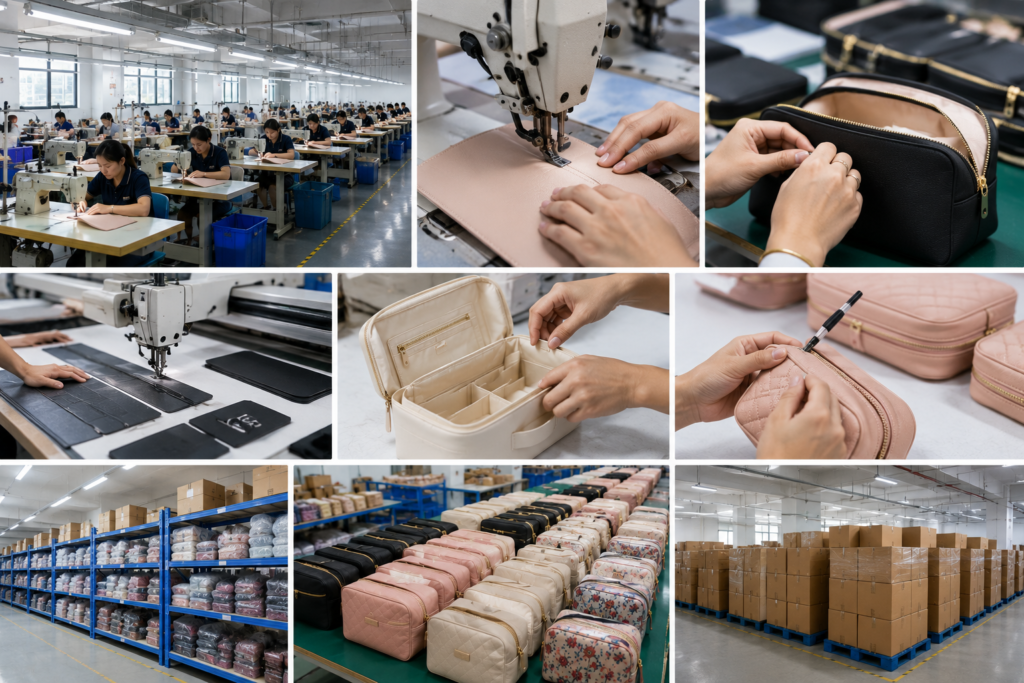
A makeup bag factory should be evaluated by the products it can produce consistently, not only by the samples shown in a catalog.
Ask whether the supplier has experience with the intended structure. A factory that produces soft canvas pouches may not have the same molding equipment or assembly knowledge needed for EVA cases with mirrors.
Quality control should cover:
- Material inspection
- Color and texture approval
- Cutting accuracy
- Logo position
- Stitch density
- Seam strength
- Zipper operation
- Lining cleanliness
- Shape and dimensions
- Packaging and carton labels
Certificates can support supplier evaluation, but they do not replace product inspection. Buyers should verify whether any certificate is current, which facility it covers, and whether it is relevant to the product being ordered.
How to Customize a Makeup Bag for Your Brand
Custom development works best when decisions are made in a clear order. Changing the structure after materials and patterns have already been prepared often creates delays and avoidable sample revisions.
1. Define the Intended Use
Explain whether the bag is for daily cosmetics, travel, skincare bottles, professional tools, a gift set, or a promotional campaign.
List the products that need to fit inside. Add dimensions or physical samples when available.
2. Select the Basic Style
You Choose a zipper pouch, organizer, toiletry bag, clear bag, box shape, structured case, mirror case, quilted bag, double-layer bag, or patterned pouch.
A reference image can help communicate the direction, but it should not replace a written specification.
3. Confirm Dimensions and Capacity
Please Define the external dimensions and expected internal capacity.
Check the length of brushes, height of bottles, width of palettes, and space taken by internal dividers. Decide whether products need to remain upright.
4. Choose the Exterior Material
You can Select a material based on appearance, durability, cleaning needs, structure, print method, and brand position.
Request physical swatches. Material colors and textures often look different under natural light than they do on a screen.
5. Develop the Interior
Choose the lining, pockets, elastic holders, brush loops, dividers, transparent panels, and protective flaps.
Keep the layout practical. Every added component should have a clear use.
6. Select Zippers, Handles, and Hardware
You should Confirm zipper type, zipper size, slider shape, puller design, hardware finish, handle placement, and reinforcement.
For travel or large-capacity bags, test these parts under load. A handle that feels strong on an empty sample may behave differently when the bag is full.
7. Add the Logo and Surface Design
You can ask bag factory provide vector artwork, color references, dimensions, and placement instructions.
The factory should prepare a logo sample or placement proof before completing the full bag. This is especially important for embroidery, metal logos, centered prints, and repeating patterns.
8. Produce and Review a Sample
Review the sample as a working product, not only as a visual model.
Open and close every zipper. Fill every compartment. Carry the bag by its handle. Check the lining, corners, stitching, logo, color, smell, and dimensions.
Photograph any required changes and provide numbered comments. Clear feedback reduces misunderstandings during the next sample round.
9. Approve a Final Reference Sample
Once all details are confirmed, approve a final sample that represents the required production standard.
This sample should remain available for comparison during bulk manufacturing and final inspection.
10. Confirm Bulk Production Controls
Before production starts, confirm the approved material, color, logo method, packaging, carton markings, inspection method, and tolerance limits.
Any approved changes should be recorded in writing. Verbal changes are easy to misunderstand and difficult to verify later.
Conclusion
Every makeup bag style serves a different purpose.
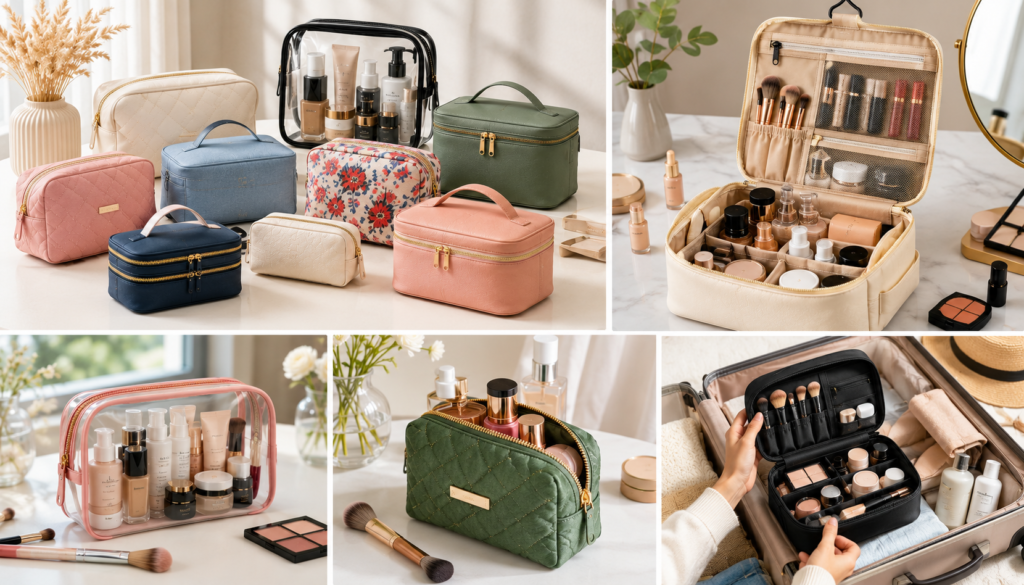
The classic zipper pouch offers simplicity and broad appeal. Travel organizers and double-layer bags provide more control over larger beauty collections. Clear bags improve visibility. Box-shaped bags create usable space for bottles and palettes. Structured cases and mirror cases support protection and premium presentation. Quilted and patterned pouches help brands build a stronger fashion identity.
The right style should be chosen around six core points:
- Target customer
- Intended use
- Required capacity
- Internal organization
- Material performance
- Brand image
A successful custom makeup bag should look attractive, but it also needs to open easily, hold the correct products, remain clean, protect its contents, and perform consistently after repeated use.
The sample stage is where these details become visible. Test the bag with real products. Check the structure while it is full. Review the zipper, lining, pockets, logo, handles, and packaging before approving bulk production.
HeteBag is based in Huadu, Guangzhou, China, an established bag manufacturing area. We have our own factory, more than 15 years of manufacturing experience, and cooperation with multiple production facilities to support different materials, styles, and project requirements. The company’s website states that its factory was established in 2011 and that it works closely with multiple factories and purchasing teams.
Whether you are developing a new custom cosmetic bag, updating an existing beauty collection, or looking for a long-term makeup bag manufacturer, you can leave your phone number and project information through our website. We will be glad to learn about your product requirements and explore how we can work together.
Frequently Asked Questions
What is the most popular makeup bag style?
The classic zipper pouch is one of the most popular styles because it is compact, practical, and easy to customize.
Which makeup bag is best for travel?
A travel makeup organizer or double-layer makeup bag is a good choice because it provides more space and separate compartments.
What materials are commonly used for makeup bags?
Common materials include polyester, nylon, canvas, PU leather, PVC, TPU, and EVA.
Can makeup bags include custom compartments?
Yes. Brands can add brush holders, mesh pockets, elastic straps, removable dividers, and bottle sections.
What size should a makeup bag be?
The right size depends on what the customer needs to carry, such as daily cosmetics, skincare bottles, brushes, or a full travel set.


