



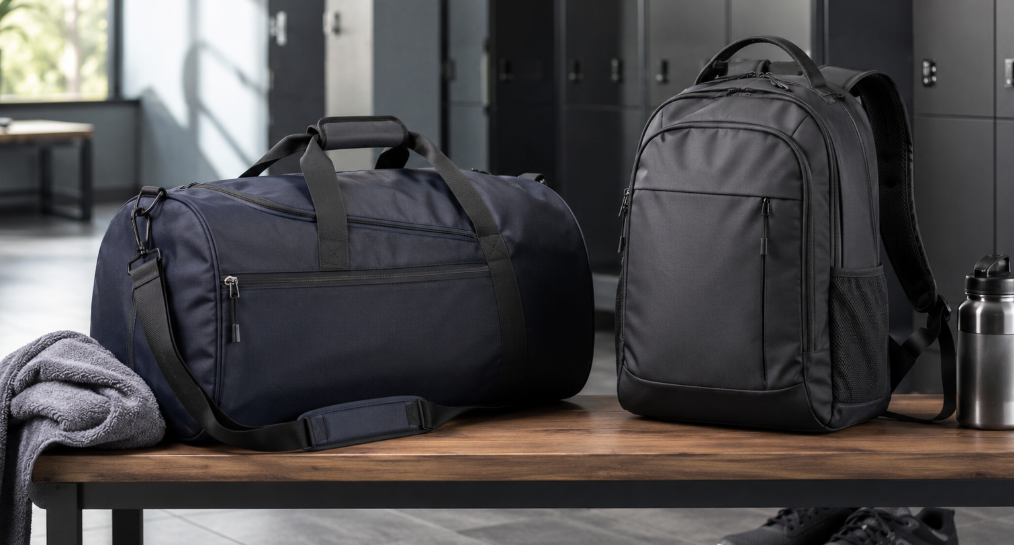
When you developing fitness-related bag products, many brands often encounter a problem: Should they choose gym bags or backpacks? Both of these products have stable market demand, but they cater to different user scenarios. Fitness bags are more suitable for carrying shoes, sports clothes, towels and training equipment, while backpacks are better suited for people who do fitness after work, students, cyclists commuting by bike, and those who engage in light exercise on a daily basis.
Therefore, for fitness brands, sports brands, gyms and wholesale purchasers, no matter which bag type you choose, you should make a judgment based on the target customers, product positioning, budget cost and customization requirements. Hetebag has over ten years of experience in the custom bag industry. In this article, we will help you comprehensively understand the differences between the two from the perspectives of B-end procurement and product development.
What Is a Gym Bag?
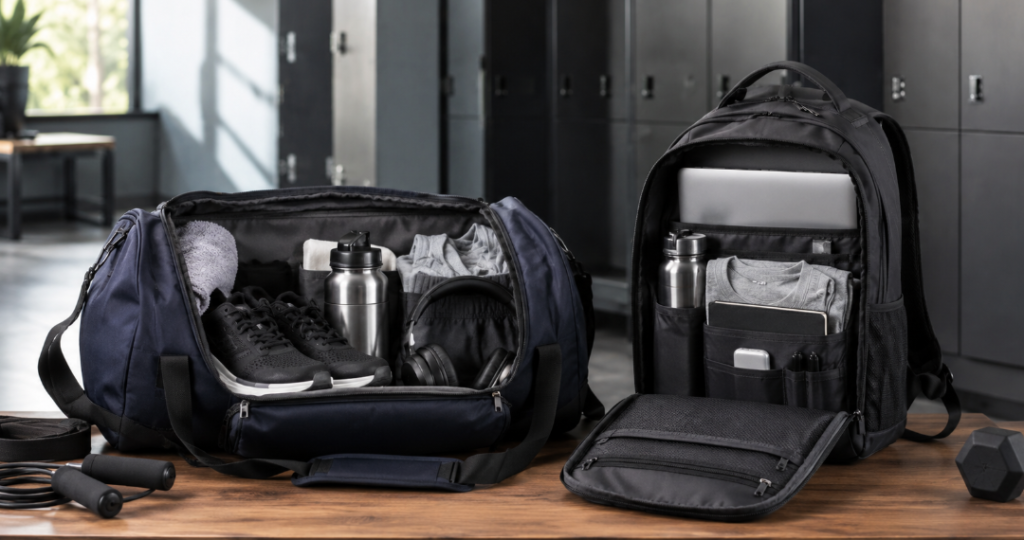
A gym bag — often referred to as a duffel bag in fitness contexts — is a cylindrical or rectangular soft-sided bag primarily designed for carrying workout gear. The main compartment is wide and open, meant to accommodate bulky items like sneakers, towels, a change of clothes, and training equipment without requiring careful folding or packing.
For brands planning to develop this type of product, a dedicated custom gym bag page can help buyers better understand available structures, materials, and customization options.
What Is a Fitness Backpack?
A fitness backpack is a two-strap, back-worn bag engineered for active users who need hands-free carrying. Unlike a standard school or travel backpack, a fitness-oriented version typically includes dedicated compartments for wet gear, ventilated shoe pockets, hydration bottle sleeves, and structured panels for back support. The carrying system itself is part of the product value.
For buyers comparing different backpack structures, our custom backpack solutions cover size, fabric, compartments, logo options, and private label development.
锚文本:
Why the Difference Matters for Product Selection
Here’s where it gets practical. When a custom gym bag manufacturer is working with a brand on product development, the very first question is: who is the end user, and what is their daily routine? A user who drives to the gym needs something they can toss in the back seat and grab quickly — that’s a gym bag. A user who bikes or walks to work before hitting the gym needs hands-free carrying and a streamlined profile — that’s a fitness backpack.
Getting this wrong means you end up with a product that looks good on spec but frustrates users in real life. And frustrated users don’t come back.
Which Bag Is More Practical for Daily Fitness Use?
Practicality is not a vague concept. It comes down to how the bag performs across a specific set of daily behaviors — and those behaviors are different for gym bag users versus backpack users.
Gym Bags for Shoes, Towels, Clothes, and Training Gear
The gym bag wins on volume access. When you need to throw in a pair of training shoes without untying them, wrap a wet towel around your water bottle, and stuff in a hoodie after your workout — the wide-mouth opening of a duffel-style gym bag handles all of that with zero friction. There’s no zipper architecture to navigate, no layered compartments to unpack.
For users who carry a high volume of gear, or gear that’s awkwardly shaped — jump ropes, resistance bands, boxing gloves, yoga blocks — the gym bag’s unstructured interior is a genuine functional advantage. A custom gym bag factory that understands this designs the main compartment with enough depth and width to accommodate bulky items without forcing them.
Backpacks for Commuting, Light Training, and Daily Carry
The fitness backpack earns its value in multi-purpose scenarios. If your customer is commuting on public transit, cycling to the gym, or carrying a laptop alongside workout clothes, a backpack is the only format that makes sense. The ergonomic carrying system distributes weight across both shoulders, reducing fatigue on longer commutes. Organized interior compartments keep gym clothes separate from everyday essentials.
Custom backpack manufacturers have developed increasingly sophisticated fitness-specific versions — with anti-theft zippers on the back panel, USB charging ports, and separate tech sleeves — that serve the fitness commuter market exceptionally well.
How Usage Scenarios Affect Buyer Decisions
| User Type | Preferred Format | Key Reason |
|---|---|---|
| Gym-only user (drives to gym) | Gym bag / duffel | Easy access, high volume capacity |
| Fitness commuter (walks, bikes, transit) | Fitness backpack | Hands-free, ergonomic, versatile |
| Studio or class-based user (yoga, pilates) | Compact gym bag or backpack | Light gear, compact format |
| Athletic team or sports club member | Large gym bag | Equipment volume, team branding |
| Online fitness seller / retailer | Both formats | Market segmentation, margin variety |
Understanding these distinctions helps you choose the right product to develop — or the right product mix to stock.
Storage and Compartment Design: Which One Organizes Fitness Gear Better?
Storage design is where product quality becomes tangible to the end user. A poorly designed compartment layout creates daily frustration. A well-designed one feels almost invisible — everything is where you expect it to be.
Shoe Compartment and Wet-Dry Separation
The shoe compartment is arguably the single most important feature in any fitness bag — gym bag or backpack alike. Training shoes carry sweat, dirt, and odor. Mixing them with clean clothes or electronics is unacceptable for most users. A vented, separated shoe pocket solves this problem entirely.
In gym bags, the shoe compartment is typically positioned at one end of the bag — a zippered side pocket with mesh panels for airflow. In fitness backpacks, it’s usually a bottom-access compartment with a waterproof lining. Both solutions work. The difference lies in access point and capacity. Gym bag shoe pockets tend to accommodate larger shoe sizes more comfortably; backpack shoe sections are more compact by design.
Wet-dry separation goes beyond shoes. Post-workout, users often need to carry damp swimwear, sweaty gear, or a used towel. A waterproof-lined inner pocket — or a fully separate wet compartment — is a feature that separates a well-designed fitness bag from a generic one. At the factory level, this requires selecting the right PVC or TPU lining, bonding it correctly to the shell fabric, and adding zippers with sufficient waterproofing.
Bottle Pockets, Inner Pockets, and Tech Compartments
Side water bottle pockets seem like a minor detail until you’re carrying a 40oz insulated bottle that won’t fit. Pocket dimensions, elastic tension, and depth all matter. A pocket that’s too shallow drops the bottle; one that’s too rigid won’t accept different bottle diameters.
Inner organization pockets — key clips, card slots, small zip pockets — add perceived value without adding significant production cost. For fitness backpacks targeting urban commuters or professionals, a padded laptop sleeve and a dedicated tech compartment can shift the bag from a pure fitness product into an everyday-carry category, expanding its market positioning.
Importance of Storage Layout for Custom Fitness Bags
When working with a gym bag factory on a custom design, storage layout is the specification that requires the most detailed discussion. Questions to resolve before production:
- How many exterior pockets, and what are the intended contents?
- Does the shoe compartment need venting, or is a sealed waterproof pocket sufficient?
- Is a separate wet compartment required, or is a waterproof-lined main body enough?
- What is the target capacity in liters, and does that align with the intended use case?
These decisions directly affect pattern complexity, material usage, and therefore unit cost. A custom gym bag manufacturer with real production experience will flag these trade-offs early — which is far preferable to discovering them during sample review.
Comfort and Carrying Experience: Which Bag Is Easier to Carry?
Carrying comfort is the one feature users feel immediately — and remember. A bag that causes shoulder pain or feels unbalanced after ten minutes of walking will not be repurchased, regardless of how good it looks in product photos.
Backpack Weight Distribution for Longer Carrying
The structural advantage of a backpack is simple physics. Studies on backpack ergonomics also show that strap design, load position, and carrying structure can affect pressure distribution and overall comfort. Two shoulder straps distribute load across both shoulders and upper back, rather than concentrating it on one point. For loads above 5–6kg, or for users carrying the bag for 20+ minutes continuously, the weight distribution difference is significant.
Fitness backpacks designed for serious use add a sternum strap and a hip belt strap to further distribute weight and stabilize the bag during movement. The back panel — padded EVA foam, mesh ventilation channels, or molded structural panels — determines both comfort and breathability. A back panel that traps heat against the user’s spine is one of the most common complaints in fitness backpack reviews.
Gym Bag Shoulder Straps and Hand-Carry Options
A standard gym bag offers three carrying options: a single removable shoulder strap, top grab handles, and often a trolley sleeve for airport or travel use. The shoulder strap — padded or unpadded, adjustable or fixed — is the primary long-carry option.
For short-distance use (from the car park to the gym floor), this is entirely adequate. The problem arises when users carry gym bags over longer distances. A single shoulder strap on a fully loaded bag creates uneven weight distribution and shoulder fatigue quickly. This is not a design flaw — it’s a format limitation. Understanding this helps brands position their gym bags accurately for their target user’s typical carrying distance.
When to Choose a Hybrid Duffel Backpack Design
The hybrid duffel backpack — sometimes called a convertible bag — attempts to solve the carrying dilemma by integrating a backpack harness system into a duffel-format body. When packed light, it carries as a backpack. When fully loaded, the harness can be tucked away and it converts to a shoulder-carry duffel.
This format is increasingly popular in the premium fitness segment. It commands a higher price point, requires more complex manufacturing (additional webbing, buckle hardware, harness channels), and appeals to users who genuinely need both carrying modes. Not every brand needs a hybrid product — but for brands targeting outdoor fitness, adventure training, or premium gym markets, it’s worth evaluating.
| Carrying Format | Best For | Weight Limit Comfort Zone | Key Manufacturing Consideration |
|---|---|---|---|
| Dual shoulder (backpack) | Long commutes, cycling, transit | Up to 12–15kg | Back panel construction, strap webbing quality |
| Single shoulder strap (gym bag) | Short-distance carry, gym use | Up to 8–10kg | Strap padding density, attachment point reinforcement |
| Hybrid duffel backpack | Multi-use, premium segment | Up to 10–12kg | Harness design, buckle hardware, dual carry points |
Material and Durability: What Should Brands Consider Before Choosing?
Material selection is where production expertise really shows. Choosing the wrong fabric — or the right fabric but the wrong specification — creates quality problems that surface after delivery, not before.
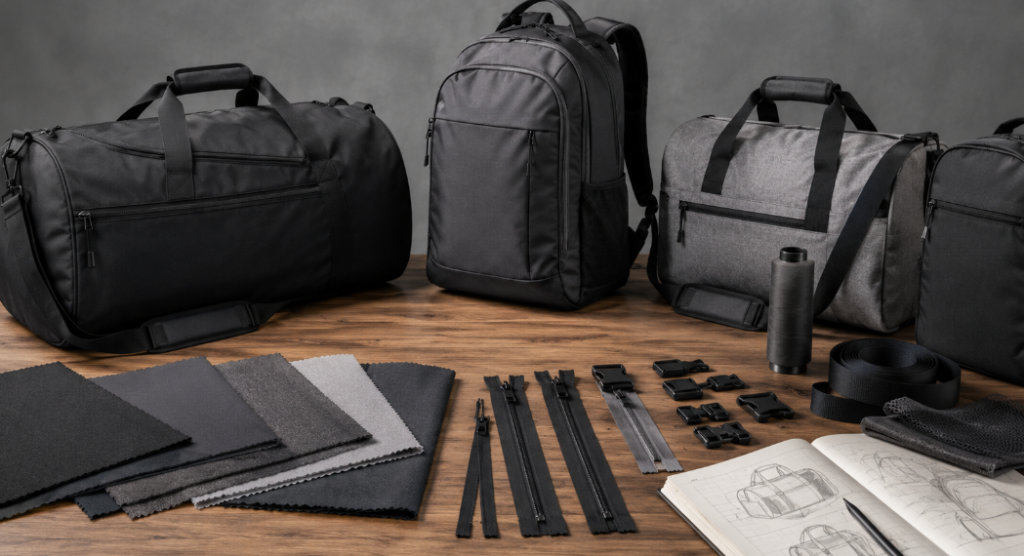
Polyester, Nylon, Canvas, and Water-Resistant Fabrics
Polyester is the most widely used material in the fitness bag category. It’s cost-efficient, durable, available in a wide range of denier weights (from lightweight 210D to heavy-duty 900D), and responds well to color dyeing. For entry-to-mid-range gym bags and backpacks, 600D or 900D polyester with a PU backing is a reliable and commercially proven choice.
Nylon offers superior abrasion resistance and a lighter weight at equivalent strength compared to polyester. It’s the preferred material for premium fitness backpacks, particularly in the 420D or 800D Ballistic Nylon range. The trade-off is cost — nylon fabrics run noticeably higher per meter than equivalent polyester, which affects minimum order economics.
Canvas brings a different aesthetic — heavier, more structured, and associated with heritage or casual-athletic branding. It’s less common in technical fitness bags but works well for lifestyle gym bags targeting a fashion-conscious market segment.
Water resistance is a specification, not just a feature claim. A true water-resistant outer fabric requires either a DWR (Durable Water Repellent) treatment or a PU/TPU coating applied to the fabric’s inner face. The difference matters at the factory level: DWR-treated fabrics bead water off the surface but are not waterproof; PU-coated fabrics offer a sealed water barrier. Brands should specify which performance level they need — and verify it with test data, not just a supplier’s assurance.
Zippers, Webbing, Lining, and Reinforced Stitching
Hardware quality is the detail that separates a well-built bag from one that fails within months. YKK zippers are the industry benchmark for smooth operation and long-term durability. Lower-cost alternatives exist — some perform adequately, many do not. At a gym bag factory with real quality controls, zipper selection is a deliberate choice, not a default.
Webbing — the straps, handles, and structural loops — should be tested for load capacity. A shoulder strap that delaminates from the bag body after repeated use is a product failure that results in returns and brand damage. Bartack stitching at all high-stress attachment points (handle bases, strap anchors, D-rings) is non-negotiable for any fitness bag expected to carry significant weight.
Interior lining serves functional and aesthetic purposes. A polyester taffeta lining makes the interior easy to wipe clean. A dark-colored lining hides minor soiling. A water-resistant lining in wet pockets prevents moisture from reaching the outer shell. These are not decorative choices — they’re functional specifications that affect user satisfaction.
If you are still comparing polyester, nylon, canvas, PU coating, or water-resistant fabrics, you can also review our guide to custom bag materials before confirming your product specification.
How Material Choice Affects Cost, Quality, and Market Positioning
| Material | Cost Level | Durability | Best Market Position |
|---|---|---|---|
| 600D Polyester + PU | Low–Mid | Good | Value and mid-range fitness bags |
| 900D Polyester + PU | Mid | Very Good | Mid-range to premium gym bags |
| 420D Nylon | Mid–High | Excellent | Premium fitness backpacks |
| 800D Ballistic Nylon | High | Outstanding | High-end performance gear |
| Cotton Canvas | Mid | Moderate | Lifestyle / casual-athletic bags |
Customization Options for Fitness Brands, Gyms, and Retailers
Customization is not just about adding a logo. It’s a strategic process that, when done correctly, creates a product that feels purpose-built for your customer — and that’s what drives retention, referrals, and repeat orders.
Logo Customization and Private Label Options
Logo application methods each produce a different visual result and carry different durability profiles. Screen printing is cost-efficient and works well on flat fabric surfaces, but fades faster under heavy wash cycles. Embroidery adds texture and perceived premium quality, particularly on structured backpacks. Heat transfer and sublimation printing allow full-color, all-over graphic application — popular in the gym merchandise category. Debossing on fabric or faux-leather patches creates a premium tactile finish.
For private label fitness bags, the most important consideration is consistency across production runs. A logo color that shifts between batches is a quality issue that affects brand identity. A reliable custom gym bag manufacturer maintains Pantone color references and conducts visual inspection against approved samples throughout production.
Size, Color, Capacity, and Structure Customization
Standard bag sizes exist because they work for most use cases — but “most” is not “all.” A brand targeting competitive CrossFit athletes has different capacity requirements than a yoga studio selling member merchandise. A custom gym bag factory should be able to adjust dimensions, add or remove compartments, modify opening angles, and engineer structural elements based on actual product briefs.
Color customization extends beyond choosing from a color chart. Fabric dyeing, hardware color matching (zipper pulls, buckles, D-rings), and lining color all contribute to the final product’s cohesive visual identity. Brands that invest in color-matched hardware and lining details consistently achieve stronger retail positioning than those that mix standard components.
How to Develop a Fitness Bag Based on Target Market
Start with the end user, not the product spec. What does a typical day look like for your customer? What do they carry? Where do they carry it? What frustrates them about their current bag? Answering these questions before writing a single specification line is what separates a product that sells from a product that sits in inventory.
From there, work backward: capacity drives dimensions, dimensions drive material yield, material yield drives unit cost, unit cost drives pricing strategy, pricing strategy determines your target market position. This is the development logic that experienced custom backpack manufacturers use when working with brands on new product launches — and it’s the process that produces results.
Gym Bag or Backpack: Which Is Better for Your Business?
The right answer depends on who you are, who your customer is, and what role the bag plays in your larger brand or business strategy.
Best Choice for Fitness Brands and Sportswear Brands
If you’re building a fitness brand from the ground up, your bag line should reflect your brand’s performance positioning. A technical fitness backpack with clean branding, intelligent compartmentalization, and quality materials signals that you understand your customer’s training lifestyle. A gym bag in a strong colorway, with a vented shoe compartment and durable hardware, appeals to the volume-focused gym user who values practicality over aesthetics.
Many successful fitness brands carry both formats — a backpack for the commuter/athlete segment and a gym bag for the gym-first user. The key is that each product is developed with its specific user in mind, not as a generic fill-in for the “bag” category.
Best Choice for Gyms, Clubs, and Promotional Projects
Gyms and sports clubs typically want a bag that creates visible brand presence. A large gym bag with bold logo placement, in brand colors, carried by members to and from the facility, functions as a mobile billboard. Volume order quantities in this segment allow for competitive unit pricing, and the use case (relatively short carry distances, high-volume gear) makes the gym bag format the natural fit.
For promotional projects — event giveaways, sponsorship merchandise, team kit — the gym bag’s lower unit cost at scale makes it the more accessible format. A drawstring bag or compact duffel can be customized at very low minimum order quantities, which suits event-scale requirements well.
Best Choice for Retailers and Online Sellers
Retailers need products that perform in a competitive digital environment — good photography appeal, clear feature communication, and strong customer reviews. Fitness backpacks tend to photograph better online due to their structured form and visible feature details. Gym bags are easier to merchandise in physical retail because they can be hung or displayed flat.
For online sellers targeting marketplaces, differentiation is everything. A product that looks like every other gym bag at a similar price point will compete on price alone — a race you don’t want to enter. A well-differentiated bag with a unique compartment layout, distinctive color blocking, or a clearly communicated feature advantage (ventilated shoe pocket, integrated trolley sleeve, laptop-compatible design) has a reason to exist in the market.
Conclusion
The gym bag versus backpack question is really a question about your customer. Everything else — materials, compartments, carrying systems, customization — flows from understanding who is using the bag, how, and where.
The brands and buyers who get this right don’t start with the bag. They start with the person carrying it.
If you’re at the stage of developing or sourcing custom gym bags or fitness backpacks for your brand, gym, or retail operation, the quality of your manufacturing partner matters enormously. A factory that can talk through compartment design, material trade-offs, and production cost implications — not just take your order — is a partner that adds real value to your development process.
Hetebag is a professional bag manufacturer based in Huadu, Guangzhou, China — the heart of China’s bag manufacturing region. With over 15 years of production experience, our own factory facilities, and established partnerships with specialized component suppliers, we support brands at every stage of the custom bag development process. From initial concept and material selection through sampling, production, and export logistics, our team has the experience to deliver products that meet real market requirements.
Our products reach buyers in over 70 countries across North America, Europe, Australia, the Middle East, and Asia. We work with fitness brands, sportswear labels, gyms, clubs, retailers, and sourcing teams who need a reliable custom gym bag manufacturer with consistent quality and clear communication.
If you’re looking for a gym bag factory or custom backpack manufacturer for your next project, we’d be glad to hear from you. Leave your details on our website and our team will reach out. We look forward to building something great together.You can also explore our custom logo bags service if your project requires logo printing, embroidery, woven labels, or private label packaging.
Frequently Asked Questions
Is a gym bag better than a backpack for fitness use?
A gym bag is usually better for users who carry shoes, towels, workout clothes, and larger training gear. A backpack is better for users who commute, walk, cycle, or need to carry fitness items together with daily essentials.
Which bag is better for carrying gym shoes?
A gym bag is often more suitable for carrying gym shoes because it usually has a wider opening and a larger shoe compartment. However, many fitness backpacks also include separate shoe sections for users who prefer hands-free carrying.
Are backpacks suitable for gym and work?
Yes. A fitness backpack is a good choice for people who go to the gym before or after work. It can include a laptop sleeve, water bottle pocket, wet-dry compartment, and separate space for workout clothes.
What materials are best for custom gym bags and backpacks?
Polyester and nylon are common choices because they are durable, lightweight, and suitable for daily fitness use. For higher-end products, brands may choose water-resistant fabrics, reinforced stitching, quality zippers, and padded straps.
Can gym bags and backpacks be customized with a logo?
Yes. Gym bags and backpacks can be customized with logo printing, embroidery, woven labels, rubber patches, custom colors, private label tags, and branded packaging. The best option depends on the bag material, order quantity, and brand positioning.