
 English
  Italian
  French
  German
  Spanish
  Arabic
 Over the past ten years, during the process of manufacturing luggage, we have come into contact with many brand owners and wholesalers from Europe, America, Australia and the Middle East. When many customers purchase cosmetic bags, they first pay attention to the price, MOQ (Minimum Order Quantity) and delivery time. These are indeed very important. However, according to market feedback, what truly affects the sales performance of the products is often whether the style selection meets the needs of the target consumers.
A well-designed and visually appealing makeup bag not only enhances the overall value of the product, but also helps the brand stand out in the highly competitive market. Whether you are a high-end beauty brand, a gift company, or an e-commerce seller, choosing the right makeup bag style is an indispensable part of the product development process.
What Is a Custom Makeup Bag?
A custom makeup bag is a cosmetic storage bag produced to a buyer’s specific requirements — not pulled from a catalogue and screen-printed, but engineered from the material selection stage forward. The distinction matters more than most buyers realize at first.
A standard cosmetic bag is a finished product that a factory designed for its own inventory. You can add your logo, sometimes swap a zipper color, and that’s roughly where your influence ends. A customized cosmetic bag starts with a brief: what material, what lining, what compartment structure, what closure hardware, what size, what packaging? Every element is a decision you own.
For beauty brands, retailers, and wholesale distributors, that level of control translates directly into margin. A bag that matches your brand’s color system and material language sells at a higher price point than one that looks like it came from a generic catalogue. Buyers who work with private label cosmetic accessories understand this intuitively — the bag isn’t a throwaway; it’s an extension of the product inside.
Common customization options include:
- Logo application — debossing, embossing, woven labels, heat transfer, screen print, or metal hardware engraving
- Material selection — PU leather, genuine leather, canvas, nylon, polyester, PVC, TPU, RPET, and recycled fabrics
- Size and internal structure — compartment count, divider placement, brush roll sections, mirror pockets
- Closure and hardware — zipper brand (YKK vs. standard), pull style, frame closures, magnetic snaps
- Packaging — polybag, hang tag, retail box, tissue paper, ribbon closure
Each of these levers affects your product’s perceived value, production cost, and lead time. Understanding how they interact is where real sourcing expertise begins.
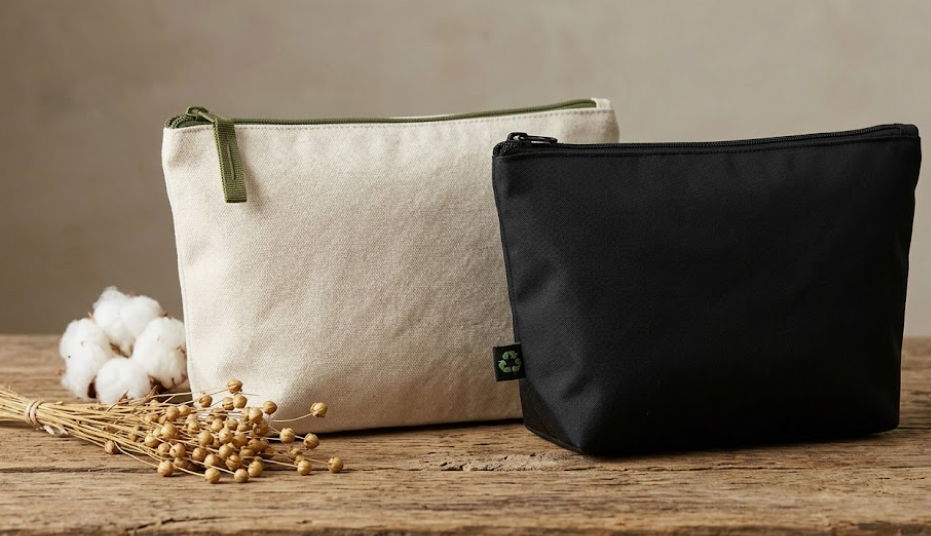
Why Custom Makeup Bags Are Popular in the Wholesale Market
The global beauty accessories market has grown steadily for years, and the travel segment amplifies that demand. More consumers are carrying their skincare and cosmetic routines across time zones, which has expanded the functional requirements for makeup bags well beyond the basic zip pouch.
Private label growth is a major factor. Smaller beauty brands that previously relied on third-party retail packaging are now building proprietary accessories to strengthen brand identity and increase average order value. A customer who buys your eyeshadow palette and your branded makeup bag is more loyal than one who buys the palette alone — the bag keeps your brand visible every time they open it.
Social media has restructured what buyers expect from packaging entirely. An aesthetically distinctive makeup bag generates organic content. When a consumer photographs their vanity or travel kit and shares it, your bag is either in the frame or it isn’t. That dynamic has made visual differentiation a sourcing priority, not just a nice-to-have.
For wholesalers and distributors, the value is structural:
- Higher retail margins compared to generic alternatives
- Stronger reorder rates when the bag quality matches the brand promise
- Differentiation in competitive retail environments
- Ability to build seasonal collections around consistent bag architecture
The brands doing this well aren’t choosing cheaper bags — they’re choosing better-specified bags that justify a higher price point at retail.
Top 10 Custom Makeup Bag Styles for Wholesale Buyers
| # | Style | Best For | Key Feature |
|---|---|---|---|
| 1 | PU Leather Makeup Bags | Premium beauty brands | Luxury feel, easy to wipe clean |
| 2 | Canvas Makeup Bags | Eco-conscious / minimalist brands | Durable, printable, natural texture |
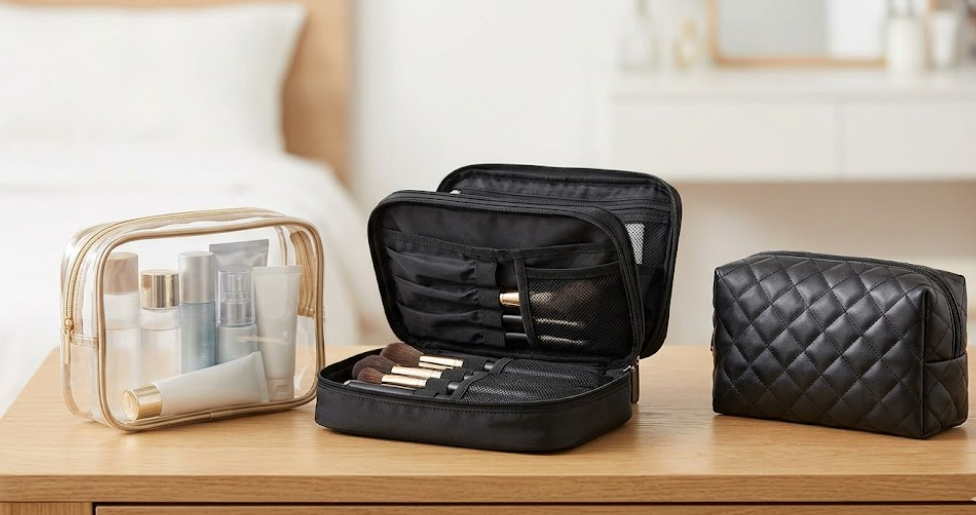
| 3 | Transparent PVC Makeup Bags | Travel retail, promotional products | TSA-compliant, contents visible |
| 4 | Quilted Makeup Bags | Gift collections, fashion brands | Elegant pattern, soft structure |
| 5 | Travel Makeup Organizer Bags | Frequent travelers, outdoor brands | Multi-compartment, roll-out design |
| 6 | Waterproof Makeup Bags | Beach, gym, bathroom use | Water-resistant shell or lining |
| 7 | Portable Mini Makeup Pouches | Daily carry, impulse purchase | Compact, lightweight, low MOQ |
| 8 | Hanging Makeup Bags | Travel kits, hotel amenities | Space-saving, hook and unfold design |
| 9 | Eco-Friendly Makeup Bags | Sustainability-positioned brands | RPET, recycled cotton, organic canvas |
| 10 | Luxury Designer Makeup Bags | High-end cosmetic collections | Premium hardware, refined material |
Best Materials Used for Custom Makeup Bags
Material selection is where most sourcing decisions are actually won or lost. The style frame matters, but the material determines durability, price point, sustainability story, and the tactile experience that either creates brand loyalty or erodes it.
If you’re comparing fabric options for cosmetic bags, you may also want to read our guide on Canvas vs Nylon Bags: Which Material Is Better for Custom Bags?, which explains the durability, cost, and customization differences between the two most commonly used bag materials.
| Material | Key Strength | Best Application |
|---|---|---|
| PU Leather | Consistent grain, easy care, takes debossing well | Premium mid-range bags |
| Genuine Leather | Unmatched feel, ages beautifully | Luxury collections |
| Canvas | Durable, printable, natural aesthetic | Eco-conscious / casual brands |
| Nylon | Lightweight, strong, water-resistant | Travel and functional bags |
| Polyester | Cost-efficient, wide color range | Promotional bags, high-volume runs |
| PVC / EVA | Transparent, lightweight, waterproof | TSA bags, clear pouches |
| TPU | More flexible than PVC, eco-safer profile | Waterproof bags, eco-positioned lines |
| RPET / Recycled Fabrics | Sustainability credentials, GRS certifiable | Eco-branded collections |
Choosing the right material for your market starts with understanding your retail price point and your customer’s use context. A canvas bag priced at $28 retail needs different construction than one priced at $12. A PU leather bag that will be carried daily needs a different grade of coating than one sold as a gift item. Discuss these use contexts explicitly with your manufacturer — a factory that asks the right questions about end use is one that understands the product.
Lining material is equally important and frequently overlooked in initial briefs. A satin polyester lining photographs beautifully but shows staining quickly. A flocked lining protects products but adds weight. Waterproof-coated linings protect against spillage but increase cost. The lining is part of the product experience and deserves the same specification attention as the exterior.
Why I Recommend This Custom Makeup Bag Manufacturer
Fifteen years in this industry has taught me exactly what separates a manufacturer worth building a long-term relationship with from one that looks good in a first quotation and disappoints in production.
Stable product quality is the foundation. Quality variance between sample and bulk production, or between one order and the next, is the single most expensive problem a wholesale buyer can face. It creates returns, damages brand reputation, and burns the margin that the initial low price appeared to offer. A manufacturer with robust quality management — documented inspection protocols, trained QC staff, measurable rejection rates — will cost slightly more and deliver far better outcomes.
OEM and ODM capabilities matter because your needs will evolve. Early in a product line’s development, you may need a manufacturer to bring design ideas to the table (ODM). As your brand matures, you’ll want to bring your own detailed specifications and have them executed precisely (OEM). A factory that handles both gives you a development partner for the long term, not just a production vendor.
Low MOQ support is genuinely valuable for brands in growth phases. A manufacturer that can produce small runs cleanly — without cutting corners on materials or finishing — allows you to test new styles without tying up significant capital. The ability to scale MOQ upward as demand proves out is a natural extension of that capability.
Fast and accurate sampling separates good factories from great ones. A sample that arrives quickly but doesn’t match the brief accurately costs more time than a slower sample done right. The speed of the sampling process tells you a lot about how organized a factory’s development team is — it’s a preview of how the production process will go.
Experience with global beauty brands brings market-specific knowledge that generic bag factories lack. Understanding TSA compliance requirements, retail packaging expectations in different regions, and the durability standards that major beauty retailers require comes from working with demanding global buyers over years. That accumulated knowledge shows up in proactive suggestions during the development process.
Competitive wholesale pricing built on genuine material sourcing advantages — being physically located in a manufacturing district like Huadu — delivers cost efficiency without quality compromise. The proximity to material suppliers, hardware vendors, and specialized subcontractors creates a cost structure that factories located far from supply chains simply cannot match.
How to Choose the Right Custom Makeup Bag Manufacturer
The selection process deserves more rigor than most buyers apply to it. A RFQ sent to five factories on Alibaba and a decision based on lowest price is not a sourcing strategy — it’s a cost-optimization gamble that frequently loses.
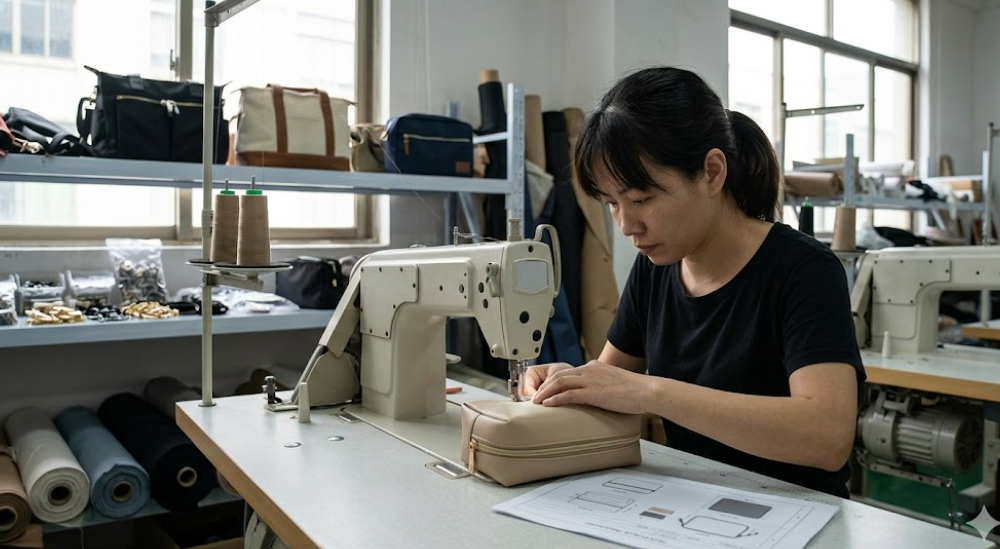
Factory experience and specialization should be your first filter. A factory that primarily produces travel bags or luggage may not have the finishing expertise for a luxury cosmetic collection. Look at what they actually make in volume, not what their catalogue claims they can do. Request photos of the production floor and the QC area.
Customization depth varies significantly between factories. Some can execute your specifications; others can only modify existing constructions. If your brief requires novel compartment engineering or specialized hardware, confirm that the factory has done comparable work before requesting a sample. Ask to see development photos from a similar project.
Product samples are non-negotiable. A first sample will rarely be perfect — what matters is how accurately it reflects your brief and how the factory responds to feedback. A manufacturer who asks good questions when receiving revision notes and produces improved samples efficiently is showing you how the production process will unfold.
MOQ and pricing structure should be evaluated together. A very low MOQ with unit pricing that doesn’t pencil at scale is not useful. A higher MOQ with pricing that creates real margin at your target retail is far more valuable. Understand the pricing breaks and build your order planning around them.
Production lead times need to be confirmed realistically, not optimistically. Ask for lead times based on current production capacity, not best-case scenarios. Build buffer into your own planning for customs clearance and logistics variability.
Certifications tell you how seriously a factory takes quality and compliance. ISO 9001 is the foundational quality management certification. BSCI, SMETA, and similar social compliance audits are increasingly required by major retail buyers and provide independent verification of labor and environmental practices.
Communication quality is a leading indicator of production quality. A factory that responds to detailed technical questions with vague reassurances, or that deflects specification questions with “no problem,” is telling you something important. Precise, detailed communication during the quoting phase predicts precise, detailed execution during production.
Common Mistakes Wholesale Buyers Should Avoid
Choosing a supplier based on price alone is the most consistent source of expensive lessons in this category. Low-cost production almost always involves compromises — in material grade, hardware quality, stitching density, or QC rigor — that emerge in customer returns, brand reputation damage, or both. The total cost of a sourcing decision includes logistics, quality inspection, potential rework, and the cost of customer dissatisfaction. Evaluate all of it, not just the unit price.
Ignoring material quality specifications creates a category of problem that only appears after the order ships. A fabric spec described as “similar to” your reference sample is not the same as a confirmed material specification with a tested sample. Before placing a bulk order, request a pre-production sample in the exact material to be used in production and physically confirm it against your approved standard.
Overlooking packaging customization leaves value on the table. The unboxing experience — tissue paper, ribbon pull, hang tag, retail bag — is increasingly where brand premium is communicated. A beautifully made bag shipped in a plain polybag with a sticker label signals that packaging wasn’t considered. Packaging is a cost, but it’s an investment in the brand moment.
Not confirming sample details before mass production is where most bulk order disasters begin. A bulk production run is not the time to discover that the zipper gauge was changed, the lining color is subtly different, or the logo position shifted. A formal pre-production approval — with a physical golden sample that production is measured against — prevents most of these problems.
Poor communication during the production process amplifies every other risk. Define approval checkpoints clearly before production begins: fabric cutting approval, first-off-line sample review, inline inspection at a specified percentage of completion, and final inspection before shipment. A manufacturer who accepts these checkpoints is more trustworthy than one who presents resistance to oversight.
Conclusion
Custom makeup bags are not a commodity category — they’re a brand asset. The style you choose, the material you specify, and the manufacturer you build a relationship with all shape how your product performs at retail, how your customers experience your brand, and what margins you carry into the next season.
The ten styles covered here represent the most commercially active segments of the market right now. Each has a distinct use case, a distinct consumer, and a distinct set of production requirements. Understanding those differences before you place a brief is what separates buyers who build strong product lines from those who repeatedly start over.
If you’re actively searching for a reliable custom makeup bag manufacturer, we’d encourage you to consider working with Hetebag — a factory-backed manufacturer based in Huadu District, Guangzhou, China, with over 15 years of manufacturing experience. Hetebag operates its own factory and collaborates with a network of specialized facilities, offering full OEM and ODM services for brands, wholesalers, and distributors worldwide. Products are exported to over 70 countries, supported by ISO 9001–certified quality management and independent audits including SGS, SMETA, and BSCI.
Whether you’re developing a new private label line or scaling an established collection, the team at Hetebag is equipped to handle the full development cycle — from material sourcing and sampling through bulk production and export. If you’re ready to move forward, you can leave your contact details directly on the website. We look forward to hearing from you and building something worth carrying.
Frequently Asked Questions
What is the typical MOQ for custom makeup bags?
MOQ varies depending on the material, design complexity, and customization requirements. For standard custom makeup bags, most manufacturers offer MOQs ranging from 300 to 1,000 pieces per style. Factories with OEM and ODM capabilities may also support lower MOQs for sampling or new product launches.
How long does it take to produce custom makeup bags?
Production timelines usually include sampling and mass production. Samples typically take 5–10 days, while bulk production takes 20–35 days depending on order quantity, materials, and factory capacity. During peak seasons, buyers should place orders early to avoid delays.
Which material is best for custom makeup bags?
The best material depends on your target market and budget. PU leather is popular for premium beauty brands, canvas works well for eco-conscious collections, and nylon is ideal for travel-focused products. Buyers should consider durability, branding requirements, and retail positioning before selecting materials.
Can I add my logo and custom packaging to makeup bags?
Yes. Most professional manufacturers offer multiple branding options, including screen printing, embroidery, embossing, debossing, woven labels, metal logo plates, and heat transfer printing. Custom packaging such as hang tags, gift boxes, tissue paper, and branded polybags can also be produced.
How do I choose a reliable custom makeup bag manufacturer?
Look beyond pricing. Evaluate the factory’s experience, product quality, OEM/ODM capabilities, certifications, sampling process, communication efficiency, and quality control system. Request samples before placing bulk orders and verify whether the manufacturer has experience working with international beauty brands.


