
 English
  Italian
  French
  German
  Spanish
  Arabic
 China has always been an important center for the global backpack manufacturing industry. By 2026, a large number of international brands, wholesalers and e-commerce brands will still choose to source from China for travel backpacks, computer backpacks, student schoolbags, and eco-friendly RPET backpacks. The mature supply chain, rich production experience, and flexible OEM/ODM customization capabilities have enabled Chinese factories to maintain strong competitiveness in the global market.
However, for the buyers, the price is not the only important factor. The quality control of the factory, the ability to produce samples, the stability of delivery time, and the efficiency of communication will also directly affect the final market performance of the products. This article has compiled 10 Chinese backpack manufacturers that are worth paying attention to in 2026, hoping to help you find the right partners more efficiently.
Besides backpack factories, China also has a highly developed broader bag manufacturing industry covering tote bags, handbags, and travel bags.Here Top 15 Bag Manufacturers in China.
Why China Dominates the Global Backpack Manufacturing Industry
The Complete Supply Chain Advantage
China’s dominance in backpack manufacturing isn’t accidental. It’s the result of decades of industrial layering — and it shows up in ways that directly affect your product quality and lead times.
The Guangdong province alone houses thousands of fabric mills, zipper suppliers, hardware stampers, webbing producers, and foam cutters within a 100-kilometer radius of most major bag factories. When a factory needs a specific grade of YKK zipper or a custom-dyed Cordura fabric, it’s not waiting weeks for a shipment from across the country. The raw materials are often an hour’s drive away.
This proximity does something powerful: it compresses your production timeline. A factory in Guangzhou can prototype, revise, and produce a sample in days. That same process can take weeks in countries still building out their supply chains.
Clusters like Huadu District in Guangzhou, Quanzhou in Fujian, and Shenzhen are not just manufacturing zones — they’re ecosystems. Skilled workers, experienced pattern makers, quality control staff, and export logistics specialists are all concentrated in these areas. You’re not just hiring a factory; you’re tapping into a multi-generational knowledge base.
OEM and ODM Production Capabilities
Chinese backpack manufacturers operate across two primary models, and understanding the difference matters before you place your first order.
OEM (Original Equipment Manufacturing) means the factory builds to your exact specifications. You control the design, materials, dimensions, branding, and every detail. The factory’s job is execution. This model works well when you have an established design language and just need a reliable production partner.
ODM (Original Design Manufacturing) means the factory brings its own designs, which you can brand and modify within certain parameters. Many factories maintain a library of seasonal designs they update each year. For buyers who don’t have an in-house design team, ODM dramatically reduces development costs and speeds up time to market.
Most experienced Chinese manufacturers handle both with equal competence. The ones worth working with have in-house designers, tech pack review capabilities, and the ability to push back on specifications that would cause structural problems during production.
Cost and Lead Time Advantages
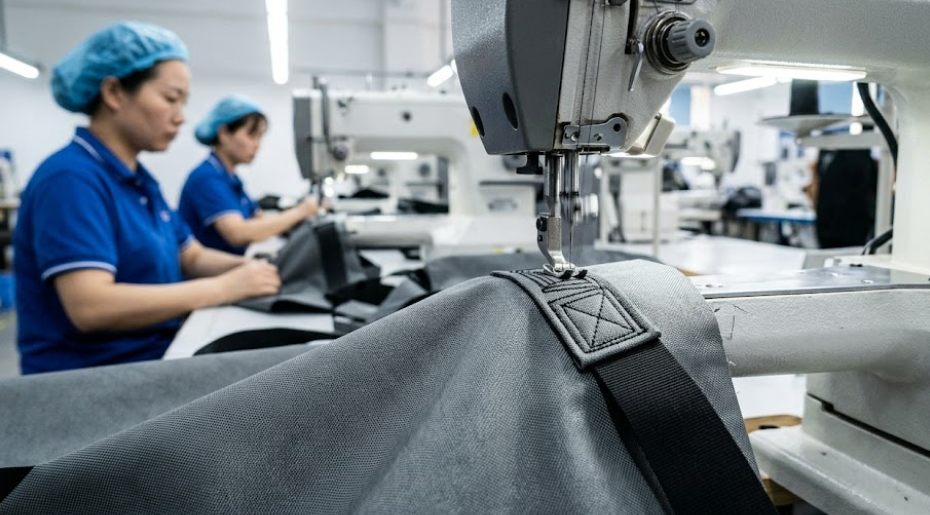
Factory-gate pricing in China remains competitive for reasons beyond raw labor costs. Automation investment over the past decade has been substantial. Modern bag factories in Guangdong now use computerized cutting machines, automated sewing jigs for repeated operations, and digital quality checkpoints throughout the production line. This reduces per-unit labor input without sacrificing consistency.
Typical lead times for custom backpack orders run between 30 and 60 days from sample approval, depending on order volume and complexity. That includes material sourcing, cutting, sewing, finishing, and QC inspection. Rush production for established relationships can compress this significantly.
China vs. Vietnam and India
Vietnam has emerged as a credible alternative, particularly for brands seeking to diversify supply chain risk. Labor costs in Vietnam are lower in certain categories, and several large factories have invested in infrastructure to handle mid-to-large volume orders. Where Vietnam still lags is in material sourcing — most technical fabrics, hardware, and zippers still come from China, which adds time and cost to the equation.
| Factor | China | Vietnam | India |
|---|---|---|---|
| Material availability | Excellent — full supply chain on-site | Moderate — imports from China | Limited — mainly cotton/canvas |
| Production capacity | Very high — scales easily | Medium — growing but limited | Medium — better for fabric goods |
| OEM/ODM capability | Extensive | Growing | Limited |
| Typical MOQ | 200–500 pcs | 500–1,000 pcs | 500–2,000 pcs |
| Sample lead time | 7–15 days | 15–30 days | 20–40 days |
| Certifications (BSCI, ISO) | Widely available | Available at top factories | Selective |
India has strengths in canvas and leather goods, but for technical backpacks — laptop bags, hiking packs, waterproof gear bags — China still outperforms on both capability and consistency.
How to Choose the Right Backpack Manufacturer in China
Factory vs. Trading Company
This distinction matters more than most buyers realize. A factory manufactures directly. A trading company acts as an intermediary, sourcing production from factories on your behalf.
Trading companies aren’t inherently bad. Some have deep relationships with specialized factories and can source niche products more efficiently than you could working directly. But they add a markup layer, and you lose direct visibility into who’s actually making your product.
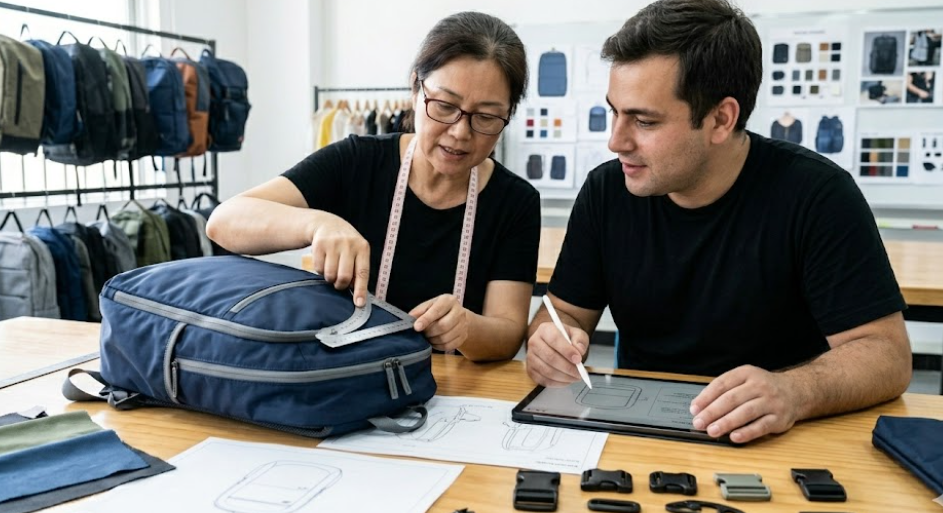
For custom backpack development — where you’re building something specific to your brand — working directly with a factory gives you more control over material choices, construction methods, and quality standards. You can visit the production floor. You can watch a sewing run. You can see the QC team in action.
If you’re buying from a trading company, ask for the factory’s business license and audit reports. Any serious sourcing relationship should include visibility into the actual production source.
Minimum Order Quantities
MOQ is one of the first numbers that shows up in a conversation, and it can feel like a wall. A factory quoting 1,000 pieces per style isn’t necessarily being unreasonable — it reflects the economics of setup costs, material minimums, and production scheduling.
That said, MOQs are negotiable, especially if you’re offering a long-term relationship or a higher per-unit price to offset the efficiency loss. Established manufacturers with a diverse client base are often more flexible than single-category factories.
For new buyers testing a product line, some manufacturers will accept smaller initial runs — sometimes as low as 200 to 300 pieces — with the understanding that volume increases as the relationship develops.
Sampling Capability
Never skip the sampling stage. A factory’s ability to turn around a clean, spec-accurate sample within two weeks tells you a great deal about how they’ll perform in production.
Watch for these signals during sampling:
- Do they read your tech pack carefully, or do they improvise on unclear specs?
- Do they flag construction concerns before starting, or do they just build what’s drawn?
- Is the sample stitching consistent, or are there loose threads and tension issues?
- Does the hardware match the spec sheet exactly?
A factory that asks good questions during sampling is a factory that cares about getting production right.
Quality Control Systems
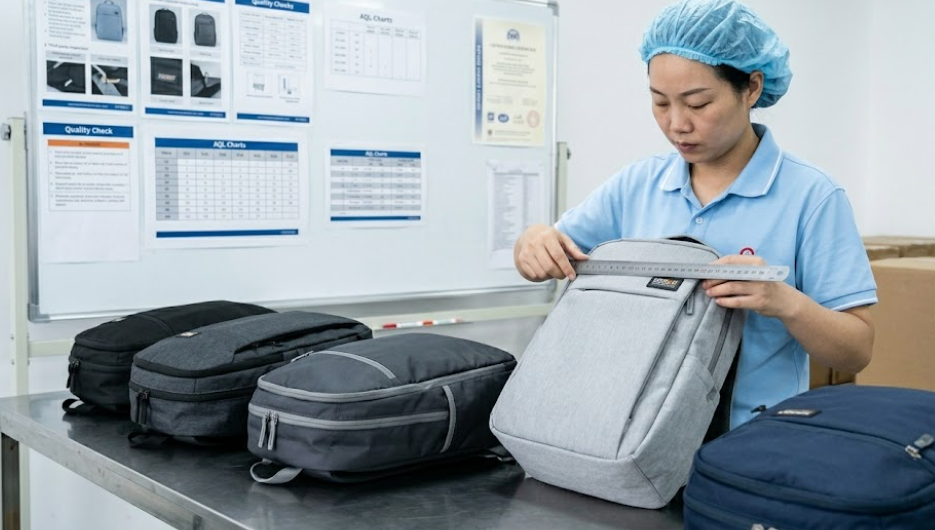
Strong manufacturers have quality control built into the production process, not bolted on at the end. Ask about their in-line QC checkpoints — the inspections that happen during sewing, not just when the bag is finished.
Relevant certifications to look for include BSCI (Business Social Compliance Initiative), ISO 9001 for quality management systems, and GRS (Global Recycled Standard) if you’re sourcing RPET or recycled materials. These aren’t just boxes to check — they indicate a factory has invested in systems and documentation that support consistent output.
For high-stakes orders, third-party pre-shipment inspections through services like SGS or Bureau Veritas add an independent layer of verification that’s worth the cost.
Communication and After-Sales Capability
This one tends to get underweighted until something goes wrong. A factory with responsive, clear English communication — or a dedicated account manager — is worth paying slightly more for. When a production issue surfaces at week three of a five-week run, you need to be able to address it fast.
Ask about their response time expectations. Ask how they handle defects discovered after delivery. A manufacturer with a clear process for post-shipment quality disputes is a more reliable long-term partner than one that goes quiet when problems arise.
Top 10 Backpack Manufacturers in China (2026)
The manufacturers listed below have been selected based on production capability, export track record, product range, and reputation within the sourcing community. This is not a ranking by prestige — it’s a practical list for buyers evaluating their options.
| Company | Founded | Location | Main Products |
|---|---|---|---|
| Hetebag | 2010 | Guangzhou (Huadu), China | Custom backpacks, tote bags, laptop bags, RPET bags |
| Kingsons | 1997 | Guangzhou, China | Laptop backpacks, business backpacks, travel bags |
| Xiangxing Group | 1998 | Quanzhou, Fujian | Sports backpacks, outdoor bags, school bags |
| Szoneier | 2007 | Shenzhen, China | Waterproof backpacks, dry bags, travel bags |
| Shenzhen Ribon Creative Co., Ltd | 2003 | Shenzhen, China | Backpacks, school bags, laptop bags, travel bags |
| Benshine Bags | 2013 | Xiamen, China | Promotional backpacks, tool bags, cooler bags |
| Honeyoung Bag | 1992 | Anhui, China | School backpacks, kids backpacks, trolley bags |
| SLBAG | 2005 | Guangzhou, China | Fashion backpacks, women’s bags, PU backpacks |
| Meyzy Bag Manufacturer | 2011 | Qingdao, China | Travel backpacks, tactical bags, outdoor bags |
| Green Field Bag Manufacturer | 2005 | Xiamen, China | Eco-friendly backpacks, RPET bags, tote bags |
Types of Backpacks Chinese Manufacturers Can Produce
Chinese factories cover an extensive range of backpack categories. Below is a practical reference for what’s widely available:
| Backpack Type | Common Materials | Key Features | Typical Use |
|---|---|---|---|
| Laptop Backpacks | 600D polyester, nylon, PU | Padded laptop sleeve, USB port, anti-theft zipper | Business, daily commute |
| Travel Backpacks | 900D polyester, Cordura nylon | Large capacity, packing cubes compatibility, TSA-friendly | International travel |
| School Backpacks | 600D–900D polyester | Ergonomic straps, reinforced bottom, multiple pockets | Students K–12 |
| Tactical Backpacks | 1000D Cordura nylon, MOLLE webbing | MOLLE attachment points, hydration bladder sleeve | Military, outdoor, EDC |
| Hiking Backpacks | Ripstop nylon, mesh back panel | Hip belt, load transfer system, rain cover | Trail and mountain |
| Promotional Backpacks | 210D–600D polyester | Logo-friendly panels, lower cost per unit | Corporate gifts, events |
| Waterproof Backpacks | TPU-coated nylon, PVC | Sealed seams, waterproof zippers, roll-top closure | Water sports, rain gear |
| Sustainable/RPET Bags | Recycled PET bottles | GRS certification available, reduced carbon footprint | Eco-conscious brands |
One point worth making clearly: Chinese factories aren’t just cutting and sewing commodity bags. The more experienced manufacturers have engineers who understand load distribution, stress points in strap attachment, and how material choices affect long-term durability. That technical depth matters when you’re developing a product that needs to hold up under real use conditions.
Backpack Materials Explained
Material selection is where many first-time buyers underestimate complexity. The material you choose affects cost, durability, customer perception, and which factories can actually produce your product well.
Nylon vs. Polyester
Nylon and polyester are the two most common synthetic fabrics in backpack production, and they’re often confused.
Nylon is stronger per unit weight, more abrasion-resistant, and has a more premium feel. It costs more. For a product that needs to handle daily abuse — laptop bags, hiking packs, tactical bags — nylon earns its price. The most common weights used in backpacks are 210D, 420D, and 630D nylon.
Polyester is more cost-effective and maintains color better under UV exposure. It’s the standard material for promotional bags and school backpacks where price sensitivity is higher. 600D polyester is the workhorse of the backpack industry — familiar, reliable, and widely produced.
If you want a deeper comparison of backpack fabrics, you can also read our detailed guide on backpack materials, including nylon, polyester, and canvas options.
Canvas vs. Oxford Fabric
Canvas is a tightly woven fabric, typically cotton or a cotton-polyester blend, that gives a natural, heavier aesthetic. It’s durable, takes wax coatings well, and appeals to lifestyle and heritage brands. The weight works against it for everyday-carry bags — canvas bags are noticeably heavier than technical fabrics.
Oxford fabric refers to the weave structure rather than the fiber content, and it’s usually polyester. The basket-weave construction gives it a textured appearance and decent tear resistance at a lower cost than nylon. It’s common in school bags and budget-tier backpacks.
RPET Sustainable Materials
RPET (Recycled Polyethylene Terephthalate) is fabric made from recycled plastic bottles. The technical performance is comparable to virgin polyester, but it carries a verified sustainability credential when certified under the Global Recycled Standard (GRS).
Demand for RPET bags has grown steadily, particularly among European and North American buyers working toward sustainability commitments. The cost premium over virgin polyester is real but shrinking as production volumes increase. Factories like Green Field and Hetebag have invested in RPET production and can provide the documentation chain required for GRS certification.
Waterproof Coatings and Zippers
“Water-resistant” and “waterproof” are not the same thing, and the distinction matters for product claims.
DWR (Durable Water Repellent) coatings applied to fabric surfaces repel light rain but won’t stop sustained water exposure. For genuine waterproofing, the seams need to be sealed and the zippers need to be either waterproof-coated or replaced with sealed zipper tape. TPU lamination applied to the interior of the fabric is another approach — effective, and commonly used in dry bags and rain-specific packs.
YKK makes the most widely recognized waterproof zippers, though alternatives like SBS and RiRi are available at different price points. Specify which zipper brand you require in your tech pack, or you may get whatever the factory uses by default.
Hardware and Accessories
Buckles, D-rings, sliders, and pull tabs are often the details buyers overlook until they receive a sample with mismatched metal finishes or plastic hardware that feels flimsy under light stress.
Specify hardware weight, finish (matte black, gunmetal, gold, nickel), and minimum pull strength if durability is a concern. For bags intended for heavy use, metal hardware is worth the cost premium over plastic equivalents. Plastic hardware from quality suppliers like ITW Nexus or Duraflex performs well in consumer applications, but off-brand hardware can fail in ways that create post-sale quality problems.
OEM vs. ODM Backpack Manufacturing: Which Is Better?
What OEM Means in Practice
OEM manufacturing puts full design responsibility in your hands. You provide the tech pack — the detailed specification document that includes dimensions, materials, colors, hardware, stitching details, and any branded elements. The factory quotes and produces against your specs.
The OEM model works well when:
- You have an established design identity
- You want complete control over differentiation
- You’re building a brand where the product design is a competitive asset
- You have the internal resources to manage tech pack development
The cost of OEM mistakes lands on you. If the spec is wrong, the production run reflects that. Experienced factories will flag obvious issues, but they’re not responsible for gaps in your documentation.
What ODM Means in Practice
ODM means the factory already has designs — sometimes hundreds of them, updated seasonally — that you can select, modify within limits, and brand with your logo and colorways. The development investment is much lower because the base design work is already done.
ODM is a smart starting point for newer buyers who don’t yet have a product development infrastructure. It lets you get to market faster, test products with real customers, and build volume before investing in fully custom development.
The trade-off: other buyers can access the same base designs. If you’re building a brand on design differentiation, ODM limits how far you can go.
Cost Comparison
| Development Type | Tooling/Design Cost | Per-Unit Cost | Time to Market |
|---|---|---|---|
| Pure OEM (new design) | $500–$2,000+ (tech pack, samples, revisions) | Slightly higher due to custom setup | 60–90 days from spec approval |
| ODM (modified factory design) | $100–$500 (logo, color changes) | Competitive — design overhead absorbed | 30–45 days |
| ODM to OEM transition | Moderate — builds on existing relationship | Optimized over time | Varies |
For startups launching a first product, ODM plus strong branding often delivers better ROI than a fully custom OEM program. As volume and brand equity build, transitioning key products to OEM makes strategic sense.
How Much Does It Cost to Manufacture a Backpack in China?
Manufacturing cost is one of the most common questions buyers ask, and one of the hardest to answer without context. A $3 promotional bag and a $45 technical hiking pack both come out of Chinese factories. The difference is entirely in what goes into them.
Core Factors That Drive Cost
Material is consistently the largest cost driver, often representing 40–60% of factory-gate cost. The difference between a 600D polyester school bag and a 1000D Cordura tactical pack is significant. Material selection is the single most powerful lever you have on cost.
Logo and branding techniques vary substantially in cost. A simple embroidered logo adds $0.30–$1.00 per piece. Heat transfer printing is often less. Full-panel sublimation printing requires specific materials and adds more. Debossed leather patches or custom metal badges are at the higher end.
Hardware — buckles, zippers, sliders — adds up quickly when you move from standard to premium options. A full hardware upgrade on a mid-tier bag can add $1.50–$3.00 per unit.
Packaging matters more than many buyers account for. Polybag-only packaging is minimal cost. Retail box packaging with hang tags, tissue paper, and printed inserts can add $1.00–$3.00 per unit or more depending on the spec.
Shipping and duties are outside the factory price but critical to your landed cost calculation. Container freight rates fluctuate, and tariff rates on bags imported to the US or EU change with trade policy. Model your landed cost from the beginning, not after you’ve locked in the factory price.
Approximate Price Ranges by Category (2026)
| Backpack Type | FOB China Price Range |
|---|---|
| Basic promotional backpack (600D polyester) | $3.00–$7.00 |
| School backpack (mid-quality) | $7.00–$15.00 |
| Laptop backpack (business grade) | $12.00–$25.00 |
| Travel backpack (large capacity) | $18.00–$40.00 |
| Hiking/tactical backpack (technical materials) | $25.00–$60.00+ |
| RPET sustainable backpack | $10.00–$22.00 |
These are FOB prices — the cost at the factory or port of origin before freight, duties, and import costs are added. Your landed cost will be higher, and the margin structure needs to account for that from the start.
2026 Price Trends
Material costs have stabilized after the volatility of 2022–2023, but they haven’t returned to pre-pandemic lows. RPET fabric has become more cost-competitive as production scale has increased. Labor costs in China have risen modestly, but automation investment in leading factories has offset much of this increase on a per-unit basis.
Tariff exposure remains a meaningful variable for US buyers, particularly given the ongoing evolution of trade policy around Chinese manufactured goods. Buyers sourcing for the US market should factor potential duty adjustments into their cost modeling rather than assuming current rates will hold.
Common Problems When Importing Backpacks from China
Sample-to-Bulk Inconsistency
This is the most frequently reported issue in backpack importing, and it happens for predictable reasons. The sample is often made by a highly skilled sample maker who takes extra care. The production run is made by regular line workers operating under time pressure.
The gap shows up in stitching tension, seam alignment, hardware attachment, and finishing details. The best protection is a clear, detailed tech pack that leaves no ambiguity, combined with in-line quality checks during production rather than a single inspection at the end.
Delivery Delays
Lead time commitments slip for a range of reasons — material delays from suppliers, production scheduling changes, quality issues that require rework, or factory capacity conflicts from other orders. Most delays are foreseeable.
Build buffer time into your planning. A 45-day lead time should be planned as 55 days in your inventory model. Ask for production status updates at meaningful milestones: material sourcing confirmed, cutting complete, assembly underway, finishing and packing.
Hidden Costs
The quoted FOB price is real, but it’s not the only cost. Material upgrades requested mid-sample stage, additional sample rounds, logo setup fees, packaging changes, color lab dip approvals — these small line items accumulate. Clarify upfront which costs are included in the initial quote and which are additional.
Quality Problems
Quality problems that slip through inspection typically fall into three categories: material defects (wrong fabric weight, inconsistent dyeing), construction defects (missed stitching, zipper alignment), and finishing defects (stray threads, hardware scratches, incorrect labeling).
Third-party inspection before shipment catches most of these. The cost is typically $200–$400 per inspection visit and covers a statistically meaningful sample of your order. It’s cheap insurance on orders valued at $10,000 or more.
Reducing Supply Chain Risk
Working with certified factories (BSCI, ISO, or equivalent) reduces — but doesn’t eliminate — risk. Building direct relationships, visiting facilities when possible, and establishing clear contractual terms around defect responsibility are the structural protections that matter most over time.
Diversifying production across two or more factories for high-volume programs creates resilience against single-factory capacity or quality failures.
Tips for Working With a Chinese Backpack Factory
Improving Communication Efficiency
Time zone differences and language gaps are real friction points, and managing them well is a competitive advantage. A few practices that consistently improve the working relationship:
Keep written communication clear, specific, and short. Long emails with multiple embedded questions often result in partial answers. Numbered questions get numbered answers. Video calls for complex technical discussions are worth the scheduling effort — showing a problem on screen is faster than describing it in writing.
Document every decision. When you agree to a spec change verbally or on a call, follow up with a written summary. Production mistakes often trace back to undocumented verbal agreements that someone remembered differently.
The Importance of a Tech Pack
A tech pack is a specification document that describes your product in enough detail that any competent factory can produce it without guessing. It includes dimensions, materials with specific codes or standard references, hardware specs, color references (Pantone or physical swatch), stitching requirements, labeling requirements, and packaging specs.
Factories that receive a complete tech pack make better samples. They also have a clear reference point for production quality — if something doesn’t match the tech pack, that’s a documentable defect rather than a subjective disagreement.
Investing in a well-developed tech pack at the beginning saves significantly more in sample revision costs and production disputes than it costs to create.
How to Inspect Goods
For pre-shipment inspection, the AQL (Acceptable Quality Level) standard is widely used. AQL 2.5 is common for consumer goods and means that approximately 2.5% defect rate in a statistically sampled batch is within acceptable range.
During inspection, check:
- Dimensions against spec (measure multiple units)
- Material weight and composition
- Stitching quality and seam strength
- Hardware function and attachment security
- Logo placement, color accuracy, and print quality
- Labeling compliance (care labels, country of origin, size tags)
- Packaging condition and quantity
How to Reduce MOQ
If the quoted MOQ is higher than you need, a few approaches tend to work:
Offer a higher per-unit price to compensate for the efficiency loss on a smaller run. Propose a multi-style order that aggregates volume — three styles at 300 units each instead of one style at 900. Share the factory’s base design (ODM) rather than requiring a fully custom build. Establish a roadmap showing projected volume growth that makes the initial small run worth the relationship investment.
Building a Long-Term Partnership
The factories that become genuine long-term partners are the ones where both sides invest in the relationship. Paying invoices on time, providing timely feedback on samples, communicating production schedule needs clearly, and treating factory staff professionally all contribute to being a preferred client.
Preferred clients get better pricing over time, priority production scheduling during busy seasons, and more proactive communication when issues arise. The relationship compounds in your favor — but only if you build it deliberately.
Conclusion
China’s backpack manufacturing industry isn’t standing still. The factories at the top of this list have been investing in automation, sustainable material capabilities, and design development — not waiting to compete on price alone. The best ones want partners who are building real products with real market ambitions, not just buyers chasing the lowest quote.
If you’re evaluating manufacturers for your next program, the process comes down to finding factories whose production capabilities, quality systems, and communication style match the complexity of what you’re building.
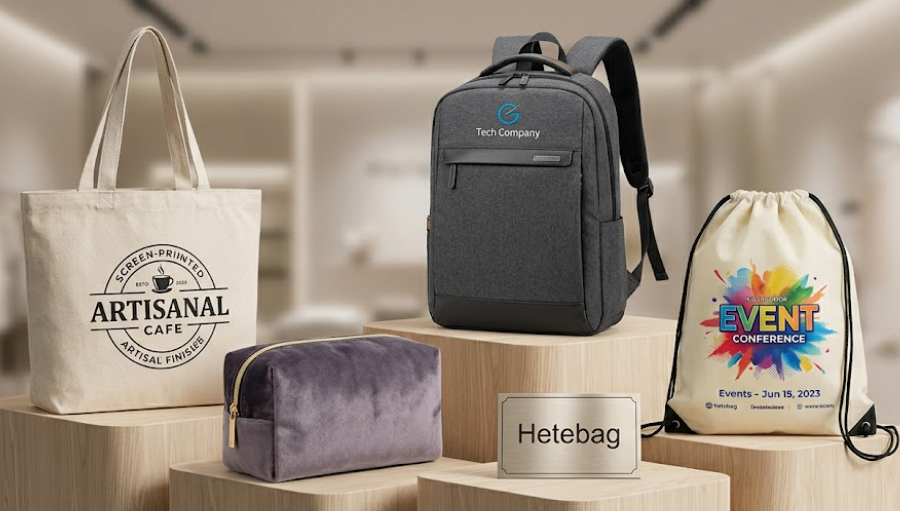
Hetebag, based in Huadu District, Guangzhou, is a manufacturer with over 15 years of factory experience producing custom backpacks, laptop bags, tote bags, and RPET sustainable bags. Working with multiple partner factories, Hetebag handles the full production process from sampling through bulk delivery, with OEM and ODM capabilities across a wide range of bag types and materials.
If you’re currently looking for a backpack manufacturer and want to discuss your specific requirements, you can leave your contact information directly on the Hetebag website. The team is ready to review your project and respond with practical guidance. We look forward to working with you.


