
 English
  Italian
  French
  German
  Spanish
  Arabic
 I’m Evan. After more than 15 years in bag development and manufacturing, I have learned that strong Custom Travel Bags do not come from adding more features or making the logo larger. They come from clear choices. Shape must fit the customer. Materials must support the load. Each pocket must solve a real packing problem. Brand details must look intentional, not added at the end.
This guide explains how to turn a travel bag idea into a product that is useful, recognizable, and realistic to manufacture. It is written for brand owners, wholesalers, product developers, sourcing teams, and buyers comparing Travel Bags Manufacturers.
Why Good Travel Bag Design Matters
Travel customers want two things at the same time: practical performance and a look they are proud to carry. If the bag looks good but feels awkward when full, repeat sales become difficult. If it works well but looks generic, your product may disappear among dozens of similar listings.
For Custom Travel Bags, a good design creates value in three ways.
First, it supports real use. The bag opens easily, carries comfortably, and keeps important items organized. Small choices such as handle drop, zipper direction, pocket depth, and trolley-sleeve height can change the whole user experience.
Second, it builds brand recognition. Customers may not remember a model number, but they can remember a distinct front panel, a signature color block, a special puller, or a clean logo patch.
Third, it protects long-term product performance. A travel bag carries more weight than many daily bags. Weak seams, thin webbing, poor zipper ends, and soft bottom panels often become visible only after the bag is loaded. A design that looks simple can still require careful engineering.
The goal is not to make the loudest bag. The goal is to make a bag that feels easy to understand and hard to confuse with another brand.
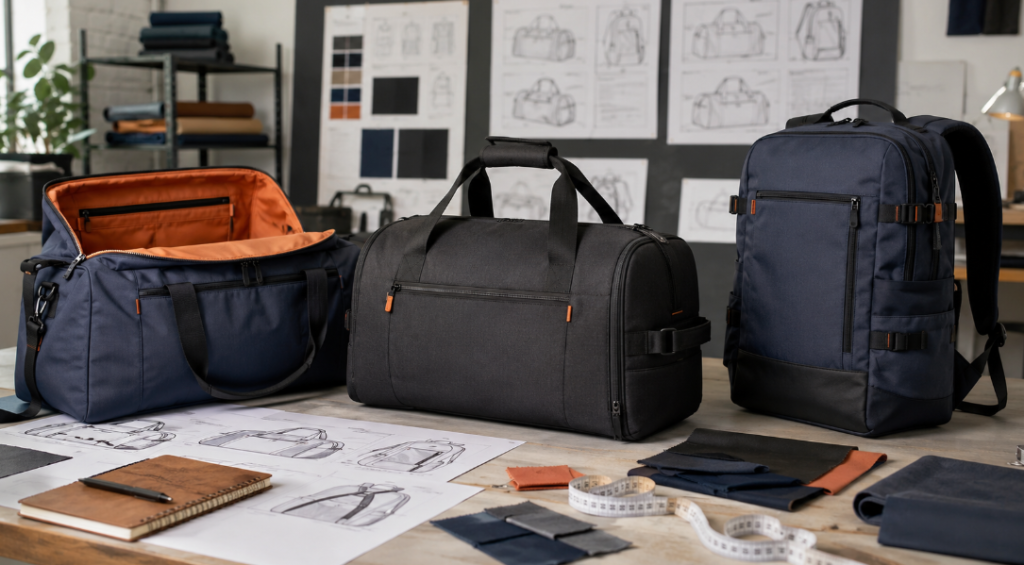
Define Your Target Market and User Needs
Do not begin with fabric swatches. Begin with the person carrying the bag.
A useful customer profile should answer more than age and gender. You need to know how the customer travels, what they pack, how long they carry the bag, where they store it, and what usually annoys them about current products.
Business travelers may care about a protected laptop section, a trolley sleeve, quick access to documents, and a shape that still looks clean after being placed under an airplane seat. For weekend travelers, one wide opening, a shoe section, and enough flexibility for a last-minute jacket may matter more. Sports travelers may accept a technical look in exchange for ventilation, washable lining, and strong webbing.
Custom Travel Bags should be built around travel behavior, so use it to guide the product brief.
| Travel scenario | Main user need | Design direction | Risk to check |
|---|---|---|---|
| Short business trips | Fast access and a polished look | Laptop sleeve, trolley sleeve, structured body | Too much weight from padding and hardware |
| Weekend travel | Flexible packing capacity | Wide opening, simple compartments, removable strap | Bag loses shape when half full |
| Sports and fitness travel | Separation of clean and used items | Shoe pocket, wet section, ventilation | Odor, lining damage, weak pocket seams |
| Family or leisure travel | Easy organization | Large opening, color-coded pockets, durable lining | Too many pockets reduce usable space |
| Outdoor travel | Weather protection and strength | Coated fabric, reinforced base, covered zipper | Claims exceed actual water resistance |
This part is where many projects become clearer. You may discover that you do not need a “travel bag for everyone.” You need one bag for one main travel pattern.
Market research should also include customer reviews, product return comments, retail listings, social media questions, and competitor specifications. Look for repeated complaints. “The strap slips.” “The shoe compartment takes too much room.” “The zipper catches the lining.” These comments are product-development data.
When you compare competitors, do not copy their feature list. Study what they chose to prioritize. Then decide what your customer needs more, less, or in a cleaner form.
Create a Distinctive and Recognizable Appearance
Recognizable Custom Travel Bags usually follow a controlled design system. Color, shape, logo, hardware, webbing, lining, and stitching should feel like parts of one idea.
Start with the silhouette. Rounded duffels feel casual and active. A boxier weekender can look more organized and business-ready. Soft foldable bags suggest convenience and low storage volume. The shape sends a message before the customer reads a product description.
Next, set a color hierarchy. Choose one main body color, one supporting color, and one small accent. The accent may appear on zipper cords, bartacks, lining, piping, or a pull tab. This gives you recognition without making the bag visually busy.
Logo size needs restraint. A large print may work for promotional use, while a woven label, rubber patch, embroidery, debossed leather patch, or metal badge may suit a retail collection. You can review common production methods in this guide to custom logo bags. The right method depends on the face fabric, logo detail, expected wear, and brand position.
The key point is placement. A logo placed across a seam may distort. A metal badge on a soft panel may pull the fabric down. Fine embroidery on coated fabric can create needle holes and puckering. A rubber patch can look strong on technical nylon but heavy on a refined weekender.
Use pattern and texture with the same discipline. Custom jacquard lining, contrast webbing, a molded zipper pull, or a signature pocket angle may create more recognition than a full-surface print.
Before approving the look, view the bag from five angles: front, back, side, top, and while carried. Many designs look balanced from the front and unfinished from the side. Customers see the whole product.
Give Function a Clear Job
In Custom Travel Bags, every feature should answer a real question. What does it hold? How often will the user open it? Can the user reach it while moving? Does it make packing easier, or only make the specification sheet longer?
Start with the main opening. A U-shaped opening gives broad access. Straight top zippers create a cleaner look but may limit visibility. Clamshell openings support organized packing but add construction steps, lining work, and zipper length.
Then plan the inside from large items to small items. Secure the laptop or tablet near the body side. Keep heavy items low. Place quick-access pockets where the user can reach them without emptying the bag. Avoid narrow pockets that look useful but cannot accept a hand or a common travel item.
Comfort needs physical measurements, not guesswork. Review handle drop, handle width, shoulder-strap range, pad length, pad position, and webbing texture. A travel bag can feel comfortable when empty and painful when loaded. Ask the manufacturer to test it with realistic weight during sample review.
Useful features may include:
- A trolley sleeve that fits common luggage handles without pulling the bag out of balance.
- A wet pocket with suitable lining and sealed or protected construction.
- A shoe compartment that does not consume the whole main space when filled.
- An expansion zipper with a gusset that opens evenly.
- A hidden pocket placed where it remains accessible but less exposed.
- A reinforced bottom panel that supports the load without making the bag stiff everywhere.
Waterproof and water-resistant are not the same promise. Coated fabric can resist light rain, yet water may still enter through seams, zipper tape, needle holes, or openings. Use exact wording in marketing and ask for testing that matches the claim.
Zippers deserve close attention. Gauge, chain type, slider, puller, zipper tape, end stops, and sewing allowance all affect performance. The official YKK fastening products for luggage and backpacks show how zipper selection changes by use. You do not need to use one brand for every project, but your specification should define the performance level rather than saying only “good zipper.” ials and Components as a System
Material selection for Custom Travel Bags is not a beauty contest. A fabric must work with the structure, load, logo process, sewing method, lining, reinforcement, and care expectations.
You can use this custom bag materials guide to review common options, then ask for physical swatches. Photos do not show hand feel, coating noise, stiffness, stretch, or recovery after folding.
| Material | Strong fit | Watch points | Useful questions for the supplier |
| Nylon | Lightweight travel, outdoor, foldable bags | Coating quality, color variation, shine | What denier, weave, coating, and abrasion target are used? |
| Polyester | Everyday and promotional travel bags | Lower grades may feel flat or pill | Is the fabric solution-dyed, piece-dyed, or printed? |
| Canvas | Lifestyle and heritage-style weekenders | Weight, staining, shrinkage, edge fraying | Is it washed, coated, backed, or preshrunk? |
| Recycled polyester | Sustainability-led collections | Traceability and claim control | Can the supplier provide valid transaction and scope documents? |
| PU or microfiber | Structured fashion travel bags | Hydrolysis, creasing, surface wear | What backing, thickness, aging test, and care limits apply? |
| Genuine leather | Premium travel pieces | Weight, color variation, maintenance | Which leather type, finish, thickness, and reinforcement are planned? |
Do not specify only “600D polyester” or “recycled fabric.” That leaves too much open. Define the weave, weight or denier, backing, coating, color standard, finish, and test expectations. Two fabrics with the same basic name can behave very differently.
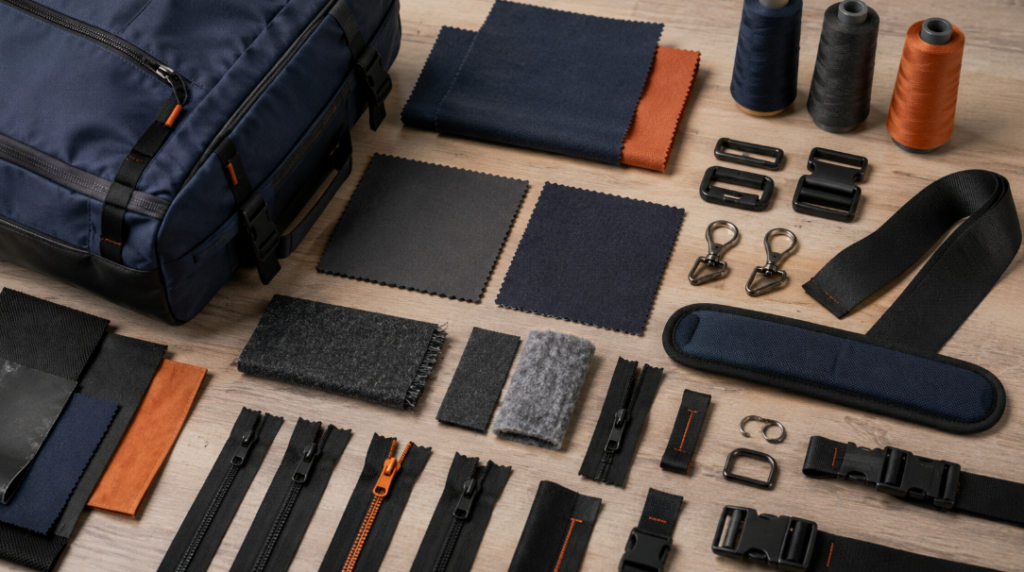
For recycled materials, ask what claim you plan to make and what proof supports it. The Global Recycled Standard information from Textile Exchange explains recycled-content verification and chain of custody. A supplier mentioning GRS is not enough. Check certificate scope, validity, product category, and transaction documentation for the relevant material flow. match the bag’s load and use. Review zipper gauge, buckle resin, hook strength, D-ring shape, swivel movement, webbing thickness, foam density, base board, piping cord, thread, and reinforcement tape. A premium face fabric cannot compensate for a weak hook or a narrow handle attachment.
This place is especially important: confirm color matching under the same light. Black fabric, black webbing, black zipper tape, and black plastic hardware may all look different. Decide which differences are acceptable before bulk production.
Work With a Professional Travel Bag Manufacturer
Good Travel Bags Manufacturers do more than follow a sketch. They ask questions before cutting material.
When developing Custom Travel Bags, your first package should include the bag type, target user, travel scenario, dimensions, capacity goal, material direction, color references, logo artwork, pocket plan, carrying methods, packaging needs, testing expectations, and target delivery window. A clear tech pack reduces assumptions, yet it does not replace discussion.
Ask the factory to point out production risks. Can the selected fabric hold the shape? Is the front pocket opening wide enough to sew and use? Will the logo sit flat? Does the shoe pocket affect the main capacity? Can the bag be packed without permanent creases? An experienced factory should give practical answers, not automatic agreement.
Sampling should follow a controlled review process.
| Review stage | What to check | What to record before approval |
| Material and component review | Hand feel, color, thickness, coating, zipper, hardware | Approved swatches, supplier codes, color references |
| First prototype | Size, shape, opening, pocket logic, carrying comfort | Measurement changes, pattern changes, feature decisions |
| Revised sample | Construction, logo, reinforcement, lining, appearance | Final dimensions, stitch methods, logo position, hardware finish |
| Pre-production sample | Full product and packaging standard | Signed sample, specification sheet, packing method, inspection points |
| Bulk inspection | Consistency and function | Defect limits, test records, carton and labeling checks |
Test the sample as a travel bag, not as a display item. Load it. Carry it by hand and shoulder. Open each zipper repeatedly. Pull the trolley sleeve over a handle. Fill the shoe pocket. Check whether the lining catches. Place the bag down and see where the base folds.
The approved sample should become the production reference. Keep material swatches, logo samples, hardware finishes, measurements, and packing details with it.
When a supplier presents management-system or audit documents, review what they cover. ISO 9001 describes a quality-management framework, but a certificate alone does not prove that your bag will meet the specification. ate, then inspect the actual controls used for incoming materials, cutting, sewing, in-line checks, final inspection, corrective action, and traceability.
Lead time also depends on development decisions. Custom-dyed fabric, molded hardware, branded zipper pullers, special webbing, printed lining, and repeated sample changes can extend preparation. Freeze important details before bulk production. Late changes create inconsistency.
Make Custom Travel Bags Stand Out in the Market
A product stands out when the customer can explain its value in one clear sentence.
“Designed for three-day business trips with fast laptop access” is stronger than “premium multi-function travel bag.” “A lightweight foldable duffel that packs into its own pocket” gives the buyer a picture. “A gym-to-weekend bag with a separate washable wet section” connects the feature to a routine.
Choose one primary selling point and two supporting points. Do not make ten claims compete for attention.
Your brand story should also come from product decisions. Talk about why the opening is shaped that way, why the lining is light enough to see inside, why the handle reinforcement extends into the body, or why the material was chosen for repeated travel. This creates trust because the story can be seen and used.
High-quality content must prove the design. Show the bag empty and packed. Photograph the inside from above. Show the strap range, trolley sleeve, bottom structure, zipper pull, lining, and stress-point stitching. Add a short video of the opening, packing flow, and carrying positions.
Product copy should answer buyer questions in the order they arise:
- Who is this bag for?
- What trip does it suit?
- What fits inside?
- How does it organize the load?
- How is it carried?
- What materials and components are used?
- What care and use limits should the customer know?
For B2B buyers, add development details that support sourcing confidence. Explain available customization areas, material directions, logo methods, sample steps, quality checks, and packaging options. Your Custom Travel Bags manufacturing page can support buyers who want to move from design planning into supplier discussion.
The core is simple. Your marketing should repeat what the product truly does well. It should not cover weak design with broad claims.
Conclusion
Custom Travel Bags stand out when appearance, function, materials, and production control support the same customer need. Start with the travel scenario. Build a clear silhouette. Give every pocket a job. Match the material and hardware to the load. Test the sample under realistic use. Keep the approved details stable during production.
When you compare Travel Bags Manufacturers, pay attention to the questions they ask. A capable partner should help you find weak points before they become bulk-order problems. They should be comfortable discussing structure, reinforcement, zipper performance, packing, testing, and quality records.
Hetebag is based in Huadu, Guangzhou, China. Our team has more than 15 years of bag-manufacturing experience and works with production partners to support custom development for global brands, wholesalers, and sourcing teams. materials, structure, logo methods, sampling, quality control, and production planning.
If you are looking for a bag manufacturer, you can leave your phone number and project details through our contact . We will be glad to learn what you are building and explore how we can work together.
Frequently Asked Questions
How do I start designing custom travel bags?
Start by defining your target customer, travel scenario, bag size, required compartments, preferred materials, logo method, and expected functions. A clear product brief helps the manufacturer prepare a more accurate sample.
Which material is best for custom travel bags?
Nylon and polyester are common choices because they are lightweight, durable, and easy to clean. Canvas offers a more casual look, while recycled polyester may suit brands with sustainability goals. The right material depends on the bag’s use, structure, and target market.
What features should a good travel bag have?
Useful features may include a wide opening, laptop compartment, shoe section, trolley sleeve, adjustable shoulder strap, reinforced handles, water-resistant fabric, and secure inner pockets. Each feature should solve a real travel need.
How long does it take to develop a custom travel bag sample?
Sample time depends on the design, material availability, custom hardware, logo process, and number of revisions. A simple design usually moves faster than a bag with molded parts, custom-dyed fabric, or complex internal compartments.
How can I check the quality of a travel bag sample?
Load the sample with realistic weight and test the handles, shoulder strap, zippers, pockets, lining, seams, and trolley sleeve. Check the measurements, logo position, shape, comfort, and overall appearance before approving bulk production.


