
 English
  Italian
  French
  German
  Spanish
  Arabic
 My name is Evan. I have been working in the luggage industry for over fifteen years and currently I am in charge of the product development and production management of HeteBag. During the actual development process, I found that many customers tend to consider both crossbody bags and shoulder bags as the same type of product, but there are significant differences in wearing position, shoulder strap structure, and capacity design between them.
Chest bags are usually close to the chest or upper body, emphasizing stability, lightness, and quick access to items; crossbody bags, on the other hand, have their bodies located near the waist or hips, offering more options in terms of capacity, internal structure, and appearance style.
In this article, I will combine my experience in product development and manufacturing of HeteBag to compare Chest Bag vs Crossbody Bag in detail and explain how to choose the appropriate bag type based on usage scenarios, carried items, materials, and comfort.
1. What Is a Chest Bag?
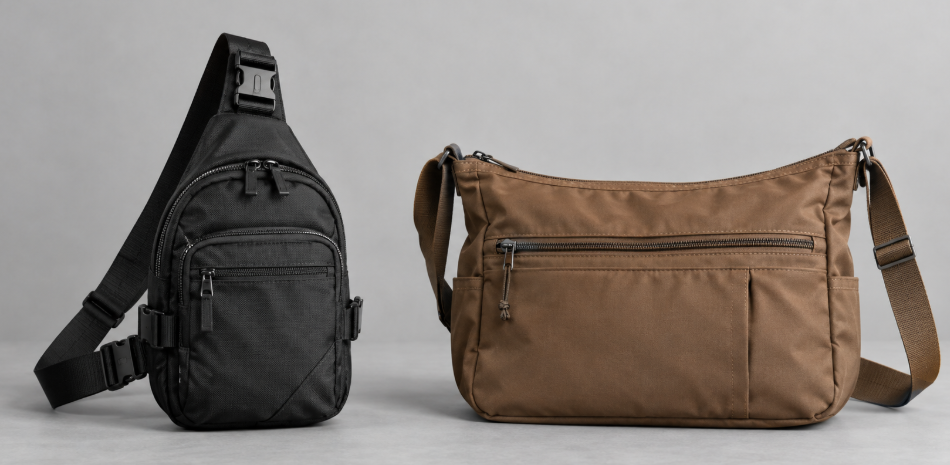
A chest bag is a compact bag worn across the upper body. Its main compartment normally sits on the chest, although many designs can be rotated to the back. The strap is shorter than a standard crossbody strap and is often fixed at an angle to keep the bag close to the body.
Some sellers also call this product a sling bag. The two terms overlap, but “sling bag” covers a wider group of one-strap bags. A typical chest bag has a relatively small body, a close fit, and a strap designed for upper-body wear.
Most chest bags have one main zip compartment, a front pocket, a hidden back pocket, and an adjustable strap with a side-release buckle. Outdoor or travel designs may also include a padded mesh back panel, reflective trim, or an internal key clip.
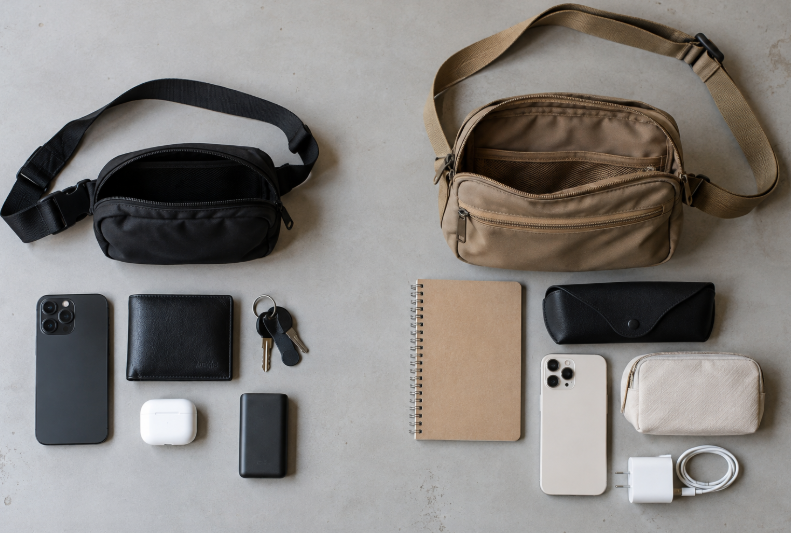
A chest bag is normally designed for a phone, wallet, keys, earphones, cards, and a small power bank. To check whether the size is suitable, place the intended items inside the sample and close every zipper. The bag should keep its basic shape without excessive bulging.
Wear the loaded bag during a fast walk. If it swings heavily, slides toward the neck, or pulls away from the chest, the strap angle or attachment position may need adjustment. A good chest bag should remain close to the upper body without limiting arm movement.
2. What Is a Crossbody Bag?
A crossbody bag is worn with a long strap running from one shoulder to the opposite side of the body. The bag normally rests near the waist, hip, or upper thigh. It may be a small phone pouch, a casual messenger bag, or a structured fashion bag.
This makes the crossbody bag a much broader category than the chest bag. The name describes how the bag is carried rather than its exact shape.
Most crossbody bags use a two-point strap connection, with one attachment on each side of the bag. This helps the body hang in a balanced position and works well for wider or more structured designs. Removable straps can also allow customers to change the carrying style.
Strap length is an important part of product development. Measure the distance from the top of the shoulder to the preferred bag position, then test the sample on people with different heights and body shapes. The adjustment range should allow the bag to sit above the hip without striking the leg while walking.
The bag should also remain level when loaded. If one side drops lower, check the position of the strap loops, the distribution of the internal pockets, and the location of heavier hardware.
For fashion-led collections, buyers can compare these structures with other custom handbag styles before confirming the final design.
3. Chest Bag vs Crossbody Bag: Key Differences
The main difference in the chest bag vs crossbody bag comparison is control. A chest bag gives the user better control over a small load. A crossbody bag provides more capacity and greater flexibility in styling.
| Comparison point | Chest bag | Crossbody bag |
|---|---|---|
| Normal wearing position | Chest or upper back | Waist, hip, or upper thigh |
| Strap structure | Short, angled sling strap | Longer strap with two side connections |
| Typical contents | Phone, wallet, keys, small power bank | Daily essentials, cosmetics, glasses, notebook, small tablet |
| Stability during movement | High | Medium |
| Access | Very fast when worn in front | Easy, but the bag may need to be moved forward |
| Common style | Sport, streetwear, travel, outdoor | Casual, business, fashion, travel |
| Best use | Active movement and light carry | General daily use and larger loads |
Wearing Position and Strap Design
A chest bag holds its weight high and close to the body. This reduces movement when the user is walking, cycling, or moving through a crowded area. Its strap angle must match the shape of the bag. If the angle is incorrect, the lower corner may lift away from the body or press against the ribs.
A crossbody bag hangs lower and usually has a longer strap. It may use swivel hooks, D-rings, buckles, or fixed webbing connections. The attachment points require reinforcement because the full weight of the bag is concentrated in these areas.
During sample evaluation, load the bag to its intended working weight and hang it for 24 hours. After the test, examine the seams, webbing, reinforcement patches, and hardware connections. There should be no loose stitches, visible fabric distortion, or movement around the D-rings.
For an internal development test, a brand may start with 1.5 times the expected user load. The correct test weight should still be decided according to the bag’s size, materials, intended use, and market requirements. It should not be presented as a universal standard.
Capacity, Organization and Accessibility
Outside dimensions do not show the full usable capacity. Thick lining, padding, curved corners, binding, and internal pockets all reduce the available storage space.
Theoretical capacity can be estimated using the following calculation:
Length × height × depth ÷ 1,000 = approximate capacity in liters
For example, a bag measuring 24 × 16 × 7 cm has a theoretical volume of about 2.7 liters. The actual usable capacity will be lower because the bag is not a perfect rectangular box.
A more reliable method is to prepare a fixed packing list. Place the same phone, wallet, keys, charger, sunglasses case, and other target items into every sample. Close the bag and check whether it bulges, tips forward, or blocks access to any pocket.
Chest bags perform best when the user carries a small number of compact items. Crossbody bags are more suitable when the packing list includes a notebook, cosmetics, water bottle, sunglasses case, or small tablet.
The zipper opening also needs attention. An item may fit inside the main compartment but still be difficult to insert through a narrow opening. During sample approval, the largest rigid item should pass through the opening easily without forcing the zipper teeth apart.
Comfort, Security and Weight Distribution
A chest bag normally feels more stable because it sits high and close to the body. When worn in front, it is also easier for the user to watch in a crowded location. A hidden pocket against the body can provide additional storage for a passport or bank cards.
A crossbody bag spreads the load along a longer strap, but a heavy bag may create pressure on one shoulder. Wider webbing, soft strap edges, or a movable shoulder pad can improve comfort. The bag’s position also matters. A low-hanging bag may repeatedly strike the leg, while a strap that is too short can restrict movement.
To evaluate comfort, wear the loaded sample for at least 30 minutes. Walk, climb stairs, sit down, and reach forward. The strap should stay flat and the buckle should not press into the body. The bag should remain controlled without requiring repeated adjustment.
4. When Should You Choose a Chest Bag?
A chest bag is the better choice when movement, quick access, and compact storage are more important than capacity.
For urban commuting, it keeps travel cards, keys, a phone, and other small items within easy reach. During a short trip, it can hold important items that the user may not want to place inside a larger backpack.
A close-fitting design also works well for cycling, light hiking, festivals, exhibitions, and busy tourist areas. Compared with a loose shoulder bag, it is less likely to swing into another person or move behind the body without the user noticing.
Before choosing the size, place all planned contents on a table and remove anything that is carried only occasionally. Measure the largest remaining item, including its thickness. The selected chest bag should provide enough internal depth and a wide enough opening for that item.
The fit should then be tested with real movement. Load the bag, tighten the strap to a comfortable position, and walk quickly for several minutes. If the bag bounces, twists, or moves toward the neck, the strap shape or attachment points should be reviewed.
A chest bag may not be suitable for heavy loads, large tablets, full-size water bottles, or supplies needed for an entire day. Overfilling places more pressure on the shoulder and chest. It can also create excessive stress around the single strap connection.
5. When Is a Crossbody Bag the Better Choice?
A crossbody bag is often more suitable for daily commuting, shopping, travel, and casual use. It gives the user more room while keeping both hands free. Its wider range of shapes and materials also makes it easier to include in a fashion collection.
Choose this style when the customer needs to carry several medium-sized items instead of only pocket essentials. A structured crossbody bag can organize cosmetics, glasses, a charger, a wallet, and a small notebook. A soft design offers more flexibility when the load changes during the day.
The sample should remain balanced when its heaviest item is placed inside. The top opening must allow the user to see and reach the main contents, while the strap should adjust for both higher waist-level wear and lower hip-level wear.
For travel collections, a crossbody style can be paired with a larger product from a custom travel bag range. The smaller bag holds documents, a phone, and personal items, while the main bag carries clothing and larger equipment.
Depth should be controlled carefully. A deep crossbody bag without enough structure may fold inward and make small items difficult to find. A base panel, light foam, or internal divider can help the body keep its shape. If the bag leans away from the user when loaded, its depth may be too large for the chosen strap position.
6. Materials and Features to Consider Before Choosing
Material selection should follow the intended use of the bag. Appearance matters, but the material must also support the expected load, cleaning method, weather exposure, logo process, and target product position.
| Material | Main strengths | Points to check | Suitable applications |
|---|---|---|---|
| Nylon | Lightweight, strong, smooth surface | Coating quality, snagging and colorfastness | Chest bags, outdoor and travel styles |
| Polyester | Stable, printable and widely available | Fabric density and abrasion resistance | Daily and promotional bags |
| Canvas | Firm hand feel and natural texture | Weight, shrinkage and staining | Casual and lifestyle crossbody bags |
| PU leather | Consistent color and many surface finishes | Peeling, hydrolysis and cold cracking | Fashion crossbody bags |
| Genuine leather | Natural character and long service potential | Color variation, scratches and care needs | Premium collections |
Buyers can review HeteBag’s custom bag materials page for more information about commonly used fabrics and surface options.
Nylon is often a good choice for a lightweight chest bag because it combines strength with relatively low weight. Polyester offers stable production and good print compatibility. Canvas creates a more natural, casual appearance, but the material may make a small bag feel heavier.
PU leather works well for fashion collections because it provides many colors and textures. Buyers should still test the surface for folding marks, peeling, and color transfer. Genuine leather provides a premium appearance, but natural variations must be defined and accepted before production.
Water Resistance and Abrasion
“Water-resistant” and “waterproof” are not interchangeable. A coated fabric may resist light rain, while water can still enter through the zipper, seams, or needle holes.
A simple sample test can be performed by placing dry tissue paper inside the bag and exposing it to a controlled water spray. Record the spray time, distance, and direction so all samples can be checked under the same conditions. After the test, inspect the lining, seam intersections, zipper ends, and strap attachment points.
Abrasion claims should be supported by a stated testing method and result. The ISO 12947 series covers the Martindale method for testing textile abrasion. A buyer should ask which layer was tested, how many cycles were completed, and what failure condition was used. A general description such as “wear-resistant fabric” is not enough for a technical specification.
Zippers, Webbing and Hardware
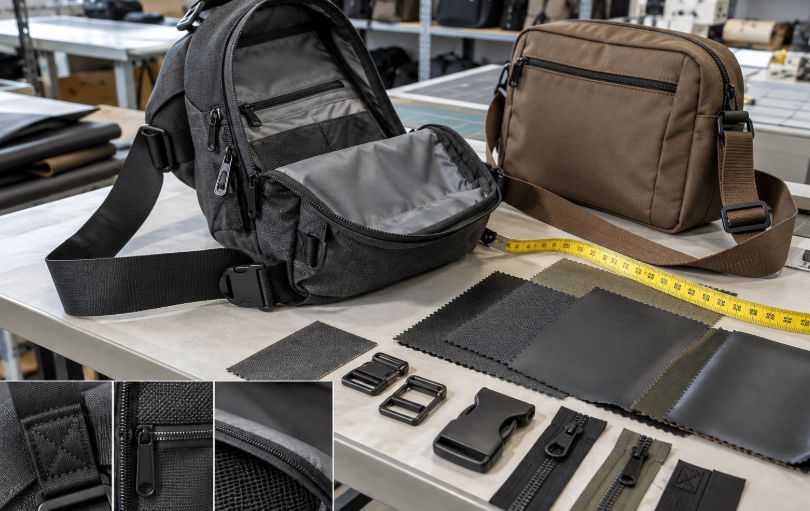
Zippers should be tested while the bag is empty and fully loaded. The slider must move smoothly around corners without catching the lining. Check the zipper tape for waves, skipped stitches, and open ends.
Webbing should remain flat after adjustment. Its cut ends need to be properly folded or heat-sealed to prevent fraying. Buckles should lock securely without requiring excessive force.
Strap attachment points carry most of the load. Reinforcement may include box stitching, bar tacks, folded webbing, or an internal backing patch. Pull the strap in several directions during sample review. The surrounding fabric should not stretch, tear, or expose the seam allowance.
Internal compartments should match the actual items the customer will carry. A phone pocket needs enough opening width, while a security pocket should sit against the body and remain accessible when the bag is worn.
For recycled polyester projects, do not rely only on a hangtag or fabric description. The Global Recycled Standard from Textile Exchange includes requirements for recycled content and chain of custody. Buyers should check the certification scope and relevant transaction documents without assuming that every product from a certified supplier is automatically certified.
7. Custom Chest Bags and Crossbody Bags for Your Brand
A successful custom bag project starts with the target user, not the material catalog. First define who will carry the bag, what they will put inside, where they will wear it, and how long they are likely to use it each day.
The technical specification should confirm the overall dimensions, material, lining, color reference, logo method, zipper type, hardware finish, pocket layout, strap width, adjustment range, labels, and packaging. Reference images can explain the visual direction, but they should not replace measurements and construction details.
At HeteBag, chest bags and crossbody bags can be developed through OEM or ODM manufacturing. An OEM project follows the buyer’s existing design and specification. An ODM project includes more support with the bag structure, material selection, and product development.
Brands can also compare different custom logo options when choosing between screen printing, embroidery, woven labels, embossing, debossing, or metal logos. The correct method depends on the surface, logo detail, expected wear, and brand position.
Sample Approval and Risk Control
A sample should not be approved from photos alone. The buyer needs to check the physical product against a written specification.
Start by measuring the bag length, height, depth, strap width, and complete adjustment range. Compare every result with the approved measurement chart. Then pack the agreed item set and close every compartment. The bag should keep its intended shape and provide access to all pockets.
Wear the loaded sample for at least 30 minutes. Test it while walking, sitting, climbing stairs, and reaching forward. Operate every zipper repeatedly and watch for caught lining, rough movement, or separation near the ends.
The load test should reflect the intended use. Hang the bag with the agreed test weight for 24 hours, then inspect the strap connections, stitching, webbing, hardware, and surrounding fabric. Any distortion should be recorded and corrected before production.
Logo position, color, symmetry, stitch density, hardware finish, and packaging must also be checked. Pack and unpack the sample to identify scratches, crushing, or strap deformation that could happen during shipping.
After approval, the buyer and factory should keep matching reference samples. Bulk production can then be checked against the approved sample during material inspection, first-piece inspection, in-line production, and final inspection.
For larger orders, an AQL inspection plan can be agreed upon according to the product risk and market requirements. Broken buckles, detached straps, open seams, sharp hardware, and unusable zippers should be treated more seriously than small cosmetic marks.
8. Conclusion
The chest bag vs crossbody bag decision comes down to movement, capacity, and product positioning.
A chest bag is usually the better option for light loads, quick access, cycling, walking, and crowded environments. A crossbody bag offers more capacity, more design choices, and greater flexibility for daily, travel, and fashion use.
The final choice should be tested with real contents under real wearing conditions. Check the strap geometry, usable opening, load performance, material behavior, and pocket layout before approving production. A good sample should prove that the bag works, not simply show what it looks like.
If you are developing a chest bag or crossbody bag collection, you can contact HeteBag with your drawings, reference images, target use, materials, dimensions, and logo requirements. Clear project information makes it easier to recommend a suitable structure and prepare an accurate sample.
Frequently Asked Questions
Is a chest bag the same as a sling bag?
Not always. “Sling bag” is a broad commercial term for bags carried with one strap across the body. A chest bag usually refers to a compact sling-style design that sits close to the chest or upper back.
Product names are not fully standardized across different markets. When sourcing, buyers should use drawings, dimensions, wearing-position images, and strap details instead of relying only on the product name.
What capacity is suitable for a chest bag?
The correct capacity depends on the intended packing list. A compact chest bag often holds a phone, wallet, keys, earphones, cards, and a small power bank.
The volume calculation can provide an early estimate, but it should not be the final decision. Padding, lining, binding, and curved panels reduce the usable space. Test the physical sample with the same items that the target customer is expected to carry.
How wide should the shoulder strap be?
There is no single strap width that works for every bag. A narrow strap may be acceptable for a light phone pouch, while a larger bag normally needs wider webbing or padding to spread the pressure.
Test the strap at the planned working load for at least 30 minutes. If it twists, cuts into the shoulder, rubs against the neck, or leaves strong pressure marks, review the width, edge finish, angle, or padding.
How can a buyer check whether a bag is water-resistant?
Ask the supplier for the base fabric, coating type, and available test information. The finished bag must still be checked because water can enter through seams, needle holes, zipper tape, or zipper ends.
Place absorbent paper inside the sample and use a repeatable spray test. Record the test time and spray distance. Afterward, inspect where moisture first appears. This helps the factory identify whether the problem comes from the fabric, construction, or zipper area.
Which zipper is suitable for a chest bag or crossbody bag?
Coil zippers are flexible and work well around curved openings. Molded plastic zippers provide a stronger visual appearance and suit some outdoor designs. Metal zippers are common on fashion bags but add weight and may require a straighter opening.
The complete zipper assembly should be tested on the finished sample. A quality zipper can still perform poorly if the opening curve, sewing tension, lining clearance, or end construction is incorrect.
What should be approved before bulk production?
The buyer should approve the final material, color, dimensions, strap range, logo, hardware, pocket layout, stitching method, lining, labels, packaging, and agreed performance tests.
Both sides should keep matching reference samples. If any detail changes after sample approval, the specification and sample record should be updated. Important production changes should not be confirmed only through informal messages.


