
 Arabic
  English
  Italian
  French
  German
  Spanish
 A polished leather bag sample can still leave a buyer uncertain about the bulk order: will the next leather lot match, will the edge finish hold up, and who will approve a hardware substitution? A private-label manufacturer shortlist is useful only when each candidate is assessed against the same design, material, sample, and inspection brief.
Leather bags require more detailed workmanship than many standard fabric bags. A small change in the leather, reinforcement, thread tension, or edge finishing can affect the appearance of the entire product. This is why buyers should look beyond catalogs and focus on the manufacturer’s real development and production capabilities.
China remains an important sourcing destination for custom leather bags because it has established leather goods manufacturing clusters, material markets, hardware suppliers, packaging factories, skilled workers, and international logistics resources.
The key question is not whether China can manufacture your bag. The real question is which manufacturer is suitable for your design, brand positioning, quantity, material requirements, and quality expectations.
This guide introduces ten custom leather bag manufacturers in China and explains what you should check before starting a project.
For the complete purchasing process, use the custom leather handbag sourcing guide to connect material approval with bag construction, supplier selection, sampling, and bulk inspection.
Why Source Custom Leather Bags from China?
China has several mature leather goods manufacturing areas, especially in Guangzhou, Dongguan, Shenzhen, and Chengdu. Huadu and Baiyun in Guangzhou are particularly well known for handbag and leather goods production.
A mature manufacturing area gives buyers access to more than factories. It also provides leather suppliers, PU material suppliers, zipper companies, metal hardware workshops, printing factories, packaging suppliers, pattern makers, and inspection services.
This complete supply chain can make product development more efficient. When a sample needs a softer leather, a stronger zipper, a different buckle, or a revised shoulder strap, the manufacturer can usually find a suitable supplier nearby.
The real value of this supply chain appears during sampling. A product rarely becomes production-ready after the first sample. The size may need to change. The leather may feel too stiff. The handle may need more reinforcement. The logo may be too large. A factory located close to material and accessory suppliers can often solve these problems faster.
China is suitable for fashion brands, private-label companies, wholesalers, retailers, designers, e-commerce sellers, and established importers. Some buyers need a manufacturer that can help turn a sketch into a finished product. Others already have complete technical files and only need stable production.
Your business size is not the only factor. A small brand can still require complex development, while a large wholesaler may order simple designs in larger quantities. The manufacturer should match the way your project operates.
The companies included in this article were selected based on their manufacturing history, product range, customization capabilities, factory location, leather goods experience, and publicly available business information. The list is not arranged from best to worst. Each manufacturer has a different product focus and customer type.
What to Look for in a Custom Leather Bag Manufacturer
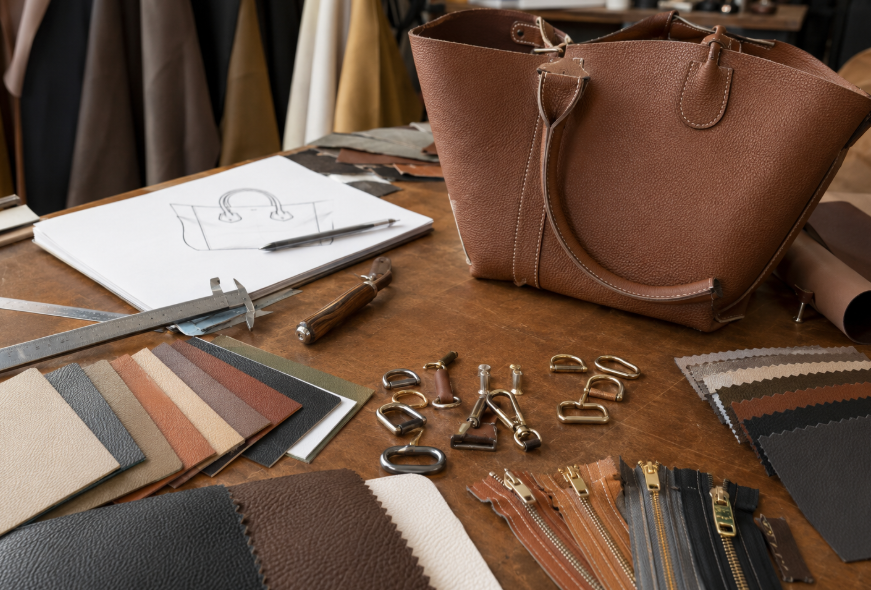
The first area to evaluate is material knowledge.
Asking whether a factory offers genuine leather or PU leather is not enough. Genuine leather can vary in animal source, grade, grain, thickness, softness, tanning method, coating, and color stability. Two materials both described as cowhide may produce completely different results.
A structured handbag usually needs firmer leather and stronger internal reinforcement. A soft shoulder bag needs leather with better flexibility and drape. A wallet needs controlled thickness because several folded layers can quickly become bulky.
PU leather also comes in many grades. The base fabric, surface coating, flexibility, abrasion resistance, odor, hydrolysis resistance, and backing strength can affect the final quality.
A capable manufacturer should be able to explain why a certain material is suitable for your design. The supplier should also keep approved swatches so the material used in bulk production can be checked against the sample.
You can review this guide to مواد تصنيع الحقائب المخصصة before preparing your product specifications.
The next area is product development.
An OEM manufacturer usually produces a bag based on your design, sample, technical drawing, or specification sheet. An ODM manufacturer may also help adjust the structure, suggest materials, create patterns, improve functions, and develop new styles.
Good development work requires more than copying a reference photo. A photo does not show the internal reinforcement, seam allowance, edge construction, zipper installation, lining attachment, or stress points.
An experienced manufacturer should identify possible production risks during sampling. For example, a thin handle may not support the intended load. A very sharp corner may be difficult to finish cleanly with edge paint. A heavy metal chain may distort a soft leather body.
A supplier that agrees to every request without discussing these details may not have studied the design carefully.
Quality control is also a major part of leather bag manufacturing.
Leather should be checked before cutting because natural hides can contain scars, wrinkles, color differences, and thickness variation. Hardware should be inspected for scratches, plating marks, sharp edges, color variation, and functional problems.
During production, the factory should control cutting accuracy, leather grain direction, stitching, edge paint, handle position, logo placement, lining fit, hardware installation, dimensions, and finished shape.
Natural leather will never look as uniform as a synthetic sheet. Some variation is normal. The factory and buyer still need a clear standard that separates acceptable natural characteristics from unacceptable defects.
Top 10 Custom Leather Bag Manufacturers in China
| No. | الشركة المصنعة | Established | الموقع | المنتجات الرئيسية |
|---|---|---|---|---|
| 1 | هيتباغ | 2011 | هوادو، قوانغتشو | Leather handbags, tote bags, crossbody bags, backpacks, travel bags, makeup bags, and OEM/ODM bags |
| 2 | مجموعة سيتوي | 1968 | Hong Kong and Guangdong | Luxury handbags, small leather goods, travel goods, luggage, and fashion accessories |
| 3 | Boshen Leather Goods | 1993 | قوانغتشو | Genuine leather handbags, fashion bags, briefcases, wallets, and private-label leather goods |
| 4 | هونغبانغ للجلود | 2009 | قوانغتشو | Handbags, wallets, backpacks, cosmetic bags, watch cases, belts, and leather accessories |
| 5 | فيدل | 2002 | Baiyun, Guangzhou | Genuine leather handbags, tote bags, crossbody bags, hobo bags, and baguette bags |
| 6 | Mherder | 2006 | قوانغتشو | Handbags, shoulder bags, crossbody bags, men’s bags, wallets, and card holders |
| 7 | جلد جيونار | 2010 | Baiyun, Guangzhou | Handbags, backpacks, travel bags, briefcases, wallets, belts, and leather accessories |
| 8 | HerminFashion | 2018 | هوادو، قوانغتشو | Handbags, tote bags, shoulder bags, evening bags, backpacks, and PU leather bags |
| 9 | SLBAG | 2011 | Shiling, Huadu | Leather handbags, wallets, backpacks, laptop bags, cosmetic bags, and canvas bags |
| 10 | XINZIRAIN | 2000 | Chengdu | Custom handbags, fashion bags, vegan leather products, footwear, and accessories |
1. Hetebag
Hetebag is a custom bag manufacturer located in Huadu, Guangzhou. The company has worked in bag manufacturing since 2011 and provides OEM and ODM services for brands, wholesalers, importers, and other business buyers.
Its product range covers leather handbags, tote bags, crossbody bags, backpacks, travel bags, makeup bags, and other custom bag categories.
This wider product range can be useful for buyers who are not developing only one handbag. A brand may start with a leather tote and later add a matching crossbody bag, cosmetic bag, backpack, or travel product.
Hetebag supports material selection, color development, pattern making, sampling, logo customization, hardware selection, bulk production, quality inspection, and packaging.
The company may be suitable for growing brands that need practical product development support and access to the Huadu leather goods supply chain.
Buyers who are developing a handbag collection can review Hetebag’s custom handbag manufacturing service.
2. Sitoy Group
Sitoy Group has one of the longest manufacturing histories on this list. The company was founded in Hong Kong in 1968 and later expanded its manufacturing operations into Guangdong.
Its business covers handbags, small leather goods, travel goods, luggage, footwear, and related fashion accessories. The group has experience working with established fashion and luxury brands.
Sitoy may be more suitable for larger brands with formal product development processes, stable order planning, detailed compliance requirements, and higher production volumes.
Buyers should confirm which production facility will handle the order. Large manufacturing groups may use several factories or production lines. The factory address, production responsibility, inspection process, and subcontracting policy should be clearly documented.
3. Boshen Leather Goods
Boshen Leather Goods is a Guangzhou manufacturer established in 1993. Its main focus is genuine leather handbags and other private-label leather goods.
The company’s product range includes fashion handbags, leather briefcases, wallets, and related accessories.
Boshen may be suitable for buyers who want a manufacturer with a strong focus on genuine leather rather than a supplier mainly producing fabric or promotional bags.
When evaluating this manufacturer, buyers should request samples made with a structure similar to their own design. A factory may be good at soft leather totes but have less experience with rigid handbags, woven leather, complex edge painting, or multi-layer construction.
The closer the sample is to your intended product, the more useful it will be during supplier evaluation.
4. HongBang Leathers
HongBang Leathers is based in Guangzhou and manufactures handbags, wallets, backpacks, cosmetic bags, watch cases, belts, and other leather accessories.
The company provides OEM and ODM support, including design development, material sourcing, sampling, production, quality inspection, and export packaging.
Public company information commonly points to 2009 as the establishment year. Its website also refers to more than 30 years of industry experience, which may represent the combined experience of its manufacturing team.
Buyers should distinguish between company age and team experience. Both can be useful, but they are not the same measurement.
Before ordering, request the current business license and confirm the address of the factory that will manufacture the products.
5. Fiedle
Fiedle was established in 2002 and operates as an OEM and ODM leather bag manufacturer in Guangzhou.
Its main products include genuine leather handbags, tote bags, crossbody bags, hobo bags, and other fashion-focused styles.
The company may be suitable for fashion brands that need regular style development and stable manufacturing across several handbag designs.
Buyers should ask whether important production processes are completed inside the factory. These may include cutting, sewing, edge painting, embossing, printing, leather weaving, and final assembly.
Outsourcing is not automatically a problem. The key issue is whether the manufacturer clearly controls the subcontracted process and checks the result before the product moves to the next stage.
6. Mherder
Mherder, operated by Guangzhou Herder Leather Products, has manufactured leather bags and small leather goods since 2006.
Its product range includes handbags, shoulder bags, crossbody bags, men’s bags, backpacks, wallets, card holders, and other leather accessories.
The company works with genuine leather, PU, PVC, canvas, nylon, and other materials.
Mherder may suit private-label buyers who want to develop matching products, such as a handbag with a wallet, card holder, or smaller accessory.
Color control becomes important when several materials are used in one collection. Genuine leather, PU leather, fabric lining, thread, and painted edges may all react differently to the same color reference.
The manufacturer should prepare a shared color standard and check each material under controlled lighting.
7. Gionar Leather
Gionar Leather was established in 2010 and is located in Baiyun District, Guangzhou.
The company focuses on handbags, backpacks, travel bags, briefcases, wallets, belts, and other higher-end leather goods.
Gionar may be suitable for brands developing structured handbags, business bags, men’s leather products, or coordinated leather collections.
When reviewing its samples, pay close attention to the areas that are difficult to hide. Check the painted edges, corners, handle attachments, hardware installation, lining fit, and internal reinforcement.
A bag may look attractive from the front while still having weak construction in less visible areas. These details usually reveal the real production level of a factory.
8. HerminFashion
HerminFashion is located in Huadu, Guangzhou, and focuses mainly on women’s fashion bags.
The current company was established in 2018, while its published manufacturing history dates back to 2011.
Its products include handbags, tote bags, shoulder bags, crossbody bags, backpacks, evening bags, purses, and vegan PU leather bags.
HerminFashion may be suitable for buyers who need fashion-led designs, frequent style updates, and synthetic leather options.
Buyers looking for genuine leather production should confirm which production line will be used. Fashion bag companies sometimes manufacture PU and genuine leather products through different factories or workshops.
9. SLBAG
SLBAG states that its team has worked in the bag industry since 1991 and that the current company was established in 2011.
The factory is located in Shiling, Huadu, one of the main leather goods manufacturing areas in Guangzhou.
Its product range includes handbags, wallets, backpacks, laptop bags, cosmetic bags, canvas bags, diaper bags, and cooler bags.
The company began with PU, nylon, and fabric bags and later added a genuine leather handbag production line.
SLBAG may suit buyers who need several product categories from one supplier. For leather orders, buyers should request recent samples from the leather production line rather than evaluating only its fabric or PU products.
10. XINZIRAIN
XINZIRAIN began as a women’s footwear manufacturer in Chengdu in 2000 and later expanded into bags and accessories.
The company now offers custom footwear and bag manufacturing services. Its bag range includes leather handbags, fashion bags, private-label products, vegan leather bags, and matching accessories.
XINZIRAIN may be suitable for fashion brands planning coordinated shoes, handbags, and accessories.
A brand developing matching products should confirm how the supplier controls leather color, hardware finish, logo placement, and packaging across different product categories.
It is also useful to confirm whether footwear and bags are produced in the same facility or managed by separate production teams.
What Customization Options Do Chinese Manufacturers Offer?
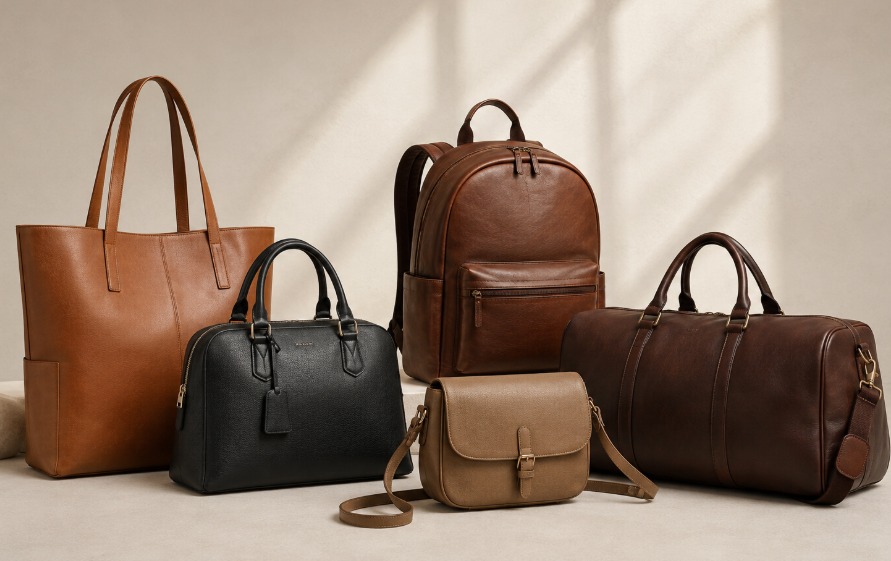
Chinese manufacturers can customize the leather, color, size, shape, internal structure, handle, shoulder strap, opening, pockets, logo, hardware, lining, and packaging.
For genuine leather, common options include cowhide, calfskin, lambskin, suede, split leather, and embossed leather. Synthetic options include PU leather, microfiber leather, PVC, and recycled alternatives.
A physical material swatch is more reliable than a photo. The swatch should show the color, grain, thickness, flexibility, backing, and surface finish.
Bag dimensions should include more than width, height, and depth. Handle drop, opening width, strap length, pocket size, zipper length, base width, and expected carrying load can all affect the product.
The intended use should also be explained. A leather laptop tote requires different reinforcement from a small evening bag. A daily crossbody bag needs reliable strap attachment and hardware. A travel bag must support more weight and repeated handling.
Logo options include embossing, debossing, foil stamping, metal logo plates, printing, embroidery, woven labels, and customized zipper pullers.
You can read this guide to حقائب بشعار مخصص when choosing a suitable branding method.
Hardware can also be customized. Common options include zippers, buckles, hooks, chains, D-rings, rivets, magnetic closures, feet, and metal frames.
Buyers using branded zippers can review the quality information provided by YKK. The zipper size, tape color, slider finish, puller design, and strength should be confirmed during sampling.
Packaging may include dust bags, tissue paper, shape supports, care cards, branded boxes, protective wrapping, and export cartons.
Genuine Leather vs PU Leather: Which Should You Choose?
| العامل | جلد طبيعي | جلد PU |
|---|---|---|
| المواد | Natural animal hide | Synthetic coating on a fabric base |
| المظهر | Natural grain and variation | More uniform surface and color |
| Feel | Often softer and develops character with use | Can be soft, smooth, firm, or highly structured |
| Positioning | Premium, luxury, heritage, and long-use products | Fashion, vegan, promotional, and color-focused products |
| Production control | Requires careful hide selection and cutting | Easier to control color and surface consistency |
| Common risks | Scars, thickness variation, color differences, and lower cutting yield | Peeling, cracking, odor, hydrolysis, and coating separation |
| Suitable products | Handbags, briefcases, wallets, and premium accessories | Trend-led bags, vegan collections, and high-color designs |
Genuine leather is often selected when natural texture, softness, durability, and aging are important parts of the product.
Its natural appearance also makes production more demanding. The factory needs to classify the hides, avoid major defects, control grain direction, and match visible panels on the same bag.
PU leather gives brands more control over color, grain, surface treatment, and consistency. It can be suitable for bright colors, printed patterns, metallic finishes, or vegan collections.
The name PU leather does not describe the real quality level. Buyers should ask about the base fabric, coating, flexibility, abrasion resistance, aging performance, hydrolysis resistance, and odor.
The final choice should match the product’s use, brand position, expected customer experience, and care requirements.
How to Evaluate a Leather Bag Manufacturer Before Ordering
A factory should be evaluated through documents, samples, communication, and production details.
Request the business license, factory address, production photos, main equipment information, workforce details, audit documents, and subcontracting policy.
A certification logo on a website is not enough. When a supplier claims BSCI, ISO, GRS, OEKO-TEX, or another certification, ask for the current document, certificate number, facility name, scope, issuing organization, and expiry date.
الـ إطار عمل amfori BSCI can help buyers understand how social compliance and supply chain monitoring are managed.
Sample development is one of the best ways to evaluate a supplier.
The first sample is rarely the final production standard. A project may pass through an initial sample, a revised sample, an approved sample, and a pre-production sample.
The final approved sample should be supported by a written specification. This document should confirm the leather, lining, reinforcement, thread, edge paint, hardware, logo, dimensions, tolerances, packaging, and labeling.
The supplier should not replace any approved material without written permission.
| Evaluation Area | What You Should Confirm | Possible Warning Sign |
|---|---|---|
| المواد | Leather type, grade, thickness, color, and supplier | The factory only says the material is high quality |
| أخذ العينات | Pattern maker, revision records, and sample approval process | Changes are only discussed through scattered messages |
| الإنتاج | Internal processes and subcontracted processes | The supplier avoids explaining where production happens |
| Quality control | Incoming, in-process, and final inspection | The factory inspects only after packing |
| التواصل | Project manager and update process | Different employees provide different answers |
| Documents | License, audit, certification scope, and expiry | Documents are expired or issued to another company |
The questions asked by the manufacturer can also show its level of experience.
A professional supplier normally wants to understand the target market, material, product use, dimensions, logo, packaging, quantity, testing requirements, and delivery schedule.
When a supplier gives a firm production promise before understanding the product, the promise may be based on guessing rather than proper planning.
How to Start a Custom Leather Bag Project in China
Begin with a clear product brief.
The brief can include sketches, technical drawings, reference photos, measurements, material preferences, internal structure, logo artwork, hardware finish, lining, packaging, quantity, and intended use.
When using reference photos, explain which feature you want from each image. One photo may show the preferred handle, another may show the closure, and a third may show the internal layout.
This reduces misunderstanding and helps the pattern maker create a more accurate first sample.
Review the sample in a fixed order. Start with the overall shape and size. Check the leather, structure, opening, pockets, handles, straps, hardware, stitching, edge paint, lining, logo, and packaging.
The bag should also be tested in normal use. Fill it with the intended items, carry it by the handle and strap, open every zipper, test every pocket, and place it on a flat surface.
Revision comments should be written in one organized file with numbered notes and marked photos. Feedback spread across email, WhatsApp, voice messages, and video calls is easier to miss.
Before bulk production begins, confirm the final sample, material swatches, specifications, quantity breakdown, packaging, carton marks, production schedule, inspection method, and shipping plan.
Production updates should be provided at meaningful stages, such as material arrival, cutting, sewing, assembly, final inspection, and packing.
The final inspection should compare bulk products with the approved sample and written specifications. The inspection should cover appearance, workmanship, dimensions, function, packaging, labeling, and quantity.
Leather bags also need suitable packaging to protect their shape, hardware, surface, and painted edges during transportation.
Compare Shortlisted Manufacturers with the Same Evidence
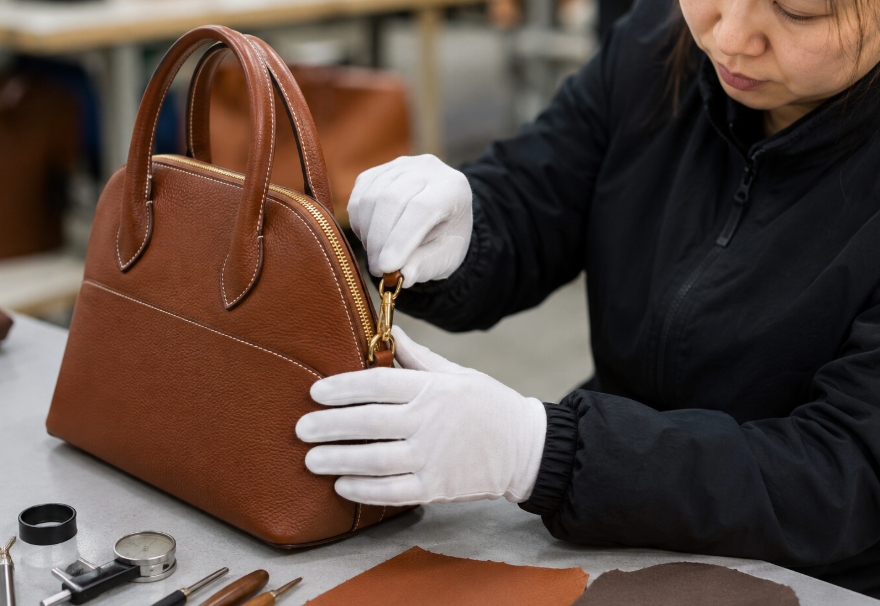
Treat this list as a research starting point, not a verified ranking or guarantee of current capabilities. Request the legal company name, production address, relevant samples, and confirmation of which steps are performed in-house or subcontracted. Use the leather grade selection guide to prepare a common material brief before comparing quotations.
Have each candidate confirm the same quantity by style and color, material reference, hardware, lining, logo, packing, sample revisions, inspection access, and conditions for substitutions. Request a dated project schedule and identify what must be approved before its production clock starts. Evaluate the responses and representative samples rather than relying on a broad capability statement.
الخلاصة
The right custom leather bag manufacturer is not always the largest company or the factory with the widest catalog.
Your decision should be based on material knowledge, pattern development, sampling accuracy, quality control, production experience, communication, and experience with similar products.
Take time to check the factory, review recent samples, confirm production details, and record every important requirement in writing.
A carefully managed sample stage can prevent material changes, size differences, weak handles, uneven stitching, poor edge paint, and packaging problems during bulk production.
هيتباغ is located in Huadu, Guangzhou, one of China’s main leather goods manufacturing areas. We have worked in bag manufacturing since 2011 and support leather handbags, tote bags, crossbody bags, backpacks, travel bags, makeup bags, and other OEM and ODM projects.
Our team can assist with material selection, sample development, logo customization, production, quality inspection, and packaging.
When you are looking for a custom leather bag manufacturer in China, you can send us your product information. Tell us the bag type, design, material, size, quantity, logo, and expected schedule.
Private Label Buyer Checklist for Custom Leather Bags
For private-label leather bags, the manufacturer should be evaluated on more than sewing capacity. Compare leather or PU sourcing, pattern development, logo and hardware customization, lining, edge finishing, sample revisions, MOQ, packaging, QC, and repeat-order consistency.
- Approve material swatches and hardware finishes before sampling.
- Confirm whether custom molds, metal logos, or Pantone colors change MOQ or lead time.
- Review stitching, edge paint, lining, zipper function, and reinforcement on the sample.
- Ask how bulk production is checked against the approved sample.
HETEBAG supports private-label and OEM/ODM leather bag projects from material selection and sampling through logo, hardware, packaging, and bulk production.
الأسئلة الشائعة
Why do brands choose custom leather bag manufacturers in China?
Many brands choose China because of its strong supply chain, experienced workers, flexible customization options, and competitive manufacturing capabilities.
What types of leather bags can Chinese manufacturers produce?
Chinese manufacturers can produce many styles, including handbags, tote bags, crossbody bags, backpacks, travel bags, and small leather goods.
Can I customize the material, color, and logo of a leather bag?
Yes. Most custom leather bag manufacturers in China offer customization for leather materials, colors, bag size, logo printing, metal hardware, lining, and packaging.
What is the difference between genuine leather and PU leather bags?
Genuine leather is made from animal hide and usually offers a more premium look and feel. PU leather is a synthetic material that is more affordable and often easier to maintain.
Is it necessary to request a sample before bulk production?
Yes. A sample helps you confirm the design, material, workmanship, and overall quality before moving into mass production.


