
 Arabic
  English
  Italian
  French
  German
  Spanish
 In the summer bag purchasing, Beach Bag and Pool Bag are often placed in the same product category. Both can be used to hold towels, sunscreen products, slippers and personal items, and their appearance may also adopt similar tote bag structures. However, from the perspective of actual production and usage environment, the requirements for materials, linings, hardware and internal structure are not the same for them.
If the purchaser only confirms the style based on its appearance and does not specify in advance whether the product will be used in the beach, swimming pool, resort or swimming club, the final product may have problems such as sand accumulation, water seepage, unpleasant smell, zipper corrosion or inability to separate wet items. In this article, we introduce the differences between beach bags and pool bags, which can help your brand specify more accurate product specifications before prototyping.
What Is a Beach Bag?
A beach bag is built around one core idea: carry a lot, carry it loosely, and don’t worry too much about precision. Beach trips involve unpredictable items — a folded blanket, a wide-brimmed hat, sunscreen, snacks, maybe a paperback that’s already starting to curl at the edges from humidity. The bag needs to swallow all of it without requiring the user to think about where each item goes.
Common Features of a Beach Bag
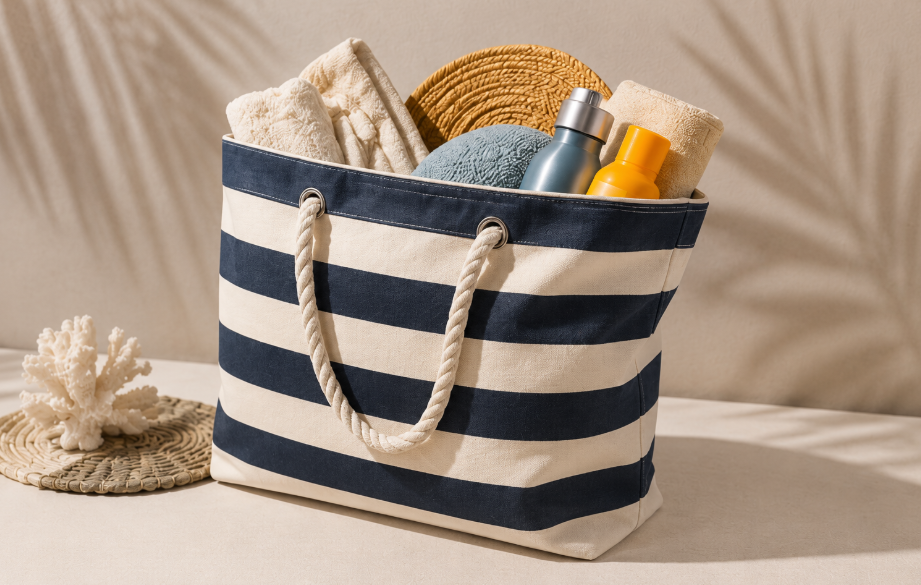
Most beach bags share a few defining traits. They’re large, often open-top or secured with a simple drawstring or magnetic snap rather than a full zipper closure. Many use breathable materials like mesh or loosely woven canvas, which lets sand fall through rather than collecting in the bottom seams. Handles tend to be long and reinforced, since beach bags are frequently slung over a shoulder while carrying other things — a cooler, a child, an umbrella.
What People Usually Carry to the Beach
Think about what actually goes into a beach bag on a typical outing. Towels take up the most volume. Sunscreen bottles, often oversized for family use, need a spot where they won’t leak onto everything else. Phones and wallets need at least some separation from sandy items. Snacks, a change of clothes, flip-flops, and sometimes a book or a portable speaker round out the list. None of this requires elaborate organization — it requires space and durability.
Typical Beach Bag Shapes and Styles
Beach bags lean toward wide, shallow silhouettes rather than tall, narrow ones. Tote-style and basket-style shapes dominate the category because they’re easy to load and unload with one hand while the other is holding a child’s wrist or a beach chair. If you’re exploring shape variations for a private-label line, it’s worth comparing these against a classic tote bag structure, since many beach bag designs borrow directly from tote proportions but scale up the volume and swap in more weather-resistant materials.

What Is a Pool Bag?
A pool bag solves a narrower, more specific problem. Pool-goers deal with one substance the beach crowd doesn’t have to think about as much: chlorinated water, dripping continuously off swimsuits, goggles, and towels the moment someone steps out of the water. That changes everything about how the bag needs to be built.
Common Features of a Pool Bag
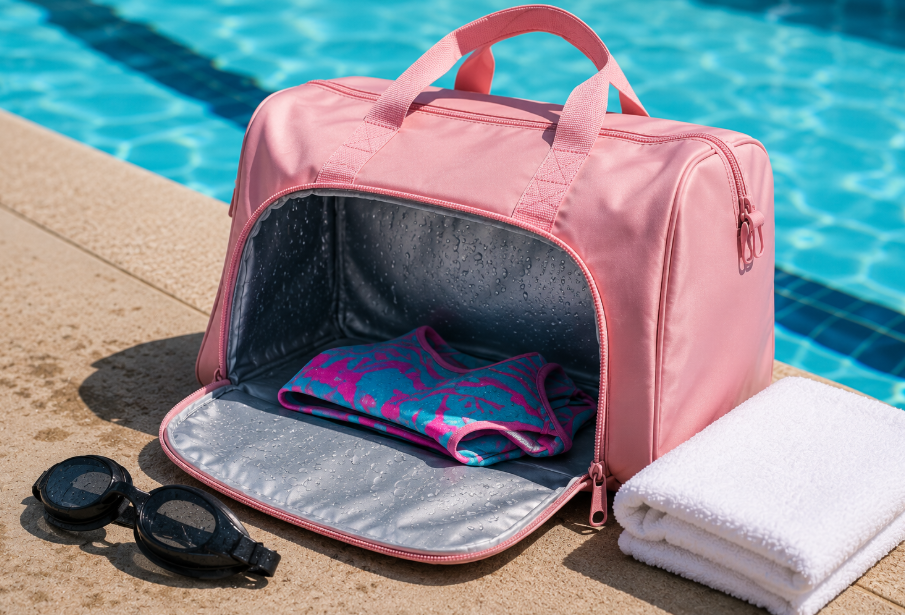
Pool bags tend to be smaller and more structured than beach bags. They usually include a dedicated wet compartment, often a separate zippered pocket or a fully lined section designed to contain moisture without soaking through to dry items. Materials lean toward synthetic fabrics that resist water absorption rather than natural fibers that soak it up. Many pool bags also include a vented or mesh side pocket specifically for goggles or wet swim caps, letting them air out slightly during transport.
What Swimmers Usually Carry
A swimmer’s kit is more specialized than a beach-goer’s. Goggles, swim caps, earplugs, and sometimes fins or paddles for training swimmers all need protected spots where they won’t get crushed. A wet swimsuit needs somewhere to go that won’t dampen a dry change of clothes packed in the same bag. Chlorine-resistant items like silicone caps hold up fine against moisture, but cotton towels and clothing don’t, which is exactly why compartmentalization matters so much more here than it does for a casual beach trip.
How Pool Bags Differ from Regular Totes
This is where buyers most often get tripped up. A standard tote bag, even a nice one, isn’t built to handle sustained moisture exposure. Pool bags need reinforced bottoms that won’t degrade when set down on wet pool decks repeatedly, and they need closures — usually zippers rather than open tops — to prevent water from sloshing out during transport. If your product line currently relies on general-purpose tote construction, it’s worth reviewing how a purpose-built tote bag differs structurally from a moisture-managing pool bag before you commit to tooling and materials.
Beach Bag vs. Pool Bag: Key Differences at a Glance
Once you line up the two categories side by side, the differences stop being subtle. They’re functional, and they affect everything from fabric selection to stitching density.
Intended Use and Carrying Environment
Beach bags are built for open, sandy, sun-exposed environments where the bag might sit directly on sand or get tossed into a car trunk afterward. Pool bags are built for poolside decks, locker rooms, and gym bags where moisture is constant but sand usually isn’t a factor at all. That single environmental difference drives almost every material and structural decision that follows.
Storage and Organization Requirements
Beach bags prioritize volume over organization. Pool bags prioritize organization over raw volume, because swimmers need quick access to specific items — goggles before a swim, a dry towel after one — without digging through a single open cavity.
Water, Sand, and Moisture Protection
Sand and water demand different defenses. Sand needs to be shaken out or allowed to fall through mesh; trapping it against fabric just creates abrasion over time. Water needs to be contained and separated, not just tolerated. A bag designed only for sand resistance will usually underperform against sustained moisture, and a bag built for moisture containment isn’t necessarily breathable enough to handle sand efficiently.
| مقال مميز | حقيبة الشاطئ | Pool Bag |
|---|---|---|
| Primary Use | Beach trips and outdoor vacations | Swimming pools and aquatic facilities |
| Main Concern | Sand, sunlight, and saltwater | Chlorine, moisture, and wet swimwear |
| Typical Structure | Large and open | More organized and compartmentalized |
| المواد الشائعة | Canvas, mesh, straw, polyester | Nylon, polyester, PVC, mesh |
| الأفضل لـ | Families, travelers, and resorts | Swimmers, gyms, schools, and sports clubs |
Materials Used for Beach Bags and Pool Bags
Material selection is where most sourcing mistakes actually happen, and it’s also where the most money gets wasted on returns and complaints. Choosing the wrong fabric for the wrong environment doesn’t just shorten a bag’s lifespan — it can turn a single bad batch into a flood of refund requests.
Canvas, Straw, Mesh, and Polyester for Beach Bags
Canvas remains popular for beach bags because it’s sturdy, takes printing well, and has the kind of relaxed, natural texture that resonates with resort and travel branding. Straw and straw-look synthetic weaves carry strong seasonal appeal, especially for boutique and lifestyle brands, though pure natural straw has real durability limits against repeated sun and moisture exposure. Mesh panels are increasingly common as accent material because they let sand fall through without compromising the bag’s structure. Polyester, meanwhile, offers a practical middle ground — lighter than canvas, more weather-tolerant than straw, and considerably easier to keep consistent across large production runs.
Nylon, PVC, and Water-Resistant Fabrics for Pool Bags
Pool bags lean heavily on synthetic fabrics built for moisture, and nylon sits at the center of that shift. Ripstop nylon resists tearing under stress, dries quickly, and holds dye well, which matters for brands running specific colorways. PVC-coated fabrics go a step further, creating an essentially waterproof barrier ideal for the wet compartments that define this category. Coated polyester rounds out the lineup, balancing water resistance with a softer hand-feel than PVC, which some swimmers prefer for bags they carry against bare skin.
How Saltwater, Chlorine, and Sunlight Affect Materials
Saltwater is corrosive to metal hardware and can leave white mineral residue on fabric if it isn’t rinsed promptly. Chlorine, meanwhile, is chemically aggressive toward certain synthetic fibers over time, gradually weakening fabric strength and sometimes bleaching color. UV exposure breaks down dyes and degrades fiber integrity in both environments, which is why colorfastness testing matters more for these two categories than for almost any other bag type you’d manufacture. A factory that understands this distinction will select UV-stabilized dyes and chlorine-tolerant coatings specifically for pool-bound products, rather than applying one generic fabric spec across both categories. If you’re unfamiliar with how different base materials perform under these conditions, comparing canvas against nylon construction is a useful starting point before finalizing your spec sheet.
Size, Compartments, and Functional Design
Structure is where beach bags and pool bags genuinely part ways. It’s not just about looking different — the internal architecture serves entirely different goals.
Large Open Storage vs. Organized Compartments
Beach bags work best as one big, accessible space. Adding too many internal dividers actually works against the use case, since beach-goers want to drop items in quickly without thinking. Pool bags benefit from the opposite approach. Swimmers and athletes appreciate predictable storage — a spot for goggles, a spot for a dry towel, a spot for a phone that needs to stay completely dry. Removing that structure to cut costs tends to backfire in customer satisfaction scores faster than almost any other design shortcut.
Wet and Dry Separation
This single feature might be the most requested customization in pool bag development, and for good reason. A dedicated wet pocket — typically lined with PVC or a heat-sealed polyester — keeps a soaked swimsuit from soaking through into a dry towel or a stack of clothes packed nearby. Some advanced designs use a removable wet bag insert instead of a built-in compartment, giving the end user flexibility to wash the insert separately. Either approach solves the same underlying complaint: nobody wants to open their bag at the end of a swim and find everything damp.
Zippers, Inner Pockets, Mesh Panels, and Reinforced Bases
Hardware choices matter more than buyers often expect. Zippers exposed to chlorinated water need corrosion-resistant coatings, or they’ll seize up within a season — this is a complaint I’ve seen surface repeatedly with budget suppliers who use uncoated metal zippers to cut costs. Reputable manufacturers typically specify branded zipper components precisely because the reliability difference is noticeable; YKK zippers, for instance, are widely used across the bag industry for their consistent pull strength and corrosion resistance, and that consistency becomes especially important in a wet-use product like a pool bag. Inner pockets should sit high enough to stay dry even if the wet compartment leaks slightly. Mesh side panels help ventilate damp items during transport. Reinforced bases, often using a denser foam or plastic insert, keep the bag’s shape intact when set down repeatedly on hard, wet pool decks.
Which Bag Is Better for Your Target Market?
There’s no universal right answer here — the better question is which bag fits your specific buyer’s actual use case. I’ve watched brands launch the wrong category entirely because they assumed “summer bag” meant one thing, when their customer base actually needed something else.
Beach Bags for Resorts, Travel Brands, and Summer Retail
If you’re supplying resorts, travel agencies, or general summer retail, beach bags almost always make more sense. These buyers want a bag that photographs well, holds a lot, and reinforces a relaxed vacation aesthetic. Customization requests in this segment tend to center on color, print pattern, and branding placement rather than technical waterproofing, since the use case doesn’t demand it.
Pool Bags for Gyms, Swim Clubs, Schools, and Sports Brands
Gyms, competitive swim clubs, schools with aquatics programs, and sports apparel brands almost always need pool bags instead. These buyers care less about aesthetic flair and more about functional reliability — does the wet compartment actually work, does the zipper hold up after fifty uses, can a coach’s logo survive repeated chlorine exposure without fading. If you’re already producing for athletic markets, it’s worth reviewing how pool bag specifications compare to a gym bag’s structural requirements, since the two categories often share similar buyers even though the products themselves are distinct.
When a Hybrid Beach-and-Pool Bag Makes More Sense
Some buyers genuinely need both functions in one product, particularly resort hotels with both beachfront and pool access, or family-oriented retailers selling to vacationers who’ll use the same bag in both settings. A hybrid design typically borrows the beach bag’s larger open structure but adds a pool bag’s wet compartment and more moisture-resistant base materials. It’s a reasonable middle ground, but it does involve trade-offs — you’re rarely getting the absolute best version of either category, just a competent version of both.
How to Customize Beach Bags and Pool Bags
This is usually where the real conversation with a factory begins, because customization decisions made early save significant rework later.
Choosing the Right Size, Fabric, and Structure
Start with the actual use case, not the aesthetic. A beach bag aimed at families needs more volume than one aimed at solo travelers. A pool bag for competitive swimmers needs to fit fins and kickboards, which is a meaningfully different size spec than a casual lap-swimmer’s bag. Fabric weight matters too — too light, and the bag sags under load; too heavy, and you’re adding unnecessary cost and shipping weight. A good factory partner will walk through these trade-offs with you rather than defaulting to whatever fabric happens to be sitting in inventory.
Adding Logos, Labels, Colors, and Custom Features
Branding placement should account for how the bag is actually carried and viewed. A logo on the front panel of a beach tote gets seen constantly when it’s slung over a shoulder; the same placement on a pool bag’s wet compartment flap might get less visibility if that section is usually facing inward. Embroidery holds up better than screen print against repeated washing and sun exposure, though it carries a different cost and lead-time profile. If your brand already has bag lines built around custom logo placement, it’s worth extending that same branding logic to your beach and pool offerings rather than treating them as an entirely separate design exercise.
Testing Samples Before Bulk Production
This step gets skipped more often than it should, usually under time pressure, and it’s almost always a mistake. A pool bag sample should be tested with actual water exposure, not just visual inspection — fill the wet compartment, let it sit, check for leakage into the dry section. A beach bag sample should be checked for how well sand actually falls through mesh panels rather than collecting in seams. Zipper pulls should be cycled dozens of times to catch early hardware failures before they show up in a customer’s hands. Skipping this stage to save a week of lead time tends to cost far more in returns and reputation than it saves in schedule.
Quality verification doesn’t have to rely solely on your own inspection either. Many buyers now request third-party testing through independent labs like SGS or Intertek, particularly for moisture-resistance claims on pool bags or colorfastness claims on beach bags exposed to sun. That kind of verification adds a layer of confidence that internal QC alone can’t always provide, especially for buyers placing their first order with a new factory.
Sustainability and Compliance Considerations Buyers Often Overlook
Material performance isn’t the only thing worth scrutinizing before you commit to a supplier. Increasingly, retail buyers — particularly those selling into European and North American markets — are asking sourcing teams to confirm compliance credentials before placing bulk orders, and for good reason. A factory’s working conditions and chemical safety practices directly affect your brand’s risk exposure.
Social compliance audits, such as those under the BSCI framework, give buyers visibility into labor practices and working conditions at the factory level, which matters increasingly to retailers facing their own supply chain disclosure requirements. On the materials side, recycled polyester and nylon are gaining ground in both beach and pool bag lines, partly driven by sustainability goals and partly by genuine performance — recycled synthetic fibers often perform comparably to virgin fiber for water resistance. Buyers sourcing recycled content should ask whether the material carries GRS certification, since that verifies the recycled content claim through chain-of-custody tracking rather than taking a supplier’s word for it.
Chemical safety is worth confirming directly rather than assuming. OEKO-TEX STANDARD 100 testing screens finished textile products for harmful substances, and it’s a reasonable certification to request specifically for pool bags, given how much direct skin and moisture contact those products see. Buyers building organic cotton or natural-fiber beach bag lines sometimes also look to Textile Exchange’s standards for fiber traceability. None of these certifications are universal requirements for every order, but asking the question upfront — rather than discovering gaps after a shipment lands — tends to prevent the kinds of disputes that damage long-term supplier relationships. A factory that holds relevant ISO quality management certifications, separate from product-specific testing, is generally also a useful signal of consistent production discipline across repeat orders.
الخلاصة
The differences between a beach bag and a pool bag come down to one practical question: what is the bag actually going to face, day after day, in the hands of the people using it? Sand demands breathability and looseness. Chlorinated water demands containment and chemical resistance. Trying to force one design to do both jobs well rarely produces a product either customer base is fully happy with, which is exactly why specialized construction continues to outperform generic summer totes in both categories.
If you’re weighing this decision for an upcoming product line, the smartest move is usually a direct conversation with a manufacturer who has actually built both categories at scale and watched how each performs after real-world use, not just in a showroom sample. At هيتباغ, we’ve spent more than 15 years manufacturing custom bags from our factory base in Huadu, Guangzhou, working alongside a network of trusted partner factories to cover everything from beach totes to technical pool bags and beyond. We’ve seen firsthand which material choices hold up and which ones generate complaint emails six weeks after a product launches, and we bring that experience into every development conversation with a new buyer.
If you’re currently sourcing a beach bag, a pool bag, or a hybrid design for your brand, we’d genuinely like to hear about your project. Leave your contact number on our website, and our team will follow up directly — we look forward to working with you on a bag program built around how your customers will actually use it.
الأسئلة الشائعة
Can a beach bag also be used as a pool bag?
Yes, but only if it uses water-resistant materials and includes a separate space for wet items. A traditional canvas or straw beach bag may absorb moisture, develop odors, or become damaged after repeated exposure to chlorinated water. For regular pool use, a purpose-built pool bag is usually more practical.
What is the best material for a pool bag?
Nylon, coated polyester, PVC-lined fabric, and quick-drying mesh are commonly used for pool bags. The best choice depends on whether the bag needs to be fully waterproof or simply water-resistant. A PVC-lined wet compartment is especially useful for separating wet swimwear from towels, clothing, and personal items.
How large should a beach bag be?
The size depends on the target customer. A family beach bag usually needs enough room for several towels, sunscreen, clothing, snacks, and accessories. A smaller beach tote may be sufficient for individual travelers or resort guests. Before production, buyers should confirm the expected contents and carrying weight.
How can I prevent a pool bag from developing odors or mildew?
Choose quick-drying fabrics, breathable mesh panels, and a removable or easy-to-clean wet compartment. Users should also empty the bag after swimming and allow it to dry fully. During product development, the factory should avoid absorbent linings that trap moisture for long periods.


