
 English
  Italian
  French
  German
  Spanish
  Arabic
 Choosing between a bucket bag and a tote bag is less about which silhouette is more fashionable and more about what the user needs to carry, how often they need to reach it, and how long they will wear the bag. A large exterior does not always create useful storage. The opening, internal depth, pocket layout, closure, strap, and base construction all affect everyday performance.
For brands developing a new collection, the same comparison has another layer. A small change to the handle drop, base reinforcement, lining, or closure can make either design considerably more practical. This Bucket Bag vs Tote Bag guide compares the two from both the user’s and the product developer’s perspective.
1. What is the main difference between a bucket bag and a tote bag?
The shape and structure of a bucket bag
A bucket bag normally has a round or oval base, a tall body, and a top that gathers inward. Many versions use a drawstring threaded through eyelets, although a flap, magnetic tab, or zipper may be added. A single shoulder strap or adjustable crossbody strap is common.
This construction creates a distinctive three-dimensional silhouette. Soft leather or PU allows the body to drape around the contents, while a reinforced base helps the bag retain its shape. The narrower gathered opening can make larger, rigid items awkward to insert even when the lower body has enough volume.
The open, rectangular design of a tote bag
A tote bag is generally square or rectangular, with two parallel handles and a wide top opening. It may be unlined and completely open, or developed with a zipper, magnetic tab, inner pouch, or structured lining. The broad front and back panels also provide a useful area for custom graphics or branding.
The custom tote bag category covers products with very different levels of structure. A foldable nylon shopper and a reinforced work tote share the same basic silhouette, but they do not serve the same load or retail position.
Quick comparison of their main features
| Feature | Bucket bag | Tote bag |
|---|---|---|
| Shape | Deep body with a round or oval base | Square or rectangular body |
| Typical closure | Drawstring, flap, magnet, or combined closure | Open top, magnet, or zipper |
| Capacity | Flexible for compact daily belongings | Usually better for wide, flat, or larger items |
| Organization | Often one deep main compartment | Easier to divide into laptop, document, and accessory zones |
| Carrying style | Shoulder or crossbody strap | Two handles, sometimes with a detachable strap |
| Common uses | Daily outings, fashion collections, light essentials | Work, shopping, commuting, travel, and promotional use |
2. Which bag offers more usable storage space?
Tote bags for laptops, documents, and larger items
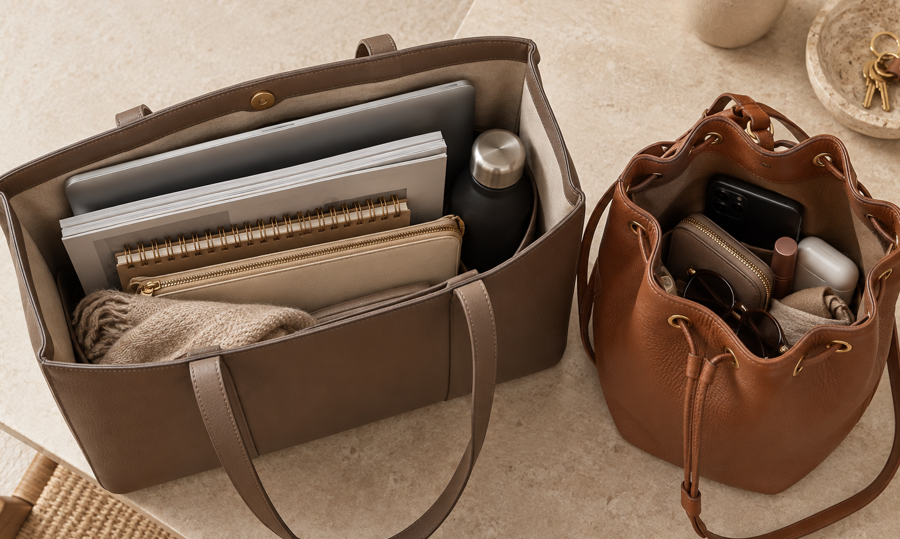
A tote usually provides more usable space for a laptop, A4 documents, folders, purchases, or travel accessories. Its relatively straight sides and broad opening allow flat objects to sit upright rather than bend around a circular base. A gusset can add depth without sacrificing the rectangular loading area.
For a work tote, capacity should be planned around the actual device and sleeve dimensions, not a generic claim such as “fits a laptop.” The sample also needs enough clearance at the zipper or top edge. A padded divider, raised laptop pocket, or reinforced base can improve protection, but each component adds weight and occupies internal space.
Bucket bags for compact but flexible everyday storage
A bucket bag can hold a surprising number of small and medium items because the body expands around them. The wider base is useful for a compact umbrella, sunglasses case, wallet, small bottle, and cosmetic pouch. Its depth, however, can turn that volume into a vertical stack.
When the opening gathers tightly, the usable entry width becomes smaller than the bag’s widest point. A rigid notebook or tablet may technically fit inside the body but still be difficult to pass through the opening. Product specifications should therefore record the top opening when fully released as well as the base and body dimensions.
How bag shape affects the use of interior space
Capacity is only valuable when users can load, separate, and retrieve their belongings. Rectangular tote space works well for flat items and organized zones. A bucket form is more forgiving with irregular objects, but small pieces tend to settle at the bottom.
Brands can test usable capacity by preparing a realistic carry set for the target customer. Load the same items into each prototype, close the bag, wear it, and retrieve a phone or keys without emptying the contents. That short exercise reveals more than an external measurement alone.
3. Which bag is easier to organize and access?
The easy-access advantage of a tote bag
A wide tote opening makes it easy to see and reach the contents. This is convenient during commuting, shopping, or travel, when the user may need a laptop, document, or bottle several times a day. A light-colored lining can further improve visibility inside a dark exterior.
An open top also exposes the contents and may allow smaller items to fall out if the bag tips over. A recessed zipper can retain the clean tote silhouette while improving security. A magnetic tab is quicker, but it does not seal the entire opening.
Why small items get lost inside a bucket bag
Many bucket bags use one deep compartment. Without organization, keys, cards, earbuds, and cosmetics drop beneath larger items, creating the familiar “bag salad” problem. The gathered opening can also block light and make the lower area harder to inspect.
Over-division is not the answer. Too many narrow pockets reduce flexibility and may not suit changing phone sizes or personal habits. One secure zip pocket, one accessible slip pocket, and a key leash often provide a better starting point than a crowded wall of small compartments.
Pockets, dividers, and detachable pouches
A removable zip pouch or insert can improve either style. In a bucket bag, it gathers small essentials and can be lifted out. In an open tote, it adds security without requiring a full top zipper. A detachable insert also lets the buyer offer different colors or materials while keeping the outer shell simple.
Pocket placement should be tested after the bag is loaded. A heavy phone pocket attached high on a soft lining may pull the wall inward, while a low pocket can become difficult to reach. Stitching, backing, and pocket opening width all matter in production.
4. Which bag provides better security and carrying comfort?
Drawstrings, zippers, magnets, and open-top designs
A drawstring gives a bucket bag more coverage than a completely open tote, especially when the cord gathers the rim closely. It should not be treated as the same level of security as a full zipper. Gaps can remain between folds, and opening or closing the drawstring may require two hands.
A zip-top tote protects the full opening, while a magnetic closure mainly keeps the sides together. Brands should choose the closure around the use case: quick access for shopping, stronger containment for commuting, or a combined drawstring and internal zip pocket for daily valuables. Closure testing should include repeated operation with the bag loaded, because tension changes when the body is full.
Shoulder straps vs. tote handles
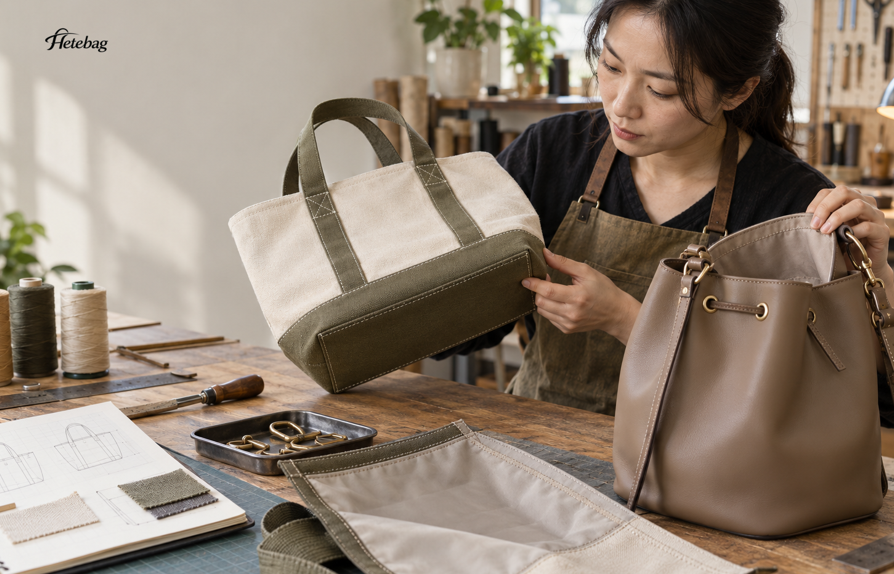
Bucket bags commonly use a longer adjustable strap, which supports shoulder and crossbody wear. Crossbody carrying keeps both hands free and can feel more secure in crowded settings. The strap needs enough adjustment range for the target user and clothing season, along with reliable reinforcement where it joins the bag.
Tote handles allow quick pickup and work well at the elbow or shoulder when the drop is long enough. Short handles may restrict the bag to hand carry, while very thin handles can become uncomfortable under a laptop or shopping load. A detachable shoulder strap can broaden the use case, although it adds hardware and weight.
How weight distribution changes comfort
Comfort begins with the empty bag. Thick material, a large base board, metal hardware, and multiple reinforcement layers can create a heavy product before anything is packed. Wider straps spread pressure over a larger contact area, but their edges, flexibility, and attachment angle still require wear testing.
A representative load test should be part of sample approval. Wear the bag in each intended position, walk with it, set it down, and check whether the body twists or the handle attachments distort. If the intended load is consistently heavy or carried for long periods, a backpack may distribute it more appropriately than either a one-shoulder bucket bag or tote.
5. Which bag works better for different occasions?
Work, shopping, travel, and daily commuting
For a laptop, documents, shopping, or travel accessories, a tote bag is usually the more practical option. Its wide opening and straight interior accept larger objects, and its handles make frequent pickup easy. Work and travel versions benefit from a secure closure, reinforced base, organized lining, and a luggage sleeve where the use case justifies it.
A lightweight canvas or nylon tote can also fold or pack more efficiently than a structured handbag. Brands should decide whether the product is meant to collapse for storage or stand upright at retail, because the required interfacing and base construction are different.
Casual outings and day-to-evening use
A bucket bag works well when the user carries a smaller set of daily belongings and wants a more distinctive silhouette. Its shoulder or crossbody strap suits hands-free movement, while leather, PU, textile, and mixed-material versions can move between casual and more polished collections.
The shape also provides a strong design identity without relying on a large print area. Hardware finish, drawstring proportion, edge treatment, and base profile become important visual details. For brands, these elements should be specified rather than left to a reference photograph.
When neither style is the perfect choice
Neither silhouette should be forced into every use case. A backpack is often more suitable for prolonged heavy loads. A zippered crossbody may be better for a passport and phone in crowded travel environments, while a compact shoulder bag may suit an evening range better than a deep bucket form.
The useful question is what the customer carries and how they move through the day. The category name should follow that use case, not lead it.
6. How do materials and construction affect practicality?
Leather, PU, canvas, nylon, and recycled materials
Soft leather can create the natural folds associated with a bucket bag, but an unsupported body may collapse when set down. Firmer leather or PU can hold a cleaner silhouette, although thickness, backing, and coating affect both weight and hand feel. Material should be evaluated as a complete specification rather than by name alone.
Canvas gives a tote body and an accessible surface for printing or embroidery. Nylon can reduce weight and suit frequent-use or packable products, depending on the fabric specification and construction. Buyers considering recycled inputs should define the claimed composition and required documentation. The RCS and GRS framework provides chain-of-custody standards for recycled materials; a material description by itself is not proof of a certified claim.
HeteBag’s custom handbag and tote development options can be evaluated around the intended structure, surface treatment, and end use rather than selecting a material from appearance alone.
Base reinforcement, lining, and stress-point stitching
A removable or sewn-in base board helps a tote carry flat items and allows a bucket bag to retain its footprint. The reinforcement must be compatible with the desired flexibility and cleaning method. Excessively stiff board can create hard edges, raise packing volume, or show through a thin outer material.
Lining improves the interior finish and supports pockets, but it should not pull, wrinkle, or interfere with the closure. Handle bases, strap anchors, pocket corners, and drawstring eyelets are common stress areas. Reinforcement patches, suitable stitch density, binding, and secure hardware backing help manage repeated loads.
How structure changes the bag’s performance
Interfacing, foam, piping, edge paint, binding, and panel construction can turn two bags made from the same surface material into very different products. More structure may improve shape retention and retail presentation, but it increases weight and can reduce packing efficiency. A softer build offers flexibility but may need thoughtful pocket and base support.
Brands should approve a loaded sample, not only an empty beauty sample. Check the silhouette after the bag has carried the intended items, then examine seam strain, base sag, handle comfort, closure alignment, and recovery after unloading.
7. Bucket bag or tote bag: which should a brand develop?
Choose according to the target customer and use case
A tote is generally the stronger starting point for commuters, students, shoppers, and travelers carrying wide or flat items. A bucket bag is often better for a fashion-led daily collection, especially when hands-free wear, a closed-looking top, and a recognizable silhouette matter.
The sales channel also affects the decision. A promotional tote may prioritize printable area and packing efficiency. A fashion retailer may place more weight on drape, hardware, finishing, and color development. An online brand needs dimensions and photography that make capacity and carrying options clear without an in-person demonstration.
Custom features that improve everyday functionality
For totes, useful upgrades can include a recessed top zipper, padded device sleeve, bottle pocket, key leash, reinforced base, and detachable shoulder strap. For bucket bags, consider a smoother drawstring path, wide adjustable strap, secure inner zip pocket, light lining, removable pouch, and base reinforcement.
Every feature has a tradeoff. Additional pockets add labor, layers, and weight. More hardware can improve adjustability while changing balance and appearance. The best feature set is the smallest one that solves the target user’s actual carrying problems.
Questions to confirm before sampling and production
Before requesting a sample or quotation, confirm:
- finished width, height, depth, and base shape;
- top opening when fully open and closed;
- target carried items and intended load;
- outer material, lining, reinforcement, and color requirements;
- closure type, hardware finish, and operating method;
- handle drop, strap width, adjustment range, and attachment points;
- pocket dimensions, position, and fastening;
- logo artwork, size, location, and application method;
- packing method, labels, hangtags, and carton requirements;
- sample approval points and any required material or performance testing.
A reference image is useful for direction, but it does not answer these production questions. A clear tech pack or marked specification reduces assumptions before pattern making and helps the approved sample become a reliable production standard.
Conclusion
If the customer needs to carry a laptop, documents, shopping, or travel items, a tote bag is usually more practical. If the customer values a gathered closure, crossbody wear, and a more recognizable silhouette, a bucket bag may be the better choice.
For a brand buyer, practicality depends on the target user, internal structure, closure, strap system, and material specification rather than the bag category alone. HeteBag works with brands on custom bag development in Huadu, China, drawing on more than 15 years of bag manufacturing experience and cooperation with multiple factories. Buyers can share their target use, dimensions, material ideas, and reference artwork through the project inquiry page for a more focused sampling discussion.


