
 Italian
  English
  French
  German
  Spanish
  Arabic
 Meta description: Learn what drives custom bag manufacturing costs, how MOQ changes unit price, which extra charges to budget for, and what to send for an accurate quote.
If you are comparing quotes for a new bag, the lowest unit price can be misleading. One supplier may price a stock fabric and basic logo, while another includes a custom lining, stronger hardware, individual packaging, and a pre-production sample. To estimate the cost to manufacture a custom bag, you first need to define the same product and quotation terms for every supplier.
1. What Is the Average Cost to Manufacture a Custom Bag?
There is no meaningful single average across a cotton tote, an insulated lunch bag, a technical backpack, and a structured handbag. Published manufacturer price guides suggest that simple bags can cost a few US dollars each at a production quantity, while more complex styles can run into the tens of dollars. Those figures are market examples, not a HeteBag price list or a guaranteed quote.
| Illustrative category | Published reference at roughly 1,000 pieces | Why the range changes |
|---|---|---|
| Simple polyester tote | About US$2.80 to $4.00 per bag | Fabric weight, size, printing, handles, and pockets |
| Laptop backpack | About US$6.50 to $10.00 per bag | Padding, compartments, zippers, straps, and assembly |
| PU cosmetic pouch | About US$2.50 to $4.50 per bag | Material grade, lining, opening, and logo treatment |
These figures come from one manufacturer’s published category examples and are useful only as an initial sense check. Another manufacturer’s price reference uses different assumptions and ranges. Neither can replace a quote against your approved specification. Ask whether the number is EXW, FOB, or another named term, and whether sampling, tooling, packing, freight, and import charges are included.
2. What Factors Affect the Cost of Custom Bag Manufacturing?
Factories cost a bag from its components and operations, not its appearance alone. Two bags with the same external dimensions can have different prices if one requires a padded laptop sleeve, reinforced base, internal binding, several pockets, and more sewing steps.
The main drivers are material consumption, component specifications, cutting and sewing time, wastage, order quantity, packaging, and quality requirements. Shape matters too: a rounded or structured panel may create more cutting waste than a simple rectangular tote. If a design needs several rounds of sampling or a dedicated mold for custom metalwork, those development costs should be shown separately or clearly amortized into the unit price.
Before discussing a target price, decide which features protect the bag’s function and which are optional. Reducing the number of decorative seams or changing an internal pocket can save work; weakening a load-bearing handle may create a far more expensive quality problem.
3. How Do Materials Affect the Cost of a Custom Bag?
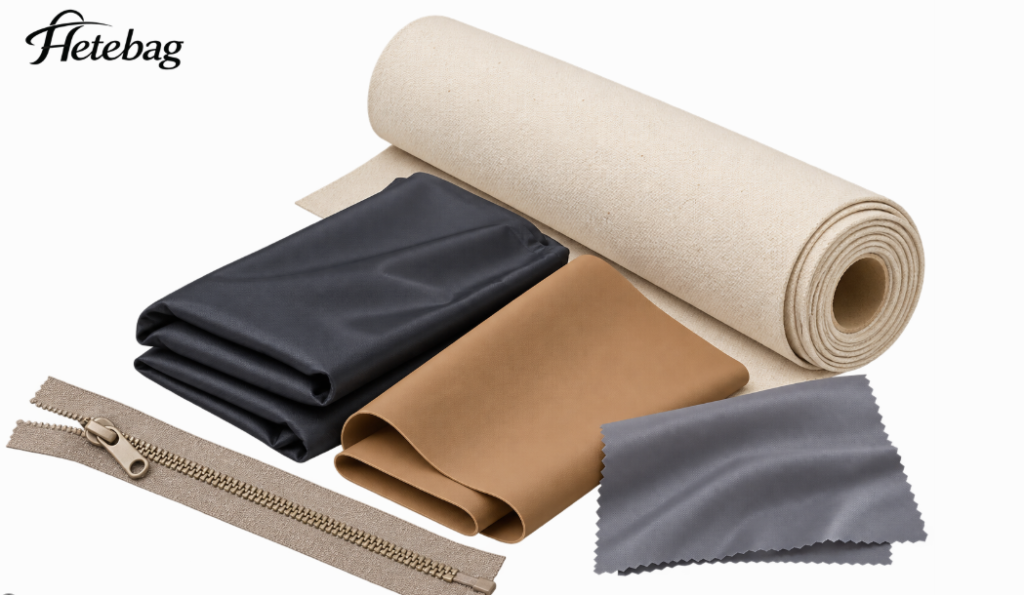
The shell fabric is only one line in the material bill. A quote should specify the outer material, lining, interlining or foam, reinforcement, webbing, thread, and closures. A canvas tote with no lining has a different material and labor profile from a fully lined bag with a rigid base.
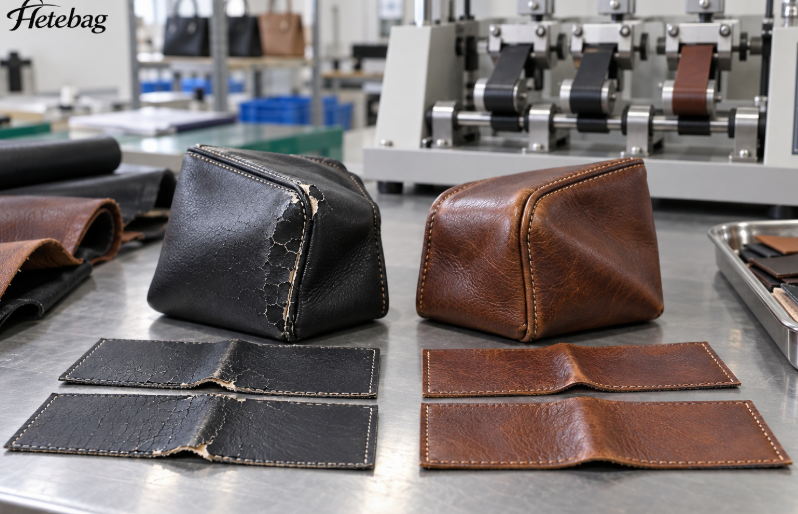
Ask for specifications you can verify on a sample: fiber composition, fabric weight or denier where relevant, thickness for PU or leather alternatives, coating, color, and finish. A cheaper swatch may feel acceptable on its own but lose its shape, mark easily, or fail at the seam in the finished bag. Our custom bag materials overview can help you compare options before requesting samples.
Material utilization also matters. Large panels, directional patterns, and color-matched small lots may increase waste or force a supplier to purchase more fabric than the order consumes. Confirm whether excess material is charged, retained for a reorder, or treated as part of the quoted price.
4. How Do Logo, Hardware, and Customization Options Affect the Price?
A one-color screen print on a flat panel may be straightforward. Embroidery over a padded panel or a custom metal logo plate requires different setup and can change the unit price. Price can change with print area, number of colors, stitch count, placement, preparation, and rejection risk. Ask to approve a physical logo sample on the final material; an attractive digital mockup does not show adhesion, edge quality, or color in real light.
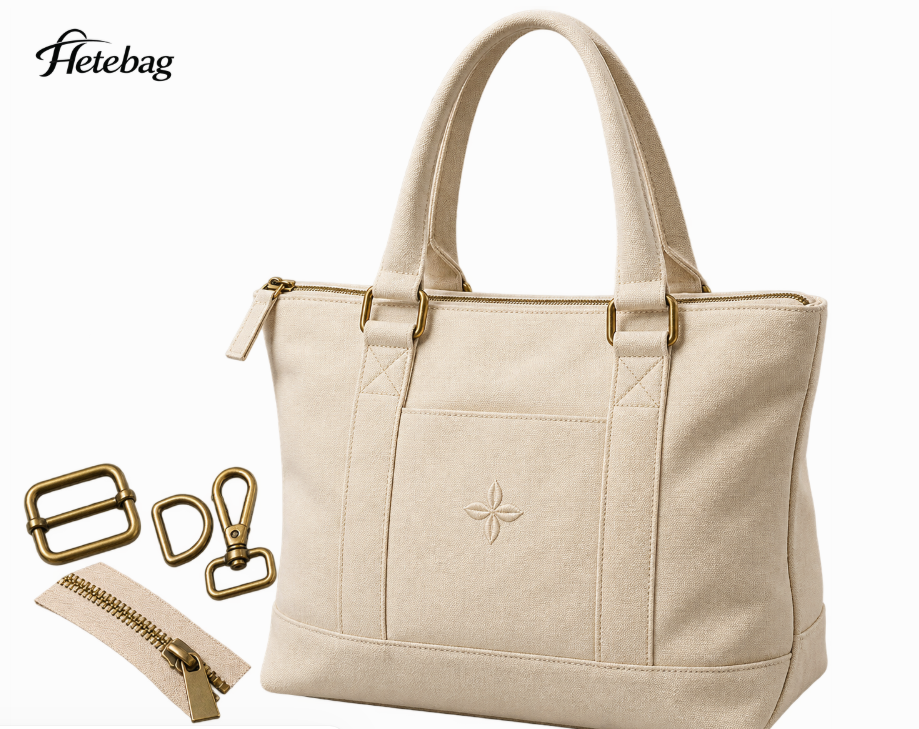
Zippers, buckles, sliders, rivets, and branded pullers affect both component cost and assembly time. You can compare an off-the-shelf finish against custom plating or a new mold, but specify the actual component grade and test requirement when durability matters. Two similar-looking closures may perform differently, so specify the zipper type and any test requirement in the brief. HeteBag’s opzioni hardware provide a starting point for a component brief.
5. How Does MOQ Affect the Cost Per Bag?
MOQ, or minimum order quantity, often reflects the smallest practical purchase of fabric, a print run, a hardware batch, or production setup. It is not necessarily one fixed number for every design. Ask whether the quoted MOQ is per style, per color, per logo, or for the combined order.
For example, spreading a hypothetical US$300 setup charge over 300 bags adds US$1.00 per bag; over 1,000 bags it adds US$0.30. This arithmetic shows why a larger order can reduce unit cost, but it does not mean buying more is automatically cheaper overall. Extra stock ties up cash and may need storage or markdowns.
Request prices at two or three realistic quantity tiers using the same specification. If your launch order is small, ask whether stock colors, standard hardware, or a shared material can reduce a supplier minimum without changing the bag’s essential function.
6. What Additional Costs Should You Include in a Custom Bag Project?
The production unit price is only part of your budget. Confirm the following before approving a purchase order:
- Development: pattern work, prototype and revised samples, courier charges, artwork setup, custom molds or dies, and any sample-fee credit against the bulk order.
- Production extras: special color matching, custom labels, hangtags, barcode stickers, individual bags, cartons, and third-party inspection or product testing where required.
- Delivery: export packing, inland transport, international freight, insurance where applicable, customs brokerage, duty, import tax, and delivery to your warehouse.
The named trade term determines which party arranges and pays for several delivery tasks. The International Trade Administration’s Incoterms guide is a useful reference, but a quotation must still spell out what is included. For EU imports, consult the official TARIC database; US buyers should confirm classification and applicable duty with their customs broker. Rates depend on the specific bag and current rules.
An internal landed-cost worksheet should add all expected project expenses and then divide them by the saleable quantity. Keep one-time tooling separate as well, so you can see both the first-order cost and the likely repeat-order cost.
7. How Can You Get an Accurate Custom Bag Manufacturing Quote?
Send each shortlisted supplier the same brief. The closer it is to a production specification, the less room there is for a low estimate that later changes after sampling.
| Include in the RFQ | Details to specify |
|---|---|
| Prodotto e utilizzo | Bag type, intended contents, target market, load or performance needs |
| Edilizia | Dimensions, capacity, compartments, handles, strap, closures, reinforcement |
| Materials and branding | Shell, lining, color, finish, logo file, method, size, and placement |
| Order and delivery | Quantity by style/color, target date, destination, named trade term |
| Approvazione | Sample stages, tolerances, inspection criteria, packaging, required documentation |
Ask for a unit price by quantity tier, a separate list of one-time and optional charges, material substitutions, MOQ by component, sampling cost, quote validity, and production lead time measured from final sample and material approval. If a supplier proposes a cheaper alternative, have it labeled as a second option rather than quietly substituted into the base quote. Compare physical samples and written specifications before deciding which offer actually meets the brief.
For a quote based on your actual specifications, discuss your project with a produzione di borse personalizzate team and share your dimensions, material choices, logo artwork, expected quantity, and destination.
Cost is easier to control when you understand where each production step creates material, labor, hardware, sampling, and inspection requirements. See our custom handbag production process guide for a stage-by-stage view from design to bulk production.
Conclusione
The cost to manufacture a custom bag depends on the design you approve, the quantity you order, and the terms under which the bags are delivered. Start with a clear specification, compare like-for-like quotes, and calculate the first-order landed cost alongside the repeat-order unit cost.
HeteBag works with brands on custom bag projects in Guangzhou, China. If you have a sketch, reference sample, or specification, send your project details for a quote, including your target quantity and destination.
Domande frequenti
Is the sample fee included in the bulk price?
It varies by supplier and project. Ask whether prototype, revision, and pre-production samples are charged separately and whether any fee is credited after you place a qualifying bulk order. Get the credit condition in writing.
Can I order several colors under one MOQ?
Sometimes, if the colors use stock material and the components remain the same. Custom-dyed fabric or color-specific hardware may have separate supplier minimums. Ask for the minimum per style and per color before finalizing the assortment.
Does a lower quoted unit price mean a lower landed cost?
No. Different trade terms, packing methods, carton volumes, inspection charges, and freight arrangements can change what you pay to receive saleable bags. Compare total expected costs at the same destination and quantity.


