
 Italian
  English
  French
  German
  Spanish
  Arabic
 You might think that the structure of a makeup bag doesn’t seem very complicated, but what really determines the quality and user experience of the bag is often the material. Different materials not only bring about different appearances and textures, but also affect whether the bag can maintain its shape, how easy it is to clean, and whether the logo can be presented clearly and accurately.
When choosing materials, it is also necessary to consider the actual use of the makeup bag. For example, the cotton small bag in a natural skincare gift box focuses more on a soft and natural feel; travel storage bags usually require waterproof, wear-resistant and easy-to-clean properties; while the PU leather makeup bags with a strong structure are more suitable for emphasizing elegance and brand image.
Therefore, when purchasing, one cannot simply decide on the material based on the pictures provided by the supplier. Pictures are difficult to truly reflect the thickness, softness, texture and color of the fabric. After the sample is completed, one might find that the bag shape is not firm enough, the color is off, or the logo craftsmanship does not match the material. A more reliable approach is to first check the material color cards and physical samples, and then confirm the final effect through the finished sample.
This guide compares the most common custom makeup bag materials and explains how to evaluate them before production. It is written for beauty brands, retailers, promotional buyers, and sourcing teams developing borse per il trucco personalizzate with a factory or supplier. For the wider process from design and sampling to production and inspection, see our cosmetic bag manufacturing guide.
1. Why Material Selection Matters for Custom Makeup Bags
Material is not only an appearance decision. It affects structure, weight, cleaning, decoration, sewing, packaging, and the way customers judge the product.
For example, a soft cotton bag can communicate a relaxed and natural image. Yet it may absorb liquid and lose shape unless the factory adds a suitable lining or reinforcement. PU leather can create a cleaner, more premium surface, but an unsuitable coating may peel, crease, or produce a strong smell. Clear TPU works well for travel and product visibility, although its thickness and welding quality must be controlled.
Before choosing a material, define five points:
| Decision area | Question to answer | Simple approval rule |
|---|---|---|
| Use | Will the bag stay at home or travel often? | Travel bags should resist spills and repeated handling |
| Struttura | Should it be soft, semi-structured, or rigid? | A filled sample should keep the intended shape |
| Pulizia | Will cosmetics touch the surface or lining? | Test whether a common makeup mark can be wiped away |
| Branding | Which logo finish represents the brand? | Approve the logo on the actual material, not on paper |
| Product position | Is it retail, premium gifting, or promotion? | Material quality must match the customer’s expected use |
A practical first test is to place the intended products inside a sample for 24 hours. Check whether the base sags, the opening becomes distorted, or the seams carry too much tension. If the sample loses its intended shape under a normal load, changing only the fabric thickness may not solve the problem. The pattern, lining, foam, and reinforcement may also need adjustment.
2. Common Materials Used for Custom Makeup Bags
Fabric Materials: Canvas, Cotton, Polyester, and Nylon
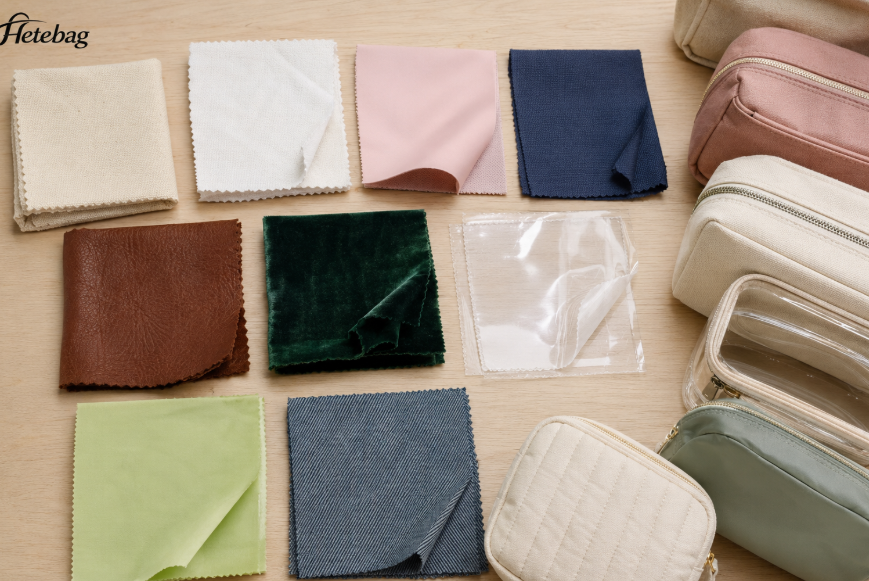
Tela is a woven fabric with a visible texture. It suits lifestyle, wellness, natural beauty, and reusable gift packaging. Medium and heavy canvas can support embroidery, screen printing, woven labels, and printed patterns. Buyers should check the fabric weight in grams per square metre, or GSM. Two fabrics described as “canvas” can feel very different when their yarn size and GSM are not the same.
Cotone feels soft and natural. It works well for drawstring pouches, skincare sets, spa products, and brands that want a less synthetic look. Uncoated cotton absorbs moisture, so a washable or wipe-clean lining is often needed. Ask whether the fabric is pre-shrunk if the bag may be washed.
Poliestere is one of the most flexible choices for custom makeup bags. It can be lightweight, printed, laminated, or combined with foam and lining. It is useful for promotional bags, colorful collections, and repeat production where consistent appearance matters. Confirm the fabric denier, backing, coating, and finished weight rather than approving it as “polyester” alone.
Nylon often has a smoother hand feel and good resistance to repeated folding and rubbing. It suits travel, sports, and functional beauty collections. Nylon can show needle marks or surface shine after sewing, so the sample should be checked under both normal and angled light.
A fabric is ready for approval when the supplier identifies its fiber content, construction, weight or denier, surface treatment, backing, and color reference in the material specification.
Fashion and Structured Materials: PU Leather, Velvet, and EVA
Pelle PU is a textile base covered with polyurethane. It offers a clean surface and works well with debossing, foil stamping, screen printing, and metal logo plates. It fits premium gift sets and fashion-led beauty brands. Quality differences often appear in the backing fabric, coating thickness, softness, odor, and resistance to peeling.
Fold a PU sample back on itself ten times and inspect the crease. This quick check does not replace laboratory testing, but cracking, whitening, or surface separation at this stage is a clear warning.
Velluto gives a soft, rich appearance and works well for fragrance, holiday gifting, jewelry-style packaging, and limited beauty collections. The direction of the pile changes how light reflects from the surface. All pattern pieces must be cut in the same direction, or the finished bag may appear to contain several shades.
EVA, or ethylene-vinyl acetate, is a foam-like material used to create molded or semi-rigid cases. It protects bottles and tools better than a soft pouch. EVA is suitable for travel sets, professional makeup tools, electronic beauty devices, and organized kits. Buyers should approve the shell hardness, foam density, molding depth, and internal tray rather than evaluating the outer fabric alone.
For structured bags, perform a simple compression check: press the center of the empty case for five seconds and release it. The shell should return close to its intended form without a permanent dent.
Clear and Sustainable Materials: PVC, TPU, and RPET
PVC provides a clear or colored surface that is easy to wipe. It is widely used for transparent cosmetic pouches, promotional packaging, and product sets. Its feel, odor, cold resistance, and regulatory suitability vary by formulation. Buyers should state the destination market and required chemical compliance before material approval.
TPU, or thermoplastic polyurethane, is usually softer and more flexible than standard PVC. It can create a modern clear bag with a less rigid feel. TPU is often chosen for higher-positioned transparent products, though its surface can scratch and may require protective film during production. For a more detailed transparent-material comparison, review our PVC vs TPU cosmetic bag guide before requesting swatches and finished samples.
RPET is polyester made with recycled feedstock. It can be woven into fabrics that look similar to conventional polyester. The word “recycled” alone is not enough for a sourcing claim. Ask which component is recycled, what percentage it contains, and whether supporting transaction and chain-of-custody documents are available.
If a brand plans to make a verified recycled-content claim, its sourcing team should review the Informazioni sullo standard Global Recycled Standard fornite da Textile Exchange and confirm the required documentation with the supplier. Do not print a certification mark or claim on the bag until the certification scope and authorization have been checked.
3. How the Main Makeup Bag Materials Compare
The table below gives a practical starting point. Actual performance still depends on thickness, coating, backing, lining, and construction.
| Materiale | Aspetto e consistenza | Durata | Impermeabilità | Pulizia | Logo compatibility | Suitable positioning |
|---|---|---|---|---|---|---|
| Tela | Natural, textured | Buono | Low unless treated | Spot clean | Print, embroidery, label | Lifestyle and reusable retail |
| Cotone | Soft, casual | Moderato | Basso | Wash or spot clean | Print, embroidery, label | Natural beauty and gifting |
| Poliestere | Smooth or textured | Buono | Moderate to good with coating | Facile | Most print methods, label | Retail and promotion |
| Nylon | Smooth, light, technical | Ottimo | Good when coated | Facile | Print, transfer, patch | Travel and functional |
| Pelle PU | Clean, fashion-led | Good if coating is stable | Buono | Wipe clean | Deboss, foil, print, plate | Premium and fashion |
| Velluto | Soft, rich | Moderato | Basso | More difficult | Embroidery, plate, label | Luxury gifting |
| EVA | Molded, structured | Ottimo | Depends on outer layer | Usually easy | Plate, patch, print | Protective and professional |
| PVC | Clear or colored | Buono | Ottimo | Molto facile | Screen print, patch | Clear promotion and travel |
| TPU | Clear, soft, modern | Buono | Ottimo | Molto facile | Print, patch | Premium clear products |
| RPET fabric | Varies by construction | Buono | Depends on coating | Usually easy | Similar to polyester | Collezioni all'insegna della sostenibilità |
Use this comparison to shortlist two or three materials, not to approve one immediately. Request samples in the correct thickness and color, then build at least one complete bag. A flat swatch cannot show how the material behaves around a zipper, curved seam, binding, or boxed corner.
4. How to Match the Material to Your Brand Positioning
Luxury and Premium Beauty Brands
Premium does not always mean the thickest material. The better test is whether every visible component feels consistent. PU leather, velvet, dense woven fabric, and structured EVA can all work when the stitching, zipper, lining, edge finish, and logo have the same quality level.
Check the sample from about one metre away and then at close range. From a distance, the silhouette and color should look balanced. Up close, the stitch line should remain even, the logo edges should be clean, and glue or raw edges should not be visible.
Natural and Lifestyle Brands
Cotton, canvas, linen-look blends, and uncoated woven fabrics support a soft, natural identity. Their colors and textures can vary more than synthetic materials, especially between dye lots.
Ask the makeup bags supplier to keep an approved production swatch. For repeat orders, compare the new material with the retained reference under daylight or a standard light box. If exact brand color is necessary, define an acceptable color tolerance before production rather than describing the color as simply “beige” or “natural.”
Travel and Functional Product Lines
Nylon, coated polyester, TPU, PVC, and EVA are strong options for travel. The bag must be judged as a system: outer material, zipper, lining, seams, compartments, and handles all carry part of the load.
Pack the sample with its expected contents and open and close the zipper at least 30 times during evaluation. Look for zipper waves, fabric caught in the slider, seam stress, and changes in shape. YKK’s product library shows that zipper types and sizes are designed for different applications, so buyers should specify zipper construction rather than treating every zipper as equal. You can review the YKK zipper product library when preparing component requirements.
Promotional and Gift-With-Purchase Programs
Polyester, cotton, canvas, and PVC are common for gift-with-purchase programs because they support strong visual branding and scalable production. The bag still needs to be useful. Thin fabric, weak zipper tape, or a lining that tears easily can reduce the perceived value of the beauty products inside.
Test one finished sample with the complete gift set. There should be enough free space to remove each product without forcing the zipper. As a working rule, allow about 5–10% usable space beyond the tightly packed product dimensions, then confirm the result with a physical packing test.
Sustainable Beauty Brands
RPET, recycled cotton, organic cotton, and long-life reusable materials may support a sustainability program. The core issue is claim accuracy. A bag is not automatically sustainable because one outer panel contains recycled fiber.
Create a component list covering the shell, lining, webbing, thread, zipper tape, label, and packaging. Mark which parts contain recycled or preferred materials and record their verified percentages. If safety testing is relevant to the market, buyers can also review OEKO-TEX STANDARD 100, which covers textiles and accessories tested for harmful substances. Certification must be verified for the actual material or product scope; it should never be assumed from a general supplier statement.
5. How Material Affects Logo and Design Customization
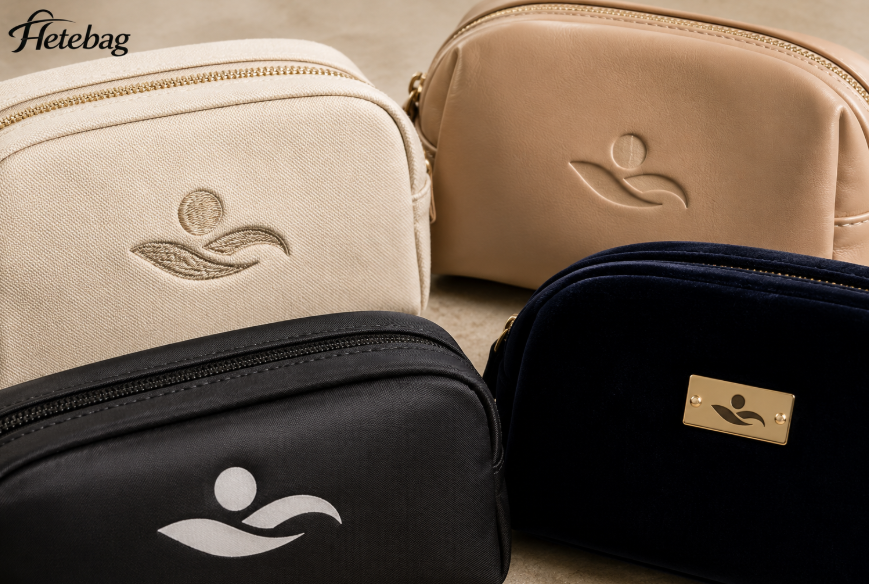
Material and logo technique must be selected together. A detailed multicolor logo may look sharp on smooth polyester but lose definition on coarse canvas. Deep debossing works on suitable PU leather, yet it cannot create the same result on thin woven fabric.
| Metodo del logo | Suitable materials | What to approve on the sample |
|---|---|---|
| Stampa serigrafica | Cotton, canvas, polyester, PVC | Edge clarity, opacity, adhesion, color |
| Trasferimento di calore | Polyester and some nylon | Film edge, heat marks, peeling |
| Ricamo | Canvas, cotton, stable woven fabrics | Stitch density, puckering, reverse backing |
| Debossing or embossing | Pelle PU | Depth, position, recovery around the mark |
| Timbratura con lamina | Suitable PU leather | Foil adhesion, sharpness, rub resistance |
| Metal plate | PU, velvet, EVA, woven fabrics | Weight, plating, attachment and sharp edges |
| Etichetta tessuta | Most sewn materials | Color, fold, placement and stitch quality |
Before approval, rub a printed or foiled logo with a dry white cloth for 20 firm strokes. Repeat with a lightly damp cloth if the intended use may involve moisture. Stop the process if color transfers, edges lift, or the surrounding surface becomes polished or damaged.
For embroidery, inspect both sides. The front should not pucker, while the back should not contain sharp thread ends that could damage the lining or stored products. Brands planning a wider bag range can review Hetebag’s guide to borse con logo personalizzato for more information on decoration methods.
6. What Buyers Should Check Before Approving a Material
Never approve custom makeup bag materials from supplier photos alone. Camera settings, screen brightness, lighting, and image editing can hide texture and color differences.
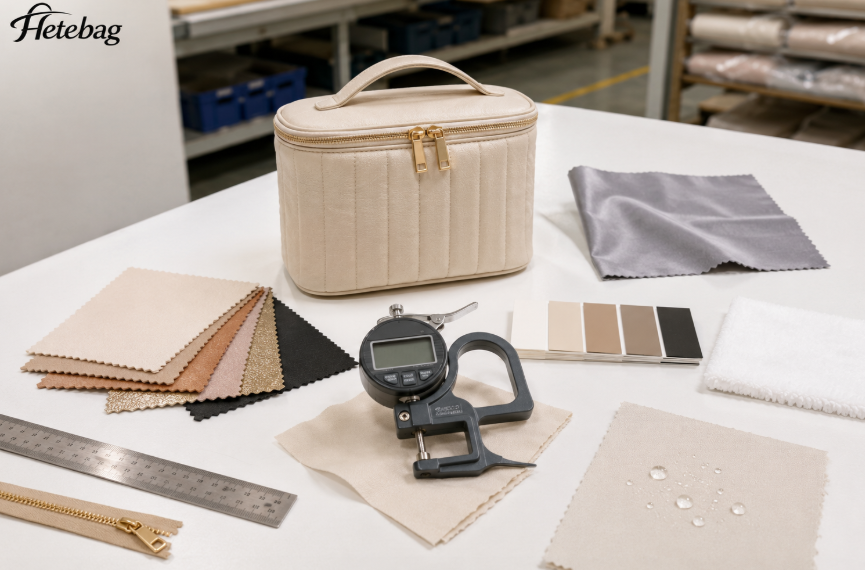
Ask for a color card, material swatches, or a complete physical sample. The approved material record should include:
- Fiber content and material construction
- Fabric weight, denier, or thickness
- Color reference and approved physical swatch
- Surface coating, lamination, or water-repellent treatment
- Backing material and lining combination
- Approved logo method and color
- Required compliance documents for the destination market
Run basic checks on the same material lot intended for sampling. Measure thickness at three different points with a thickness gauge. For fabric weight, cut a known area and calculate:
GSM = sample weight in grams ÷ sample area in square metres
A 10 cm × 10 cm fabric piece covers 0.01 square metres. If it weighs 3 grams, the calculated weight is 300 GSM. Small cut pieces may create measurement error, so use a larger sample or professional fabric cutter when accuracy matters.
Next, fold and rub the surface, smell the material after it has been sealed in a clean bag for 24 hours, and wipe it with a white cloth. Check for color transfer, coating separation, strong odor, scratches, and visible stress marks. For waterproof or coated materials, place a small amount of water on the surface for 30 minutes. Inspect both the face and back. This is a screening check, not proof that the finished bag is waterproof because water can still enter through seams and zippers.
The lining must also match the outer shell. A heavy outer material with a very light lining can create pulling or tearing at internal seams. Place typical cosmetic items inside, including any bottles with corners or caps, and carry the sample by its handle for several short test cycles.
Before bulk production, approve a final pre-production sample with all confirmed materials and components. This process is also covered in Hetebag’s guide on how to design custom makeup bags for a brand.
7. How to Choose the Right Custom Makeup Bag Material
A useful material decision can be completed in five steps.
1. Define the customer and use.
List the products stored inside, expected carrying frequency, destination market, and cleaning needs. The decision is complete when the supplier can explain the bag’s actual use in the technical specification.
2. Choose the appearance and structure.
Decide whether the bag should be soft, semi-structured, or rigid. Provide reference images, but also describe what must keep its shape. Test this with the intended contents inside.
3. Set cleaning and durability requirements.
Define whether the surface should be washable, wipe-clean, water-resistant, or only suitable for dry storage. Agree on simple tests or relevant laboratory methods before production.
4. Match the material with the logo process.
Produce the logo on the real material in the intended color. Approve its size, position, edge quality, adhesion, and appearance under normal lighting.
5. Test a complete sample.
Review measurements, loading, zipper movement, stitching, odor, color, cleaning, logo quality, and packing. Record every approved detail in a specification sheet instead of relying on chat messages or photos.
A reliable makeup bags factory should help you compare options based on use, structure, branding, and production risk. At Hetebag, material recommendations can be developed around your brand position, target market, product dimensions, logo method, lining, and packaging needs. If you are planning a new collection, you can contact Hetebag to discuss suitable materials and request samples before bulk production.
Domande frequenti
What is the best material for a custom makeup bag?
There is no single best material. Coated polyester and nylon suit frequent travel, while cotton and canvas work well for natural or lifestyle brands. PU leather supports a cleaner fashion look, and EVA is better when the contents need structure and protection. The right material is the one that passes your use, cleaning, branding, and sample tests.
Is a thicker material always more durable?
No. Thickness is only one factor. Fiber quality, weave density, coating adhesion, backing, seam construction, and reinforcement also affect durability. A thick PU material with a weak coating may peel sooner than a thinner material with a stable surface. Compare complete samples and request test requirements that match the intended use.
Should the outer material or lining be water-resistant?
For most makeup bags, a wipe-clean or water-resistant lining gives useful protection against cosmetic spills. A water-resistant outer material helps during travel but does not make the whole bag waterproof. Seams, zipper openings, and needle holes remain possible entry points unless the product uses specialized sealing methods.
How can buyers control material color in bulk production?
Approve a physical color swatch and keep one signed reference with both the buyer and factory. Bulk fabric should be compared under consistent lighting before cutting. For sensitive brand colors, set an agreed tolerance and request lab dips or strike-offs before the full material lot is produced.
Can RPET makeup bags carry a recycled claim?
They can when the recycled content and supply chain evidence support the claim. Buyers should identify which components contain recycled material, verify the percentage, and check the validity and scope of any certification documents. Do not assume that the entire bag is recycled because the outer fabric is described as RPET.
When should a buyer request laboratory testing?
Consider laboratory testing when the destination market has chemical or safety requirements, when the bag will have frequent skin contact, or when performance claims affect the sale. Testing may cover restricted substances, colorfastness, abrasion, coating adhesion, or other agreed properties. The test material should match the actual production lot as closely as possible.


