
 Italian
  English
  French
  German
  Spanish
  Arabic
 A quote for a custom tote or handbag can come from a factory, a sourcing company, or a business that coordinates several production partners. All three may call themselves a custom bag supplier. The name on the quotation tells you less than the work the company actually controls.
For a brand buying in Europe or North America, the useful question is who develops the sample, buys the materials, runs production, checks the bags, and resolves a problem after delivery. This guide compares those responsibilities so you can choose a custom bag manufacturer or supplier that fits your product and team.
What Is a Custom Bag Supplier, and What Is a Manufacturer?
A custom bag supplier is the company that sells and delivers the finished bags to you. It may be a factory, a trading company, an agent, or a group coordinating specialist workshops. A custom bag manufacturer makes bags and manages at least part of the production process. A custom bag factory is the physical production site; some manufacturers use more than one site or outsource certain operations such as printing or hardware finishing.
These labels overlap. A manufacturer is usually also your supplier, while a supplier may arrange production elsewhere. Ask for the production address of your specific style, which processes happen there, which are subcontracted, and who is named on your purchase order.
| Question | Supplier coordinating production | Manufacturer with direct production control |
|---|---|---|
| Main contribution | Sources options, coordinates factories and manages communication | Develops and produces bags within its production setup |
| Product range | May combine several specialist sites and materials | Often strongest in the categories and constructions it already makes |
| Visibility | Depends on access to the producing factory and its records | Usually has more direct access to work in progress |
| Accountability | Your contract should name one party responsible for the whole order | Your contract should still define responsibility for outsourced steps |
The comparison describes common operating models, not a guarantee of quality. A capable coordinator can give you better control than a factory with poor documentation, and a direct factory relationship can be efficient when your product matches its experience.
Who Handles Bag Design, Sampling, and Production?
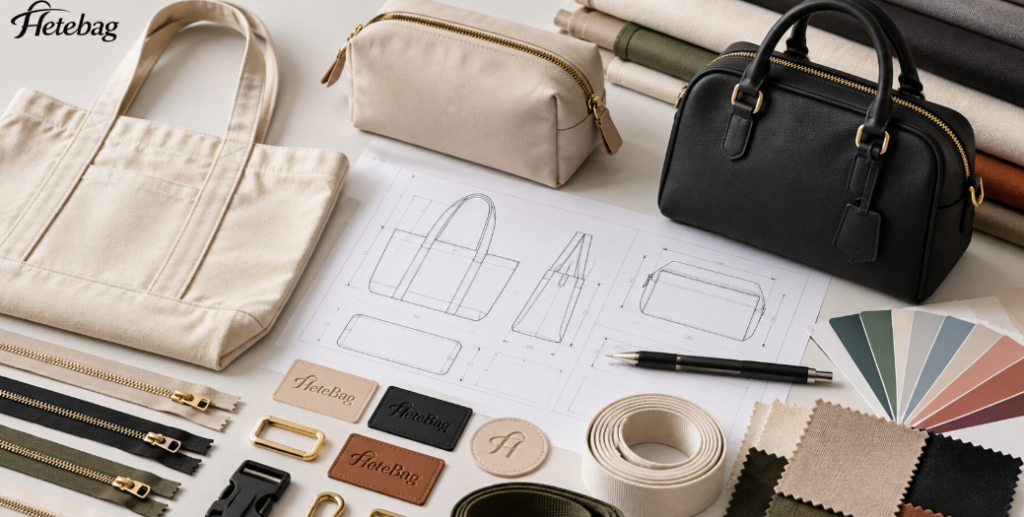
Begin with the design inputs you already own. For an original bag, give the partner a tech pack or reference sample showing dimensions, intended load, fabric or leather alternative, lining, pockets, straps, closures, logo placement, color, and packaging. If you only have a sketch, ask who will develop the pattern and turn it into measurable specifications. HeteBag’s Guida ai materiali per borse personalizzate shows why material choice belongs early in that discussion.
A supplier may pass the brief to one or more factories, then consolidate feedback and samples. A manufacturer may communicate directly with pattern makers and production staff. Neither structure removes the need for an agreed sample sequence: initial prototype, revisions, and a final pre-production sample that represents the intended bulk materials and construction.
Approve that sample against a written specification. Record changes to dimensions, strap reinforcement, zipper type, lining, stitching, logo artwork, hardware finish, labels, and packing. Keep an approved physical sample with the production team and another with the buyer when practical. Before placing the order, ask who owns the pattern or tooling, who may reuse it, and whether a factory change requires your approval.
How Do Customization Options Differ?
For a simple private-label project, an existing tote or cosmetic bag may need only a new color, logo, label, or packaging. A supplier with several production partners can offer a broad catalog. A factory experienced in a particular construction may be better placed to refine panel shapes, handle attachments, internal organizers, edge finishing, and material combinations through sampling.
The limit is often a component, not the bag itself. A custom-dyed fabric, molded metal fitting, printed lining, or unusual zipper can introduce a separate minimum quantity or longer material preparation. Ask whether each option is stock, made to order, or sourced from another workshop, and request a sample of the actual combination. HeteBag’s borse con logo personalizzato outlines common logo development steps, while its borsa personalizzata illustrates how construction details matter beyond the artwork.
If you sell across several markets, settle labeling and product claims before production. For EU consumer products, the General Product Safety Regulation places duties on economic operators, including importers. In the US, children’s products can trigger additional testing and certification requirements under the relevant CPSC rules. The applicable requirements depend on the bag’s intended use, age group, materials, and sales market; request product-specific evidence rather than a generic certificate.
How Do MOQ, Pricing, and Lead Times Compare?
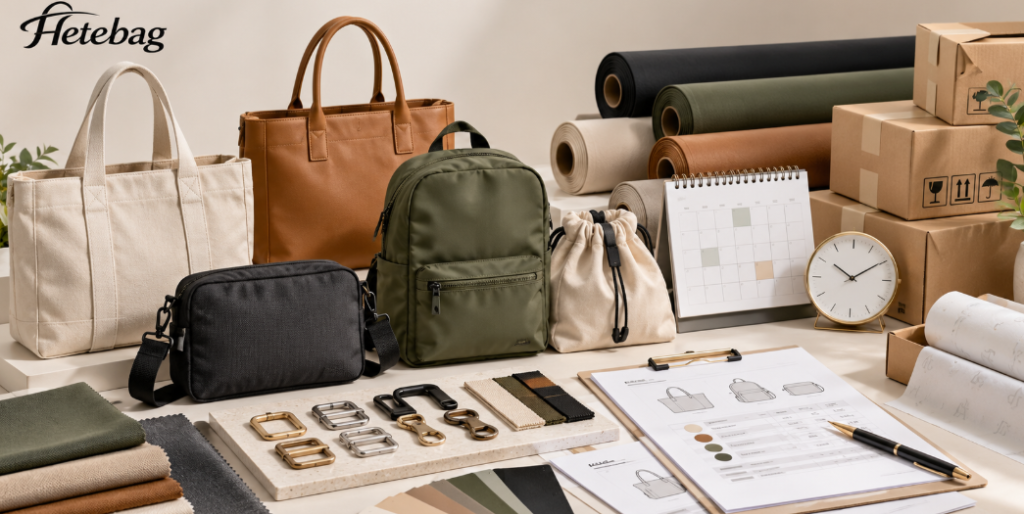
There is no reliable rule that a supplier always has a lower MOQ or a factory always gives a lower total cost. An existing design in stocked fabric can often be ordered more flexibly than a newly engineered bag with custom color fabric and unique hardware. The minimum may be set by the fabric mill, print run, hardware supplier, or packaging vendor, not the sewing line.
Compare quotes on the same specification. Confirm whether sampling, molds, artwork setup, labels, individual packing, inspection, and freight are included. Also ask whether the quoted MOQ is per design, per color, or across the whole order. A low unit quotation is difficult to compare if revisions and material substitutions are undefined.
For timing, separate sample development, material procurement, bulk production, inspection, and shipping. Ask the partner to show the sequence and the date at which artwork, materials, and the pre-production sample must be approved. A supplier coordinating several sites may need extra handoffs; a factory may still wait on outside material or hardware vendors. The best schedule is the one that identifies those dependencies and names the person who updates you when one slips.
Who Is Responsible for Quality Control and Production Issues?
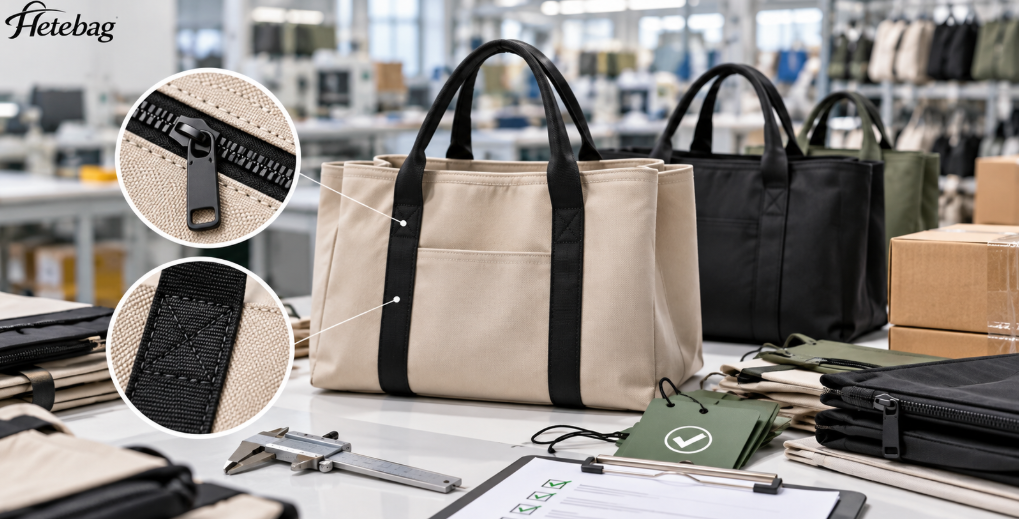
Your purchase order should identify the party responsible for finished bags, even if a subcontractor sews, prints, or packs them. Ask who checks incoming materials, who approves the first production pieces, who inspects work during sewing, and who signs off before shipment. If the seller says it has a QC team, request the inspection checklist and a redacted example of the report for a similar bag.
Set measurable acceptance points before bulk production: bag dimensions and tolerances, seam appearance, strap attachment, zipper operation, logo position, color reference, hardware finish, and packing condition. A load test, colorfastness test, or restricted-substance test should have a defined method and threshold when it is relevant to your product. For lot inspection, ISO 2859-1 describes acceptance sampling plans; a sampling plan does not replace a sound specification or prove that every bag was examined.
Agree in writing on how defects are documented, classified, and remedied. Who pays for rework or replacement when the bulk order differs from the approved sample? Will you have a chance to inspect before final payment and shipment? When there are several workshops, one clear escalation path matters more than a promise that quality is “strictly controlled.”
When Should You Choose a Supplier or a Manufacturer?
Choose by the work your team needs to delegate. A coordinating supplier can make sense when you need different bag categories, mixed materials, or one contact to manage several specialists. A direct manufacturer can make sense when the style closely matches its production strengths and you need rapid technical feedback during development.
| Your situation | What to prioritize |
|---|---|
| One technically demanding style | Relevant samples, pattern development, access to production staff |
| Several bag categories in one program | Coordination, documented factory allocation, consistent specifications |
| Small first launch with a standard design | Stock material options and clear per-color minimums |
| Repeated seasonal orders | Stable material codes, retained approved sample, change control |
A hybrid arrangement is common. Your contract and workflow should make it clear which company is accountable for the full order and where each critical operation takes place. Do not reject a partner because it uses another workshop; ask how that workshop is qualified and controlled.
If you need development and production support for a new design, review HeteBag’s OEM and ODM bag manufacturing in China and send a brief that identifies the bag type, materials, quantity, and target market.
How Can You Verify a Custom Bag Partner Before Ordering?
Start with the legal company name, business registration, production locations for your bag type, and the entity receiving payment. Request recent, relevant production examples and inspect an actual sample for seams, stress points, zipper action, lining, logo quality, and packaging. A photo of a factory building alone does not establish who made your sample.
Next, conduct a video walkthrough or arrange an independent site visit where appropriate. Ask to see the applicable sewing and finishing processes, material storage, inspection records, and how a rejected piece is handled. Confirm any subcontracted printing, embroidery, or hardware work. The U.S. International Trade Administration’s due diligence guidance is a useful reminder to check counterparties before committing funds.
Finally, run a small approval loop before bulk ordering: issue a written brief, receive a detailed quotation, review samples, freeze the pre-production specification, and agree to inspection and corrective-action terms. If the partner changes the material, production site, or approved construction, require written notice and a new approval where necessary. The right custom bag factory or supplier should make the production trail easier to follow, not harder.
Conclusione
“Supplier” describes the selling relationship; “manufacturer” describes production involvement. The distinction matters when it reveals who can alter a pattern, approve a material, catch a defect, and resolve a claim. Compare partners using the same brief and ask for evidence at every handoff, from the first sample to the packed carton.
If you are developing a bag for your brand, HeteBag can discuss materials, sampling, and a suitable production approach. Share your design, target quantity, destination market, and timing through the project inquiry so the team can review the requirements with you.
Domande frequenti
Can a custom bag supplier also be the manufacturer?
Yes. A factory may sell directly to your brand and therefore act as both supplier and manufacturer. Ask which site will produce your particular style and which operations, if any, will be subcontracted.
Does buying directly from a factory always reduce the MOQ?
No. MOQ can be determined by custom fabric, color, hardware, printing, and packaging. Ask for the minimum per style and color, plus an alternative using stocked components if your first order is small.
What should I approve before bulk production?
Approve a representative pre-production sample, written dimensions and tolerances, material and hardware specifications, logo artwork, labels, packaging, and an inspection checklist. Record the version and require approval for later substitutions.


