
 French
  English
  Italian
  German
  Spanish
  Arabic
 If you are currently looking for a leather briefcase manufacturer in China, you will likely encounter a problem: there are many suppliers, and their websites all look quite similar. Almost every one will tell you that you can do OEM, ODM, customize the logo, and also showcase many products that look good.
After you have made several product samples, you will know that choosing a factory cannot be based solely on these factors. When we were working on the briefcase project before, the clients often repeatedly adjusted the leather material, handle, hardware, and internal structure during the sample stage. Sometimes it was just changing a zipper or altering a little bit of the leather thickness, but the final appearance of the product would be completely different.
My name is Evan. I have extensive experience in the briefcase industry. I have compiled this list to introduce 10 Chinese Custom Leather Briefcase Manufacturers. I will also write down the aspects that I usually pay attention to when judging suppliers. You can combine your product positioning, quantity, and customization requirements, and then decide which manufacturers are worth further prototyping and communication. I hope this is helpful to you.
1. Why Source Custom Leather Briefcases from China?
China remains one of the most practical sourcing locations for custom briefcases because the manufacturing ecosystem extends far beyond the final assembly factory.
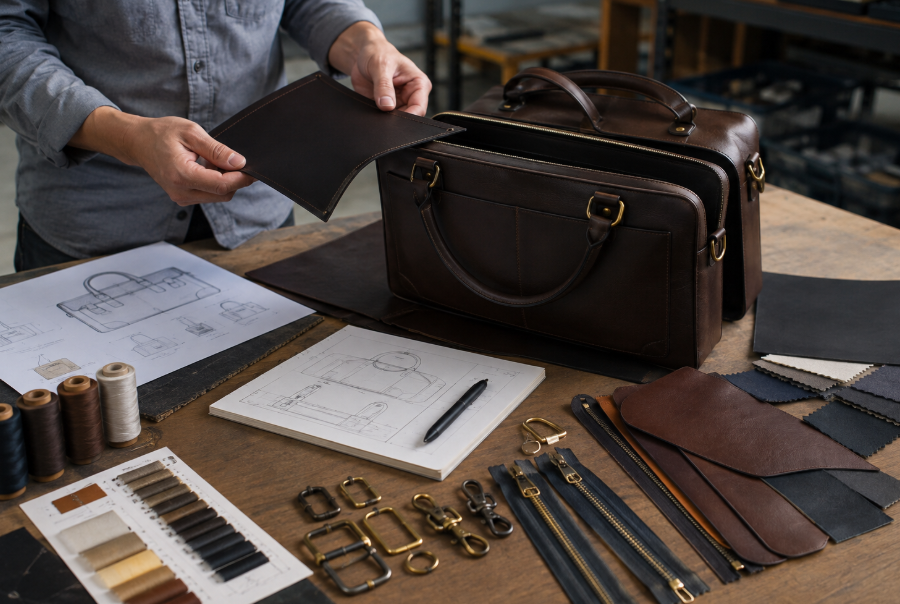
A briefcase may require leather or synthetic leather, lining, reinforcement boards, foam, zippers, buckles, hooks, metal logo plates, magnets, thread, edge paint, packaging, labels, and several other components. Factories located around established bag-manufacturing areas can usually access these suppliers more efficiently.
Guangzhou is particularly strong in leather goods and bag manufacturing. Shenzhen, Dongguan, Jiangmen, and surrounding Guangdong manufacturing areas also have experienced suppliers.
Manufacturing experience and supply chain advantages
The main advantage is not simply production volume. It is the concentration of suppliers.
When developing a leather briefcase, we may compare several leather grains, different thicknesses, lining weights, zipper constructions, metal finishes, and reinforcement materials before the sample is approved. Having these resources nearby makes development easier.
You can read more about common options in this Guide des matériaux pour sacs personnalisés.
Material access still does not guarantee quality. Your specification has to be clear enough that the factory knows exactly what can and cannot change between the approved sample and bulk production.
OEM and ODM capabilities for different brands
OEM production works well when you already have drawings, dimensions, material specifications, logo files, and construction requirements.
ODM becomes more useful when you have a concept but need support with structure, compartment arrangement, materials, hardware, or production feasibility.
Many Chinese manufacturers offer both. The level of development support varies widely, so I would ask who actually handles sampling and whether the development team communicates directly with production.
Access to leather, hardware, and accessories
Leather gets most of the attention, but hardware can quickly become the weak point of a briefcase.
Zippers, D-rings, buckles, handle fittings, magnetic closures, locks, and metal logo pieces should all be confirmed during sampling. If branded zipper components are required, buyers can also check technical and quality information directly from manufacturers such as YKK, which maintains its own fastening quality standards and testing procedures.
The key is to specify the component rather than write something vague such as “high-quality zipper.”
2. What Makes a Reliable Leather Briefcase Manufacturer?
A good-looking website tells you very little about how a factory manages bulk production.
I normally pay more attention to how a supplier responds when you start discussing technical details.
Leather quality and material selection
“Genuine leather” is not a complete specification.
You still need to discuss leather type, animal source where relevant, thickness range, surface treatment, grain, softness, color tolerance, backing, coating, and acceptable natural variation.
Full-grain, top-grain, corrected-grain, split leather, PU-coated split leather, microfiber leather, and PU leather behave differently during cutting and production.
Natural leather also has scars, wrinkles, grain variation, and color differences. Before bulk cutting begins, buyer and factory should agree on what level of natural variation is acceptable.
We normally recommend keeping an approved leather swatch together with the final sample. Photos alone are not enough.
Sampling, craftsmanship, and production capability
Look closely at the areas that workers find difficult to hide:
- Handle roots
- Corner stitching
- Zipper ends
- Edge-painted curves
- Gusset alignment
- Logo positioning
- Pocket openings
- Hardware installation
- Lining corners
A leather briefcase often carries a laptop, documents, chargers, and other relatively heavy items. The handle connection and shoulder-strap attachment points need proper reinforcement inside the structure.
That reinforcement is invisible after production, which is exactly why it should be confirmed before approving the sample.
Quality control and export experience
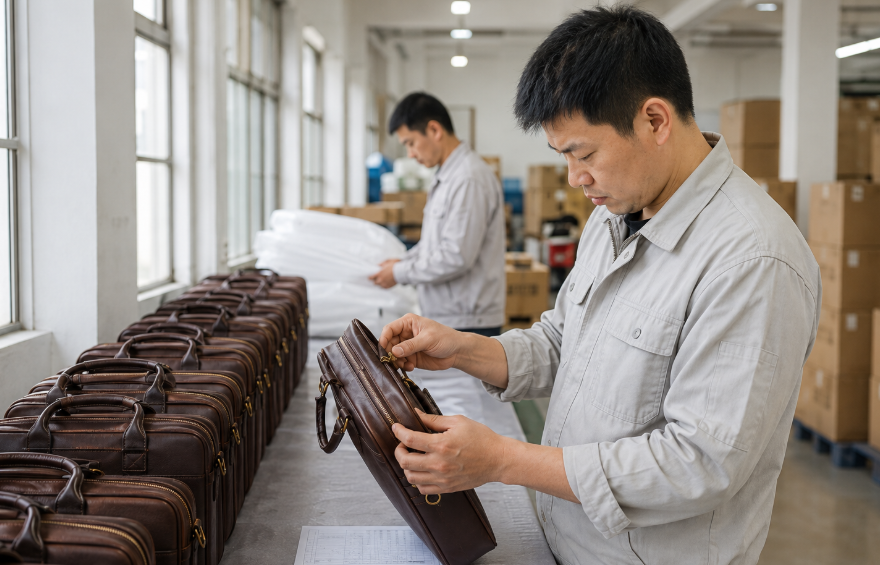
A reliable custom briefcase company should be able to explain its inspection process in practical terms.
Ask what gets inspected during incoming material checks, inline production, and final inspection. Ask how defects are classified. Ask whether the approved sample and specification sheet remain at the production line.
Testing requirements depend on the destination market and buyer specification. Independent organizations such as Intertek provide luggage and bag testing covering areas such as fastening, buckle, handle, and strap strength. SGS also provides testing and certification services for bags, components, product performance, and regulatory compliance.
Mentioning these organizations does not mean every factory holds their certification. Buyers should request actual documents when certification or testing is required.
3. Top 10 Custom Leather Briefcase Manufacturers in China
The manufacturers below were selected based on their relevance to leather bags, business bags, briefcases, laptop bags, and OEM/ODM manufacturing. The list is meant to help buyers build a shortlist rather than suggest that one supplier fits every project.
| Rang | Fabricant | Established / Experience | Localisation | Main Relevant Products | OEM / ODM | Points forts |
|---|---|---|---|---|---|---|
| 1 | HeteBag | Since 2011 | Guangzhou, Guangdong | Leather bags, briefcases, handbags, backpacks, travel bags | Oui | Custom development, material customization and private-label production |
| 2 | Jiangmen Baijia Leather Products Co., Ltd. (RONEER) | Since 2007 | Jiangmen, Guangdong | Briefcases, handbags, laptop bags, backpacks, wallets | Oui | Broad custom bag range and leather business bag experience |
| 3 | Guangzhou Herder Leather Products Co., Ltd. (Mherder) | Since 2006 | Guangzhou, Guangdong | Leather briefcases, laptop bags, handbags, wallets, travel bags | Oui | Genuine-leather manufacturing and structured product development |
| 4 | Guangzhou Kingsons Bags Technology Co., Ltd. | Since 1997 | Guangzhou, Guangdong | Briefcases, business bags, laptop bags, backpacks, luggage | Oui | Long history in business and laptop bag manufacturing |
| 5 | Szoneier Leather | Since 2007 | Shenzhen, Guangdong | Leather briefcases, business bags and leather goods | Oui | Dedicated leather product customization and OEM development |
| 6 | Guangzhou Ballman Leather Co., Ltd. (Baliya) | 24+ years | Guangzhou, Guangdong | Leather briefcases, messenger bags, backpacks, wallets, handbags | Oui | Genuine-leather products and business briefcase manufacturing |
| 7 | Guangzhou Fiedle Leather Bag Co., Ltd. | Since 2002 | Guangzhou, Guangdong | Genuine leather bags, business bags, briefcases, travel bags | Oui | Established OEM/ODM leather manufacturing capability |
| 8 | Guangzhou Haoen Leather Co., Ltd. | Since 2003 | Guangzhou, Guangdong | Leather/PU laptop bags, satchels, handbags, backpacks, travel bags | Oui | Leather and PU bag production with export experience |
| 9 | Guangzhou FY Bag Co., Ltd. | 15+ years | Guangzhou, Guangdong | Briefcase-style laptop bags, business bags, sleeves, leather bags | Oui | Business and laptop bag customization |
| 10 | Guangzhou Dujiang Leather Goods Co., Ltd. | Since 2006 | Guangzhou, Guangdong | Genuine leather briefcases, laptop bags, backpacks, wallets | Oui | Strong focus on genuine leather and Crazy Horse leather products |
The establishment dates and manufacturer details above follow the sourcing information prepared for this article. Current public information also supports several of the major entries, including Kingsons’ business-bag production since 1997, Szoneier’s leather manufacturing since 2007, Fiedle’s leather bag production since 2002, and Haoen’s establishment in 2003.
1. HeteBag
HeteBag was founded in 2011 and operates from Huadu, Guangzhou, one of China’s established bag-manufacturing areas. Its product development covers leather bags, handbags, backpacks, travel bags, and other customized bag categories.
It is a practical option for buyers who want material, dimensions, compartments, logo, lining, hardware, and packaging developed around their own product requirements. Most custom projects have an MOQ around 300 pieces, although the actual quantity depends on design and material requirements.
Buyers researching a wider range of suppliers can also compare this list with the custom leather bag factory guide.
2. Jiangmen Baijia Leather Products Co., Ltd. — RONEER
Baijia was established in Jiangmen in 2007. Its product range includes handbags, briefcases, backpacks, wallets, and other bag categories, making it relevant to buyers developing both business bags and broader leather collections.
The company may suit brands that want several related bag styles developed under one supplier rather than purchasing only briefcases.
3. Guangzhou Herder Leather Products Co., Ltd. — Mherder
Mherder is a Guangzhou-based manufacturer focused heavily on leather bags and small leather goods.
Its current product range includes laptop bags, duffle bags, wallets, card holders, and other leather goods, with OEM and private-label manufacturing support.
This makes it worth considering when genuine-leather construction and a broader leather collection are central to the sourcing plan.
4. Guangzhou Kingsons Bags Technology Co., Ltd.
Kingsons has operated since 1997 and has a strong position in laptop backpacks, business bags, briefcases, and travel-related products. Its current briefcase range includes microfiber leather and technical textile constructions along with custom hardware and internal configurations.
Buyers developing business-oriented collections may find its experience with laptop protection and functional compartment design particularly relevant.
5. Szoneier Leather
Szoneier is based in Shenzhen and dates its leather-goods manufacturing operations to 2007. The company offers custom leather briefcases and supports changes to leather type, structure, hardware, lining, logo, and internal layout.
Its specialization makes it worth reviewing when leather goods form the core of the project rather than being one small category in a larger bag collection.
6. Guangzhou Ballman Leather Co., Ltd. — Baliya
Ballman, operating under the Baliya name, focuses on genuine leather bags and wallets. Its current product categories include leather briefcases, messenger bags, backpacks, shoulder bags, travel bags, and wallets.
Buyers interested in traditional leather business styles may find its product direction particularly relevant.
7. Guangzhou Fiedle Leather Bag Co., Ltd.
Fiedle was founded in 2002 and specializes in genuine leather bags. The company states that it operates OEM/ODM production and maintains an integrated manufacturing facility in Guangzhou.
Its long focus on leather goods makes it one of the suppliers worth comparing when production capacity and established export manufacturing are important parts of your evaluation.
8. Guangzhou Haoen Leather Co., Ltd.
Haoen was established in 2003 and produces both leather and PU bags. Its range includes laptop bags, satchels, handbags, backpacks, wallets, and travel bags.
This mixed-material capability can be useful when a brand wants similar briefcase structures offered at different material positions.
9. Guangzhou FY Bag Co., Ltd.
FY Bag operates from Shiling Town in Guangzhou’s Huadu District and provides OEM/ODM custom bag manufacturing. Its product development includes laptop and business-oriented bag categories.
It may be useful for buyers whose briefcase design sits closer to a contemporary laptop bag than a traditional full-leather attaché case.
10. Guangzhou Dujiang Leather Goods Co., Ltd.
Dujiang focuses on genuine leather products and works with materials including top-grain cowhide and Crazy Horse leather. Its range includes men’s bags, business-oriented leather goods, wallets, and related products.
This makes it a relevant manufacturer to investigate if the design relies heavily on vintage leather appearance, natural surface character, or traditional men’s business styling.
4. What Can You Customize on a Leather Briefcase?
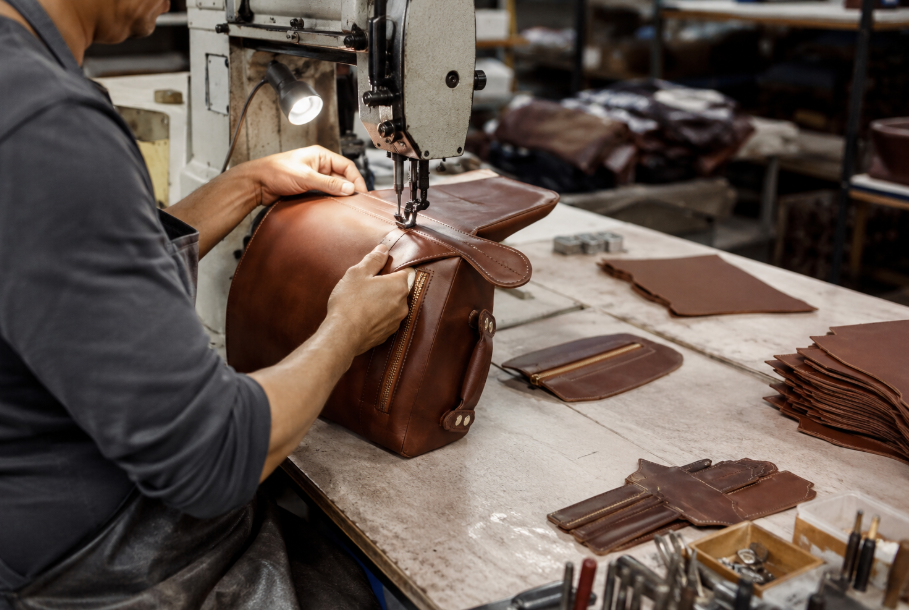
A custom briefcase can go far beyond placing a logo on an existing model.
| Zone | Common Customization Options |
|---|---|
| Matériau extérieur | Full-grain leather, top-grain leather, Crazy Horse leather, microfiber leather, PU and mixed materials |
| Color & Finish | Custom colors, matte, glossy, waxed, pebbled, smooth or vintage finishes |
| Structure | Soft, semi-structured or rigid construction |
| Intérieur | Laptop sleeve, tablet pocket, document section, pen slots, zipper pockets and cable compartments |
| Matériel | Zippers, locks, buckles, hooks, D-rings, rivets and metal logo plates |
| Carrying System | Top handles, detachable shoulder strap, trolley sleeve |
| Image de marque | Debossing, embossing, foil stamping, metal logo, printed lining and woven labels |
| Emballage | Dust bags, boxes, hangtags, inserts and private-label packaging |
Leather thickness and reinforcement should be decided together. A soft leather combined with weak internal support can create a briefcase that collapses after loading.
Handles deserve the same attention. We usually look beyond the visible stitching and confirm how the handle base is reinforced inside the bag.
Branding also needs to be tested on the actual material. Debossing pressure that looks clean on smooth cowhide may look completely different on heavily pebbled leather.
You can compare common branding methods in this Guide sur les sacs avec logo personnalisé.
5. How to Choose the Right Custom Leather Briefcase Manufacturer
Start by giving suppliers the same product brief. Without that, comparing factories becomes almost meaningless.
Include dimensions, target leather, lining, laptop size, pockets, hardware finish, logo method, packaging, quantity, destination market, and required testing.
Start with samples and material confirmation
Do not approve a bulk order from drawings alone.
Request physical material swatches first when possible. Once the prototype is made, review the bag under normal use rather than only checking its appearance on a table.
Load it.
Open and close the zipper repeatedly. Carry it by the handle. Attach the shoulder strap. Put a laptop inside. Check whether the base deforms and whether the handle roots pull against the leather.
The final approved sample should become the production reference.
Evaluate MOQ, production capacity, and lead time
MOQ needs context.
A factory may accept 300 pieces of one construction, yet a custom leather color, molded fitting, special lock, printed lining, or custom packaging component may have a different supplier MOQ.
Ask suppliers to separate these requirements early.
Production capacity should also be discussed in terms of your actual product. A factory capable of producing thousands of simple fabric bags each month may not have the same capacity for edge-painted leather briefcases that require more handwork.
Check quality control before bulk production
Create a specification sheet that production and QC can actually use.
It should cover:
- Finished dimensions and tolerance
- Leather reference
- Approved color
- Densité des mailles
- Thread color
- Logo dimensions and position
- Finition des éléments métalliques
- Zipper specification
- Pocket dimensions
- Reinforcement locations
- Edge-paint standard
- Packaging method
Pre-production samples become far more useful once these details are frozen.
Random inspection before shipment is the final check, not the first time quality requirements should be discussed.
6. Common Mistakes When Sourcing Custom Leather Briefcases
Choosing a supplier based only on a low quote
Two quotations rarely represent the same product unless every specification is identical.
Leather grade, usable cutting yield, reinforcement, lining weight, zipper brand, hardware plating, edge-paint process, packaging, inspection level, and workmanship can all change the manufacturing cost and final quality.
Compare specifications first.
Skipping material and hardware confirmation
This is one of the mistakes we see most often.
A buyer approves a brown leather briefcase in a photo and assumes the bulk leather will look the same. Natural leather can vary by batch, while synthetic materials can also show noticeable differences in texture and color.
Hardware plating needs approval as well. “Gold” or “gunmetal” describes a color family, not a precise finish.
Keep approved physical references whenever possible.
Moving to bulk production without a final sample
The first prototype is rarely the sample I would use as the bulk-production standard.
Changes usually happen after the first fitting: handle length, compartment size, reinforcement, zipper opening, edge paint, logo size, or hardware.
Once those changes are made, request a revised sample or clearly documented pre-production sample.
Bulk production should begin only when both sides know which version is final.
7. Conclusion
The best custom leather briefcase manufacturer is not automatically the oldest factory or the factory with the largest production floor.
The right supplier is the one that can understand your specification, source the correct leather and components, develop a workable sample, control the difficult construction points, and repeat that approved standard through bulk production.
Take the time to inspect materials, handles, reinforcement, zippers, hardware, edge paint, lining, and packaging before placing the order. Those details usually tell you much more about a supplier than a long company introduction.
HeteBag is a bag manufacturer based in Huadu, Guangzhou, with manufacturing experience dating back to 2011. We work with multiple production and supply-chain partners and support custom bag development, OEM, ODM, material selection, private labeling, and bulk production.
Si vous êtes actuellement à la recherche d'un custom briefcase company or a reliable briefcase factory in China, vous pouvez contactez notre équipe and send us your drawings, reference photos, material requirements, expected quantity, or even an early product idea.
We are always happy to look at a new bag project and discuss how it can be developed into a production-ready product.
FAQ
What information should I send to a custom leather briefcase manufacturer before requesting a sample?
Send the target dimensions, reference photos or drawings, leather type, preferred color, lining, laptop size, pocket layout, hardware finish, logo artwork, packaging requirement, estimated quantity, and destination market. A tech pack is helpful but not mandatory if your supplier has product-development capability.
What MOQ should I expect for a custom leather briefcase?
MOQ depends on leather, hardware, construction, logo, packaging, and material availability. At HeteBag, many custom bag projects start around 300 pieces, but the final MOQ can change according to the product specification. Special leather colors or fully custom components may have their own upstream supplier requirements.
How can I confirm that bulk leather will match my approved sample?
Approve a physical leather swatch and record the material specification before production. Ask the factory to compare bulk material with the approved reference before cutting. Natural leather will always have some grain and shade variation, so acceptable tolerance should also be discussed instead of demanding an unrealistic perfect match.
Which parts of a leather briefcase should receive the most attention during inspection?
Check handle attachment strength, shoulder-strap anchor points, zipper operation, edge paint, stitching around corners, hardware plating, laptop compartment dimensions, lining cleanliness, bag symmetry, base structure, logo placement, and finished dimensions. Load testing is useful because some structural problems only appear after weight is added.
Should I request third-party testing for custom briefcases?
It depends on your market, retailer requirements, material claims, and internal quality standards. Testing may cover physical performance, hardware strength, restricted substances, colorfastness, leather properties, and other buyer-specific requirements. Organizations such as SGS and Intertek provide testing services for bags and leather goods.
Is genuine leather always better than PU or microfiber leather for a custom briefcase?
No single material is automatically better for every project. Genuine leather offers natural grain and aging characteristics, while good microfiber leather can provide greater color consistency and easier batch control. PU can work well for certain collections where design flexibility and consistent appearance matter. The material should match your positioning, expected use, construction, and quality target.


