
 French
  English
  Italian
  German
  Spanish
  Arabic
 Custom toiletry bags let you choose the materials, size, compartments, logo, and packaging around your brand’s personal-care range. Start with what goes inside: which bottles, grooming tools, and travel accessories must fit, and how customers will use the bag.
A sample can look great empty and become awkward once you add shampoo, skincare, and a toothbrush. Pack it as your customer would, and tight openings, shallow pockets, and corners that are difficult to clean become much easier to spot.
HeteBag’s custom makeup and cosmetic bag options provide a starting point for discussing a toiletry bag project. Before settling on a design, work through the choices that affect daily use, sample approval, and consistency across a wholesale order.
What Are Custom Toiletry Bags?
A toiletry bag keeps personal-care products together during travel, gym visits, or everyday storage. Customization can involve adding a logo to an existing style or developing a new shape, pocket layout, material combination, and packaging format.
You may also see terms such as wash bag, travel toiletry kit, or Dopp kit. These names overlap, so send a reference image and a specification rather than relying on the product name to explain your requirements.
The distinction from a makeup bag usually comes down to the intended contents. A toiletry bag might need upright bottle storage and space for grooming tools, while a makeup pouch may prioritize brushes and smaller cosmetics; HeteBag’s guide to makeup bag styles and features can help if your collection includes both.
Which Toiletry Bag Style Is Right for Your Brand?
Choose the style around a clear use case. A compact pouch for a skincare gift set has different requirements from a hanging organizer intended for frequent travel.
| Style | Suitable use | What to check in the sample |
|---|---|---|
| Simple zip pouch | Gift sets, compact essentials, promotional collections | Opening width, usable depth, and access to the bottom corners |
| Structured Dopp kit | Grooming ranges and travel accessories | Stability when loaded, shape recovery, and zipper clearance |
| Hanging organizer | Travel routines where counter space may be limited | Hook attachment, hanging balance, and access to each pocket |
| Wide-opening case | Larger skincare assortments and countertop use | Whether contents remain upright when the bag opens |
| Clear pouch | Visible storage or a removable liquids pouch | Film clarity, flexibility, edge construction, and actual dimensions |
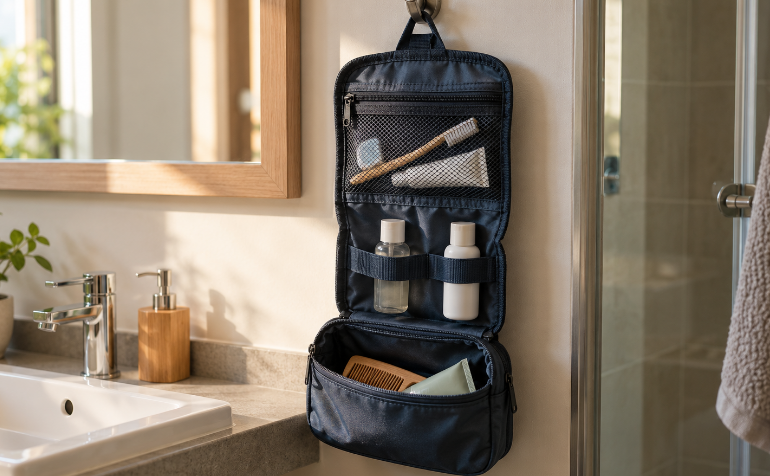
A hanging organizer should also work when there is nowhere to hang it. Try the sample on a towel rail, on a small hook, and on a counter, then check whether customers can still reach the contents comfortably.
Clear material does not make a bag automatically suitable for every airport screening requirement. If you plan to market a removable liquids pouch to US travelers, check the TSA’s current travel guidance and verify the pouch format before writing the product claim.
How to Choose Materials and Easy-Clean Linings
Choose the shell and lining separately
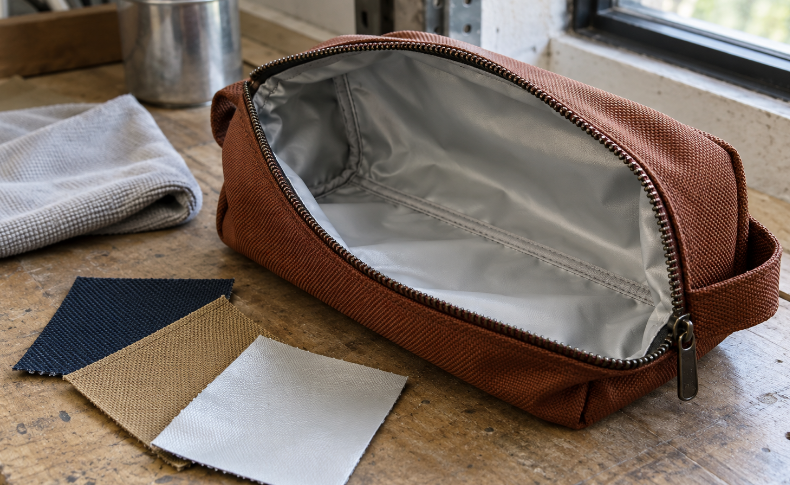
The outer material creates the look and feel, while the lining handles contact with spills and damp items. Selecting both separately gives you more control over appearance, cleaning, and construction.
Nylon and polyester are useful options for lightweight fabric bags, although performance depends on the weave, coating, weight, and construction. Canvas offers a textured appearance but needs closer review if frequent spills are expected; PU-coated materials can offer a smooth finish, with durability depending on the particular material grade and care conditions.
“600D polyester” or “premium PU” leaves too much undecided for a purchase order. Request a physical swatch and specify composition, coating or backing, thickness or weight where relevant, and the approved color.
Check how the lining actually cleans
Coated fabric, PEVA, or TPU-based linings can be considered where wipe-clean performance is important. Their behavior varies with the grade, thickness, surface finish, and assembly method, so evaluate the actual sample instead of treating the material name as a guarantee.
Agree on a simple cleaning trial with the supplier using representative toiletries, a defined contact time, and the intended cleaning method. Inspect for residue, staining, surface damage, and moisture trapped around pocket edges; record the procedure so later samples can be compared fairly.
Water-resistant fabric does not establish that the finished bag contains leaks. Stitch holes, seams, pocket openings, and ordinary zippers can provide escape paths, so a leak-containment claim needs a defined finished-product test.
Match documentation to the finished specification
Ask for documentation that identifies the materials and components you are approving. A report for a different coating, lining, or hardware finish may not support the specification in your order.
For EU projects, review applicable chemical restrictions with your importer or testing partner. ECHA’s explanation of REACH restrictions describes how restrictions can apply to substances in articles, which makes the bag’s coatings, films, decoration, and hardware relevant to the review.
If a supplier proposes an OEKO-TEX claim, confirm the certificate’s validity and product scope. OEKO-TEX’s guidance on component and product claims explains why certification of a fabric alone should not be presented as certification of the complete product.
How to Plan Sizes, Compartments, and Practical Features
Start with a contents list and measure the actual items, including caps, pump heads, and protective covers. External bag dimensions are useful for planning, but lining, padding, seams, and pocket construction reduce the space available inside.
A practical development brief should include:
- Closed external dimensions and the agreed measurement points.
- The tallest and widest products the bag must hold.
- Pocket openings, depths, and intended contents.
- Whether bottles must remain upright during normal use.
- Opening style, handle position, and hanging requirements.
- Any removable pouch, divider, or cleaning requirement.
Fill the sample with your planned assortment and close it without forcing the zipper. Watch for bottles pressing against the opening, check how firmly the elastic loops hold them, and try retrieving the smallest items.
Every compartment should have a job. A narrow pocket that cannot hold the planned item adds sewing and bulk without helping the customer, while a large undivided section may allow bottles to fall sideways.
For hanging designs, specify the intended loaded weight and agree on a test procedure for the hook and its attachment. Review the opened bag for balance, pocket access, and stitching distortion rather than testing the metal hook in isolation.
Wet-item storage also needs a clear brief. Mesh can support visibility and ventilation but does not contain liquid, while an enclosed compartment may hold moisture; decide whether customers need airflow, spill separation, or a removable pouch that can be cleaned and dried separately.
Logo and Packaging Options for Custom Toiletry Bags
Match the logo method to the material
Screen printing, heat transfer, embroidery, woven labels, patches, and debossing are possible approaches, depending on the shell and design. Request a decoration sample on the approved material, because texture, coatings, and panel thickness can change the result.
Printing needs a suitable surface and an agreed adhesion check. Embroidery introduces needle holes and backing, so review how it affects thin fabric, lining assembly, and any water-resistance claim; debossing needs a material and panel structure that hold the detail clearly.
Specify artwork size, position, color, and orientation using a measured drawing. Keep the mark clear of seams and folds, and approve it on the finished sample before authorizing production.
Approve packaging with the bag
Packaging should protect the product and suit your sales channel. A retail collection may need hangtags and barcodes, while a beauty gift set may require a specific presentation and enough space for the products packed inside.
Compare flat packing with lightly supported packing before choosing a format. Flat packing can reduce volume, but some structured bags may develop creases; test the proposed method and inspect the bag after unpacking.
Confirm individual packaging, SKU labels, carton quantities, carton dimensions, and any required markings. Pack a complete sample set so barcode placement, closure pressure, and presentation are approved together.
What to Know About MOQ, Sampling, and Lead Times
Ask what the MOQ covers
The minimum order quantity may apply per style, color, material, or logo treatment. Ask whether several colorways can share a production order and which components have separate purchasing minimums.
Stock fabrics and standard hardware may simplify a smaller launch. Custom-dyed fabric, exclusive zipper pulls, special films, or printed packaging can introduce additional minimums, so the final quantity should be confirmed after the specification is reviewed.
HeteBag’s ordering FAQs are a useful starting point for discussing development and production. Confirm the MOQ for your exact toiletry bag project rather than applying a number from another product category.
Use samples for different approval decisions
A development sample helps you assess shape, access, and pocket layout. A pre-production sample should reflect the approved materials, logo, hardware, construction, and packaging; record any remaining difference before giving production approval.
Keep an approved reference sample and a written specification with a version date. If the supplier proposes a material substitution later, request approval before it enters production, including whether new testing is needed.
Build the schedule backward from arrival
Separate material sourcing, sample development, revision rounds, testing, production, final inspection, and transport in the schedule. Ask when each stage starts and what must be approved first, because “production lead time” may exclude several of them.
Tell the supplier your required warehouse arrival date and allow time for corrections. Late artwork, revised bottle sizes, or a new lining choice can affect several stages at once, so freeze those decisions before bulk production begins.
How to Choose a Manufacturer and Check Quality Before Bulk Orders
Look for relevant construction experience
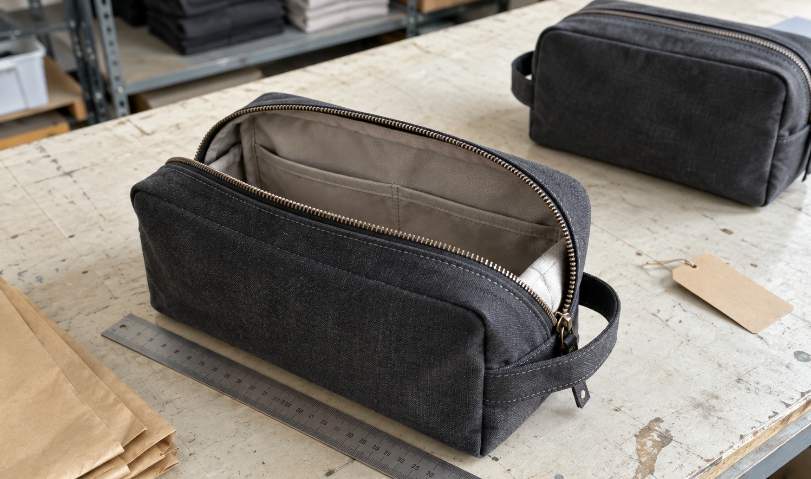
When evaluating a custom toiletry bags factory, ask to see samples with similar linings, pockets, openings, and hanging features. A broad bag catalog is less useful than evidence that the supplier can explain how your particular design will be assembled and checked.
Clarify who develops the sample, where bulk production will take place, and which processes are subcontracted. If several factories or specialist workshops are involved, identify who controls the specification, approves changes, and resolves defects.
Send the same brief to each shortlisted supplier so their proposals are comparable. Include drawings or reference photos, contents measurements, material requirements, quantities by color, logo artwork, packaging, destination market, and the required arrival date.
Turn quality expectations into inspection points
“Good quality” gives an inspector very little to work with. Write down what passes, what fails, and how to measure it, then compare production against both the approved sample and the written specification.
| Vérifier | What to verify | Acceptance requirement to agree |
|---|---|---|
| Dimensions and fit | Closed size, pocket openings, and loaded fit | Measurement method, tolerances, and contents list |
| Fermetures à glissière | Smooth travel, alignment, and lining clearance | Test conditions and agreed cycle requirement |
| Seams and attachments | Pocket edges, handles, and hook attachment | Construction details and relevant load procedure |
| Lining and cleaning | Staining, residue, surface damage, and trapped moisture | Approved cleaning method and evaluation criteria |
| Logo and appearance | Position, color, adhesion, marks, and loose threads | Approved artwork, sample, and defect limits |
| Emballage | SKU, quantity, labels, protection, and carton condition | Approved packing sample and shipment specification |
Agree on checks during production as well as before shipment. Early checks can identify lining or assembly problems while corrections are still manageable, and a final inspection should cover the completed goods and packing.
If you use a sampling inspection plan, agree on the lot definition, inspection level, defect categories, and acceptance limits beforehand. A sampled inspection does not mean every unit has been checked, and it does not replace testing needed to support specific performance claims.
Before placing the order, document how defects, rejected goods, reinspection, and shipment release will be handled. Keep laboratory reports separate from appearance inspection records, and make sure each report can be connected to the approved product specification.
Conclusion
Custom toiletry bags work best when the design starts with the contents and the way customers will use them. A suitable style, cleanable lining, accessible layout, and clearly approved sample give your brand a stronger basis for a bulk order.
If you are planning a new collection or wholesale program, share your reference images, product dimensions, quantities by color, and launch schedule with HeteBag through a project inquiry on the website. The team can review your requirements and discuss materials, customization, sampling, and production arrangements for your project.
Questions fréquemment posées
What should I send when requesting custom toiletry bags?
Send reference images or a drawing, the planned contents and their dimensions, preferred materials, quantities by color, logo artwork, packaging requirements, destination market, and required arrival date. Mark which details are fixed and which the supplier can recommend, so the response addresses your actual project.
Can I use an existing bag style with my own logo?
An existing style can simplify development if its size and layout suit your products. Confirm availability, material options, decoration methods, MOQ, and whether any changes require a new sample before committing to the order.
Does an easy-clean lining make the bag waterproof?
An easy-clean lining describes a maintenance feature, while waterproofing or leak containment depends on the finished construction. Review seams, closures, and compartment openings, and agree on a test before making a stronger performance claim.


