
 German
  English
  Italian
  French
  Spanish
  Arabic
 More and more brands are hoping to use rPET in custom luggage, but the common problems encountered during the procurement process are: Is rPET as durable as ordinary polyester? Can the color remain consistent? Will the printing effect be affected? Are the GRS or RCS certificates provided by the suppliers really applicable to this batch of orders?
In fact, rPET is still a type of polyester material. The main difference between the two lies in the source of raw materials. The quality of the finished product needs to be judged comprehensively based on factors such as fabric weight, weaving method, coating, color control and luggage structure.
Next, we will combine the actual production process of luggage to explain which products are suitable for each of these materials, and what information the purchasers should check before making samples, conducting tests and starting mass production.
1. What Are rPET and Virgin Polyester?
Both materials are usually polyethylene terephthalate, or PET. The difference is mainly where the polymer comes from.
How Virgin Polyester Is Produced
Virgin polyester starts with newly made petrochemical feedstock. The polymer is melted, pushed through tiny holes to form filaments, stretched, and made into yarn. The yarn is then woven or knitted, dyed, and finished.
Controlled feedstock and production settings often give virgin polyester reliable shade matching and broad availability. This matters for repeat orders in the same color.
Buyer check: Do not approve “polyester” as a complete specification. Record the denier, weave, fabric weight in g/m², coating or lamination, color reference, and usable width on the approved material sheet.
How Plastic Bottles Become rPET Fabric
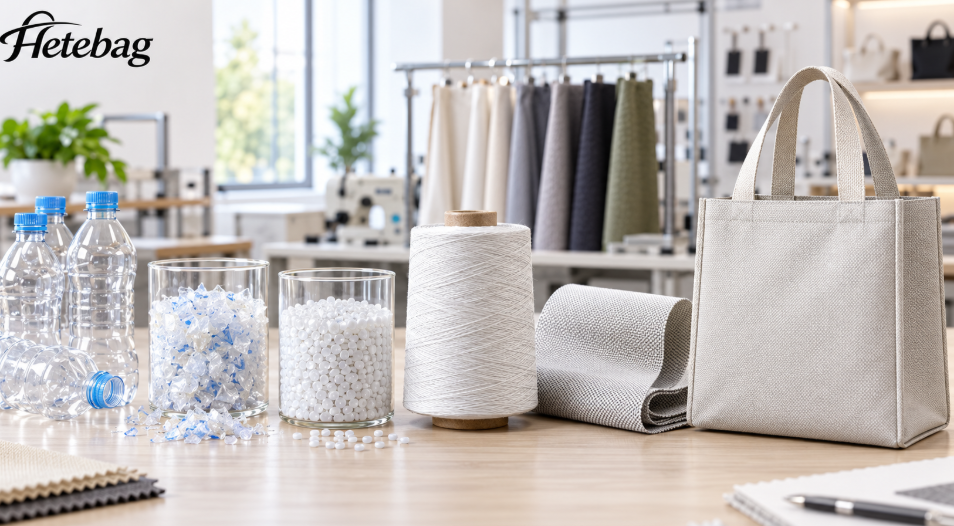
Most bag-grade rPET begins with post-consumer PET bottles. They are sorted, cleaned, crushed, processed, spun into yarn, and made into fabric.
Recycling quality affects yarn stability. Buyers should ask whether the claimed content is post-consumer or pre-consumer and whether it applies to the face fabric, backing, or whole product.
Why rPET Is Still a Type of Polyester
rPET is recycled polyester, not a separate fiber family. It can be woven into Oxford, plain weave, twill, ripstop, or other constructions, just like virgin polyester.
A “600D rPET Oxford” and a “600D virgin polyester Oxford” may look similar, but they are not automatically equal.
Pass rule: A material description is ready for sampling only when it identifies fiber source, recycled percentage, yarn size, construction, weight, backing, finish, and color. Explore the wider range of Materialien für maßgefertigte Taschen if polyester is only one option in your project.
2. rPET vs Polyester: Key Differences at a Glance
| Faktor | rPET | Virgin polyester | What the buyer should verify |
|---|---|---|---|
| Raw material source | Recycled PET, often bottles | Newly produced PET | Recycled percentage and pre- or post-consumer source |
| Appearance and texture | Can show slightly more variation | Often more uniform | Approved swatch under standard lighting |
| Langlebigkeit | Can approach virgin material at a matched specification | Stable and widely available | Same-method tensile, tear, and abrasion results |
| Wasserbeständigkeit | Comes from coating, lamination, and construction | Same | Hydrostatic or spray-test requirement and seam risk |
| Farbkonsistenz | May need tighter lot control | Usually easier for exact repeats | Lab dip, color tolerance, and lot segregation |
| Printing compatibility | Good when surface and heat settings are suitable | Broad and predictable | Printed strike-off on the production fabric |
| Verfügbarkeit von Material | Depends on certified mill, content, and finish | Usually broader | Current stock, mill lead time, and reorder route |
| Certification requirements | Evidence is needed for recycled claims | No recycled-content certificate needed | Scope certificate, chain of custody, and transaction certificate route |
| Sustainability positioning | Supports a recycled-material story when proven | Cannot support a recycled-content claim | Exact claim wording and supporting documents |
Use this table to shortlist, not approve, a material. Quote both options against the same performance specification. Changing denier, weight, weave, or coating makes the comparison invalid.
3. Does rPET Perform as Well as Polyester in Bag Manufacturing?
It often can. Fiber origin alone does not decide bag life. Yarn quality, fabric construction, coating, stitching, reinforcement, and load distribution work together.
Tensile Strength, Tear Resistance, and Abrasion Performance
Ask a laboratory to test both candidates by the same method.
Breaking strength measures how much force the fabric withstands before failure. Tear strength checks whether a small cut will spread. Abrasion testing measures surface wear caused by rubbing.
Die ASTM textile standards list recognized methods for fabric mass, breaking strength, tear strength, and Martindale abrasion.
There is no universal pass number for every bag. Set requirements from product use and benchmark against a tested control. The rPET candidate must meet the product minimums and stay within the agreed tolerance of the control in high-risk tests.
Water-Resistant Coatings and Laminations
Polyester absorbs little moisture, but woven fabric has gaps. Coating, lamination, water-repellent treatment, seams, and zippers determine how water enters.
Test the structure rather than accepting “waterproof rPET.” After a spray test, check for wetting, backing pinholes, peeling, and fold whitening. For stronger claims, agree on a laboratory method and pressure value.
Unsealed seams cannot support a fully waterproof claim merely because the fabric passed a hydrostatic test.
Why Fabric Construction Matters More Than the Fiber Name
Compare these five fields on one sheet:
- Denier
- Fabric weight in g/m²
- Weave density
- Coating type and thickness
- Oberflächenbeschaffenheit
Cut test specimens from the actual selected color because dyeing and finishing can affect performance.
Approval method: Test the first sample, a pre-production material cutting, and fabric from the first bulk roll. Keep one signed swatch. Bulk fabric should match that swatch and remain inside the agreed test tolerance.
4. How Do the Two Materials Affect Bag Appearance and Customization?
The visual risk is not that rPET always looks rough. The risk is assuming that two fabrics with the same denier will have the same shade, sheen, hand feel, and print response.
Color Matching and Batch Consistency
Provide a Pantone reference, but approve a physical lab dip or swatch under at least two relevant light sources.
For exact matching, set a Delta E tolerance and agree on the formula, measuring instrument, and lighting condition. A numerical tolerance is more reliable than descriptions such as “slightly darker” or “close enough.”
For reorders, ask whether the mill will repeat the original dye recipe or match a retained standard. Never mix dye lots within one visible panel. Record roll and lot numbers during cutting so any shade issue can be traced.
Screen Printing, Heat Transfer, Sublimation, and Embroidery
| Methode | Optimale Verwendung | Main production check |
|---|---|---|
| Siebdruck | Solid logos and larger runs | Adhesion, opacity, edge sharpness, rub and tape tests |
| Wärmeübertragung | Detaillierte oder mehrfarbige Grafiken | Heat marks, dye migration, peeling, and color change after cooling |
| Sublimation | Full-color artwork on suitable light polyester | Final shade, artwork scale, and show-through |
| Stickerei | Premium, textured branding | Puckering, backing, stitch density, and panel strength |
Approve a print or embroidery strike-off on the exact bulk fabric, not on a “similar” polyester fabric.
Heat can alter the gloss or shade of some recycled fabrics and coatings. Dark polyester may also release dye into light-colored heat transfers.
For more logo-process planning, see HeteBag’s guide to Taschen mit individuellem Logo.
Fabric Texture, Structure, and Finish Options
Hand feel comes from filament, yarn, weave, backing, and finish. Structure may come from foam, reinforcement, or lining.
Record every layer in the bill of materials to prevent unapproved substitution during bulk production.
Appearance pass rule: Approve the face fabric, backed fabric, decorated panel, and completed sample as four separate checkpoints. A flat fabric swatch cannot predict seam puckering, panel distortion, or the final bag shape.

5. Which Bags Are Best Suited to rPET or Polyester?
Material choice should follow the expected load, use frequency, selling market, and brand position.
| Bag type | When rPET is a strong choice | When virgin polyester may be safer | Required sample check |
|---|---|---|---|
| Tote and promotional bag | Sustainability is central and the load is moderate | Exact color repeats and broad stock access matter most | Fill to the agreed working load and cycle-test the handles |
| Backpack and travel bag | Certified fabric with the required durability is available | Heavy wear, complex coatings, or urgent repeatability cannot be proven in rPET | Static load, strap pull, abrasion, seam and zipper cycling |
| Cosmetic bag and organizer | The brand wants a recycled shell or lining with a clear component claim | Gloss, exact shade, wipe-clean finish, or heat decoration is difficult to match | Spill test, color transfer, odor, print adhesion, and zipper use |
| Outdoor and performance bag | Recycled fabric passes the same weather and wear requirements | High abrasion, hydrostatic pressure, or stable technical supply is the priority | Wet conditioning, abrasion, coating adhesion, and seam leakage |
Tote Bags and Promotional Bags
rPET works well for many individuelle Tragetaschen when the fabric and handle construction match the intended load.
Define a working load before sampling. Test above that load using an agreed safety margin. Inspect the handle attachment points and seam opening after repeated lifting.
A strong fabric will not prevent failure if the webbing, stitch pattern, seam allowance, or reinforcement is too weak.
Backpacks and Travel Bags
Backpacks place repeated force on strap anchors, handles, base panels, and zipper ends.
Für eine maßgeschneiderter Rucksack, load the sample evenly, hang it for the agreed period, and perform repeated lift and strap-pull checks. Record seam growth, coating creases, and hardware deformation.
The bottom panel and shoulder-strap attachment areas may need extra reinforcement even when the outer rPET fabric passes laboratory strength tests.
Cosmetic Bags and Organizers
For cosmetic bags, wipeability, odor, color transfer, and decoration may matter more than tensile strength.
Test the lining with expected liquids or cleaners. Check whether makeup, oil, or cleaning products leave stains or damage the coating.
Confirm whether the recycled claim covers only the shell. Zippers, foam, labels, thread, binding, and lining may use different materials.
Outdoor and Performance Bags
Choose the fabric based on the most severe expected use.
Condition the sample while wet if it will face rain. Rub high-contact zones and flex coated areas around folds. Pay attention to the base, corners, strap connections, zipper covers, and any area where several material layers meet.
If the product claim is “waterproof,” test the finished seams and closures, not only the fabric.
6. What Certifications and Documents Should Buyers Check for rPET Bags?
Recycled-content verification and product-performance testing are two separate systems.
GRS or RCS can support material identity and traceability. They do not replace abrasion, colorfastness, chemical, coating, or finished-bag tests.
GRS vs RCS Certification
Textile Exchange explains that the RCS and GRS both cover third-party verification of recycled materials and chain of custody.
GRS also includes added processing requirements related to social practices, environmental controls, and chemical use. RCS focuses on recycled-content integrity and does not by itself cover these broader processing areas.
Define the claim your brand wants to make, then check the current content and labeling rules. Do not rely on a percentage copied from an old supplier brochure because standards can change.
Transaction Certificates and Chain of Custody
A scope certificate shows that an organization and its listed processes are covered for a stated period. It does not prove that every shipment from the company is certified.
A transaction certificate, commonly called a TC, links certified material to a specific transaction.
Use this document-checking process:
- Confirm the certificate holder’s legal name and production address.
- Check the standard, permitted process, product category, and validity dates.
- Confirm that the fabric supplier, dyeing and finishing route, bag factory, and seller are covered where required.
- State in the purchase order who must apply for the TC.
- Define which shipment the TC must cover and when it must be delivered.
- Match the product description, quantity, recycled content, seller, buyer, invoice, and shipping references to the order.
Textile Exchange describes chain of custody as the system that tracks claimed fiber through stages such as spinning, dyeing, weaving, cutting, and sewing.
How to Avoid Unsupported Recycled-Material Claims
Do not describe finished products as “GRS-certified bags” only because a fabric mill sent a certificate.
Ask the certification body or use the authorized verification route to check the certificate and transaction certificate. Keep the following records in one order file:
- Purchase order
- Approved bill of materials
- Supplier and mill information
- Scope certificates
- Transaction certificate
- Material invoices
- Shipping documents
- Approved recycled-content claim
- Bulk inspection report
Release rule: Marketing may use a recycled-content or certification claim only after the responsible person matches the planned wording to valid order-level evidence.
If the evidence covers only the outer fabric, name that component instead of implying that the whole bag is recycled.
Chemical safety should also be specified separately. OEKO-TEX STANDARD 100 covers textiles tested for harmful substances. It is not proof of recycled content.
7. How Should Brands Choose Between rPET and Polyester?
Choose rPET When Sustainability and Traceability Are Priorities
rPET fits when recycled material is part of the product brief, evidence is available, and the fabric passes the required functional checks.
It can be especially suitable for retail collections, promotional programs, and brand projects that need a clear recycled-material position.
Go rule: Approve rPET only when all three gates are green:
- Performance tests meet the agreed requirements.
- Color, texture, print, and finished appearance are approved.
- The certificate and transaction-certificate route is confirmed in writing before ordering.
A failure at any one of these gates means the material is not ready for bulk production.
Choose Virgin Polyester When Supply Stability or Exact Color Reorders Matter
Virgin polyester may suit frequent small reorders, exact shades, rare coatings, or immediate stock needs. In these situations, supply risk may outweigh the planned recycled claim.
Use a reorder test before launching the product. Ask the supplier to confirm:
- Material code
- Fabric mill
- Standard production lead-time range
- Minimum dye-lot requirement
- Color-control method
- Availability of the original coating
- Process if the original base fabric becomes unavailable
A sample can look correct today but still create problems six months later if the material cannot be reproduced.
8. Schlussfolgerung
In an rPET vs polyester comparison, recycled origin is only one line in the material specification. A suitable custom bag material must also meet the product’s load, wear, water-resistance, appearance, printing, and supply requirements.
Good-quality rPET can perform close to virgin polyester in many tote bags, backpacks, travel bags, cosmetic bags, and organizers. The reliable way to choose is to compare fabrics with matching specifications, test actual decorated samples, retain an approved standard, and verify recycled claims at order level.
HeteBag supports brands, wholesalers, importers, and project buyers with custom bag development and manufacturing. When requesting a material recommendation, please provide your bag type, dimensions, target load, use environment, selling market, logo method, color reference, expected order pattern, and required recycled-content claim. With this information, our team can recommend and test a suitable material rather than selecting one based only on its name.
Häufig gestellte Fragen
Is 600D rPET as strong as 600D virgin polyester?
It can be, but “600D” only describes yarn linear density. It does not confirm fabric weight, weave density, yarn quality, coating, or finished strength.
Compare both fabrics using the same tensile, tear, and abrasion test methods. Approve the rPET option only if it meets the product-specific requirements and the completed bag passes its load, seam, and strap tests.
Is an rPET bag automatically GRS certified?
No. rPET describes recycled polyester, while GRS is a third-party certification and chain-of-custody system.
A certified fabric or factory does not automatically make every finished order GRS certified. Confirm the current scope certificates, the complete certified supply route, claim eligibility, and whether a transaction certificate can be issued for your shipment.
Can a brand claim that the whole bag is made from recycled bottles?
Only if the product composition and supporting evidence cover the whole bag.
Many bags contain virgin thread, zippers, foam, labels, coatings, reinforcement, or lining. Define the claimed component and recycled percentage in the bill of materials.
If the evidence covers only the outer fabric, use accurate wording such as “outer fabric made with certified recycled polyester,” subject to the applicable claims rules.
Does rPET fabric make a bag waterproof?
No. Water resistance comes mainly from fabric density, coating or lamination, seams, zipper design, and finished construction.
Test both the face material and finished bag against a defined method. Do not use a waterproof claim if water can enter through unsealed seams, needle holes, zippers, or closures.
How can buyers control color differences in rPET bulk fabric?
Approve a physical lab dip or fabric swatch under agreed lighting. Set a measurable color tolerance and keep different dye lots separate during cutting.
Ask the factory to record the fabric mill, dye-lot number, and roll number. For repeat orders, compare the new fabric against a retained master standard rather than relying only on a Pantone code or screen image.


