
 Arabic
  English
  Italian
  French
  German
  Spanish
 If you keep a close eye on luxury bags, it is hard to overlook Goyard. The brand doesn’t saturate the market with advertising or rely on conspicuous logos; yet, the Saint Louis Tote and the signature Chevron pattern have gradually become designs that resonate with many people.
This aspect is crucial. When consumers purchase a Goyard bag, they are buying more than just a vessel for their belongings; they are acquiring the brand’s heritage, the tactile quality of the materials, a lightweight design, personalized services, and a sense of exclusivity—the feeling of owning something not easily found elsewhere. These details collectively shape the brand’s appeal.
As someone with extensive experience in the development and manufacturing of bags and luggage, I prefer to examine this subject from the perspective of the product itself. We will explore the reasons behind Goyard’s popularity and consider how its design philosophy offers valuable insights for custom bag creation, brand development, and supplier selection.
1. A Long Heritage Gives Goyard Its Luxury Status
From Parisian Trunk Maker to Global Luxury House
Goyard’s story reaches back further than many customers realize. The business that eventually became Maison Goyard traces its roots to Maison Martin, established in Paris in 1792. François Goyard took over the business in 1853, giving the house the name it carries today. Goyard’s own brand history documents this development from packing and trunk making into an internationally recognized luxury house.
That matters because luxury buyers do not judge a bag only by what is sitting on the shelf today. They also buy the story accumulated behind it. Trunks, travel, craftsmanship, Parisian heritage, family history, and old production traditions give modern Goyard bags context before a customer even touches one.
This is difficult for a new brand to copy, and trying to invent artificial heritage usually feels forced. What a newer bag brand can do is build consistency. Keep recognizable materials. Develop a stable design language. Maintain the same quality standard across several collections. After enough years, those decisions become part of the brand’s own history.
How Brand History Shapes Modern Perception
People tend to judge an established luxury house differently from an unknown bag company. A slightly unusual construction detail may be interpreted as heritage rather than simply an odd design choice. An old pattern can feel familiar rather than dated.
Goyard has used that advantage carefully. The house does not need to redesign its visual identity every season to stay visible. Its history gives older elements permission to remain.
I see a useful lesson here for custom bag projects. Buyers sometimes want to change the logo, fabric, silhouette, color, hardware, lining, packaging, and decoration in the same development. The result can lose its identity before production even begins. Strong brands usually repeat a few recognizable elements instead of changing everything.
2. The Goyardine Canvas Is Instantly Recognizable
What Is Goyardine Canvas?
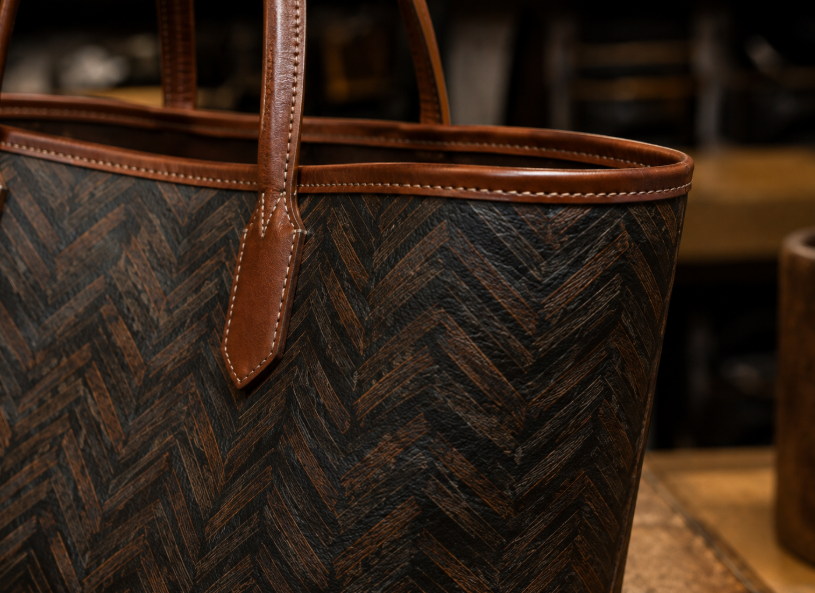
Goyardine is one of the biggest reasons Goyard bags can be recognized from several meters away. According to Maison Goyard, the textile uses a tight linen-and-cotton weave coated with a light natural resin. The combination is designed to provide lightness, flexibility, water resistance, and durability.
From a bag-development view, this is more meaningful than simply calling it “coated canvas.” A bag material affects weight, folding behavior, seam construction, edge treatment, handle reinforcement, surface wear, print clarity, and the structure of the finished product.
You can see the impact clearly in the Saint Louis PM. Goyard lists the bag at about 34 × 15 × 28 cm and only 280 g. That low weight is not accidental; the material and unlined construction are part of the product concept.
Brands developing their own coated textile bags should think in the same way. Do not select a material from a small swatch and stop there. Fold it. Stitch it. Rub it. Load the sample. Check whether the coating cracks near seams and whether the fabric pulls around handle attachments. Our guide to مواد تصنيع الحقائب المخصصة covers the same issue from a production perspective: material choice has to follow the intended use of the bag, not just its appearance.
The Meaning Behind the Chevron “Y” Pattern
The repeating Goyardine pattern is more than decoration. Goyard states that Edmond Goyard created the canvas in 1892. The dotted chevrons reference log driving in the Goyard family’s earlier history, while the repeated form creates a “Y,” the central letter of the Goyard name.
That is strong visual branding because the pattern works even when the customer cannot see a large wordmark. The surface itself becomes the identifier.
This is one area where many custom bags fall short. A company asks for a large logo because the base product has no other recognizable feature. Better product development can create recognition through a combination of color, stitching position, panel shape, hardware, lining, trim, or a proprietary pattern.
Why Signature Materials Matter in Bag Design
Material can become part of a brand language just as much as a logo. Think about what happens when customers recognize a bag by texture or surface pattern before reading the name. The product starts doing some of the branding work itself.
That does not mean every company needs a custom-coated canvas. Development costs, quantities, repeat-order potential, color control, abrasion resistance, and intellectual-property issues all matter. At normal wholesale volumes, a carefully selected existing material with distinctive original detailing may be a better choice.
When textile safety requirements are part of a project, buyers should also request documentation rather than relying on phrases such as “eco-friendly” or “safe fabric.” Standards such as معيار OEKO-TEX 100 provide a recognized framework for textiles tested for harmful substances. The exact standard needed still depends on the product, material, and destination market.
3. Craftsmanship and Personalization Make Each Bag Feel Special
Construction, Leather Trims, Stitching, and Finishing
Luxury perception is usually built at the points customers touch repeatedly. Handles are one example. Edge paint, leather thickness, stitching tension, corner finishing, hardware movement, seam alignment, and reinforcement under stress points all influence whether a bag feels carefully made.
Goyard bags use different construction levels across the collection. The Saint Louis is intentionally soft and minimal. The Artois adds a zipper, leather corners, more structure, and an inside pocket. Saïgon models bring trunk-making details such as wooden elements, leather corners, and riveted hardware into handbag construction.
This variation matters. “More components” does not automatically mean “better bag.” The construction has to match the intended product.
| Design Goal | Construction Decision | What the User Feels |
|---|---|---|
| Lightweight daily tote | Fewer layers, soft body, limited hardware | Easy to carry and pack |
| Structured city tote | Reinforcement, zipper, protected corners | More security and shape retention |
| Premium handbag | Shaped panels, controlled edges, refined hardware | More formal and substantial |
| Travel-inspired luxury bag | Reinforced structure and trunk-style details | Strong heritage character |
When we develop a حقيبة يد مصنوعة حسب الطلب, this is the point I usually want clarified early: should the bag feel soft, structured, light, protective, formal, or casual? Those decisions affect almost every material and construction choice that comes after.
Hand-Painted Initials, Stripes, and Custom Marquage
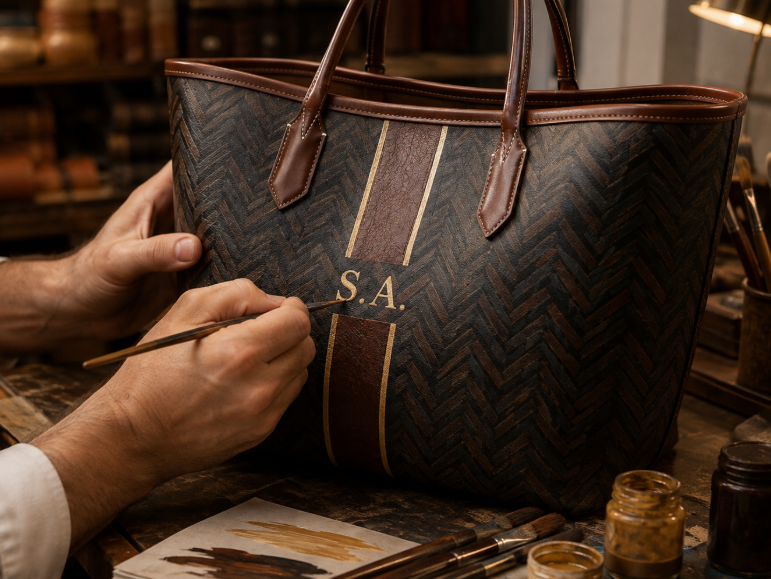
Goyard’s personalization program adds another layer of identity. Its official Art of Marquage includes initials, stripes, colors, and other motifs. Goyard states that its traditional marquage is painted by hand by trained painters using natural-pigment-based colors.
That process changes the relationship between customer and product. Two buyers may start with the same bag model, then end up with pieces that feel different because of initials, stripe combinations, and color choices.
Customization in ordinary OEM manufacturing works differently, but the principle is useful. A logo does not have to be the only customization. Brands can work with embroidery, metal logos, woven labels, patches, debossing, screen printing, custom zipper pulls, branded lining, and original hardware. The right method depends on the material and desired positioning, which is why our custom logo bag guide separates the main logo techniques rather than treating them as interchangeable.
How Personalization Adds Emotional Value
Once somebody chooses initials, colors, placement, or another personal detail, the bag stops feeling completely interchangeable. That extra decision gives the owner a small role in creating the finished piece.
Brands planning wholesale personalization need to manage the production side carefully. Personalized orders create more SKUs, more artwork approvals, and more opportunities for spelling or positioning errors. A factory should confirm artwork, size, color references, placement, and tolerance before bulk work starts.
4. Limited Availability Creates a Sense of Exclusivity
Why Goyard Uses Selective Distribution
Goyard does not appear everywhere luxury bags are sold. Its own store locator shows a controlled network of Maison Goyard boutiques in selected international cities. The brand now also offers online availability for selected products in some markets, so the older statement that Goyard can “only be bought in boutiques” is no longer fully accurate.
The larger point still holds: distribution remains tightly controlled compared with brands that rely on large wholesale networks, department-store coverage, outlets, and aggressive e-commerce exposure.
That control gives the buying process more friction. In luxury, a little friction can become part of the appeal. Customers may need to locate a boutique, check availability, choose a color, or wait for personalization rather than treating the purchase like an ordinary online checkout.
Less Advertising, More Brand Mystery
Goyard has historically relied less on mass-market advertising than many major fashion houses. This has helped create the feeling that people discover the brand through travel, fashion communities, existing customers, celebrities, or repeated exposure rather than one huge campaign.
Mystery works only when the product already has enough identity to support it. A new brand that simply avoids marketing will usually become invisible, not exclusive.
The transferable lesson is control. You do not need to sell every design through every channel. Some collections can stay limited to selected retailers, members, events, markets, or seasonal releases. Scarcity feels credible when it comes from an actual distribution strategy rather than a countdown timer on a product page.
How Scarcity Increases Consumer Desire
Availability changes perception. If shoppers know they can buy an identical product anywhere at any time, urgency drops. If availability depends on location, color, season, customization, or stock, the decision feels different.
Luxury brands have used this psychology for decades. The difficult part is keeping scarcity from becoming inconvenience. Customers still expect accurate product information, reasonable service, and confidence that they are buying through an authorized channel.
Goyard’s own FAQ states that its products are sold through authorized Goyard boutiques, which also matters in an industry where authentication and counterfeiting are persistent concerns.
5. Goyard Fits the Rise of Quiet Luxury
Recognizable Without Oversized Logos
Goyard is an interesting version of quiet luxury because it is not truly logo-free. The chevron pattern is highly visible. The difference is that recognition depends more on knowing the visual code than reading a huge brand name.
That creates an “I recognize it” effect. People familiar with the brand can identify Goyard bags quickly, while somebody outside luxury fashion may simply see a patterned tote.
The same design principle can work for smaller brands. A distinctive silhouette or repeated detail often ages better than making the logo larger every season.
Timeless Design Instead of Fast-Moving Trends
Many popular Goyard bags use simple forms: open totes, structured handbags, small trunk-inspired bags, and practical travel shapes. These silhouettes can stay relevant longer because the basic function does not depend on one short fashion cycle.
A tote is still a tote when trends change. The real question is how well the proportions, handle drop, opening, interior organization, and weight have been resolved.
We see the same issue when developing custom bags. Buyers sometimes focus heavily on a visual trend and barely test actual use. Then the shoulder strap feels short, the opening is narrow, or the bag becomes too heavy after adding reinforcement. Good-looking samples still need to work.
Why Understated Luxury Appeals to Modern Buyers
Luxury customers increasingly have many ways to signal taste. Some prefer obvious branding. Others want a product that people inside a particular community recognize without displaying a large logo.
Goyard sits comfortably in that second space, even though its pattern has become much more widely recognized.
Its continued popularity also shows that “quiet” does not have to mean plain. A strong pattern can still feel restrained if the silhouette, hardware, colors, and finishing remain controlled.
6. Iconic Goyard Bags Combine Luxury With Everyday Function
Why the Saint Louis Tote Became So Popular
The Saint Louis explains a large part of the Goyard bags phenomenon because it solves an ordinary problem with a luxury product. It carries daily belongings without the weight and rigid structure of many premium handbags.
Goyard says the Saint Louis was originally conceived as a beach bag. The modern version remains reversible, unlined, lightweight, and fitted with a removable pouch.
That simplicity is useful. People can carry it for shopping, travel, work, or daily errands without treating it like a delicate evening handbag.
From the manufacturing side, achieving “simple” well can be harder than it looks. With fewer panels and less decoration, proportion, material quality, handle attachment, seam accuracy, and edge finishing become more visible. If you are developing your own version of a practical tote—not a Goyard copy—our تصنيع حقائب اليد المخصصة page shows the kinds of materials and customization options normally considered during development.
Saint Louis vs. Artois vs. Anjou vs. Saïgon
These bags show how one brand can serve different use cases without abandoning its design language.
| الطراز | Main Construction Character | Approx. Weight of Referenced Model | الأكثر ملاءمة لـ |
|---|---|---|---|
| Saint Louis PM | Soft, unlined, reversible tote | 280 g | Lightweight everyday carry |
| Artois PM | Zip closure, leather corners, more structure | 460 g | Daily use needing more security |
| Anjou PM | Calfskin and Goyardine, reversible | 440 g | More leather-focused luxury feel |
| Saïgon Tote | Trunk-inspired details and wooden batten | 730 g | More structured, statement-oriented use |
Official product specifications show how much construction changes the physical character of each bag. The Saint Louis PM is roughly 280 g, while the Artois PM is 460 g and the Saïgon tote reaches about 730 g.
That weight difference tells you something important about bag design. Reinforcement, leather, closure systems, hardware, lining, and structural parts add functionality, but they also change how the product feels after several hours of carrying it.
Lightweight Construction, Capacity, and Everyday Use
Customers rarely describe a favorite tote using technical production terms. They say it is “easy to carry,” “fits everything,” or “doesn’t feel heavy.”
Behind those simple comments are design decisions. Handle drop affects shoulder comfort. Base width affects capacity. Material stiffness changes how easy the bag is to access. Reinforcement controls whether the body collapses. Closure design changes security.
This is why I would never develop a tote by dimensions alone. Put real items inside the sample. Carry it. Set it on a table. Open it with one hand. Check how the handles behave under load. Those small tests usually reveal more than another round of renderings.
7. Celebrity Influence and Cultural Status Keep the Hype Alive
From Historic Clients to Modern Celebrities
Luxury products become stronger cultural symbols when they repeatedly appear around people others watch. Goyard has a long association with prominent clients, and modern Goyard bags continue to appear in celebrity travel and street-style photography.
That visibility works differently from a standard advertisement. A large campaign clearly tells the audience, “this is the product we are promoting.” Repeated organic or editorial appearances can make a bag feel as though it already belongs inside a certain lifestyle.
Recent fashion coverage still regularly connects the Saint Louis with high-profile travelers and celebrities, showing that the product remains culturally visible rather than surviving only on historical reputation.
Social Media, Collectors, and the Luxury Resale Market
Social media made recognizable bags easier to identify, compare, discuss, and collect. A person who may never have visited a Goyard boutique can now learn color names, models, sizes, personalization styles, and older releases through videos and collector communities.
Resale adds another layer. Older colors, discontinued pieces, personalized examples, and hard-to-find versions stay visible after they leave primary retail channels. Sotheby’s has also highlighted limited availability, craftsmanship, and discreet brand positioning as factors behind collector interest in Goyard totes.
This creates a loop. More recognition increases curiosity. Curiosity creates more searches and social posts. More visibility introduces the brand to another group of buyers.
Are Goyard Bags Really Worth the Hype?
That depends on what the buyer values.
If somebody wants maximum internal organization, heavy-duty carrying, a fully closed top, or a very structured bag, the Saint Louis may not be the best choice. Goyard itself advises owners not to carry excessively heavy items in the Saint Louis and gives specific care guidance for heat, dampness, rubbing, and storage.
If the buyer values heritage, low weight, a recognizable material, personalization, controlled distribution, and a design with long-term cultural recognition, the appeal becomes much easier to understand.
The same logic applies when sourcing an original bag for your own brand. Do not ask only, “Does the sample look premium?” Ask whether the material, structure, weight, details, function, brand identity, and target customer all point in the same direction. That alignment is what turns a collection of components into a convincing product.
الخلاصة
Goyard bags are popular because several strengths reinforce one another. More than two centuries of company history give the brand depth. Goyardine gives it instant visual recognition. Marquage makes ownership more personal. Selective distribution protects exclusivity, while models such as the Saint Louis give customers something they can genuinely use rather than simply display.
Brands do not need to copy Goyard to learn from it. In fact, they should not. Searching for Custom Goyard Bags or a Goyard Bags supplier should not lead a buyer toward unauthorized replicas. A better approach is to study why the original works, then develop your own materials, silhouette, logo system, details, colors, and functional features.
If you are building an original bag collection and need manufacturing support, هيتباغ is based in Huadu, Guangzhou, China, with its own factory established in 2011 and long-term cooperation with additional manufacturing and purchasing partners. The team works on OEM and ODM development covering materials, sizes, colors, logos, hardware, sampling, and production for international customers.
Most of our projects start around 300 قطعة, although MOQ changes with material, construction, hardware, logo process, and other custom requirements. If you are looking for a bag manufacturer for a new collection, you can اتصل بفريقنا and leave your phone or WhatsApp details together with your design requirements. We are happy to review your project and look forward to building something original with you.
الأسئلة الشائعة
1. Can a manufacturer legally produce Custom Goyard Bags for my brand?
A factory should not reproduce the Goyard name, chevron artwork, branded hardware, or other protected brand elements for an unauthorized commercial order. If you like the lightweight tote concept or coated-canvas look, develop your own pattern, proportions, material combination, logo, colors, and construction so the final product has an independent identity.
2. What should I ask a supplier if I want a Goyard-inspired lightweight tote without copying Goyard?
Start with measurable product requirements rather than a request to “make it like Goyard.” Give the supplier your preferred dimensions, target bag weight, fabric composition, coating requirement, handle material, loading requirement, closure style, reinforcement level, logo method, and intended retail positioning. Ask for an original pattern and sample before approving bulk production.
3. What material can be used for an original coated-canvas luxury tote?
Cotton canvas, cotton-polyester blends, polyester fabric, nylon, PU-coated textiles, PVC-coated fabrics, microfiber, and other engineered materials may work depending on the required appearance and performance. The material should be tested for coating adhesion, folding, abrasion, color transfer, seam strength, odor, and surface stability before bulk production. Material selection should follow actual use rather than appearance alone.
4. What MOQ should overseas buyers expect for custom luxury-style bags?
Our typical starting quantity is around 300 قطعة, but the final MOQ depends on the project. Custom-developed materials, molded hardware, special colors, complex metal logos, printed lining, or unique packaging can push component minimums higher, while projects using existing materials and standard hardware may be easier to arrange.
5. How should I evaluate a Goyard Bags supplier claim online?
Check what the seller actually means. Genuine Goyard products should come through legitimate Goyard sales channels, while an OEM bag factory should describe itself as a manufacturer of original custom bags rather than presenting unauthorized replicas as genuine goods. Ask for company information, production capabilities, sample procedures, quality-control steps, material specifications, and clear intellectual-property terms before placing an order.
6. What should be inspected before approving bulk production of a custom tote?
Check the approved material and color against the final sample first. Then review dimensions, handle drop, stitching density, seam alignment, reinforcement, edge finish, logo placement, hardware function, lining, bag weight, odor, loading performance, packaging, and acceptable tolerance ranges. A signed or sealed pre-production sample gives both buyer and factory a much clearer reference once mass production begins.


