
 Arabic
  English
  Italian
  French
  German
  Spanish
 Over the years of making luggage, I have noticed that many customers, when they first make leather bags, will ask: “Which kind of leather is the best?” This question is actually very difficult to answer directly. When making tote bags, cross-body bags, backpacks or briefcases, the thickness, softness and surface treatment of the leather used may all be different.
Before, when we were making samples, we also encountered cases where customers brought a very beautiful piece of leather and hoped to directly use it on a bag with a relatively sturdy structure. But when the actual prototyping was done, it was discovered that the leather was too soft and the bag body couldn’t be supported. This is why when choosing leather, one should not only consider the color and feel, but also the bag shape, structure, stitching method, lining and hardware all need to be taken into account together.
If you are just starting to learn about leather bags, this content can be regarded as an introduction guide. We will start from full-grain, top-grain, suede to PU leather, and then look at which bag types are suitable for different types of leather, as well as how to judge a truly well-made leather bag from which details.
1. What Is a Leather Bag?
What Makes a Bag a “Leather Bag”?
A leather bag is a bag whose main exterior body is made from natural leather produced from animal hide. The lining, reinforcement, zipper tape, thread, edge paint, and some decorative parts may use other materials, so “leather bag” does not mean every component is leather.
The description also needs more detail than the word “leather.” Cowhide, calfskin, goatskin, and other hides behave differently, while tanning and finishing create another layer of variation. Full-grain leather, corrected top-grain leather, suede, and heavily pigmented leather can all be natural leather, yet they produce very different products.
This is where buyers can get confused. “Genuine leather” confirms that natural leather is present, but it tells you very little about grain quality, surface treatment, thickness, hand feel, or durability. Those details should appear in the material specification of a professional custom project.
Why Leather Is Commonly Used for Bags
Leather works well for bags because it combines flexibility with enough body to build shape. It can be folded, skived, stitched, embossed, painted, burnished, reinforced, and formed around different structures. Certain finishes develop a softer hand and visible patina with use, while more heavily finished leathers maintain a cleaner and more uniform appearance.
The material also gives designers many construction choices. Softer leather works naturally with slouchy shoulder bags and bucket bags. Firmer leather suits satchels, briefcases, structured handbags, and bags that need sharper corners.
Leather has its own challenges. Natural hides vary from piece to piece, usable cutting areas need to be planned around marks and weak zones, and some finishes need more care around moisture, rubbing, and scratches. You can compare leather with other common choices through this دليل مواد الحقائب المخصصة.
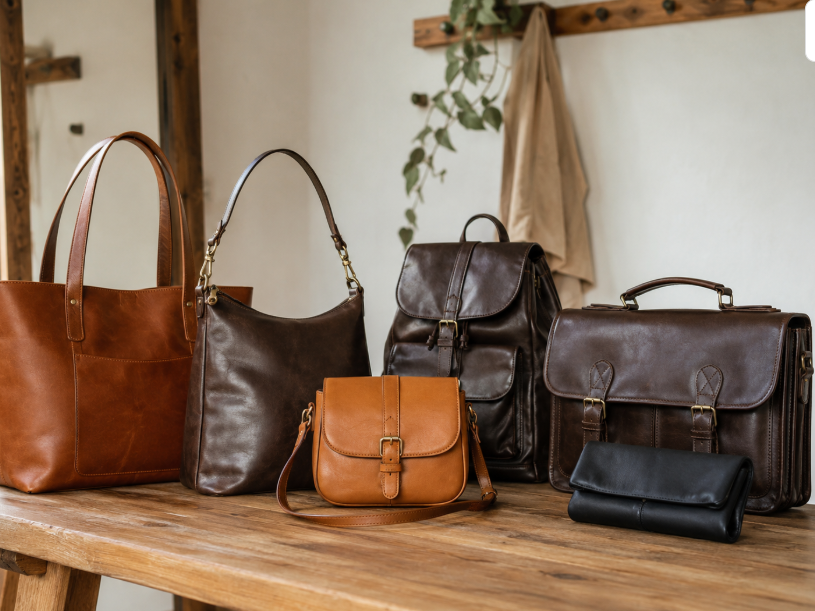
2. What Types of Leather Are Used for Bags?
Full-Grain vs Top-Grain Leather
Full-grain leather keeps the natural grain surface of the hide with minimal correction. Small pores, grain variation, wrinkles, or natural marks may remain visible. Many buyers like this character because the surface looks less artificial and tends to develop its own appearance as the bag ages.
Top-grain leather is taken from the upper part of the hide as well, but the surface may be sanded, corrected, coated, or refinished to create a more controlled appearance. This can make color and grain more consistent across production.
The better choice depends on the product rather than the name alone. A rugged briefcase may benefit from thick full-grain leather, while a fashion handbag requiring very consistent color and a smooth surface may work better with carefully finished top-grain leather.
| Leather Type | Surface Character | Typical Feel | Production Consideration | Common Bag Use |
|---|---|---|---|---|
| Full-Grain | Natural grain and variation | Firm to supple | More careful hide selection | Briefcases, totes, premium handbags |
| Top-Grain | More controlled surface | Smooth and balanced | Easier visual consistency | Handbags, shoulder bags, satchels |
| Split Leather | Lower layer of hide | Softer, less dense | Often coated or finished | Fashion and value-focused bags |
| Suede | Velvety nap | ناعم | Needs careful handling | Casual bags, panels, fashion styles |
| Nubuck | Fine sanded grain surface | Soft and refined | More sensitive to stains | Premium casual bags |
Genuine and Split Leather
The phrase “genuine leather” is often misunderstood as a precise quality grade. In sourcing, you should treat it as a broad material description and ask what layer of the hide is being used, how the surface is finished, and what thickness will be supplied.
Split leather comes from lower layers after a hide has been separated. It can be coated, embossed, or finished to create a more uniform face. Good split leather can be suitable for certain product positions, but it should be described accurately rather than presented as something it is not.
Ask your supplier for a physical swatch whenever appearance matters. Photos can hide grain depth, flexibility, gloss, coating thickness, and color variation that become easy to notice once the material is in your hands.
Suede, Nubuck, and Other Leather Finishes
Suede has a soft, fibrous surface created by buffing the flesh side or a split layer. It works well when a relaxed texture is wanted, though dirt and moisture can be more difficult to manage than on a protected smooth leather.
Nubuck is usually made by lightly sanding the grain surface, creating a finer velvet-like feel. It can look more refined than typical suede, but the open surface tends to show handling and stains more easily.
Other common finishes include pebbled grain, saffiano-style embossing, waxed leather, pull-up leather, patent finishes, matte pigment coatings, and aniline or semi-aniline treatments. The finish changes much more than appearance. It affects scratch behavior, color consistency, cleaning, edge treatment, and how easily the material can be used around curved panels.
3. Genuine Leather vs PU Leather: What’s the Difference?
Material and Construction Differences
Genuine leather comes from animal hide that has been tanned and finished. PU leather usually uses a textile or synthetic backing covered with a polyurethane surface designed to reproduce the appearance of leather.
This creates a clear difference during manufacturing. Natural leather has irregular grain, thickness variation, and different stretch directions across the hide. PU normally arrives in rolls with more predictable width, surface texture, and color, which can make cutting layouts more consistent.
Neither material should be selected only by touching a small sample. Your target customer, bag structure, expected lifespan, finish, care requirements, branding position, and production quantity all belong in the decision.
| مقال مميز | جلد طبيعي | جلد PU |
|---|---|---|
| Base Material | Natural animal hide | Coated synthetic or textile base |
| Grain | Naturally variable | Highly consistent |
| Aging | Can soften and develop character | Usually keeps a more uniform surface until coating wear appears |
| القطع | Requires hide inspection and nesting | Easier to plan from rolls |
| Maintenance | Depends heavily on finish | Usually easy to wipe clean |
| Repair Potential | Some finishes can be conditioned or refinished | Surface peeling is difficult to restore |
| Production Consistency | More natural variation | Easier color and texture consistency |
Appearance, Durability, and Maintenance
Natural leather should not always look perfectly identical. Small grain differences are part of the material, especially with less heavily coated finishes. Buyers who demand zero variation may actually be asking for a finish that conflicts with the natural character they selected.
PU is useful when uniformity, lighter maintenance, controlled surface texture, or certain fashion effects matter more. Quality still varies widely. Base fabric, coating formulation, coating thickness, bonding quality, hydrolysis resistance, flex performance, and storage conditions can all influence how a PU bag performs.
Leather care also depends on the finish. Aniline leather needs different treatment from heavily pigmented leather, and suede should not be cleaned like smooth cowhide. Product care instructions should match the exact leather rather than using one generic “leather care” label.
4. Common Styles of Leather Bags
Leather Tote, Shoulder, and Crossbody Bags
Leather totes usually have a relatively simple body shape, but their large panels expose material quality very clearly. Uneven grain placement, distorted panels, weak handle attachments, or poor edge painting become easy to see. Structured totes may also need reinforcement around the base, mouth, and handle mounting points.
Shoulder bags place more attention on strap comfort, hardware, and the points where the strap connects to the body. Crossbody bags add another issue: repeated pulling force. Strap anchors, D-rings, swivel hooks, and stitched reinforcement need to work as one system.
Brands developing fashion-focused styles can review the construction options used in حقائب يد مصنوعة حسب الطلب before preparing their specification.
Leather Backpacks, Satchels, and Briefcases
Leather backpacks need more than an attractive front panel. Shoulder straps carry repeated loads, back panels flex, zippers open under tension, and the upper handle may be used to lift the full weight of the bag. Reinforcement inside these areas is often invisible after assembly, which makes sample inspection especially useful.
Satchels and briefcases usually depend more on shape retention. Firmer leather, backing materials, internal boards, piping, folded edges, and structured gussets may all be used to control the silhouette.
If you are developing this type of product, the structure should be discussed early with the factory. The same leather can create a soft backpack or a rigid business bag depending on thickness, reinforcement, skiving, and panel construction. Our custom backpack manufacturing options show how material and structure can be developed together.
Clutches, Bucket Bags, and Other Popular Styles
Clutches appear small, but clean edge work becomes more noticeable because there are fewer design elements to distract the eye. Magnetic closures, frames, flap alignment, edge paint, corner turning, and lining fit all need tight control.
Bucket bags depend heavily on drawcord behavior, eyelets, top-edge reinforcement, and the way the body collapses when carried. Hobo bags usually need softer leather with enough flexibility to create the intended drape.
Style and leather should always be selected together. Choosing a very stiff leather for a relaxed hobo shape can make the bag feel forced, while a very soft leather may cause a structured top-handle bag to lose its intended silhouette.
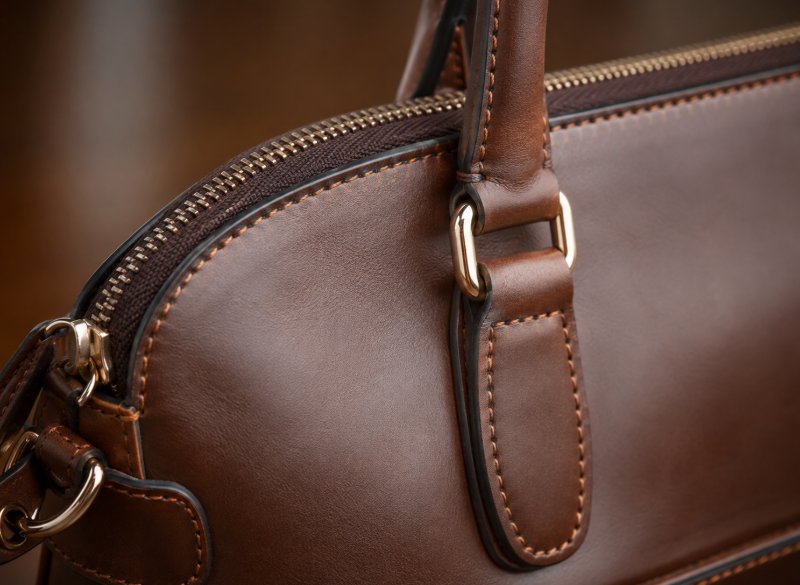
5. What Makes a Good Leather Bag?
Leather Quality and Thickness
Thickness has a direct effect on weight, hand feel, stitch behavior, edge finishing, and structure. There is no single “best thickness” for every leather bag. A soft fashion bag may use relatively thin leather with backing, while a heavy briefcase can use thicker material in major structural panels.
The important part is consistency with the design. Factories may skive selected areas around seams, folded edges, zipper openings, or handles so several layers do not become too bulky. Poor skiving can leave lumps, weak edges, or uneven folds.
Leather quality also needs to be judged across the usable cutting area. Looking at one clean section of a hide tells you very little about how a full production batch will behave.
Stitching, Lining, and Hardware
Good stitching is not simply “more stitches.” Stitch length, thread size, needle choice, seam margin, leather thickness, and reinforcement need to match. Stitching that is too dense can create a perforation line in some leather, especially close to an edge or stress point.
Buyers who need measurable requirements can reference standards such as ISO 23910:2019 for leather stitch tear resistance. The standard defines a method for evaluating how leather resists tearing at a stitched area, which is much more useful than judging seam quality only by appearance.
Lining deserves the same attention. Thin lining fabric can tear around pockets long before the exterior leather wears out. Pocket openings, internal zipper ends, label areas, and lining attachment points should be checked during sampling.
Hardware also changes how the finished bag feels. Zippers, clasps, buckles, magnetic snaps, rings, feet, and logo plates need suitable plating and attachment methods. When a branded zipper is part of the specification, buyers can use the YKK leather-goods zipper range as one reference when discussing zipper construction and finish. YKK lists its EXCELLA line for applications that include handbags.
Structure and Reinforcement
Much of a good leather bag is hidden. Reinforcement may sit behind handles, D-rings, magnetic closures, zipper openings, bottoms, side panels, or hardware plates. Once the lining is closed, the customer never sees it.
The problem appears later if these areas are underbuilt. Handles begin to pull away, the leather stretches around a ring, corners collapse, or a magnetic closure starts distorting the flap.
Experienced Leather Bag Manufacturers should be able to explain what is inside the structure, not just show you the exterior sample. Ask what material is used for backing, where stress points are reinforced, and whether those components change between the sample and bulk production.
6. How to Choose the Right Leather Bag
Choose Leather Based on Daily Use
Start with the way the bag will be used. Office bags may need shape retention, clean edges, laptop protection, and stronger handles. Everyday crossbody bags need comfortable straps, controlled weight, and resistance around frequently touched areas.
Travel or commuting products need closer attention to repeated loading. Fashion-focused bags may place more emphasis on surface texture, drape, color, and hardware appearance.
Your Leather Bag Company should know the final market before recommending material. A finish that looks beautiful under showroom lighting may be a poor choice for a bag that will be handled every day in humid or rainy conditions.
Consider Size, Structure, and Compartments
Bag dimensions should be evaluated together with weight and material stiffness. Increasing a leather tote by a few centimeters can add material weight and change the way the body holds its shape.
Interior organization creates its own construction requirements. Laptop sleeves, bottle pockets, dividers, zip pockets, card slots, and padded sections can add several layers inside the shell. This changes seam thickness and may require different reinforcement.
Prototype the full internal layout rather than approving only the exterior shape. Once bulk production starts, changing pocket dimensions or reinforcement is far more disruptive than correcting them during sampling.
Match the Leather Finish to the Bag Style
Smooth leather gives structured bags a clean appearance but can reveal scratches more easily depending on the finish. Pebbled surfaces can disguise minor handling marks and work well across many everyday styles.
Suede and nubuck create a softer visual character that fits relaxed designs, though buyers need realistic care expectations. Patent or glossy finishes create a sharper fashion look but require very clean surface handling during production.
عند تطوير... Custom Leather Bag, ask for more than a small color swatch. Review the material in a panel large enough to show grain direction, natural variation, bending behavior, and how the surface looks under normal light.
Many of our custom bag projects start around 300 قطعة, though MOQ changes with leather type, custom color requirements, special hardware, logo development, and construction. Custom leather colors or made-to-order metal fittings may require different production quantities, so the final MOQ should be confirmed after the specification is clear.
7. How Are Leather Bags Made?
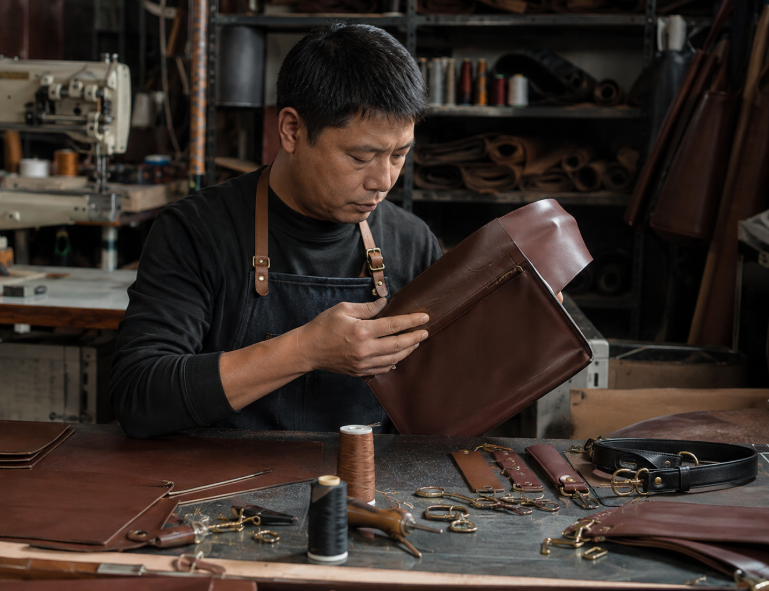
Leather Cutting and Pattern Making
Production begins with patterns. Each panel needs seam allowance, folding allowance, hardware positions, reinforcement areas, zipper openings, and alignment marks before cutting starts.
Natural leather adds another task: hide inspection. Workers need to identify usable areas, grain direction, scars, loose sections, wrinkles, color variation, and thickness differences. Panel placement matters because two pieces cut from very different parts of a hide can behave differently after assembly.
Good cutting is partly about accuracy and partly about judgment. Large front panels usually receive more visual attention, while smaller components can sometimes use sections with greater natural variation without affecting the finished appearance.
Stitching, Edge Finishing, and Assembly
Cut components may be skived before sewing so folded or layered areas remain controlled. Reinforcement is added, zipper openings are prepared, and pockets or internal components are assembled in a planned sequence.
Edge finishing can involve folded edges, painted edges, raw burnished edges, piping, or binding. Painted edges may require repeated coating, drying, sanding, and recoating before they look smooth. Rushing this stage often creates uneven edges that become easy to spot on a structured handbag.
Final assembly brings the body, gussets, base, lining, handles, straps, zipper, and hardware together. Workers need to control alignment throughout the process because small differences at the beginning can shift the shape by the time the final panels are closed.
Quality Inspection Before Completion
Inspection should cover much more than scratches. Shape, dimensions, stitching, edge paint, zipper movement, hardware plating, logo position, lining fit, strap length, handle symmetry, magnetic closure alignment, and surface cleanliness all need attention.
Stress areas deserve physical checks as well. Intertek’s leather and leathergoods testing services include assessments for strap fastening strength, seam performance, abrasion, flexing, color fastness, and chemical substances. These are useful references when a buyer needs to build a more technical QC specification for an overseas market.
Testing requirements should match the product and destination market. You do not need every possible laboratory test for every order, but you should know which failure would create the biggest problem for your customer and build your inspection plan around that risk.
8. الخاتمة
Understanding a leather bag means looking past the material name. Full-grain, top-grain, split leather, suede, nubuck, and PU each behave differently, but the finished result still depends on thickness, finish, cutting, reinforcement, stitching, hardware, lining, and the structure of the bag.
If you are comparing Leather Bag Manufacturers, ask how they control these details before asking which leather is “best.” Strong manufacturers should be able to explain why a material fits your design, what needs reinforcement, where production variation may appear, and how the sample will be translated into bulk production.
هيتباغ is based in Huadu, Guangzhou, China, an established bag-manufacturing area. We have more than 15 years of experience in bag development and manufacturing, operate our own production facilities, and work with a stable supply network supporting different materials and bag categories. Our current manufacturing services include genuine leather and PU options alongside OEM and ODM development for international buyers.
If you are planning a Custom Leather Bag collection or looking for an experienced Leather Bag Company، يمكنك اتصل بفريقنا and leave your phone or WhatsApp number together with your design, quantity, dimensions, material preference, or reference photos. We are happy to review your requirements and look forward to building the right bag with you.
الأسئلة الشائعة
What information should I send to a leather bag manufacturer before requesting a sample?
Send the bag dimensions, target leather type, preferred finish, color, lining, hardware finish, logo method, strap length, pocket layout, expected order quantity, and reference drawings or photos. If the bag will be sold in a market with defined chemical or performance requirements, mention that before material sourcing begins. The clearer the specification is, the easier it is for the factory to build a meaningful first sample.
What is the typical MOQ for a custom leather bag?
Our MOQ starts at around 300 pieces for many bag projects, but leather specifications can change that figure. Custom-dyed leather, special grain embossing, exclusive hardware, custom zipper colors, or complex logo fittings may have their own supplier minimums. Experienced Leather Bag Manufacturers should confirm these material-related limits before the order is approved rather than changing them after sampling.
Can genuine leather be matched exactly to a Pantone color?
Pantone can be used as a communication reference, but natural leather should still be approved through a physical material sample or lab dip. Leather absorbs dyes and coatings differently depending on hide condition, tanning, grain, and finish, so minor batch variation can occur. Buyers who need tight color consistency should define an acceptable tolerance and approve production swatches before bulk cutting.
Which quality tests are useful for leather bags?
The testing plan depends on the product. Common checks may include strap or handle pull strength, seam strength, stitch tear resistance, color fastness to rubbing, flex resistance, abrasion, zipper performance, hardware attachment strength, plating resistance, and relevant chemical testing. Bags designed to carry laptops or heavier daily loads usually need more attention around handles, shoulder straps, and hardware attachment points.
How can I tell genuine leather from PU leather when checking a sample?
Look at several clues together rather than relying on smell or one surface test. Natural leather usually shows variation in grain and fiber structure, while PU often has a more uniform surface and a visible textile or synthetic backing when the cut edge can be inspected. Material documentation and supplier traceability are much more dependable than informal tests such as burning, scratching, or smelling the sample.
Should I choose full-grain leather for every premium bag?
No single leather suits every premium product. Full-grain leather works well when natural character and aging are part of the design, but a carefully finished top-grain leather may be better when the collection needs smooth color, controlled grain, and consistent appearance across hundreds of units. The right choice should follow the bag design, customer expectations, care requirements, and production standard.


