
 Arabic
  English
  Italian
  French
  German
  Spanish
 The evening bag packaging may seem small in size, but when it comes to actual production, it often requires more meticulous control by the factory. Materials such as satin, velvet, beading, rhinestones, metal frames and chains, if the stitching, hardware, electroplating or finishing are slightly subpar, the texture of the finished product will show a significant difference.
I’m Evan, and I have over 15 years of experience in the luggage manufacturing industry. After working on so many projects, I’ve discovered that many buyers initially pay more attention to the style and pictures, but what really determines the reliability of a supplier is often during the sample making and mass production stages. Whether the factory has truly made evening bags, whether they understand materials and hardware, and whether they can consistently replicate the sample and confirm the design – these are more important than how good the product catalog looks.
If you are looking for a suitable Evening Bag Manufacturer, this article will show you from the perspective of actual procurement and production which aspects you should focus on, including product requirements, factory experience, material processing, customization capabilities, samples, quality control of mass production, and communication and cooperation.
1. Start With Your Evening Bag Requirements
A good supplier evaluation starts with your own specification. If your request only says “I need a custom evening clutch,” the manufacturer still has to guess the material, dimensions, structure, closure, lining, hardware finish, logo method, decoration, packaging, and expected quality level.
Those guesses create unnecessary sample revisions. A clearer product brief also makes it easier to compare several factories because everyone is quoting and developing the same product.
Define the Bag Style, Materials, and Target Market
Start by deciding what type of evening bag you actually want to manufacture. A soft satin pouch, structured box clutch, beaded evening bag, leather clutch, acrylic minaudière, and metal-frame party bag may all sit in the same fashion category, but their production methods are very different.
Material choice should follow the design instead of being treated as a separate decision. Satin gives a smooth formal appearance but requires careful handling because wrinkles, pulls, glue marks, and needle holes can become visible. Velvet creates more depth but needs consistent pile direction during cutting. PU and genuine leather provide more structure, while beaded and rhinestone surfaces require extra attention to attachment methods and abrasion.
You can review a broader range of مواد تصنيع الحقائب المخصصة when deciding which surface material, lining, reinforcement, or alternative fabric suits your collection.
Your target market matters too. A promotional party bag and a boutique evening clutch may have similar dimensions but very different expectations for plating, lining, structure, edge finishing, and packaging.
| Item to Define | Questions to Answer Before Sampling |
|---|---|
| Bag style | Clutch, frame bag, pouch, minaudière, chain bag, beaded bag? |
| Main material | Satin, velvet, PU, leather, mesh, acrylic, beads? |
| الهيكل | Soft, semi-structured, or rigid? |
| الأجهزة | Frame, clasp, chain, magnetic closure, zipper? |
| Decoration | Rhinestones, beads, embroidery, sequins, metal ornaments? |
| العلامة التجارية | Metal logo, embossing, printing, label, custom hardware? |
| التغليف | Polybag, dust bag, gift box, branded packaging? |
| Market | Boutique, department store, bridal, promotional, wholesale? |
Clarify Customization and Order Requirements
Tell the manufacturer what must be customized and what can remain standard. This distinction affects development difficulty more than many buyers expect.
Using an existing chain or clasp in a different color is quite different from developing a new metal mold. Choosing a stock satin color is different from matching a specific Pantone reference. Adding a standard metal logo is easier than building the brand name directly into a custom closure.
Your expected order quantity should also be discussed early. Many of our bag projects start at around 300 قطعة, but MOQ depends on the material, color, hardware, decoration, packaging, and level of customization. A special plated frame or custom-dyed fabric may have its own upstream supplier MOQ, even when the bag factory itself can sew a smaller quantity.
A reliable supplier should explain where those limitations come from instead of simply giving you a number.
2. Check the Manufacturer’s Experience With Evening Bags
A factory that makes backpacks well is not automatically a good evening bag factory.
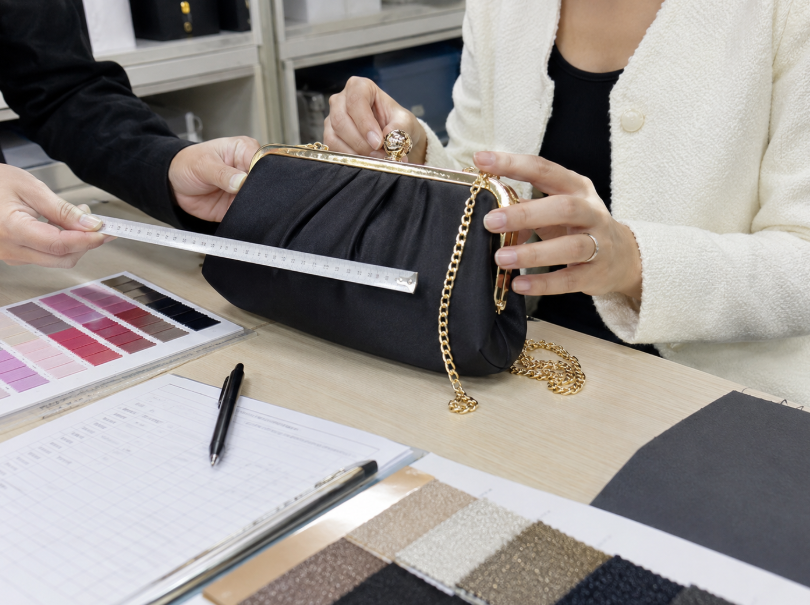
The equipment may overlap, but the workmanship priorities do not. Sports bags depend heavily on load-bearing seams, functional fabrics, webbing, and zippers. Evening bags place much more attention on shape, surface appearance, symmetry, decorative work, small hardware, plating, edge finishing, and how the product feels in the hand.
Ask the supplier to show products that are genuinely close to your project. Look for evening bags, clutch bags, party bags, beaded bags, frame bags, chain bags, or other small fashion handbags rather than a catalog filled mainly with backpacks and tote bags.
A factory with relevant experience should be comfortable discussing questions such as how a satin body will be reinforced, how a metal frame will be attached, how beadwork is secured, how chain connection points are strengthened, and how the lining is fitted inside a very small structure.
This knowledge becomes even more important with clutch bags. Buyers who are still deciding the exact construction can review our guide to clutch handbag styles and construction to understand how materials and silhouettes change the finished product.
Photos are useful, but they are not enough. Ask what the factory actually handled on those products. Did it make the complete bag, perform only the sewing, or outsource most of the specialized work? Which processes are controlled internally, and which go to hardware, plating, embroidery, beadwork, or packaging partners?
3. Evaluate Materials, Hardware, and Craftsmanship
Evening bag quality is very visible. There is little room to hide uneven workmanship on a compact fashion product because almost every part of the bag sits close to the customer’s eye.
A strong Evening Bag Manufacturer should be able to explain not only which materials are available, but also why one material or construction method works better for your design.
Check Fabrics, Leather, Beads, Chains, and Metal Hardware
Ask for physical material swatches whenever surface appearance matters. Screen colors can be misleading, especially with satin, velvet, metallic PU, glitter fabrics, and electroplated hardware.
Look at the material under different lighting. Check whether satin shades change too much between daylight and indoor light, whether velvet has an even pile, and whether coated materials develop obvious creases when folded around the bag structure.
Beaded evening bags deserve extra attention. Check how beads, pearls, sequins, or rhinestones are attached and what happens around corners and edges, where decoration is exposed to more friction. A beautiful sample is not enough if decorative elements start loosening after repeated handling.
Hardware needs the same level of attention. Compare the clasp, frame, chain, rings, logo plate, and other visible metal pieces side by side. Their color should belong to the same finish family rather than appearing as several slightly different shades of gold or silver.
The plating surface should also be checked for scratches, bubbles, uneven color, rough edges, and fingerprints. Open and close the clasp repeatedly. A beautiful closure that feels loose after a few cycles is still a poor component.
Textile safety documentation can also matter when your brand has defined chemical or material requirements. معيار OEKO-TEX 100 covers textiles tested for harmful substances, including components such as threads, buttons, and accessories within the scope of a certified article. Buyers should ask for valid documentation when certification is required rather than assuming that a fabric is certified because a supplier describes it as “eco-friendly.”
Pay Attention to Stitching, Edges, Linings, and Finishing
The small finishing details often tell you whether the factory understands premium fashion bags.
Look at stitch density and straightness, but do not stop there. Check whether seams create puckering on satin, whether corners are balanced, whether the left and right sides match, and whether visible thread ends have been cleaned properly.
Edge paint on leather or PU styles should feel smooth and controlled. Thick, wavy, cracked, sticky, or poorly matched edge paint can make an otherwise good bag look unfinished.
The lining should fit the shell without excessive loose fabric. Open every pocket and feel inside the corners. Adhesive should not be visible around decorative parts, and hard reinforcement should not create unexpected bumps underneath thin outer materials.
| المساحة | What a Buyer Should Inspect |
|---|---|
| Satin or fabric | Pulls, wrinkles, stains, needle marks, color variation |
| Beads and rhinestones | Loose pieces, uneven spacing, weak attachment |
| Metal frame | Alignment, opening resistance, closing accuracy |
| Chain | Plating consistency, connection strength, rough edges |
| الخياطة | Straightness, puckering, skipped stitches, exposed threads |
| Edge finish | Smoothness, cracking, paint thickness, color matching |
| البطانة | Fit, cleanliness, wrinkles, pocket construction |
| الشكل | Symmetry, corner formation, structure after handling |
4. Understand Their Customization and Product Development Capabilities
Many suppliers say they provide OEM and ODM service. The useful question is what they can actually develop.
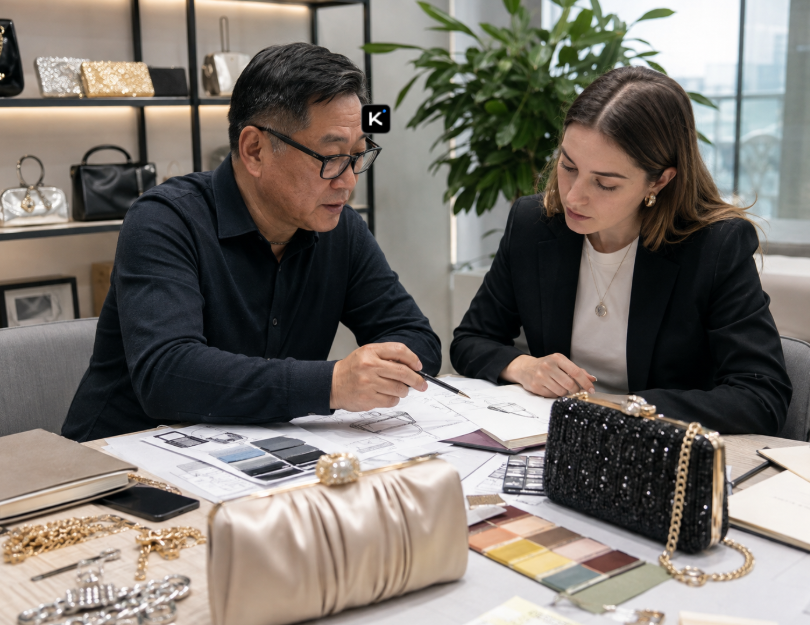
A capable evening bag factory should be able to work from a technical drawing, reference sample, concept image, measurement sheet, or an existing design that needs modification. The development team should then help turn that information into a manufacturable structure.
That can include adjusting the bag dimensions, selecting reinforcement, changing the opening, matching a chain length, developing a metal frame, choosing plating, modifying an internal pocket, or finding a better method to attach decorations.
Branding deserves the same attention. Evening bags often use metal logos because they match the hardware and formal appearance, but embossing, debossing, printing, woven labels, hangtags, and custom metal accessories can also work. Our guide to حقائب بشعار مخصص explains the main branding methods and where each method fits.
Ask how the factory controls a custom development project from one revision to the next. There should be a clear record of dimensions, material codes, color references, hardware finishes, logo position, packaging, and approved changes.
This point is easy to underestimate. Verbal approval such as “make the gold slightly lighter” can be understood differently by the buyer, salesperson, sample room, plating supplier, and production team. A good manufacturer converts subjective feedback into measurable or traceable specifications whenever possible.
Recycled materials need similar discipline. If you plan to make sustainability claims, ask what documentation supports the material claim and whether traceability continues through the relevant supply chain. Textile Exchange’s المعيار العالمي لإعادة التدوير provides third-party criteria for recycled content and chain of custody, together with social, environmental, and chemical processing requirements. The presence of recycled polyester alone does not automatically mean a finished bag is GRS certified.
5. Request Samples Before Placing a Bulk Order
Never approve an Evening Bag Manufacturer based only on website images, catalog photos, or a digital rendering.
The sample is where the supplier’s promises become physical. Hold the bag in your hand. Put it on a flat surface. Open and close it. Attach the chain. Remove the chain. Check the interior. Look at it under bright light and normal indoor light.
Measure the sample against your specification instead of judging only by appearance. Small differences can matter on an evening bag because the product itself is compact. A one-centimeter change in height, chain drop, flap position, or frame opening may noticeably change the proportions.
Color should be compared against an agreed reference. Hardware should be checked against an approved plating sample when color accuracy matters. Your logo size and position should also be measured rather than approved only by eye.
We normally recommend treating the approved final sample as the physical reference for mass production. Keep the specification sheet with it so both visual and measurable requirements are clear.
Your approval checklist can include:
- finished dimensions and acceptable tolerance;
- outer material and lining;
- approved color reference;
- bag shape and reinforcement;
- frame, clasp, zipper, or magnetic closure;
- chain length and attachment points;
- plating color;
- bead, rhinestone, or decorative placement;
- logo size, position, and finish;
- pockets and interior construction;
- packaging method.
Do not rush sample approval just because the overall bag “looks good.” The sample stage is the cheapest place to correct a production problem.
6. Review Quality Control and Production Management
A perfect sample does not guarantee a perfect bulk order.
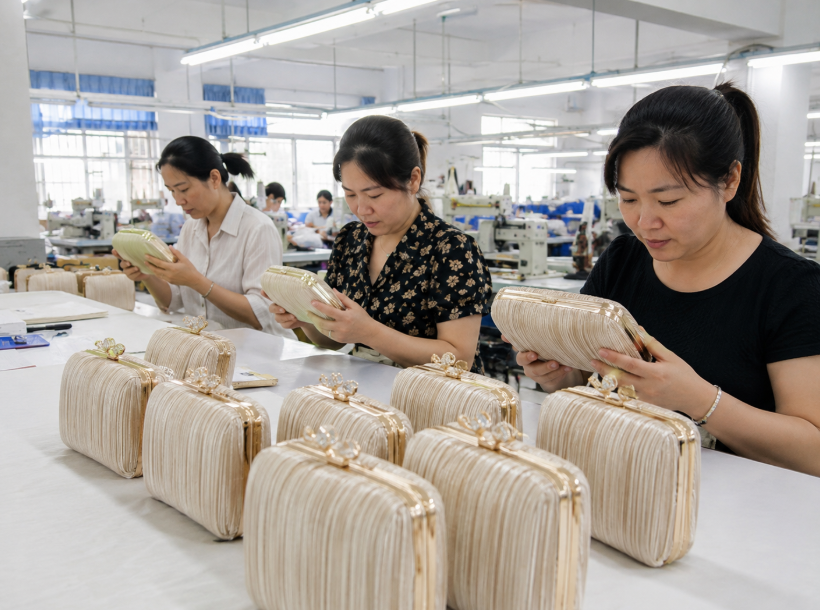
The sample room may work on one piece for a long time. Production workers need to repeat the same result hundreds of times while working with different batches of fabric, hardware, decorations, and packaging materials. That is why production management matters as much as sampling ability.
Ask How Quality Is Checked During Production
Ask the factory what gets inspected before sewing begins. Incoming materials should be checked against approved references, especially fabrics, leather, lining, frames, chains, clasps, decorative components, and plated hardware.
Production should also have in-process checks. Waiting until the entire order is finished makes corrective work much harder.
Early production pieces are particularly useful. If the first assembled bags reveal uneven frames, wrong reinforcement, lining problems, or plating differences, the process can still be adjusted before the same problem spreads through the full order.
Final inspection should cover both appearance and function. Bags can be counted, measured, visually checked, opened and closed, inspected for stains and scratches, and verified against packaging requirements.
ISO 9001 is one useful reference when evaluating whether a supplier operates a structured quality management system. The ISO 9001 quality management standard focuses on processes for consistently meeting customer and applicable requirements. A certificate should still be verified rather than treated as proof that every individual shipment will automatically be defect-free.
Confirm How They Handle Defects and Bulk Order Consistency
Ask what happens when an inspector finds a defect. “We will check the quality” is not a complete answer.
You want to know whether defective pieces are separated, repaired when possible, replaced when necessary, and checked again before packing. Repeated defects should also trigger a review of the production step causing them.
Bulk consistency is especially important with evening bags because visible components often come from several suppliers. Fabric may come from one mill, frames from a hardware producer, plating from another workshop, and decorative components from another source.
A reliable factory manages those inputs as one product. That means using approved references, controlling material batches, recording changes, and avoiding unapproved substitutions simply because one component becomes difficult to source.
7. Compare Communication, Reliability, and Long-Term Support
Manufacturing ability is only useful when the factory can communicate it clearly.
Pay attention to the quality of answers you receive during sampling. A good supplier does not automatically say yes to every request. Experienced production teams will sometimes tell you that a construction is unstable, a decoration needs reinforcement, a material may wrinkle, or a particular hardware design creates a production risk.
That kind of feedback is valuable. You need a manufacturing partner who can identify problems before bulk production, not one who agrees with everything and explains the limitations after the order has started.
Response speed matters, but accuracy matters more. Check whether specifications remain consistent across conversations and whether sample changes are recorded correctly. See if the supplier can explain why something changed rather than giving a vague answer.
Long-term support also becomes important when you add new colors, reorder a successful style, replace a discontinued material, or expand the original design into another size. A factory that maintains product records and approved references can make repeat orders much easier to manage.
If you are still comparing suppliers in China, our guide on how to find a trustworthy handbag manufacturer covers factory verification, documentation, production capability, and other checks that complement the evening-bag-specific points above.
الخلاصة
Choosing the right Evening Bag Manufacturer comes down to how well the factory controls details from development through mass production. Relevant evening bag experience matters. Material and hardware knowledge matter. The ability to turn your idea into a controlled specification matters just as much as the final sample you receive.
Look closely at what the manufacturer does before problems appear. A dependable supplier should ask questions about your design, explain material and construction limitations, document approved details, inspect incoming components, control production quality, and keep bulk goods aligned with the sample you approved.
Hetebag is based in Huadu, Guangzhou, China, with our own factory and more than 15 years of experience in bag development and manufacturing. We support OEM and ODM projects and work with an established network of material, hardware, and production partners around Guangzhou’s bag manufacturing supply chain. Our work covers product development, material sourcing, sampling, customization, production management, quality control, and export support.
If you are looking for an evening bag manufacturer for a new collection or an existing product line, you can contact the Hetebag team and leave your phone or WhatsApp number together with your product requirements. We will be glad to learn more about your project, discuss what is practical to manufacture, and explore the possibility of working together.
الأسئلة الشائعة
What MOQ should I expect when ordering custom evening bags?
Many of our custom bag projects start at around 300 pieces per style, although the actual MOQ depends on the construction, material, color, hardware, decoration, and packaging. Custom-dyed fabrics, specially plated hardware, molded metal parts, or unique decorations may carry their own supplier MOQs, so it is better to confirm these items before sampling.
What should I send an evening bag manufacturer to get an accurate sample?
A useful development package normally includes bag dimensions, reference images or drawings, material preferences, color references, logo files, hardware finish, chain length, lining requirements, decoration details, packaging requirements, and expected order quantity. Vector logo files and clear measurements reduce unnecessary interpretation during sample development.
How can I make sure the bulk evening bags match my approved sample?
Keep a confirmed sample together with a detailed specification sheet and approved material, color, and hardware references. Ask the manufacturer how it manages pre-production confirmation, incoming material inspection, early production checks, in-line inspection, and final inspection. Any changes after sample approval should be documented before they enter bulk production.
What are the most common quality problems with evening bags?
The issues we pay close attention to include satin puckering, loose beads or rhinestones, scratched hardware, inconsistent plating colors, uneven frames, weak chain attachment points, visible glue, poorly fitted linings, irregular edge paint, and shape differences between pieces. The exact inspection points should be adjusted to the bag’s construction rather than using the same checklist for every style.
Can an evening bag manufacturer develop custom hardware and metal logos?
Yes, experienced manufacturers can usually coordinate custom metal logos, frames, clasps, chains, decorative pieces, and other hardware. Fully custom components may require mold development and separate approval of dimensions, surface finish, plating color, and attachment method. Ask for a hardware sample or pre-production reference when the component is visually important to the design.
Should I use a third-party inspection before shipment?
It can be useful for overseas buyers, especially with a new supplier, technically detailed product, or larger repeat program. A third-party inspection does not replace the factory’s own quality control; it gives you another verification point before shipment. Your inspection criteria should refer to the approved sample and written product specifications so the inspector knows exactly what should be accepted or rejected.


