
 Arabic
  English
  Italian
  French
  German
  Spanish
 A handbag sample can look right in a photograph and still leave important production questions unanswered. How firm should the body feel? Will the lining catch in the zipper? Can the finished strap attachment carry the intended contents?
The custom handbag manufacturing process turns those decisions into a repeatable product. For European and North American brands, that means agreeing on the design, materials, sample standard, production controls, and shipment requirements before the order reaches the cutting table.
At each stage, you need something concrete to review: a specification, a physical sample, a production check, or a packed unit. Leaving those reviews until the order is nearly finished makes corrections harder.
1. Define Your Handbag Design and Prepare a Tech Pack
Start with how the handbag will be used. A structured work handbag, a soft shoulder bag, and a compact evening bag need different capacities, openings, reinforcements, and carrying arrangements, even when they share a similar outline.
Define the intended contents and the desired silhouette before discussing decoration. Check whether a phone, wallet, or other essential item can pass through the opening, rather than relying only on the bag’s outside dimensions.
A tech pack is the written and visual specification used to develop and manufacture the handbag. Reference photographs help explain style, but drawings and measurements tell the sample maker what to build.
Include these details in the first version:
- Front, back, side, base, and interior drawings.
- Finished width, height, depth, handle drop, and strap adjustment range.
- Pocket locations, usable openings, closures, and lining arrangement.
- Shell material, lining, reinforcement, thread, and hardware specifications.
- Logo artwork, application method, size, and placement.
- Measurement methods, acceptable tolerances, and packaging requirements.
Give the style a reference number and the document a revision date. When development changes a pocket or strap, update the drawings and component list together so the next sample uses one consistent instruction set.
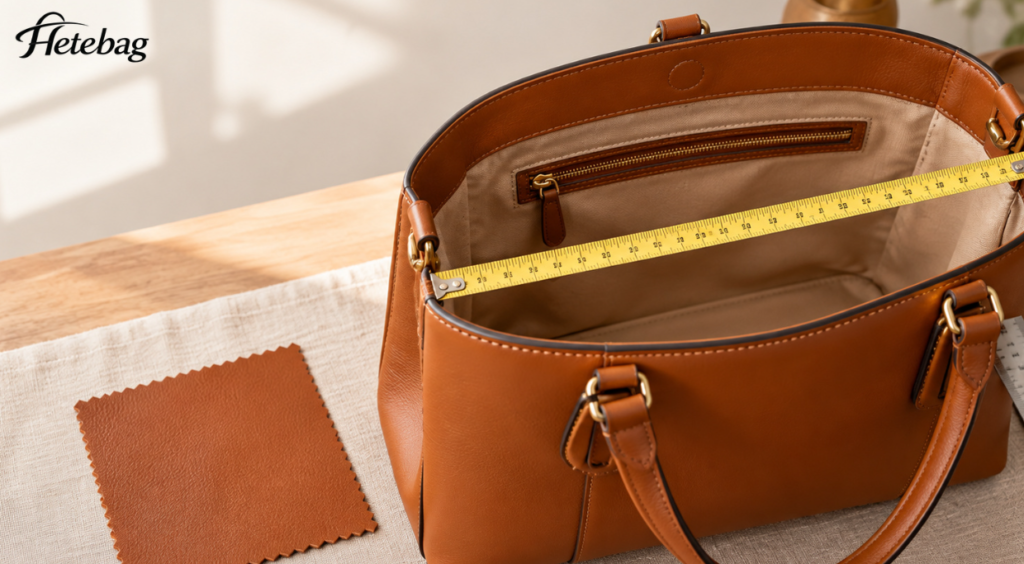
For a soft handbag, specify whether measurements apply when it is empty, laid flat, or lightly filled. The measurement method matters as much as the number, particularly when different teams will check the sample and the finished goods.
2. Choose Materials, Lining, Hardware, and Branding Details
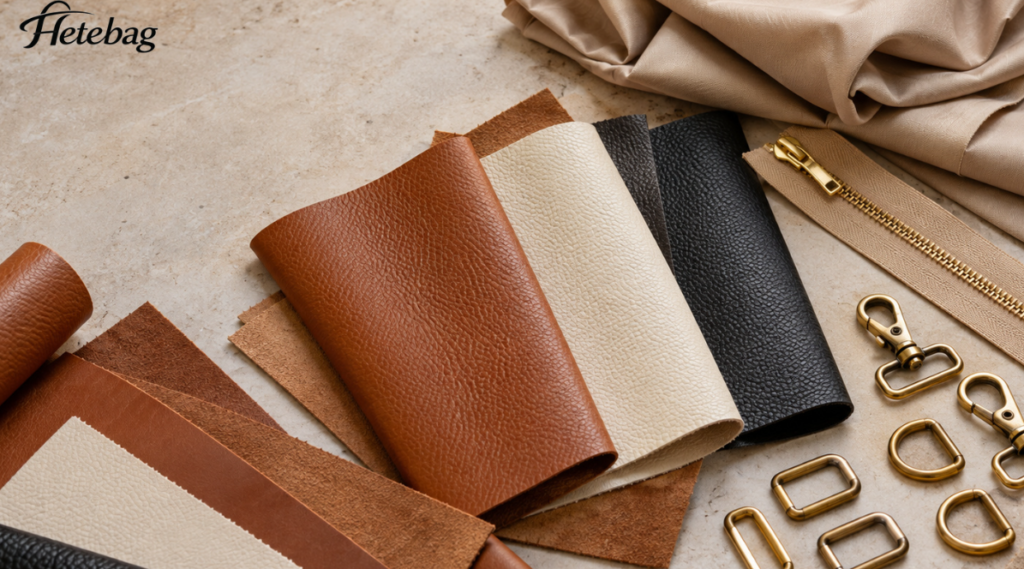
Material selection affects the handbag’s shape as well as its surface appearance. A soft leather may need additional support for a structured silhouette, while a heavy reinforcement can make a compact bag feel unnecessarily rigid.
Review physical swatches and describe the actual material construction. Terms such as “premium leather” or “high-quality PU” leave too much open to interpretation; specify thickness, finish, backing, and the properties relevant to the design.
HeteBag’s خيارات مواد تصنيع الحقائب المخصصة provide a starting point for discussing suitable materials. Your final choice should still depend on the actual swatch, construction, and agreed performance requirements.
| Component | What to specify | What to check during development |
|---|---|---|
| المادة الخارجية | Material identity, thickness, finish, color reference | Drape, folding behavior, surface marking, panel consistency |
| البطانة | Composition, weight, color, pocket construction | Snagging, loose fabric near closures, color transfer |
| Reinforcement | Type, location, attachment method | Shape retention, stiffness, added weight |
| الأجهزة | Dimensions, finish, mechanism, attachment | Closure alignment, sharp edges, coating wear, fastening security |
| العلامة التجارية | Artwork, method, size, placement reference | Legibility, alignment, attachment, effect on the surrounding panel |
Choose zippers, rings, snaps, and buckles as functional components. A heavier metal finish may suit the appearance but change the weight or pull on a small attachment tab. Discuss the complete assembly when reviewing أجزاء معدنية مخصصة للحقائب, including how each part connects to the handbag.
Approve branding on the intended material. Debossing depth, print adhesion, and the support needed behind a metal badge can change with the substrate. Record placement from a finished seam or another stable reference so it remains meaningful after assembly.
For European orders, consider material compliance while selecting components. ECHA’s guidance on skin-sensitising chemicals identifies restrictions relevant to leather and textile articles, including chromium VI in leather. Agree with your laboratory which restrictions and tests apply to the actual product before ordering bulk materials.
For the United States, establish the intended user group early. The CPSC’s children’s product guidance explains how products primarily intended for children aged 12 or younger are classified. A children’s handbag project needs a compliance review appropriate to that classification, rather than automatically using an adult handbag’s requirements.
3. Develop Patterns and Make the First Handbag Sample
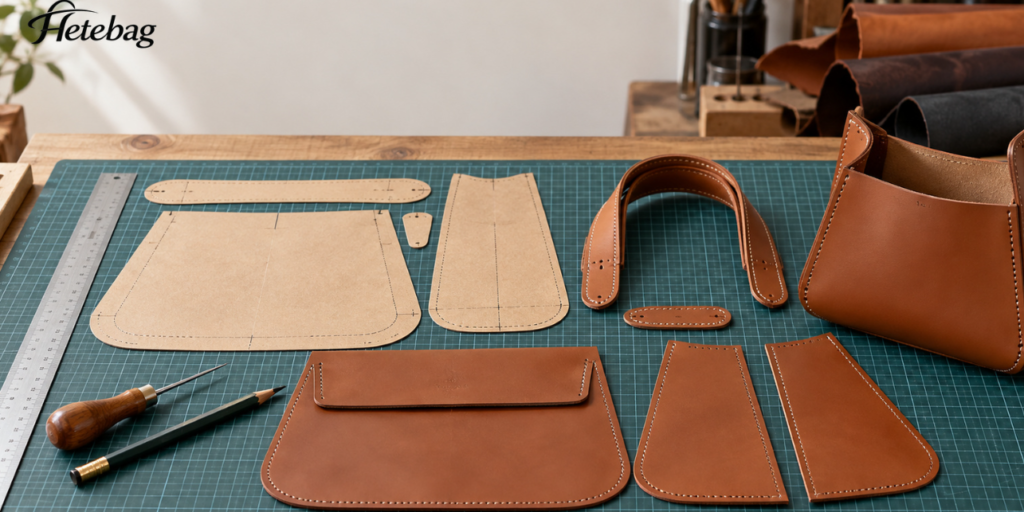
The pattern maker converts the design into individual pieces for cutting and assembly. These pieces account for seam allowances, curves, folds, reinforcement, and the way the lining fits inside the shell.
Curved corners, shaped gussets, and thick seams deserve attention at this stage. A drawing may show the intended shape clearly while leaving the assembly sequence unresolved, especially where several layers meet around a closure or handle attachment.
The first sample lets you assess proportions and construction. Check the opening, pocket access, handle position, and balance when carried, alongside the handbag’s appearance on a table.
Ask the manufacturer to identify every temporary component used in the prototype. A substitute zipper, available lining, or different reinforcement can be useful for checking construction, but it does not establish approval of the intended production material.
Keep development feedback in one review sheet. Describe the location, requested change, and reason for each correction; photographs with marked reference points help the pattern maker understand what needs adjusting.
For example, “the phone pocket opening needs more clearance with the lining attached” is more useful than “make the inside better.” Check the revised sample with the intended contents so the correction addresses actual use.
4. Review Samples and Approve the Pre-Production Sample
Sample review should cover appearance, function, and construction. Fill the bag with representative contents, carry it using each strap arrangement, and check whether the closure still operates smoothly when the body changes shape.
Inspect the interior as carefully as the exterior. Loose lining, narrow seam allowances, poorly secured thread ends, or an unsupported hardware attachment may remain hidden in product photographs.
Use a written approval checklist with the following points:
- Dimensions measured using the agreed method.
- Shell, lining, reinforcement, and hardware matching the component list.
- Shape, symmetry, handle balance, and usable compartment space.
- Stitching, seam construction, attachment points, and edge finishing.
- Closure operation, strap adjustment, and hardware security.
- Logo execution, labels, and the complete packaging arrangement.
Set practical test conditions with the supplier. For a carrying test, record the load, duration, method, and acceptable result; for closure checks, agree on the operating sequence and number of cycles. A development check can reveal a weakness, but it does not replace laboratory testing needed to substantiate a specific performance claim.
Establish a clear production reference
The pre-production sample should use the materials, components, branding, and construction intended for the order. If anything remains different, record the exception and how it will be verified before production proceeds.
Once approved, identify the physical reference sample with the style, color, date, and document revision. The buyer and manufacturer should retain matching references where possible, with approval photographs and the final tech pack available to the inspection team.
Avoid approving a sample with unresolved instructions such as “improve the edge paint.” Define the required correction and its verification method. Changes affecting shape, function, or material behavior generally deserve another physical review before bulk cutting.
5. Confirm Order Details and Prepare for Bulk Production
Before placing the order into production, reconcile the purchase order with the approved sample and specifications. Check quantities by style and color, packaging, labeling, and the latest document versions.
Component availability also affects custom handbag manufacturing. Custom-dyed materials, specially made hardware, and printed packaging may have separate minimum quantities or longer preparation schedules than the sewing work.
Ask the supplier to separate the schedule into material procurement, production, inspection, and shipment readiness. Define what starts the production clock, for example, sample approval and receipt of the required materials, so the delivery promise has a clear basis.
| Order control | What to confirm before release |
|---|---|
| Product standard | Approved sample identification, tech pack revision, final component list |
| Quantity | Units by style and color, agreed treatment of quantity variation |
| المواد | Approved references, availability, incoming checks, substitution procedure |
| Quality | Defect definitions, measurement tolerances, test conditions, inspection plan |
| التغليف | Shape protection, unit packing, barcode positions, carton quantities |
| Delivery | Milestones, inspection release, shipping responsibilities, required documents |
Define how changes will be approved after the order starts. The supplier should explain the effect on materials, work already completed, and delivery before implementing a revision.
Use the pre-production meeting to review difficult details with the manufacturing team. Ask for a first production piece or agreed early-stage evidence where a new construction needs confirmation before the full batch advances.
6. Produce the Handbags: Cutting, Sewing, Assembly, and Finishing
The exact sequence varies with the handbag’s material and construction. Some branding and hardware operations happen on flat panels, while other components can only be fitted after the body takes shape.
Cutting and component preparation
Production begins with checking the incoming materials against the approved references. The cutting team then prepares shell panels, lining pieces, straps, pockets, and reinforcement components from the finalized patterns.
For natural leather, cutting decisions should account for grain, shade, thickness variation, and visible surface marks. Agree which variations suit the design and where they are acceptable so appearance judgments remain consistent across the batch.
Preparation may include thinning leather at selected seams, adding reinforcement, or completing decoration on flat panels. These operations need to match the approved construction; changing layer thickness can affect both stitching and the finished shape.
Sewing and assembly
Operators assemble subcomponents such as pockets, handles, and straps before joining the main body and lining. Reinforcement and hardware attachment should follow the approved method at the points that carry load.
Inline checks help catch problems while they are still accessible. If a pocket position, seam, or closure alignment needs correction, the team should address the affected work and confirm the cause before more pieces pass through the same operation.
Finishing and production checks
Finishing may include thread trimming, surface cleaning, edge treatment, and shaping, depending on the design. Check that these steps produce the agreed appearance without hiding construction defects or damaging the material.
Request progress evidence focused on the order’s risk points. Photographs of strap attachments, closure alignment, and interior seams can help a remote buyer review production, although they do not replace an agreed inspection of the batch.
7. Inspect Finished Handbags and Prepare Them for Shipment
Finished goods inspection compares the order with the approved sample, specifications, and packaging requirements. Inspectors need clear defect definitions so decisions do not depend entirely on personal taste.
Distinguish functional problems from appearance variations that fall within the agreed standard. A closure that fails, an insecure strap attachment, and a visible material mark can require different responses depending on the specification and severity.
Agree on the inspection method before the order is complete. If using acceptance sampling, define the lot, sampling standard, inspection level, and acceptance criteria with the inspector. A sampling result supports a batch decision; it cannot demonstrate that every unexamined unit is defect-free.
An independent inspection can be useful where the buyer needs additional verification. Intertek’s inspection services describe inspection support across production and supply chains; the scope for your handbag order should specify the actual workmanship, quantity, function, and packing checks required.
Check the packed product
A handbag can pass appearance inspection and arrive with avoidable transport damage. Confirm that stuffing supports the shape, protective materials separate hardware from vulnerable surfaces, and the packing arrangement does not create permanent folds.
Approve a packed unit as well as the unpacked handbag. Check labels and barcode scans, carton counts, carton dimensions, and any retailer-specific packing instructions against the order documents.
Shipment release should follow the agreed inspection result and any required corrective work. Record how reworked goods will be rechecked, then reconcile the packing list and shipping documents with the approved quantities.
الخلاصة
The custom handbag manufacturing process works best when each stage leaves a clear reference for the next. A complete tech pack guides development, an approved sample sets the product standard, and production checks help maintain that standard through assembly and packing.
Resolve material choices, functional details, and acceptance criteria before the batch begins. Those decisions give both your team and the manufacturer a practical basis for identifying problems and agreeing on corrections.
If you are preparing a handbag collection, explore HeteBag’s custom handbag manufacturing services. Send your design references or tech pack, target quantities, intended market, and preferred launch schedule to discuss the next development steps.
الأسئلة الشائعة
Can I start without a complete handbag tech pack?
You can begin with sketches, reference photographs, or a physical sample. Ask the manufacturer which details need clarification, then build a written specification during development so the approved design can be reproduced consistently.
How many sample rounds should I plan for?
The number depends on the design’s maturity, construction, and availability of the intended components. Allow for prototype review and confirmation of the production standard, with additional revisions when shape, materials, hardware, or function remain unresolved.
What determines the minimum order quantity for custom handbags?
Minimum quantities can depend on the handbag construction and the sourcing requirements for each material, color, hardware item, and packaging component. Ask whether the quoted MOQ applies per design or per color, and whether an available component could support a smaller first order.
How long does custom handbag manufacturing take?
The schedule depends on sample revisions, material procurement, component development, production capacity, testing, and inspection. Request a dated milestone plan for your actual order, and distinguish factory shipment readiness from arrival at your warehouse.
Can the manufacturer change materials after sample approval?
Set a written substitution procedure before production starts. Review the proposed replacement’s identity, appearance, function, and relevant test evidence; when the change affects construction or use, request an updated sample before approving it.


