
 Arabic
  English
  Italian
  French
  German
  Spanish
 A makeup bag may begin as a small part of a beauty launch, yet the design decisions behind it can affect much more than storage. The bag may sit beside your skincare products in a gift set, travel with a customer for months, appear in social content, or become a retail product of its own. Once customers keep using it, your brand keeps going with them.
We have worked on bag development for many years, and one pattern comes up often: buyers start with appearance too early. They choose a color, send a logo, find a reference photo, and ask the factory to make something similar. The sample may look attractive when empty. Once actual bottles, palettes, brushes, or cosmetics are packed inside, the weak points become easier to see.
جيد Custom Makeup Bags should be designed from the inside out. You need to know what goes inside the bag, who will use it, how often it will be handled, and what the finished product should say about your beauty brand. Shape, material, lining, zipper, logo, pockets, and hardware can then support the same goal instead of competing with one another.
If you are developing a new cosmetic pouch or travel beauty case, you can also review our custom makeup bag manufacturing options while planning the specification.
1. Why Custom Makeup Bag Design Matters for Beauty Brands
Beauty brands use makeup bags in very different ways. Some are sold as standalone accessories. Others hold a skincare collection, support a holiday gift set, come free with a qualifying purchase, or form part of a travel kit or subscription box. The intended role changes what a good design looks like.
A gift-with-purchase pouch usually needs immediate visual recognition and convenient everyday storage. Customers may not expect a complicated organizer, so adding too many internal components can make the bag heavy and awkward. A retail makeup organizer has a different job. Buyers are paying for the bag itself, which puts more pressure on the zipper, lining, stitching, internal organization, and overall finish.
| Brand Use | Design Priority | Common Design Direction |
|---|---|---|
| Gift with purchase | Brand visibility and easy daily use | Simple pouch, recognizable color, clear logo |
| Skincare set | Bottle fit and spill management | Wider base, wipeable lining, upright storage |
| Travel beauty set | Organization and protection | Compartments, secure zipper, structured body |
| Retail accessory | Finish and long-term usability | Better hardware, refined construction, detailed interior |
| Subscription box | Compact packing and versatility | Lightweight structure, efficient dimensions, flexible storage |
This is why copying an existing cosmetic bag often gives disappointing results. The reference bag was designed around somebody else’s products and customer expectations. Your bag has a different job.
Brand consistency matters here as well. Packaging disappears after the product is opened, while a useful makeup bag may stay in a handbag, bathroom, suitcase, or desk drawer for a long time. That gives the product a useful second life and makes good design part of the customer experience rather than just decoration.
2. Start With Your Beauty Brand and Product Purpose
Before drawing the bag, write a short product brief. It does not need to be complicated. It should answer what the bag carries, where it will be used, how the customer should interact with it, and what impression it should create.
Define How the Makeup Bag Will Be Used
Start by deciding whether the makeup bag is a retail item, promotional gift, skincare set, travel set, subscription-box accessory, influencer kit, or part of another beauty program.
This choice affects nearly every later decision.
A pouch holding three makeup items can stay soft and compact. A skincare kit containing glass bottles may need a wider base, extra body support, and an interior that is easier to wipe. Travel-oriented Custom Makeup Bags may need stronger zipper construction and better organization because users open, close, pack, compress, and carry them more often.
Think about the packaging process too. If your beauty products will be inserted into the bag before retail packing, the opening needs enough space for workers to load them efficiently. Narrow openings sometimes look clean on drawings but become frustrating during assembly.
Understand Your Target Customer
Look beyond age and gender. Daily behavior tells you more about how the bag should work.
Does your customer carry a few makeup essentials to work? Does she use full-size skincare bottles at home? Is the bag mainly for international travel? Does the brand sell professional brushes, compact cosmetics, clean skincare, or luxury beauty products?
Customer behavior can guide surprisingly small details. Someone using a pouch inside a handbag usually values low weight and quick access. Someone storing skincare on a bathroom counter may appreciate a bag that stands upright. A customer carrying brushes may need a separate area that prevents bristles from rubbing against bottles and palettes.
Brand position matters at the same time. Minimal beauty brands often work better with controlled colors, clean surfaces, subtle branding, and fewer decorative details. Fashion-led beauty collections can carry stronger textures, quilting, contrasting hardware, printed interiors, or unusual silhouettes.
Before discussing styles with a Makeup Bags Supplier, answer one question clearly:
Who is this bag for, and what should it carry?
Once that is settled, the remaining design work becomes much easier.
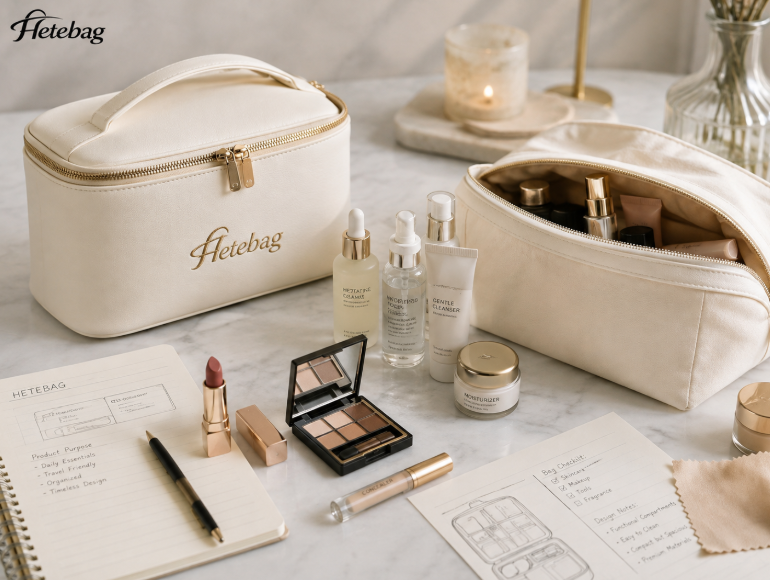
3. Design the Size, Shape, and Internal Layout Around the Products
This is where many makeup bag projects either become practical products or attractive objects that customers stop using.
Dimensions should come from the contents, not from a general request such as “medium size.”
Determine Size and Capacity
Collect the actual dimensions of the products that will go inside. Measure the height, width, depth, and shape of foundation bottles, lipstick tubes, palettes, brushes, skincare containers, compacts, and any secondary packaging that will remain inside the bag.
Do not simply add these measurements together. Products need handling space.
A bottle that is exactly the same height as the finished internal dimension can press against the zipper. A palette that technically fits may be difficult to remove once other items are packed around it. Thick seams, lining, foam, piping, dividers, and zipper construction also reduce usable internal space.
We usually think in terms of usable volume, not only external dimensions. This is especially important with rounded corners, quilted bodies, thick padding, structured EVA panels, and double-layer bags. Two cosmetic bags with the same outside measurements can hold noticeably different amounts.
Bottle orientation also deserves attention. If your set contains liquid skincare, keeping bottles upright may reduce mess and improve presentation. That may require a flatter base, enough internal height, and elastic retainers or dividers.
Plan Compartments, Pockets, and Opening Structure
More compartments do not automatically make a better makeup bag. Every pocket consumes space, adds material, creates seams, and changes how the main compartment behaves.
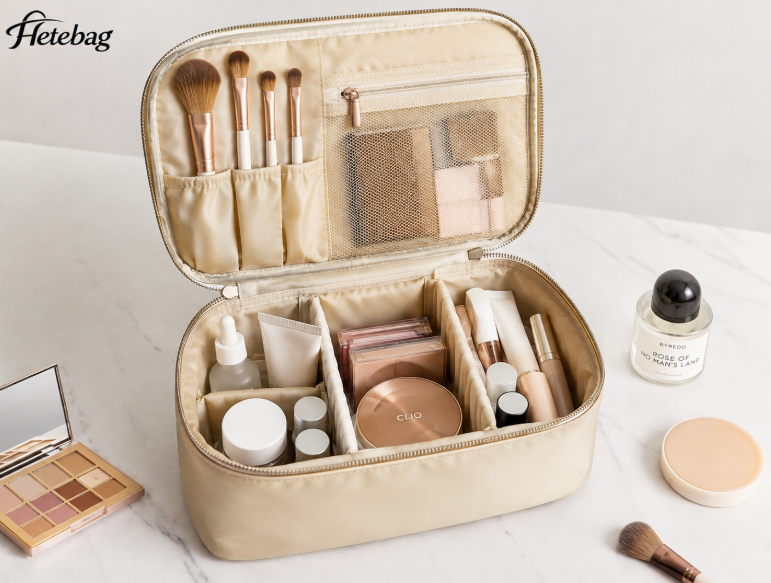
Brush holders work well when the customer regularly carries brushes. A protective flap above them can help stop makeup residue from transferring to the rest of the interior. Mesh pockets are useful when visibility matters. Elastic bottle loops can control movement, but the elastic tension and loop width need to match the intended containers.
Removable dividers suit larger structured organizers because customers can change the layout. Small cosmetic pouches usually gain more from one useful pocket than several narrow sections that limit capacity.
Opening design may matter even more than the number of pockets. A wide zipper opening lets users see and reach the bottom. Double zippers can improve access on larger cases. Clamshell construction gives excellent visibility but needs controlled hinge, lining, and zipper engineering to prevent the bag from collapsing awkwardly when opened.
Try packing the sample with real products. Close it. Carry it. Open it again and take items out one by one. That simple test reveals more than looking at an empty sample on a table.
4. Choose Materials and Finishes That Match Your Brand
Material selection should solve several problems at once: appearance, cleaning, structure, hand feel, decoration, durability, and production consistency.
Select the Outer Material and Lining
PU works well when you want a smooth surface, defined shape, and a more polished beauty presentation. The surface can also be easier to wipe than many woven fabrics. The exact PU construction still matters because thickness, backing, grain, softness, and surface finish can change both sewing behavior and the finished look.
Nylon works well for lightweight travel-oriented bags. Polyester gives brands a wide range of colors, prints, constructions, and finishes. Canvas creates a more natural, lifestyle-driven feeling and suits designs where woven texture is part of the visual identity. Quilted fabrics can make a cosmetic pouch feel softer and more fashion-led, but padding thickness needs control or the bag may become bulky.
Clear PVC and TPU serve a different purpose. They let customers see the contents and work well for transparent cosmetic organizers. Material thickness, clarity, flexibility, cold resistance, edge construction, and odor should all be reviewed during sampling instead of judging the material only from a small swatch.
You can review a broader comparison of مواد تصنيع الحقائب المخصصة when preparing your material specification. For options specific to this product, our custom makeup bag materials guide compares outer fabrics, linings, and the checks to make before approval.
| المواد | Brand Character | مقاس مناسب | Detail to Check During Sampling |
|---|---|---|---|
| PU | Clean, refined, fashion-focused | Premium beauty sets, retail pouches | Surface feel, creasing, edge quality |
| النايلون | Light, technical, practical | Travel and daily-use bags | Density, coating, structure |
| البوليستر | Flexible and versatile | Promotions, printed collections | Weave, backing, color consistency |
| قماش | Natural and casual | Lifestyle and clean-beauty brands | Shrinkage, texture, print result |
| PVC / TPU | Modern and transparent | Clear organizers, travel sets | Clarity, flexibility, odor, seam construction |
| Quilted fabric | Soft and fashion-led | Retail and gifting | Padding thickness, stitch consistency |
The lining deserves as much attention as the outside. Cosmetic products leak. Powders break. Brushes carry residue. A beautiful pale lining that absorbs foundation easily can create a poor customer experience after only a few uses.
When textile safety requirements matter for your target market or brand policy, specifications can reference recognized testing frameworks rather than vague phrases such as “safe fabric.” معيار OEKO-TEX 100 covers textiles tested for harmful substances, including components used in finished textile articles. Ask your supplier for documentation that applies to the actual material or component being supplied instead of assuming a material category is automatically certified.
Brands using recycled fabrics should take the same approach to environmental claims. Textile Exchange’s Global Recycled Standard addresses certification of recycled materials and chain of custody. A supplier saying “this is recycled polyester” is not the same as having traceable documentation that supports the claim required by your program.
Coordinate Colors, Texture, and Hardware
Once the main material is selected, look at the entire bag as one visual system.
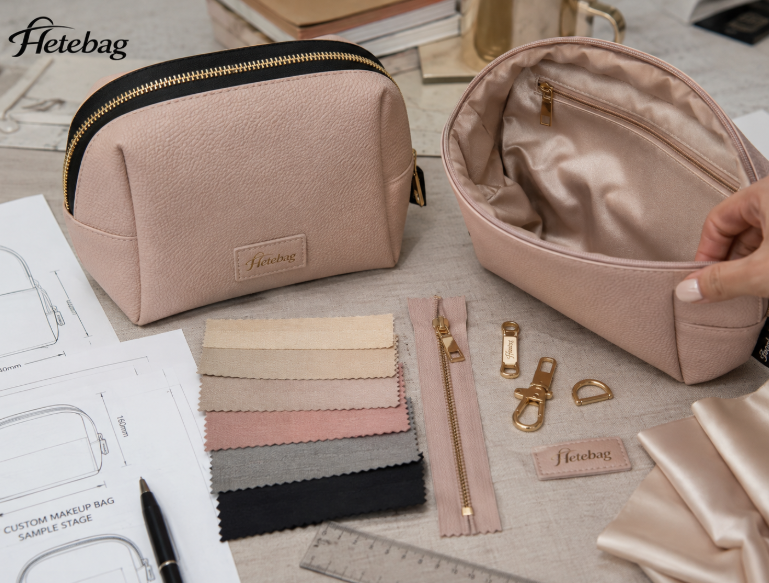
Place the exterior fabric, lining, zipper tape, zipper teeth, puller, thread, binding, labels, and metal hardware next to each other. A small mismatch that seems acceptable on separate samples can become obvious when everything is assembled.
Beauty brands often pay close attention to Pantone matching on the outer fabric but overlook zipper tape and stitching thread. Those small differences can make the final product feel less controlled.
Metal finish also affects brand perception. Bright polished hardware creates a different feeling from brushed, matte, or gunmetal finishes. The choice should support the brand rather than simply follow whatever component is easiest to source.
5. Turn Your Brand Identity Into Makeup Bag Details
Putting a logo on a stock-looking bag is customization, but it is not always strong product design.
Better Custom Makeup Bags use branding across several details without turning every surface into an advertisement.
Choose the Right Logo Method and Placement
Embroidery creates texture and works well with canvas, nylon, polyester, and quilted fabrics, though dense stitching can distort thin or heavily padded panels. Screen printing suits many simple graphics. Heat transfer can reproduce fine details and multiple colors. Embossing or debossing works naturally with suitable PU surfaces. Metal plates and custom metal lettering can support more refined collections.
Placement changes the result just as much as technique. A large centered logo creates obvious brand visibility. A small embossed mark near an edge feels quieter. A woven label inserted into a side seam can work for brands that prefer subtle recognition.
You can compare more custom logo bag options before approving artwork for sampling.
Logo artwork should be tested on the selected material, not approved from a computer mockup alone. Texture, coating, padding, heat sensitivity, and surface stretch can all change the final result.
Create Signature Brand Details
The strongest identity sometimes comes from details that customers notice gradually.
A zipper pull can use a recognizable shape. The lining can carry a small repeating brand pattern. Contrast stitching can echo a packaging color. A woven label can repeat the same typography used across the beauty collection. Handles, piping, zipper tape, binding, and interior pockets can all contribute.
Keep the hierarchy controlled. If you combine a large logo, printed lining, custom hardware, contrast stitching, patterned fabric, and several labels in one small pouch, the design can quickly become noisy.
Choose one or two signature elements and let the rest support them.
Zippers deserve functional attention here too. They are touched almost every time the bag is used. If zipper performance is a major requirement, ask your manufacturer how the chosen zipper is evaluated rather than relying only on appearance. YKK, for example, publishes zipper testing methods covering chain strength, stop strength, slider lock strength, and pull-tab strength. YKK zipper testing methods give buyers a useful reference for understanding what zipper performance can actually involve.
6. Make and Test a Sample Before Bulk Production
The sample is where the design stops being an idea.
Do not approve it after checking only color and logo. Fill it with the products it was created to carry and use it as a customer would.
Check whether the tallest bottle clears the zipper. See whether bottles remain upright when the bag is moved. Put brushes into the holders and make sure they can be removed without catching surrounding pockets. Pack the intended quantity of products and look at the silhouette from every side.
Pay attention to the lining around the zipper. Loose lining can become trapped in the slider. Look at corners where several layers meet; excessive bulk can make the zipper difficult to close and create uneven shapes.
Turn the bag inside out where construction allows. Review seam allowances, binding, loose threads, reinforcement points, pocket alignment, and areas where hardware is attached.
Then check the branding against approved artwork. Measure logo position instead of judging it by eye. Compare exterior color, lining color, thread, zipper tape, and hardware under normal lighting.
Cleaning should also be tested. Put a small amount of representative cosmetic residue on a spare lining swatch and confirm how easily it can be removed using the care method you plan to recommend.
One issue buyers sometimes miss is what happens when the bag is full. A flat pouch may become rounded and pull the logo toward the bottom. A structured case may bulge between reinforcement panels. Internal dividers can consume more volume than expected. Sample approval should reflect the packed product, not only the empty bag.
If changes are required, write them into the revised specification. Do not rely on messages such as “make the pocket a little larger” or “move the logo slightly higher.” Give the updated dimension or position so the production team has something measurable to follow.
7. Work With a Custom Makeup Bag Manufacturer From Design to Production
Choosing a Makeup Bags Factory should involve more than comparing finished catalog styles. The supplier needs to understand product development, because many quality problems begin before sewing starts.
A useful development process normally moves through a clear sequence:
Design brief → Material confirmation → Prototype → Sample revision → Pre-production approval → Bulk production → Quality inspection
Your design brief should include intended use, target dimensions, products that need to fit inside, preferred materials, lining, internal structure, logo artwork, color references, hardware direction, packaging requirements, destination market, and any testing or compliance requirements.
Material confirmation comes next. Ask for swatches or actual components when color, texture, coating, transparency, recycled content, or hardware finish matters. Once the material system is stable, the prototype becomes much more meaningful.
Revisions need to be documented. After the final sample is approved, the factory should work from an agreed specification covering measurements, construction details, materials, logo position, colors, hardware, stitching, labeling, and packing. Our cosmetic bag manufacturing guide explains the subsequent production stages and quality checks to confirm before releasing the bulk order.
Production quality control should compare finished bags against that approved standard. Measurements alone are not enough. Zipper operation, stitching, shape, pocket placement, lining cleanliness, logo consistency, hardware finish, and packing also need attention.
At our manufacturing operation in Huadu, Guangzhou, we have been working with bag design and production since 2011. Our team supports OEM and ODM projects for international brands, wholesalers, distributors, and sourcing teams, with product development covering materials, structure, sampling, production, and inspection.
Years in this industry have taught us that successful Custom Makeup Bags rarely come from adding more features. They come from making the right decisions in the right order. Start with the products. Understand the customer. Build the correct internal space. Choose materials that fit the use and brand. Test the actual sample before committing to production.
When those pieces work together, the makeup bag feels like part of the beauty brand rather than a generic pouch carrying its logo.
If you are developing a new cosmetic pouch, beauty gift bag, travel makeup organizer, or private-label collection and are looking for an experienced bag manufacturer in China, you can send us your project requirements. We are based in Huadu, Guangzhou, have more than 15 years of manufacturing experience, and work with an established network of production and supply-chain partners. Leave your phone number or project details on the website, and we will be glad to discuss your design and explore how we can build it together.
Frequently Asked Questions About Custom Makeup Bag Design
What information should I send a manufacturer before developing a custom makeup bag?
Send the intended use, bag dimensions or product dimensions, reference images, preferred material, lining requirements, logo artwork, colors, internal pockets, zipper style, hardware, packaging, expected quantity, destination market, and any testing requirements. If the bag will contain a fixed beauty set, providing the dimensions of every product is especially useful.
Should I design the makeup bag before choosing the products that go inside?
If the bag belongs to a fixed skincare, cosmetics, or travel set, finalize the main product dimensions first. The bag pattern can then be built around the real contents. Designing the bag first often creates wasted internal space, poor bottle orientation, difficult access, or a bag that becomes distorted once packed.
Which lining is best for makeup bags that may get dirty?
The right lining depends on the bag construction and brand requirements, but buyers should focus on surface cleanability, moisture resistance, flexibility, seam compatibility, color, and how the lining behaves around the zipper. Ask for a lining swatch and perform a cleaning test with representative cosmetic residue before approving bulk production.
How do I know if the compartments are actually useful?
Pack the sample with the exact products or products of similar dimensions. Check whether each compartment can be accessed when the bag is full, whether elastic loops hold bottles without excessive pressure, and whether pockets reduce the main compartment too much. Internal organization should make products easier to use, not simply increase the number of features.
What should I check on a pre-production makeup bag sample?
Review finished dimensions, usable capacity, material and lining, color, logo size and position, zipper movement, hardware, stitching, pocket placement, reinforcement, shape when fully loaded, ease of cleaning, packaging, and all approved brand details. Any change should be recorded in the final specification before bulk cutting begins.
How can a beauty brand keep custom makeup bags consistent across repeat orders?
Keep an approved physical sample and a detailed specification covering fabric, color reference, lining, dimensions, logo method, hardware, zipper, thread, pocket construction, and packaging. Material changes should be approved before a repeat production run. When consistency is important, avoid replacing components based only on similar appearance; confirm that the new component matches the agreed performance and visual standard.


