
 Arabic
  English
  Italian
  French
  German
  Spanish
 A custom lunch bag may look like a simple sewn product, but it combines several systems in one small package. The outer fabric must resist daily wear. The insulation must hold its shape. The lining must be easy to clean. Zippers, handles, seams, printing, and packaging must stay consistent across a full production run. A weak decision in any one area can create leaks, poor temperature control, crooked logos, or repeat-order problems.
China remains a practical sourcing base for Custom Lunch Bags because its major bag-making regions bring fabric mills, foam suppliers, lining converters, zipper vendors, printers, sewing factories, testing services, and export logistics close together. That network gives buyers more development choices and makes it easier to adjust a design before mass production. The real advantage is not simply access to many factories. It is access to a complete product-development system.
The challenge is choosing the right partner. Some suppliers are strong in technical cooler bags. Some are better at promotional lunch totes. Others manage broad lifestyle collections through a network of factories. A buyer should not select a Lunch Bags Manufacturer by website photos alone. You need to compare product fit, engineering skill, material control, communication, compliance support, and repeat-order stability.
This guide reviews 15 Chinese manufacturers and explains how to evaluate them from a factory-side purchasing view. The list is not an absolute quality ranking. It is a sourcing shortlist based on public company information, product focus, operating history, and relevance to custom insulated bag projects. You should still verify every supplier against your own specification and market requirements before placing an order.
Why Choose Custom Lunch Bag Manufacturers in China?
Complete Supply Chains and Production Capability
The strongest bag-manufacturing regions in China are not isolated sewing centers. Guangzhou and Dongguan have deep networks for textiles, trims, printing, sampling, and export services. Quanzhou and Xiamen have long experience with backpacks, sports bags, cooler bags, and outdoor sewn products. Yiwu, Jinhua, Ningbo, Hangzhou, Wenzhou, and Hefei support different combinations of wholesale sourcing, lifestyle products, promotional bags, and scaled production.
This matters because Custom Lunch Bags need more than fabric and sewing. A common three-layer construction includes an outer shell, an insulation layer, and an inner lining. Each layer may come from a different specialist. The bag may also require webbing, buckles, zipper tape, printed labels, woven labels, piping, hook-and-loop tape, mesh, base boards, and custom packaging.
When these inputs are available within a mature regional supply chain, the manufacturer can compare alternatives quickly. A polyester shell can be changed to RPET. A thin foam can be replaced with a firmer grade. A sewn PEVA lining can be redesigned as a welded insert. The zipper gauge can be increased. A print can move away from a seam before the sample is approved.
Production capability also includes process control. Cutting accuracy affects panel alignment. Lamination quality affects wrinkles and insulation stability. Sewing skill affects corner shape and binding. Heat welding affects leak resistance. Final packing affects how the bag looks after shipping. A capable Lunch Bags Manufacturer should understand how all these stages connect.
Commercial Efficiency Without Weakening the Specification
China is often selected for competitive manufacturing economics, but buyers should not treat the lowest quotation as the main goal. Two lunch bags can look almost identical in a photo while using different fabric weights, foam densities, lining thicknesses, zipper grades, reinforcement methods, and inspection standards.
A lower quotation may come from a valid design simplification. It may also come from hidden specification changes. The factory could use a lighter fabric, thinner foam, generic zipper, shorter webbing reinforcement, fewer stitches, or a less controlled printing method. None of these choices is automatically wrong. The problem starts when they are not disclosed.
Experienced buyers compare the complete bill of materials, construction, testing plan, packaging, and inspection scope. They ask what has changed between quotation versions. They also confirm whether the approved sample reflects the materials that will be used in mass production.
The best commercial result comes from removing features that do not serve the user while protecting the parts that drive performance. A simple front pocket may add real value. Decorative piping may not. A wider opening can improve daily use. Extra internal dividers may only increase sewing complexity. Good factories help you make these trade-offs before production begins.
Mature OEM and ODM Services
OEM service usually starts with your design, specification, artwork, or reference sample. The manufacturer turns those requirements into a producible item. ODM service may begin with an existing factory structure that is adapted through materials, dimensions, colors, trims, branding, and packaging.
Both models can work. Your choice should depend on how original the product must be, how quickly you need to validate the concept, and how much development risk your team can manage.
A mature OEM or ODM process should include requirement review, material confirmation, pattern development, prototype sampling, sample comments, pre-production approval, bulk material control, production inspection, and shipment release. It should not be limited to adding a logo to a stock bag.
Before contacting a supplier, prepare a one-page product brief. State the target user, intended contents, loaded weight, external dimensions, usable internal dimensions, carrying method, cleaning needs, insulation expectation, logo method, sales market, packaging, and testing requirements.
Reference photos help, but each photo should include a note explaining what you like. A factory cannot measure words such as “premium,” “strong,” or “high quality” without clearer standards.
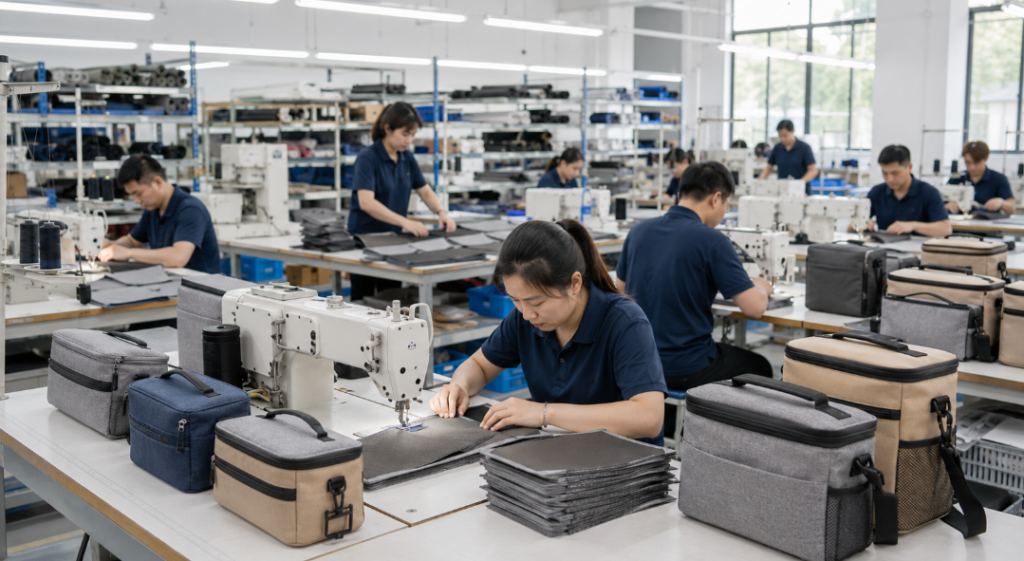
How to Choose the Right Custom Lunch Bag Manufacturer
Factory Experience and Product Quality
Years in business are useful, but relevant production experience matters more. A factory that has produced promotional tote bags for twenty years may still struggle with a double-deck insulated lunch bag. The technical risks are different.
Ask the supplier to show products with a similar structure, not simply the same category name. A box-shaped lunch bag requires clean corner construction. A lunch backpack needs correct load distribution and reinforced shoulder straps. A welded liner requires heat-sealing equipment and trained operators. A foldable design needs materials that recover after compression.
During supplier screening, confirm who owns the factory, who holds the export contract, and where production will occur. Request the legal company name, business license, factory address, production photos or a live video walkthrough, and a clear statement of outsourced processes. Outsourcing is common and can be well managed. Hidden outsourcing is the risk.
Quality should be defined through measurable checkpoints. These may include fabric weight, coating, color standard, foam thickness, lining type, seam allowance, stitch density, zipper specification, handle attachment, print position, logo color, finished dimensions, loaded appearance, odor, cleanliness, and packing method.
From our factory-side work, one of the most common sourcing mistakes is approving the appearance while leaving the hidden construction undefined. The bag looks right, yet the bulk order uses a different foam, lining, zipper, or reinforcement method. That is why a serious Lunch Bags Manufacturer should document the inside of the product as carefully as the outside.
One approved sample is not enough. You also need a signed specification, bill of materials, approved color references, artwork files, packaging instructions, and a defect classification. The sample shows the target. The documents help the factory repeat it.
Customization Capability and Material Selection
A strong supplier does not respond to every request with “yes.” It explains what will work, what may fail, and what needs testing.
For example, embroidery can look rich on canvas or firm polyester, but a large dense design may compress foam and distort the front panel. Heat-transfer printing can reproduce detailed artwork, yet the film, adhesive, fabric coating, and cleaning method must be compatible. Screen printing is efficient for simple colors, but seam placement and panel curvature can affect the final appearance.
The same practical thinking should guide material selection. Polyester is widely available, stable in color, and suitable for many daily-use bags. Nylon can provide a smoother hand feel and strong tear performance, though coating, denier, and weave still matter.
Canvas creates a natural lifestyle look, but it absorbs moisture more easily unless treated or combined with another layer. RPET supports recycled-material positioning, but the recycled claim should be supported by traceability documents rather than a verbal statement.
Buyers who need a deeper material comparison can review this buyer’s guide to materials for custom lunch bags before requesting samples.
The inner construction requires equal attention. Aluminum foil can provide a bright, familiar insulated appearance, but thin foil may tear at folds. PEVA is flexible and easy to wipe, yet a sewn PEVA lining is not automatically leakproof. EPE foam is common for cushioning and insulation, while thicker foam may create sewing and binding problems at tight corners.
In our sampling work, we often see buyers request the thickest foam available. That sounds safe, but it can create bulky seams, uneven corners, zipper waves, and poor packing efficiency. The better choice is the foam structure that meets the thermal and shape target without making the bag hard to sew cleanly.
Ask the manufacturer to present at least two material routes with clear differences. One route may prioritize a soft, lightweight feel. Another may prioritize structure and wipe-clean performance. Comparing complete constructions is more useful than discussing one fabric at a time.
MOQ, Quotation Scope, and Lead Time
MOQ is not just a number set by the sewing line. It is influenced by fabric dyeing, custom coating, printed artwork, zipper color, webbing color, molded parts, labels, packaging, and the number of colorways.
A factory may accept a smaller sewing quantity but still require a larger material purchase. Ask which component creates the MOQ and whether several colorways can share the same base material. This question often reveals whether the supplier truly understands the order structure.
Review the quotation scope carefully. Confirm whether it includes sampling assumptions, bulk materials, logo application, labels, individual packaging, cartons, testing, inspection support, and export terms. The purpose is not to negotiate every line separately. It is to prevent a specification from changing after development begins.
Lead time should be split into stages: material booking, lab dips or print strike-offs, pre-production sample, bulk cutting, sewing, finishing, inspection, and packing. A single total number hides the critical path. Custom fabric, molded accessories, complex printing, or welded liners may require extra preparation.
Do not approve a schedule that starts before key materials are confirmed. Rushing into cutting can lock in the wrong color or construction. A realistic timeline protects both buyer and factory.
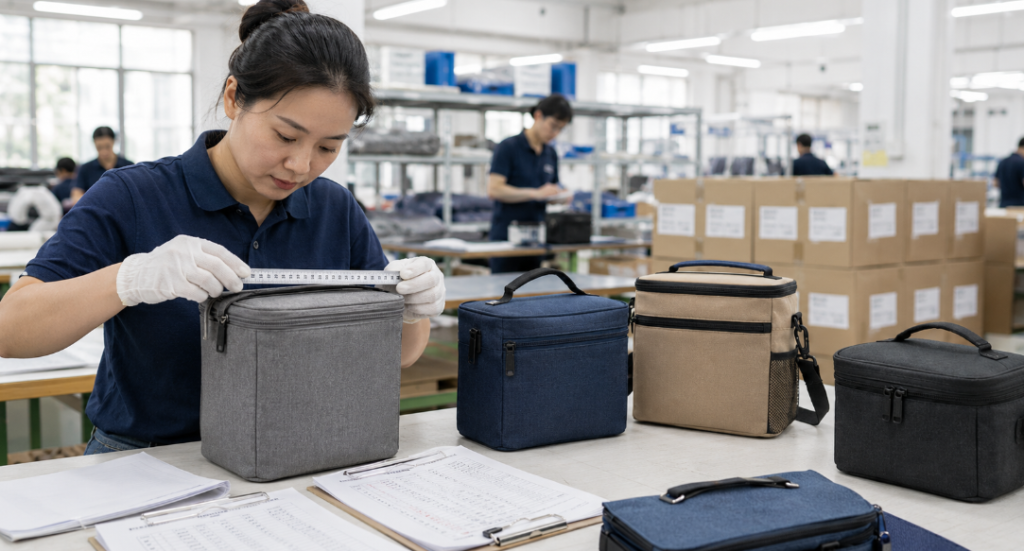
Best 15 Custom Lunch Bag Manufacturers in China
| الشركة المصنعة | تأسست | الموقع | المنتجات الرئيسية |
|---|---|---|---|
| هيتباغ | 2011 | قوانغتشو، قوانغدونغ | Custom lunch bags, insulated bags, cooler bags |
| Dongguan Fenglinwan Leisure Products Co., Ltd. | 2007 | Dongguan, Guangdong | Lunch bags, cooler bags, outdoor insulated bags |
| Everich | 2000 | Hangzhou, Zhejiang | Custom lunch bags, coolers, outdoor products |
| Yiwu Meiyi Bags Co., Ltd. | 2007 | Yiwu, Zhejiang | Lunch bags, cooler bags, backpacks |
| Xiamen Benshine Bags Co., Ltd. | 2013 | Xiamen, Fujian | Cooler bags, backpacks, functional outdoor bags |
| Syloon | 2004 | Ningbo, Zhejiang | Custom lunch bags, coolers, lifestyle products |
| Anhui Honeyoung Enterprise Co., Ltd. | 1998 | Hefei, Anhui | Lunch bags, cooler bags, backpacks |
| Zhejiang Yisen Bag Co., Ltd. | 2008 | Jinhua/Yiwu, Zhejiang | Lunch bags, cooler bags, cosmetic bags, travel bags |
| Jinhua SANNE Household Products Co., Ltd. | 2004 | Jinhua/Yiwu, Zhejiang | Lunch bags, cooler bags, picnic bags |
| Xiamen Oready Industry & Trade Co., Ltd. | 2013 | Xiamen, Fujian | Cooler bags, travel bags, sports bags, backpacks |
| Quanzhou Osgoodway Co., Ltd. | 2014 | تشوانتشو، فوجيان | Cooler bags, school bags, travel bags, backpacks |
| Shenzhen Tongjin Bags & Gifts Co., Ltd. | 2014 | شينزين، قوانغدونغ | Lunch bags, cooler bags, storage bags, cosmetic bags |
| Wenzhou Conlene Bags Co., Ltd. | 2007 | Wenzhou, Zhejiang | Cooler bags, shopping bags, canvas bags, reusable bags |
| Xiamen PackRich Import & Export Co., Ltd. | 2009 | Xiamen, Fujian | Insulated lunch bags, cooler bags, packaging bags |
| Quanzhou Twinkling Star Handbag Co., Ltd. | 1995 | تشوانتشو، فوجيان | Lunch bags, school bags, cooler bags, travel bags |
1. Hetebag
Hetebag was founded in 2011 and states that it operates its own factory in Huadu, Guangzhou. Its bag range covers lunch bags, handbags, totes, backpacks, travel bags, and other custom categories, with OEM and ODM support for brands, wholesalers, and distributors.
The company’s lunch bag materials include polyester, nylon, canvas, Oxford fabric, coated fabrics, and RPET, with options for insulated structures, pockets, straps, and several logo methods.
Hetebag is a practical candidate when a buyer needs more than a ready-made promotional item. Its broad bag background can help with projects that combine lunch bags with backpacks, totes, travel products, or other coordinated accessories. That can reduce communication gaps across a multi-category program.
For supplier evaluation, ask Hetebag to convert your design into a controlled specification. Review the foam, lining, zipper, reinforcement, artwork position, and packaging on the finished sample. Buyers developing a new project can also review its custom lunch bags manufacturing options to prepare a clearer brief.
2. Dongguan Fenglinwan Leisure Products Co., Ltd.
Dongguan Fenglinwan states that it was established in 2007 and focuses on outdoor waterproof bags, cooler bags, insulated outdoor bags, and other functional soft products. Its public materials describe OEM and ODM services from product design through mass production.
This focus makes Fenglinwan worth considering for technical or outdoor-oriented Custom Lunch Bags. Buyers developing rugged coolers, waterproof-style lunch bags, camping products, or bags with more complex functional construction may find its experience relevant.
Do not assume that “waterproof” applies to the complete bag. Ask which panels, seams, zipper areas, and liners are sealed. A coated outer fabric can resist rain while needle holes, zipper gaps, and sewn lining seams still allow water movement. Request a test method that matches the actual use.
3. Everich
Everich traces its business to 2000 and is based in Hangzhou. The company is widely associated with drinkware and outdoor products, while its lunch bag division offers custom insulated lunch bags and coolers with OEM and ODM options.
Everich may suit buyers building a coordinated food-and-drink program, such as lunch bags paired with bottles, tumblers, lunch boxes, or outdoor accessories. Its broader product platform can help when design language, packaging, and color need to match across several items.
Because Everich operates across multiple product categories and business entities, confirm which legal entity will contract the order and which facility will make the bag. Ask for bag-specific samples and production evidence rather than relying only on drinkware credentials.
4. Yiwu Meiyi Bags Co., Ltd.
Yiwu Meiyi presents itself as a bag manufacturer operating since 2007. Its product range includes insulated cooler and lunch bags, backpacks, messenger bags, cosmetic bags, shopping bags, duffels, and travel products.
Meiyi can be useful for importers, promotional buyers, online sellers, and wholesalers who need a broad catalog with customization. Yiwu’s sourcing environment also supports packaging, accessories, and mixed-product purchasing.
The key question is whether your project requires catalog adaptation or original engineering. For a standard lunch tote with custom colors and branding, a broad supplier may be efficient. For a high-performance leakproof bag, ask for evidence of welded lining capability, thermal testing, and specialized quality controls.
5. Xiamen Benshine Bags Co., Ltd.
Benshine states that it was established in 2013 in Xiamen and produces custom bags using polyester, nylon, canvas, and more sustainable material options. Its public product positioning covers cooler bags, backpacks, outdoor bags, and custom sewn products for several industries.
The company may fit buyers seeking flexible development across functional bag types. Xiamen has a mature export base for backpacks, sports bags, travel bags, and cooler products, which can support projects that share similar materials and sewing methods.
Ask Benshine how it controls approved materials across repeat orders. Fabric color, coating feel, foam firmness, and zipper shade can drift when substitute lots are used. A repeat-order plan should identify which materials are standard, which are custom, and how changes will be approved.
6. Syloon
Syloon was founded in 2004 in Ningbo and describes a business model that combines in-house manufacturing with a large qualified-supplier network. Its range covers stationery, gifts, promotional products, drinkware, bags, and other lifestyle items.
This model can work well for retailers and brands that need a coordinated lifestyle collection rather than one isolated bag. Syloon may help with design themes, packaging systems, and multiple SKUs across lunch, school, office, and gifting categories.
Buyers should understand which items are made in-house and which are sourced from partner factories. Ask for the exact production site before approval. The quality system must follow the order to the real factory, not stop at the trading or project-management office.
7. Anhui Honeyoung Enterprise Co., Ltd.
Anhui Honeyoung Enterprise was founded in 1998 in Hefei. Public company information describes a combined manufacturing and export group, while its bag operations cover backpacks, school bags, travel bags, cooler bags, duffels, and drawstring bags.
One company profile states that a dedicated travel-products branch was founded in 2008.
Honeyoung may suit buyers looking for a broad, established organization with design, production, export, and quality-control functions. Its experience across school bags and backpacks can also be relevant for lunch bag sets or coordinated children’s products.
Confirm the contracting entity and the factory assigned to your order. Group history and bag-factory history are not always the same. Your audit, sample approval, purchase order, and inspection should all identify the actual production site.
8. Zhejiang Yisen Bag Co., Ltd.
Public profiles describe Yisen Group as originating in 2008 and operating bag-related businesses in Yiwu and other locations. The product range includes school bags, backpacks, cosmetic bags, cooler bags, and travel bags.
Another current public profile lists a later founding date, so buyers should verify the active legal entity during due diligence.
Yisen may be relevant for buyers who want lunch bags within a wider bag assortment. Its range suggests experience with both structured and soft sewn products.
Before nomination, ask for a product-specific factory assessment. Review cutting, sewing, lining, print, and final-inspection areas. Confirm whether cooler and lunch bag production is a regular line or an occasional category handled through another facility.
9. Jinhua SANNE Household Products Co., Ltd.
SANNE is publicly described as a manufacturer of lunch bags, cooler bags, picnic bags, meal-prep bags, and promotional bags. Several company profiles state that its factory history began in 2004 in the Yiwu/Jinhua area, although some marketplace records show a later company registration.
Its product focus is closely aligned with insulated food-carrying bags, making it a relevant specialist for buyers who need several cooler or lunch formats. This may include compact lunch bags, larger picnic coolers, and meal-prep structures.
The date difference is a useful reminder: verify both factory operating history and present legal registration. Ask which entity owns the equipment, employs the workers, receives payment, and appears on export documents.
10. Xiamen Oready Industry & Trade Co., Ltd.
Xiamen Oready states that it has operated since 2013 and provides OEM and ODM manufacturing for promotional bags, travel bags, sports bags, backpacks, and specialty products. Its public site also lists cooler bag capability.
Oready may be a good fit for brands that need lunch bags to share materials or styling with travel and sports collections. Experience with functional sewn products can support pockets, shoulder straps, reinforced handles, and more complex panel layouts.
Ask how the supplier handles thermal construction. A factory can be strong in backpacks but still need separate control points for foam lamination, lining cleanliness, seam leakage, and insulation consistency. The sample and quality plan should cover these areas directly.
11. Quanzhou Osgoodway Co., Ltd.
Osgoodway’s public company profile lists a 2014 founding date in Quanzhou, while the team also references earlier industry experience. Its products include cooler bags, backpacks, school bags, duffels, laptop bags, diaper bags, dry bags, and organizers.
The company may suit buyers developing a family of soft bags with shared fabrics and trims. Quanzhou’s manufacturing base is especially relevant for backpacks, sports bags, and outdoor products.
Clarify whether the chosen lunch bag will run on a regular production line and whether special processes are internal. For example, heat-welded liners, high-frequency logos, or custom-molded parts may be outsourced. Ask who controls those subcontractors and how rejected components are handled.
12. Shenzhen Tongjin Bags & Gifts Co., Ltd.
Tongjin states that it was founded in 2014 in Shenzhen. Its categories include storage bags, lunch bags, cooler bags, cosmetic bags, backpacks, and related custom products.
This range can serve promotional, retail, gifting, and organization-focused programs. Shenzhen also provides access to printing, packaging, labels, and export services.
When screening Tongjin, focus on sample accuracy and production documentation. Broad-category factories can develop many designs, but consistency depends on controlling each bill of materials. Confirm that the bulk line receives the same approved fabric, foam, lining, trims, and artwork instructions as the sample room.
13. Wenzhou Conlene Bags Co., Ltd.
Wenzhou Conlene was registered in 2007 and produces shopping bags, canvas bags, cooler bags, beach products, washable kraft-paper bags, and reusable packaging products.
Conlene may be especially relevant for promotional lunch totes, reusable shopping-and-lunch hybrids, nonwoven or woven polypropylene constructions, canvas styles, and sustainability-led collections. Its material background differs from factories focused mainly on technical backpacks.
Match the supplier to the performance target. A lightweight promotional cooler bag and a demanding meal-prep bag are different products. Ask for clear insulation, load, lining, and cleaning requirements instead of assuming every cooler bag structure provides the same result.
14. Xiamen PackRich Import & Export Co., Ltd.
PackRich was founded in 2009 in Xiamen and focuses heavily on packaging products, shopping bags, garment covers, gift packaging, and related sewn items. Its range also includes cooler or chiller bags made from materials such as nonwoven fabric, cotton, canvas, PEVA, nylon, and polyester.
PackRich may fit buyers whose lunch bag project is close to promotional packaging, gifting, wine carriers, or reusable retail bags. Its packaging orientation can be useful when presentation and coordinated outer packaging matter.
It may not be the first choice for every technical insulated bag. Ask for product-specific proof of thermal construction, leak control, and repeated daily-use performance before deciding.
15. Quanzhou Twinkling Star Handbag Co., Ltd.
Twinkling Star was established in 1995 in Quanzhou and produces business bags, travel bags, fashion bags, school bags, recycled-material bags, and other textile products. Public company materials also show insulated lunch and cooler bag products.
Its long operating history and broad bag platform may suit buyers with repeat programs, several bag categories, or more structured supplier-management needs. School and travel bag experience can transfer well to lunch sets, bottle pockets, reinforced straps, and coordinated collections.
A long history is not a substitute for product approval. Review the exact line, materials, equipment, and quality team assigned to your order. Ask for current documents rather than relying on old customer lists or historical claims.
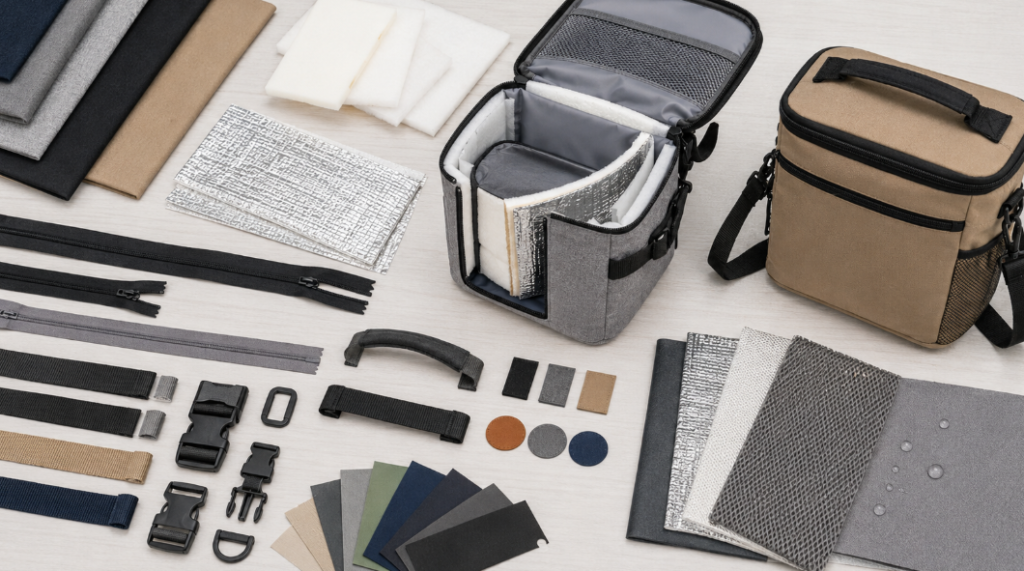
Common Materials and Features for Custom Lunch Bags
Outer Fabrics and Insulated Linings
The outer fabric controls appearance, abrasion resistance, print compatibility, structure, and cleaning. The insulation and lining control temperature retention, internal shape, moisture management, and wipe-clean performance. These layers should be selected as one system.
| Component | Common Options | أفضل استخدام | Main Buyer Checks |
|---|---|---|---|
| Outer shell | Polyester, nylon, Oxford fabric, canvas, RPET, nonwoven or woven polypropylene | Daily retail, school, office, promotion, outdoor use | Weight, weave, coating, abrasion, colorfastness, print compatibility |
| Insulation | EPE foam, PE foam, sponge, other closed-cell foam constructions | Thermal control and bag structure | Thickness, density, recovery, odor, lamination stability |
| Inner lining | PEVA, aluminum foil, coated textile, TPU-based constructions | Wipe-clean interior and moisture resistance | Thickness, seam method, tear resistance, cleaning, market compliance |
| Base support | PE board, PP board, removable insert, foam reinforcement | Upright containers and shape retention | Sagging, edge finish, removability, washability |
| Closures and trims | Coil zipper, molded zipper, hook-and-loop, buckles, webbing | Access, carrying, organization | Gauge, slider movement, pull strength, color consistency |
Polyester is the most common all-around option because it balances availability, durability, color control, and decoration. The word “polyester” alone is not a specification. Denier, weave, fabric weight, backing, coating, and finish all affect performance.
Oxford fabric is also a construction description, not one fixed quality level. Ask for a physical swatch and technical data. A firm 600D fabric with a stable backing behaves very differently from a light 210D fabric.
Canvas works well for lifestyle lunch totes and embroidery. It may need a separate water-resistant layer or coating if the product will face frequent spills. Check shrinkage, color transfer, and surface variation before approving bulk fabric.
RPET can support a recycled-content program, but the buyer needs more than an RPET hangtag. The المعيار العالمي لإعادة التدوير الصادر عن منظمة «تكستيل إكستشينج» covers third-party certification of recycled input and chain of custody, with added processing requirements under GRS.
Ask for current scope certificates and transaction documents when a certified claim is required. GRS does not prove zipper strength, insulation, or leak resistance; those performance points still need separate testing.
Waterproof, Leak-Resistant, and Insulated Performance
These terms should not be used as if they mean the same thing.
A water-resistant outer fabric can handle light moisture on its surface. A waterproof material may block water through the fabric itself. A leak-resistant inner bag may contain small spills for a limited time. A fully leakproof construction usually needs sealed or welded seams and a closure design that prevents liquid escape.
Most standard sewn lunch bags are not fully leakproof because needles create holes in the lining. Binding seams also create channels. A welded removable liner can provide better containment, but its corners, weld width, material thickness, and fit need inspection.
Temperature retention is also system-based. Foam thickness alone does not decide performance. Bag size, opening frequency, zipper coverage, ambient temperature, starting food temperature, ice packs, empty air space, and test duration all affect the result.
Ask the factory to define the test setup. A useful test report should state the room temperature, starting temperature, internal load, ice-pack quantity, measurement points, opening schedule, and acceptance limit. Claims such as “keeps cold all day” are not enough for procurement.
A practical sample test can include:
- Load the intended containers and check whether the base sags.
- Place absorbent paper beneath the liner during a controlled spill test.
- Open and close the zipper repeatedly while the bag is loaded.
- Carry the bag by each handle and strap at the agreed test weight.
- Wipe the lining several times with the expected cleaning method.
- Compress the packed bag, then check shape recovery.
- Run a thermal test that matches the user’s real routine.
Logo, Color, and Structural Customization
Logo selection should follow the fabric and panel design. Screen printing works well for bold artwork with limited colors. Heat transfer supports detail and gradients. Sublimation suits compatible polyester panels and all-over artwork. Embroidery provides texture but adds needle penetration, weight, and panel stiffness.
Woven patches, rubber patches, metal badges, and printed labels can create a more product-led identity.
Logo placement must be approved on the finished bag. Foam, seams, curved panels, pockets, and piping change the way artwork sits. Keep small text away from stitch lines. Check the logo while the bag is empty and loaded.
Color control should use an agreed standard, such as a physical swatch or recognized color reference. Screen colors are unreliable. The outer fabric, zipper, webbing, lining, and print may use different materials and dye systems, so a “matching” color can still show visible shade differences.
Zippers deserve special attention because users touch them every day. Specify zipper type, gauge, tape color, slider, puller, end stops, and opening direction. A branded zipper can help, but brand alone does not replace application testing.
YKK’s own selection guidance stresses choosing compatible size and details for the end use. Buyers can review YKK’s zipper selection guidance and then set a performance requirement for the lunch bag.
Structure should be tested with real containers. Internal volume is less useful than usable dimensions. A wide container may not pass through a narrow zipper opening even when the stated capacity seems large. A tall bottle may require a side pocket, extra height, or an adjustable divider. Build the product around the load.
The Process of Sourcing Custom Lunch Bags from China
Inquiry and Requirement Confirmation
A strong inquiry helps a serious Lunch Bags Manufacturer respond well. Send a product brief, reference images, dimensions, target market, estimated order quantity, color count, logo file, packaging needs, and expected use.
Explain whether the project is promotional, retail, school, corporate, meal-prep, outdoor, or private label.
The factory should return questions. That is a positive sign. It may ask about container size, foam thickness, lining preference, print colors, shoulder strap, pockets, base support, cleaning, testing, or carton limits.
A supplier that quotes immediately without resolving key details may be assuming a cheaper or simpler construction.
Request a written specification after the first discussion. Track each revision. When one feature changes, review the effect on other parts. A thicker foam can change seam bulk. A larger zipper opening can require reinforcement. A new print method can change panel preparation.
Sampling and Sample Testing
The first sample is a development tool, not the final quality standard. Review it in a structured way.
Start with function. Load the actual meal boxes, bottles, snacks, utensils, and ice packs. Check opening access, internal clearance, balance, handle comfort, strap length, and base stability.
Then inspect construction. Look at panel symmetry, stitch lines, binding, zipper ends, corners, lining fit, loose threads, print placement, and odor.
Record comments with photos and measurements. Avoid comments such as “make it better.” State the problem and the acceptance target.
For example: “Move the logo 15 mm upward from the pocket seam,” or “Increase the zipper opening so the intended container can enter without tilting.”
When the revised sample is approved, identify it as the golden sample. Sign and date it. Keep one sample with the buyer and one with the factory. Freeze the bill of materials, artwork, color references, measurements, and packaging.
Before bulk production, approve a pre-production sample made with bulk-intended materials. This step catches differences between sample-room materials and production materials.
We recommend treating this sample as a production gate: no bulk cutting until the materials, measurements, colors, logo, and packaging are signed off.
Bulk Production, Inspection, and Shipping
Bulk production should begin only after the key materials and pre-production sample are approved. The factory should check incoming fabric, foam, lining, zipper, webbing, labels, and packaging before cutting.
Inline inspection is valuable because lunch bag defects become harder to correct after assembly. Inspectors can check cut panels, print alignment, laminated parts, handle reinforcement, zipper installation, lining seams, and dimensions while production is running.
Final inspection should follow an agreed sampling plan and defect standard. Critical defects may include sharp objects, contamination, severe odor, incorrect safety labeling, or a construction failure that makes the product unsafe.
Major defects may include broken zippers, detached handles, serious leakage, wrong materials, incorrect branding, or measurements outside tolerance. Minor defects may include small cosmetic issues that do not affect use.
Packing checks are also important. Confirm individual packaging, warning labels where required, carton quantity, carton marks, barcode position, moisture protection, and packed-product shape.
Over-compression can damage foam and create permanent creases. Excess empty space can increase movement and carton damage.
Shipping terms should match your import capability. Confirm the named port or destination, document responsibilities, carton data, and inspection release process before the goods leave the factory.
Do not treat shipment booking as a separate task from production. Packing dimensions and completion dates affect logistics planning.
What to Check When Requesting a Quotation
Confirm MOQ and Quotation Assumptions
A professional RFQ should make assumptions visible. Ask each Lunch Bags Manufacturer to quote against one defined construction and list any alternatives separately. This prevents an attractive quotation from being based on a different fabric, thinner insulation, simpler logo, or weaker packaging.
Use the checklist below when comparing manufacturers.
| RFQ Item | What to Provide or Ask | لماذا هذا مهم؟ |
|---|---|---|
| Product purpose | User, sales channel, contents, loaded weight | Guides structure and material decisions |
| الأبعاد | External size, usable internal size, opening size | Prevents fit problems |
| المواد | Outer fabric, coating, foam, lining, base support | Controls look, performance, and repeatability |
| العلامة التجارية | Artwork, size, position, method, color standard | Reduces logo errors |
| البناء | Pockets, straps, reinforcement, seam type, closure | Defines labor and quality points |
| الحد الأدنى لكمية الطلب | Quantity by design and color; material minimums | Reveals the true order structure |
| أخذ العينات | Sample stages, revision process, approval documents | Controls development risk |
| Production schedule | Material, pre-production, sewing, inspection, packing stages | Shows the critical path |
| الاختبار | Load, zipper, colorfastness, leakage, thermal, chemical tests | Links claims to evidence |
| Compliance | Market, restricted substances, social or recycled-content needs | Prevents unsupported claims |
| التغليف | Individual pack, labels, barcodes, carton limits | Protects retail and logistics requirements |
| Inspection | Inline and final plan, defect classes, acceptance method | Defines shipment release |
Understand Sample and Production Timing
Ask for separate timing for material sourcing, lab dips, print strike-offs, development samples, revised samples, pre-production approval, bulk production, inspection, and packing. This helps your team see which decisions can delay the project.
Sample timing depends on more than sewing. Custom-dyed fabric, printed panels, molded pullers, metal badges, woven labels, and special packaging each have their own preparation cycle.
A supplier may sew a sample quickly while using substitute materials. That sample can confirm shape, but not final color or performance.
Mark every substitute clearly. Approve final bulk-intended materials before production. When the deadline is tight, reduce unnecessary complexity rather than skipping approvals.
Check Certifications and Quality Standards
Certifications should be checked for scope, holder, site, product relevance, issue date, and validity. A logo on a supplier’s website is not enough.
Social audits and product certifications solve different problems. The نظام amfori BSCI supports supply-chain social due diligence and risk management.
It is not a product performance certificate and does not prove that a lunch bag is leakproof, chemically compliant, or thermally effective. Ask for the current audit report, the audited site address, and any corrective-action status when social compliance is required.
GRS supports recycled-content traceability and processing requirements. It does not prove every claim about the finished bag.
A test report from SGS, Intertek, or another qualified laboratory may support specific material or product requirements, but the report must match the material, color, supplier, test method, and market.
Be careful with the phrase “food-grade lining.” Lunch bag linings usually contact closed containers, not food directly. Define the actual contact scenario and ask your compliance team or testing laboratory which regulations apply in the destination market.
Do not request a generic certificate without a clear test scope.
Quality management certificates can show that a system exists, but your product still needs a specification, approved sample, process controls, and inspection. The certificate supports due diligence. It does not replace it.
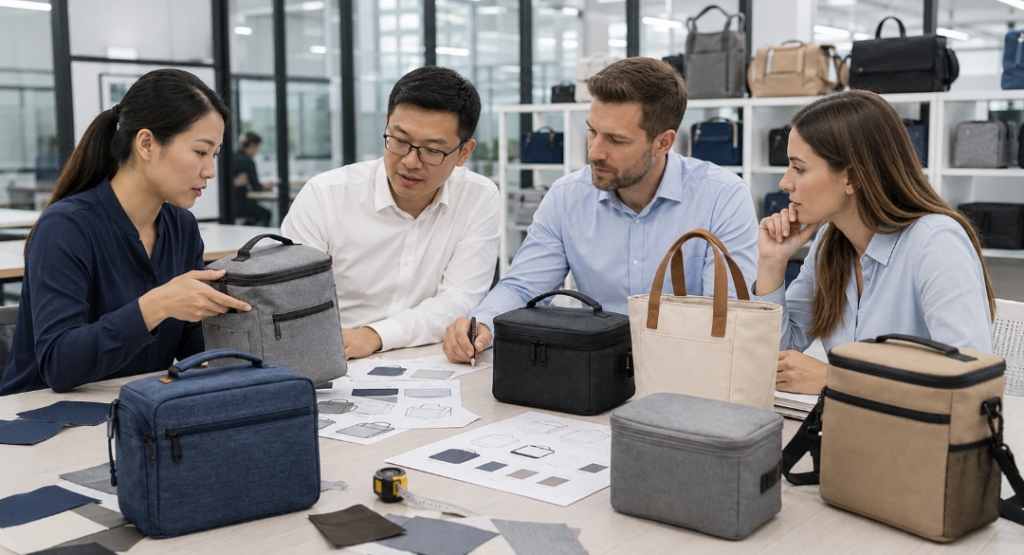
الخلاصة
The best Custom Lunch Bags supplier is the one that can turn your product brief into a repeatable production standard. Factory age, catalog size, and export history can help you build a shortlist, but they do not decide product fit on their own.
Start with the user. Define what the bag must carry, how it will be cleaned, how long it needs to protect temperature, where it will be sold, and how the brand should appear.
Then compare manufacturers by relevant construction experience, material control, sample accuracy, production transparency, quality planning, compliance support, and repeat-order stability.
A capable Lunch Bags Manufacturer should challenge unclear requirements before cutting fabric. It should explain the difference between water-resistant and leakproof construction. It should show how foam, lining, zipper, reinforcement, printing, and packaging work together. It should also document changes instead of relying on memory or chat messages.
هيتباغ is based in Huadu, Guangzhou, and has worked in bag manufacturing since 2011. The team develops Custom Lunch Bags and other custom bag categories through OEM and ODM support, material selection, sampling, production coordination, and quality control.
Hetebag also works with multiple manufacturing resources, which can support buyers who need different bag types within one sourcing program.
When you are screening a Lunch Bags Manufacturer in China, send your intended size, quantity, target market, logo, reference images, and functional requirements through the Hetebag contact .
You can also leave your phone number and project details. The team will review the construction, identify the main production risks, and discuss a workable development route. We welcome your message and look forward to building reliable, long-term cooperation.
الأسئلة الشائعة
What is the typical MOQ for custom lunch bags?
The MOQ depends on the design, material, logo method, and number of colors. Standard designs usually have lower minimum quantities than fully customized products.
How long does it take to produce custom lunch bags?
Production time depends on material availability, design complexity, and order quantity. Sampling, material approval, mass production, inspection, and packing should all be included in the schedule.
Can custom lunch bags be made waterproof and leakproof?
The outer fabric can be made water-resistant or waterproof. A fully leakproof interior usually requires welded seams or a specially designed removable liner. Standard sewn linings may resist small spills but are not always completely leakproof.
How should I choose a lunch bags manufacturer in China?
Check the manufacturer’s experience, factory location, material knowledge, sample quality, production capacity, quality-control process, delivery schedule, and ability to provide compliance documents.
Should I request a sample before mass production?
Yes. A sample allows you to check the size, materials, insulation, logo position, zipper quality, carrying comfort, and overall construction before bulk production begins.
What information should I provide when requesting a quotation?
Provide the bag dimensions, order quantity, target market, materials, logo artwork, color requirements, insulation needs, packaging details, and expected delivery schedule.


