
 Arabic
  English
  Italian
  French
  German
  Spanish
 A custom drawstring bag may look like a simple product. It usually has a fabric body, a cord channel, two drawstrings, and reinforced corners. Yet small construction choices can change how the bag looks, feels, and performs.
A cord that is too thin may feel uncomfortable on the shoulder. A weak corner patch may tear after repeated use. The wrong printing method may crack when the bag is closed. A fabric that looks good in a photo may feel too light once you hold it.
I have worked with bag development and manufacturing for more than 15 years. From the factory side, many production problems do not begin on the sewing line. They begin when product requirements are not discussed clearly before sampling.
A reliable custom drawstring bag supplier should do more than send a quotation and promise a delivery date. The supplier should understand the bag’s use, recommend suitable materials, identify production risks, and turn your requirements into a clear manufacturing specification.
Before choosing among drawstring bag manufacturers, ask the following ten questions.
1. How Much Experience Do You Have in Manufacturing Custom Drawstring Bags?
Start by asking about experience with drawstring bags, not simply experience with bags.
A factory may have produced handbags or backpacks for many years but still have limited experience with lightweight drawstring products. The sewing methods, printing risks, reinforcement structure, and fabric handling can be quite different.
Thin polyester may wrinkle around the seams. Cotton may shrink after washing. Heavy canvas may create a thick cord channel that is difficult to close. Metal eyelets can pull out when the backing material is too small or too soft.
Ask the supplier how long it has manufactured custom drawstring bags, which markets it normally exports to, and what type of buyers it serves. A supplier working with sports brands may understand abrasion and load requirements. A supplier focused on promotional products may be more familiar with large logo areas, simple construction, and high-volume packing.
You should also ask which processes are completed inside the factory. Printing, embroidery, fabric dyeing, lamination, and retail packaging may be handled by production partners. This is normal in the bag industry. The key is whether the supplier controls those partners through approved samples, inspection standards, and written production records.
Product photos are useful, but they are not enough. Ask whether the supplier has made bags with a similar material, size, logo process, cord structure, and intended use. An experienced supplier should be able to explain why a construction works, not only show that it has been made before.
2. What Materials and Bag Styles Can You Provide?
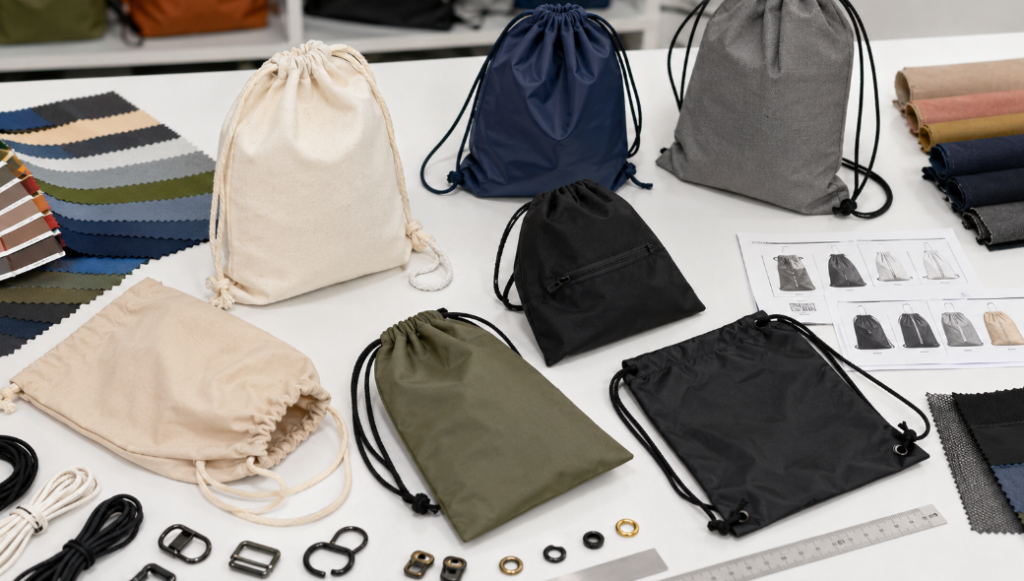
Material selection should begin with how the bag will be used.
Cotton, canvas, polyester, nylon, non-woven polypropylene, and RPET are all common choices. Each material also comes in different weights, weaves, coatings, finishes, and quality grades.
Two fabrics may both be called polyester, yet one may be soft and light while the other is dense, stiff, and water resistant. The same difference appears in cotton and canvas. A fabric name alone does not define the product.
When discussing cotton or canvas, ask for the fabric weight in GSM. Check whether the fabric is natural, bleached, dyed, brushed, washed, or coated. For polyester and nylon, ask about denier, fabric density, backing, coating, water resistance, and abrasion performance.
You can use this as a starting point:
| المواد | Suitable Uses | Details to Confirm |
|---|---|---|
| القطن | Gift bags, retail packaging, reusable promotional bags | GSM, shrinkage, color fastness, softness, and print surface |
| قماش | Heavier daily-use bags and premium promotional products | Fabric weight, seam thickness, hand feel, and washing response |
| البوليستر | Sports, schools, events, and general promotional use | Denier, coating, opacity, tear strength, and print compatibility |
| النايلون | Lightweight sports and outdoor products | Fabric density, tear resistance, coating, and needle-mark control |
| Non-woven PP | Lightweight campaigns and short-term distribution | GSM, seam strength, lamination, and load requirement |
| RPET | Projects requiring recycled material | Recycled content, certification scope, traceability, and claim wording |
For recycled material, ask for more than a statement that the fabric is environmentally friendly. Check which company holds the certification, which part of the product is covered, and whether the order can be supported by proper traceability documents.
الـ Global Recycled Standard published by Textile Exchange can help buyers understand how recycled content and chain-of-custody claims are verified.
Chemical safety may also matter, especially when bags are used for clothing, personal items, food packaging, or children’s products. معيار OEKO-TEX 100 is one reference used for textiles tested for harmful substances.
A factory audit and a product test report are not the same thing. One evaluates the management or production system. The other evaluates a material or finished product.
Before sending an inquiry, you can review the main options in this دليل مواد الحقائب المخصصة.
3. What Customization Options Are Available?
A custom drawstring bag involves more decisions than bag color and logo placement.
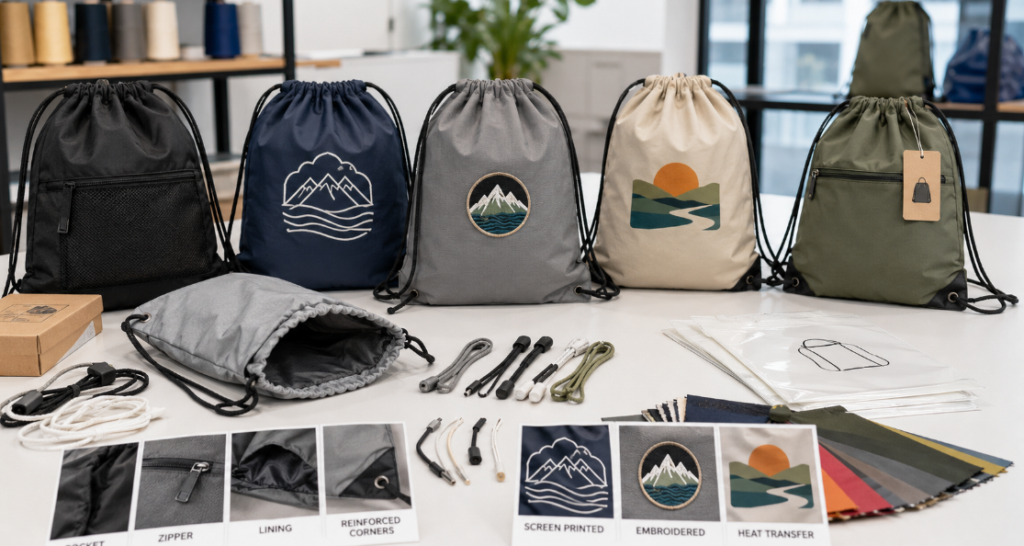
The finished size, cord type, opening structure, corner reinforcement, internal pocket, lining, zipper, label, and packaging can all be changed. Each choice affects production.
The supplier should ask what the bag will carry, how often it will be used, and whether it will be sold at retail, used for promotion, or given as packaging. These questions help determine the right structure.
A small cotton pouch for product packaging does not need the same construction as a drawstring gym bag carrying shoes and clothing. A retail product may need cleaner internal seams, branded labels, better shape control, and individual packaging. A promotional bag may place more attention on print area and efficient packing.
Ask the supplier to prepare a product specification or technical drawing. It should show the finished dimensions, material, cord thickness, cord length, top-channel size, reinforcement method, logo position, labels, and packing requirements.
This part is especially important. Instructions such as “make it stronger” or “same as the photo” are too vague for production.
A photo cannot confirm fabric weight, seam allowance, stitch density, cord length, tolerance, or reinforcement size. Those points need to be written down.
The supplier should also state which features may create extra production risk. A thick round cord needs enough space inside the channel. A large front pocket can affect the print area. A metal eyelet needs suitable reinforcement behind the fabric. A lining can change the finished dimensions and sewing sequence.
You can review common structures and customization choices on the أكياس مخصصة برباط before preparing your product brief.
4. Which Logo Printing Methods Do You Offer?
Logo quality depends on the material, artwork, print size, number of colors, and expected use.
A good supplier should not recommend a printing method before checking those points.
Screen printing works well for many solid-color logos. It is often used on cotton, canvas, polyester, and non-woven fabric. The supplier should confirm ink coverage, color matching, curing conditions, and rubbing resistance.
Heat transfer can produce detailed graphics and multiple colors. It may not suit every coated fabric. Too much heat can create press marks, change the fabric surface, or weaken some coatings.
Digital printing can handle complex artwork and color gradients. The final result depends on fabric preparation, ink type, artwork resolution, and color management.
Embroidery creates a textured and premium appearance. It works best on fabric that can support the stitch density. Lightweight fabric may pucker or become stiff around the logo.
Sublimation is suitable for polyester and full-color designs. It can cover a large area or the full bag panel. It normally requires a light-colored polyester base.
| Logo Method | أفضل استخدام | Main Points to Check |
|---|---|---|
| الطباعة بالشاشة الحريرية | شعارات بسيطة وألوان موحدة | Ink coverage, Pantone match, curing, and rubbing resistance |
| نقل الحرارة | Detailed and multi-color artwork | Adhesion, press marks, cracking, and fabric heat resistance |
| الطباعة الرقمية | Complex graphics and gradients | Resolution, color accuracy, fabric preparation, and wash response |
| التطريز | Small premium logos | Stitch density, backing, puckering, and inside finish |
| التبخير | Full-color polyester designs | Polyester content, base color, panel alignment, and color shift |
Send vector artwork whenever possible. AI, EPS, or print-ready PDF files usually give the factory better control than a low-resolution JPG.
Confirm the final logo size in millimeters or inches. Also state the Pantone color when an exact brand color is required.
The logo should be tested on the actual production fabric. A print that works on smooth cotton may behave differently on coated polyester or textured canvas.
Ask how the factory checks rubbing, washing, flexing, and adhesion. The correct test depends on how the bag will be used.
You can read more about common applications in this دليل الحقائب ذات الشعار المخصص.
5. What Is Your Minimum Order Quantity?
MOQ is usually connected to the way materials and production processes are arranged.
A stock fabric in a standard color may support a lower minimum. A custom-dyed fabric may require a larger quantity because the textile mill has its own dyeing minimum. Custom cord colors, special hardware, printed labels, embroidery, and retail packaging may also have separate minimums.
Do not ask only, “What is your MOQ?”
Ask whether the MOQ changes by material, color, size, logo method, or packaging type. Also confirm whether the total quantity can be divided into several colors or designs.
For example, a supplier may accept one total order quantity but still require a minimum for each fabric color. Printing setup can create another limit for each logo design.
This does not mean the supplier is making the process difficult. The issue comes from how fabric mills, printing workshops, trim suppliers, and production lines operate.
For a first order, a practical approach is to use a standard material, one or two colors, a proven construction, and a logo process that matches the fabric. This makes the trial order easier to repeat.
A very small order with too many custom parts may not reflect the product you plan to reorder later. The sample can be approved, but the bulk process may change once custom materials are introduced.
6. Can You Provide Samples Before Bulk Production?
Sampling is one of the best ways to reduce risk.
You need to know which type of sample the supplier can provide.
An existing sample can show general workmanship, fabric feel, and construction quality. It will not confirm your exact design.
A custom development sample is made according to your requested size, material, color, structure, and logo.
A pre-production sample is made after the main details are confirmed. It should use the approved bulk material and production method. This sample becomes the reference for mass production.
Keep one approved sample on your side and ask the factory to keep another. Both samples should carry the same revision number and approval date.
During sample review, check more than appearance. Measure the finished size. Pull the cords several times. Load the bag with the intended weight. Inspect the side seams, bottom corners, eyelets, stitching, print position, and internal finish.
Record each requested change clearly.
Instead of writing, “The cord is not good,” explain whether it is too thin, too rough, too short, too soft, or difficult to pull. Clear comments help the supplier make the right correction.
Ask how long each sampling stage will take. Material sourcing, pattern making, artwork preparation, printing, sewing, and revision all require time. The supplier should explain the process rather than giving one unclear sample date.
7. What Is Included in Your Quotation?
A quotation is useful only when it matches a clear product specification.
A short description such as “polyester drawstring bag with logo” leaves too much room for interpretation. The fabric weight, coating, size, cord, reinforcement, print method, labels, packing, and quality requirements can all change the final product.
Ask the supplier to identify the exact material, finished dimensions, logo size, logo position, number of print colors, accessories, labels, and packing method.
The quotation should also state whether sampling, printing setup, testing, inspection, export cartons, and shipping documents are included in the supplier’s scope.
Shipping terms need a named location. “FOB China” is not complete. The quotation should identify the port. DDP should identify the delivery destination.
Keep the quotation, approved artwork, product specification, packing instructions, and purchase order under the same revision. When one document changes, check the others.
This is where many mistakes happen. The sample may show the correct logo size, while the older purchase order still contains the first version. Production teams usually follow the final approved document, so version control matters.
A professional custom drawstring bag supplier should help you remove unclear details before the order is confirmed.
8. What Is Your Production Lead Time and Monthly Capacity?
Do not rely only on a general statement such as “production takes three weeks.”
Ask what must happen during those weeks.
The schedule may include material booking, color approval, print testing, pre-production sampling, cutting, logo application, sewing, inspection, packing, and shipment preparation.
Some stages can run together. Others cannot.
Fabric cannot be cut before the final measurements are confirmed. Bulk printing should not begin before the logo color and position are approved. Packing should not begin before printed surfaces are fully dry and stable.
Monthly capacity also needs context. A factory may have a large total output, but only part of that capacity may be available for your order.
Ask whether the required fabric is in stock, whether the printing process has its own production limit, and how the supplier manages peak-season orders.
Urgent production should not mean removing important controls. Skipping the pre-production sample, reducing curing time, or shortening inspection may create larger delays later.
A reliable supplier should report problems early. The update should explain what happened, which stage is affected, the revised completion date, and what action is being taken.
9. How Do You Control Product Quality?
Quality control should begin before mass production.
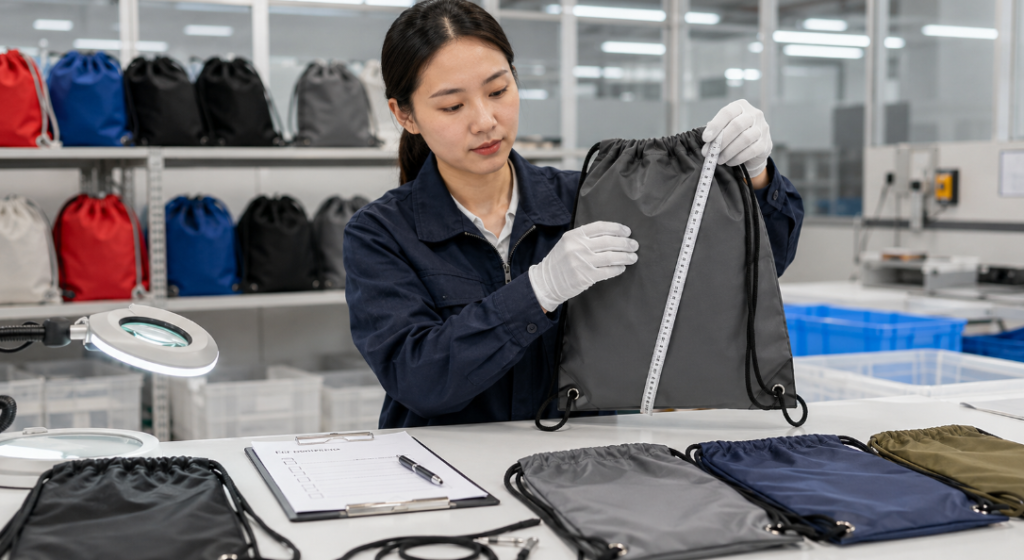
The first check is normally the incoming material inspection. The factory should verify fabric type, color, weight, width, defects, shrinkage, cord diameter, trim color, and accessory function.
Before sewing starts, the production team should review the approved sample, measurements, logo position, workmanship standard, packing method, and defect requirements.
Inline inspection helps catch problems while they can still be corrected. Inspectors may check seam allowance, stitch density, skipped stitches, cord-channel width, reinforcement position, print alignment, and finished size.
Final inspection confirms the appearance, measurements, function, labels, packing, carton marks, and quantity.
For a drawstring bag, the areas that deserve close attention include the bottom corners, side seams, cord channel, eyelets, reinforcement patches, cord length, print adhesion, shade variation, loose thread, odor, and finished dimensions.
Load testing should reflect the intended use. A lightweight gift pouch and a sports drawstring bag should not use the same load requirement.
Ask the supplier how defects are classified. Critical, major, and minor defects should be defined before inspection.
When sampling inspection is used, ISO 2859-1 provides a recognized framework for lot-by-lot inspection based on acceptance quality limits. Your own specification still needs to explain what counts as a defect for your product.
Third-party inspection can provide an independent review. It should support the factory’s quality system, not replace it.
10. What Shipping and After-Sales Services Do You Provide?
Shipping preparation begins with the packing method.
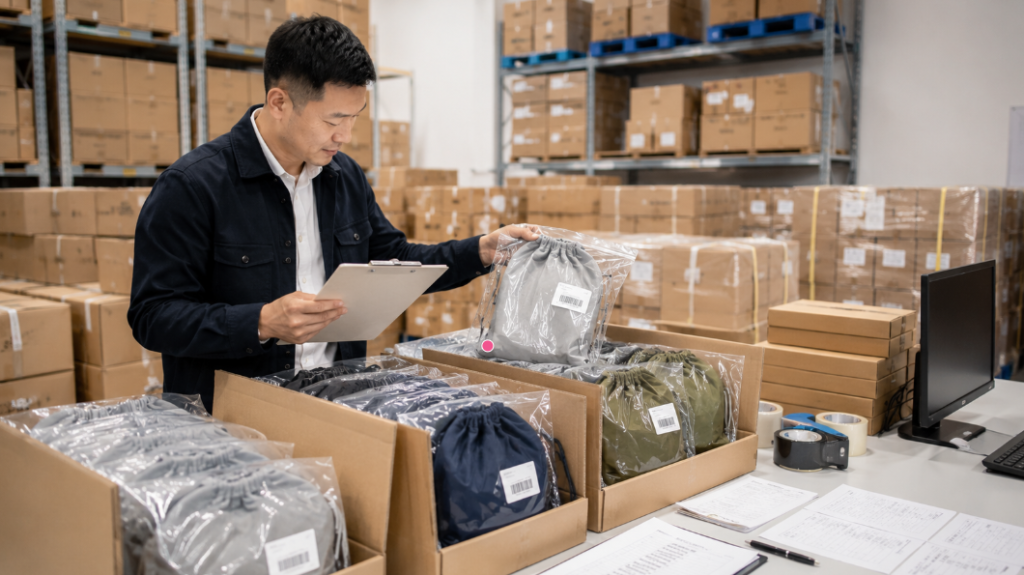
Before the goods leave the factory, confirm how each bag will be folded, how many pieces will be packed in each carton, and whether the selected method may create wrinkles or print marks.
Carton size and gross weight should match your warehouse and transport requirements. Moisture protection may be needed for cotton, canvas, coated fabric, or sea freight.
For retail orders, check the barcode, warning label, country-of-origin mark, hangtag, and carton mark against the approved artwork. Request packing photos and carton measurements before shipment.
The supplier should also confirm the Incoterm, shipping method, cargo handover point, and required export documents. These may include a commercial invoice, packing list, certificate of origin, and other documents requested by the destination market.
Ask how shipment updates will be provided. You should know when the cargo is booked, when it leaves the factory, and which documents will be available.
After-sales handling should be agreed before production.
The agreement should state how long you have to report a problem, what photos or inspection records are required, how quickly the supplier will respond, and how the cause will be reviewed.
A dependable supplier should compare your claim with the approved sample, production records, inspection report, and packing information. The goal is to identify the cause and prevent the same issue in the next order.
الخلاصة
Choosing a custom drawstring bag supplier requires more than comparing quotations.
You need to look at product experience, material knowledge, customization ability, logo control, MOQ structure, sample management, production planning, quality inspection, shipping support, and after-sales response.
Request a physical sample before bulk production. Approve a written specification that includes the material, dimensions, tolerances, cord, reinforcement, logo, labels, packing, inspection requirements, and delivery terms.
These details give both sides the same production reference. They also make it easier to compare different drawstring bag manufacturers fairly.
هيتباغ is a custom bag manufacturer located in Huadu, Guangzhou, China. We have more than 15 years of manufacturing experience and work with a stable network of specialized production partners. Our team supports material selection, product development, sampling, logo application, bulk manufacturing, quality inspection, and export coordination.
If you are looking for a custom drawstring bag manufacturer in China, you can leave your phone number or WhatsApp details through our contact Us.
Tell us how the bag will be used, what it needs to carry, your preferred material, order quantity, logo requirements, target market, and expected delivery date. We will review the details carefully and help you develop a practical custom drawstring bag for your project.
الأسئلة الشائعة
What materials are available for custom drawstring bags?
Common options include cotton, canvas, polyester, nylon, non-woven fabric, and RPET. The right material depends on the bag’s use, required strength, printing method, and desired appearance.
Can I add my logo to a drawstring bag?
Yes. A custom drawstring bag can use screen printing, heat transfer, digital printing, embroidery, or sublimation. Your supplier should recommend a suitable method based on the fabric and artwork.
Can I order a sample before bulk production?
Yes. You can request an existing sample, a custom sample, or a pre-production sample. A pre-production sample is the best reference for checking the final material, size, logo, and workmanship.
What is the minimum order quantity?
The MOQ depends on the material, color, size, logo method, and packaging. Stock materials and standard colors usually offer more flexible order quantities than fully customized materials.
How long does production take?
Production time depends on material availability, sampling, printing, order quantity, and factory capacity. Ask your supplier for a clear schedule before confirming the order.


